We are at Dreamforce 2026, Industry Pavilion at San Francisco


June 19, 2026
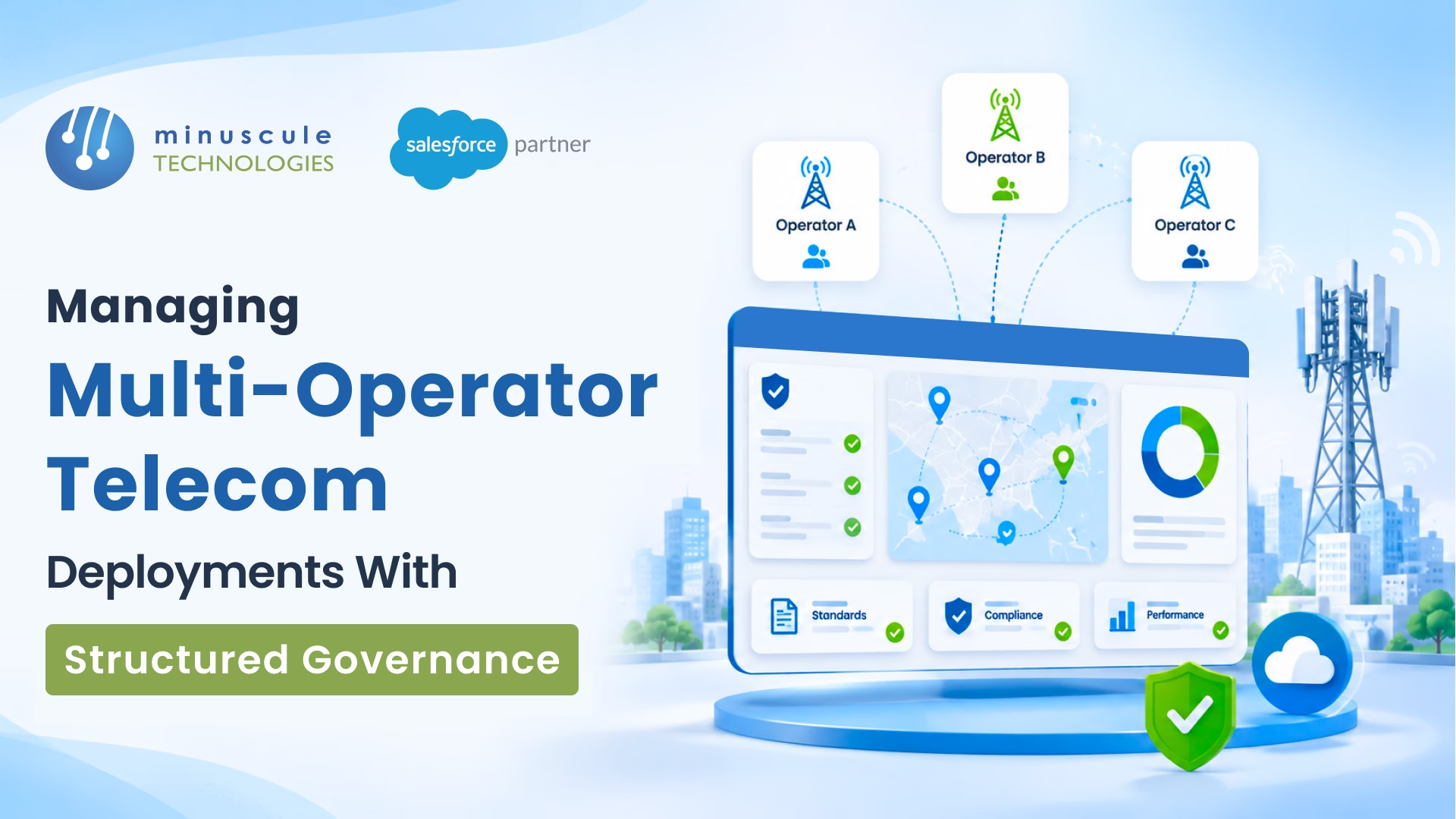
A single-operator deployment has one approval queue, one SLA window, and one acceptance criterion to meet. A neutral host site serving three operators has three of each - running in parallel, with different timelines, different documentation requirements, and different definitions of done.
That's not three times the coordination effort. It's something closer to nine times - because the dependencies between operators aren't just additive, they're combinatorial. A frequency confirmation from one operator can affect the RF design package another is reviewing. An acceptance delay from one tenant can hold the entire site's commercial closeout.
This post breaks down where multi-operator telecom deployments actually fail, what governance has to do differently from single-operator programs, and what a structured platform looks like when it has to coordinate parallel stakeholder workflows without losing the consolidated site view.
The instinct most program managers have when first scoping a multi-operator deployment is to treat it as a parallel set of single-operator tasks. Same site survey, repeated for each operator. Same RF design framework, replicated per spectrum band. Same approval flow, multiplied by the operator count.
That instinct underestimates the problem. The complexity of multi-operator coordination isn't proportional to the number of operators - it grows with the number of dependencies between them.
When Operator A's design package requires a frequency confirmation that depends on Operator B's spectrum allocation decision, you don't have two independent workflows. You have one workflow with a cross-stakeholder dependency that no single approval queue captures. When the venue owner needs a single coordinated installation window, all three operators' commissioning schedules have to converge - even though each operates on its own timeline.
Traditional rollout tracking is built around a single source of truth - one project plan, one approval workflow, one timeline. This is the same structural limitation we covered in our pillar on why telecom deployment governance needs to move beyond spreadsheets - and it gets exponentially worse when multiple operators are involved.
Multi-operator deployments need a different structure: a consolidated site record that holds the shared physical reality, plus per-operator workflows that hold the parallel approvals, SLAs, and acceptance records. Without that split structure, you end up with either an oversimplified view (one row per site, missing the operator-level detail) or an unmanageable one (a separate tracker per operator, with no consolidated site view). Neither version produces real governance.
Consider a neutral host DAS deployment in a 14-floor commercial building, serving three operators. From the venue owner's perspective, it's one project - one installation, one access window, one closeout package. From your delivery team's perspective, it's also one site - one physical infrastructure, one shared coordination effort.
From each operator's perspective, it's their own deployment. They have their own RF design package, their own spectrum and frequency requirements, their own approval workflow, their own acceptance criteria, and their own SLA commitments to honor. None of them care how the other operators' workflows are progressing - they care about theirs.
Your governance model has to serve all three perspectives simultaneously. The consolidated view for the venue owner and the delivery team. The operator-specific view for each tenant. And - critically - the cross-cutting view for the program manager who needs to see where dependencies between operators are creating risk. This is the Lead-to-Live governance model applied to a parallel-stakeholder context - one connected lifecycle, multiple stakeholder lenses.
Operator A logs in to their portal and sees the pending RF design package waiting for their review, the spectrum confirmation they've submitted, the commissioning evidence they've uploaded, and the acceptance criteria they still need to validate. They don't see Operator B's design revisions. They don't need to.
Operator B has their own queue - likely with different documentation requirements, a different design template, and different SLA expectations on their internal review process. Same site, different workflow.
Operator C may be operating on a private 5G network sharing infrastructure with the macro tenants, with completely different acceptance criteria oriented around enterprise SLAs rather than public coverage. Same site, completely different definition of done.
Governance has to hold all of this in one platform without forcing any of them into a single workflow.
Multi-operator approvals fail in predictable places. Knowing them lets you design governance against them.
Prequalification with conflicting requirements. Each operator may require a different set of prequalification data — coverage objectives, target areas, spectrum bands, power requirements. When these are collected in a single combined form, gaps appear. When they're collected separately, the site team ends up answering the same questions multiple times in slightly different formats.
Provisional participation lag. One operator confirms participation quickly. Another delays. A third confirms with conditions. The site can't fully advance because the design depends on knowing which operators are actually in. Email-based coordination here is where weeks disappear.
RF design review across parallel paths. Each operator reviews their own RF design package on their own timeline. When Operator A's design depends on a frequency confirmation from Operator B, and Operator B hasn't reviewed yet, Operator A's review can't complete. Tracking this dependency manually means someone has to remember it exists.
Frequency confirmation conflicts. Spectrum allocation decisions affect adjacent operators. When Operator A confirms a frequency that overlaps with Operator B's expected range, the resolution requires a joint conversation - which without structured governance happens in a 14-person email thread.
BOM and equipment alignment. Shared infrastructure means shared equipment specifications, but each operator has its own requirements for compatibility, certification, and approval. Reconciling these across operators is rarely captured in a single tracker.
Commissioning evidence collection. Each operator may require its own set of commissioning tests, signal measurements, and validation documents. Compiling these per-operator while running shared installation work creates documentation overhead that's invisible to project plans.
Acceptance criteria divergence. Even after a site is technically live, each operator has its own definition of acceptance - based on its own KPIs, coverage benchmarks, and contractual commitments. A site can be live for one operator and still in dispute with another.
Most of these failures aren't caused by lack of effort. They're caused by lack of structure. When approvals, dependencies, and acceptance criteria are governed in a platform that knows the relationship between them, the failure modes change.
The platform can flag that Operator B's frequency confirmation is overdue and blocking Operator A's design review. It can track which operators have submitted commissioning evidence and which haven't. It can show acceptance status per operator while maintaining a consolidated view of the site for the venue owner. This is where process clock governance becomes a multiplier - when SLA timers track per-operator and surface cross-stakeholder blockers automatically.
A governance platform built for multi-operator deployments needs a data model that separates the site from the operator-specific workflow. The site record holds the shared reality - physical infrastructure, venue agreements, installation milestones, consolidated closeout. The operator participation record holds everything specific to one operator on that site - their approval status, their design package, their SLA timers, their acceptance criteria.
When these objects are connected - one site to many operator participations, each with their own document and approval history — your platform can serve both the consolidated view and the per-operator view from the same data. No reconciliation needed. The Salesforce architecture for this is covered in detail in how Salesforce governs RAN deployment execution end to end - the same custom object structure applies here with per-operator participation as a child record.
For each operator participation record, governance needs to track participation status (confirmed, conditional, declined), approval workflow stage (per-stage status, not just overall status), required documents (operator-specific lists), SLA clocks (running against each operator's commitments), revision history (per design package, per operator), and acceptance criteria (operator-defined KPIs and benchmarks).
This isn't extra complexity for its own sake. It's the structure that makes operator-specific workflows manageable without losing the consolidated site view.
A single-operator deployment generates a manageable set of documents - survey reports, design packages, BOMs, commissioning reports, acceptance sign-offs. When that gets multiplied across three operators on one site, the documentation set isn't three times larger - it's structurally different.
You have shared documents (venue access agreement, physical installation specs, consolidated closeout) and operator-specific documents (RF design packages, frequency confirmations, per-operator commissioning evidence, individual acceptance records). The same shared folder structure that worked for single-operator deployments now needs to differentiate between shared and operator-scoped documents - and most folder structures don't do that cleanly.
The result is documentation that's either too consolidated (everyone has access to everything, including documents they shouldn't see) or too fragmented (each operator has its own folder tree and the shared documents get duplicated across them).
A governance platform solves this through document objects linked to either the site record or the operator participation record, with role-based access enforced by the platform. Shared documents live on the site record and are visible to all stakeholders. Operator-specific documents live on the operator participation record and are visible only to that operator's portal users and your internal team.
This isn't just a permissions feature. It's the difference between defensible audit-ready documentation and a shared folder you hope nobody sees the wrong file in. The same principle extends through closeout and acceptance governance [link → Closeout & Acceptance Governance spoke] — per-operator acceptance records need the same role-based isolation.
The most expensive question in multi-operator deployments is the one nobody wants to ask: when something goes wrong, whose problem is it?
A site that's been pending commissioning for three weeks - is it because Operator A hasn't approved the RF design, because Operator B hasn't confirmed its frequency allocation, or because the system integrator hasn't completed installation? Without structured ownership, the answer is usually "all three, and they're each waiting on the other."
Governance breaks that cycle by making ownership explicit at the action level - not just at the stage level. The platform doesn't just show that approval is pending; it shows which specific operator owns it, when it was assigned, what they've been told, and how long the clock has been running.
The harder accountability problem isn't single ownership - it's dependency. When Operator A is blocked by Operator B's missing input, both records need to surface that dependency. Without it, Operator A's program manager sees a delay attributed to "operator review" without knowing the underlying cause was Operator B's overdue submission.
Structured governance captures these dependencies as data, not as commentary. The platform knows that Operator A's design review is blocked pending Operator B's frequency confirmation. When that confirmation is submitted, the dependency clears automatically, and Operator A's review resumes. When it's not, the escalation path is clear - and the SLA clock doesn't pause just because the responsibility is shared.
The compounding value of structured multi-operator governance shows up across deployments. When approval cycle times, documentation completeness, and SLA adherence are tracked per operator across every site in your program, you build historical performance intelligence.
You can see which operators consistently approve RF design packages within their SLA windows and which routinely run late. You can see which operators require the most documentation revisions before acceptance. You can see which dependencies between operators most often cause delays. You can see whether certain venue types - high-density urban, enterprise, transit hubs, or neutral host installations - have systematically different multi-operator coordination outcomes.
This isn't just retrospective data. It's input for scoping future deployments. If your historical data shows that Operator B's RF design reviews average 22 days against a 14-day SLA, you can build that reality into your forward planning rather than committing to timelines that assume the SLA holds.
That's the difference between deploying multi-operator programs with hope and deploying them with structured intelligence about what actually happens.
Multi-operator deployment complexity isn't linear - it grows with the dependencies between operators, not just the number of operators. Traditional rollout tracking, built for single-operator workflows, can't capture that structure.
A governed multi-operator model needs a split data structure: a consolidated site record for shared infrastructure, plus per-operator participation records for parallel approvals, SLAs, and acceptance criteria. Both views from the same data, no reconciliation needed.
Approval failures happen at predictable points - provisional participation lag, frequency confirmation conflicts, parallel RF design dependencies, commissioning evidence collection, and divergent acceptance criteria. Knowing them lets governance design against them.
Documentation at multi-operator scale needs to differentiate shared documents from operator-specific documents — with role-based access enforced by the platform, not by hoping the right people open the right folders.
Accountability requires explicit action-level ownership and visible cross-stakeholder dependencies. "Operator review pending" without identifying which operator and what's blocking them is not governance.
Historical multi-operator performance data - approval cycle times, documentation completeness, SLA adherence per operator — turns deployment scoping from estimation into evidence-based planning.
The complexity doesn't grow linearly with the number of operators - it grows with the dependencies between them. Each operator has its own approval workflow, documentation requirements, SLA timers, and acceptance criteria. When those workflows have cross-stakeholder dependencies — frequency confirmations affecting adjacent designs, shared commissioning schedules, joint acceptance criteria - coordination effort multiplies far beyond what single-operator tracking handles.
A consolidated site view shows the shared physical reality - installation status, venue agreements, overall site progress. An operator-specific view shows everything tied to one operator on that site - their approvals, design package, SLA clocks, acceptance records. A governed platform serves both from the same data model, giving the venue owner one view and each operator their own without requiring separate trackers.
Operators typically participate at prequalification (confirming participation and providing coverage objectives), provisional participation (formal sign-in to the site), RF design review (operator-specific design package approval), frequency confirmation (spectrum allocation and conflict resolution), BOM alignment (equipment specification approval), implementation readiness (sign-off before installation begins), commissioning validation (acceptance of test results), and final acceptance (formal site sign-off).
Each operator participation record has its own SLA clocks tied to its own stage transitions. The governance platform tracks them independently — Operator A's design review SLA runs separately from Operator B's frequency confirmation SLA. The consolidated site dashboard shows aggregate SLA exposure, while each operator's portal shows only their own clocks. When one operator's delay creates a dependency for another, the platform flags it as a cross-stakeholder blocker.
Documentation needs to be split between shared documents (visible to all stakeholders - venue access, physical installation specs, consolidated closeout) and operator-specific documents (visible only to that operator and your internal team - RF design packages, frequency confirmations, per-operator commissioning evidence, individual acceptance records). Role-based access in the governance platform enforces this differentiation automatically rather than relying on folder permissions.
Salesforce supports a parent-child data structure where a single site record can have multiple operator participation records as child objects. Each participation record carries its own workflow stage, approval routing, SLA timers, and document set. Experience Cloud gives each operator portal access to only their participation record - not the others. This delivers consolidated reporting and per-operator visibility from the same data model.
Provisional participation is the formal stage where an operator confirms they intend to participate on a specific site, before committing to full design and implementation. It typically requires basic coverage objective confirmation, spectrum band identification, and target acceptance criteria. Delays at this stage are common and often invisible - which is why governance benefits from tracking provisional participation as a discrete stage with its own SLA clock.
A governance platform captures dependencies as data - Operator A's design review depends on Operator B's frequency confirmation, for example. When that dependency exists, the platform shows it explicitly on both operator records and surfaces it on the consolidated site view. When the blocking input is submitted, the dependent workflow resumes automatically. Without structured dependency tracking, these connections live in someone's head and break when that person isn't available.
Site acceptance refers to overall site closeout from a venue and delivery perspective - physical installation complete, consolidated documentation in place, site operationally live. Operator acceptance is per-operator formal sign-off that the site meets that operator's specific coverage, performance, and contractual criteria. A site can be physically complete and still pending operator acceptance from one or more tenants, which means governance needs to track them separately.
Per-operator approval cycle times, SLA adherence rates, documentation revision counts before acceptance, dependency-caused delay durations, and acceptance criteria fulfillment timelines. Over multiple deployments, this data builds an evidence base that lets you scope future programs realistically — using actual operator behavior rather than committed SLA durations that may not hold in practice.
If your telecom program is managing multi-operator deployments with shared folders, parallel email threads, and per-operator project plans that don't reconcile, you're paying the coordination tax in delays and escalations.
Minuscule Technologies provides Salesforce-native multi-stakeholder governance for telecom deployments involving operators, WSPs, vendors, system integrators, neutral host providers, and enterprise customers - with consolidated site visibility, per-operator workflows, role-based documentation, and dependency-aware SLA tracking.
You've seen what's possible. Now, let's make it happen for your business. Whether you need an end-to-end Salesforce solution, a complex integration, or ongoing managed services, our team is ready to deliver.

Schedule a Free Strategic Call


