We are at Dreamforce 2026, Industry Pavilion at San Francisco


June 3, 2026
A Salesforce implementation partner is a certified consulting firm that plans, builds, configures, and launches your Salesforce org, then supports your team through adoption and beyond. Instead of assigning the project to an internal team that's learning Salesforce on the job, you bring in a partner who has already solved the setup, data, and workflow problems your business is about to run into. The right partner shortens your time to launch, cuts the risk of a failed rollout, and gives your team a system people actually use.
Here's what a partner typically brings to the table:
Picture a mid-size distribution company running sales on spreadsheets and a patchwork of email threads. Leads fall through the cracks, forecasts are guesses, and the sales team spends more time updating trackers than talking to customers. Bringing in a Salesforce implementation partner turns that scattered process into one connected system, with clean data, automated follow-ups, and a pipeline everyone can actually trust.
This guide walks through why a partner matters, what services they provide, the specific roles they fill on your project, how to work with them once the engagement starts, what a Salesforce implementation costs in the United States, and how to pick the right one for your business.
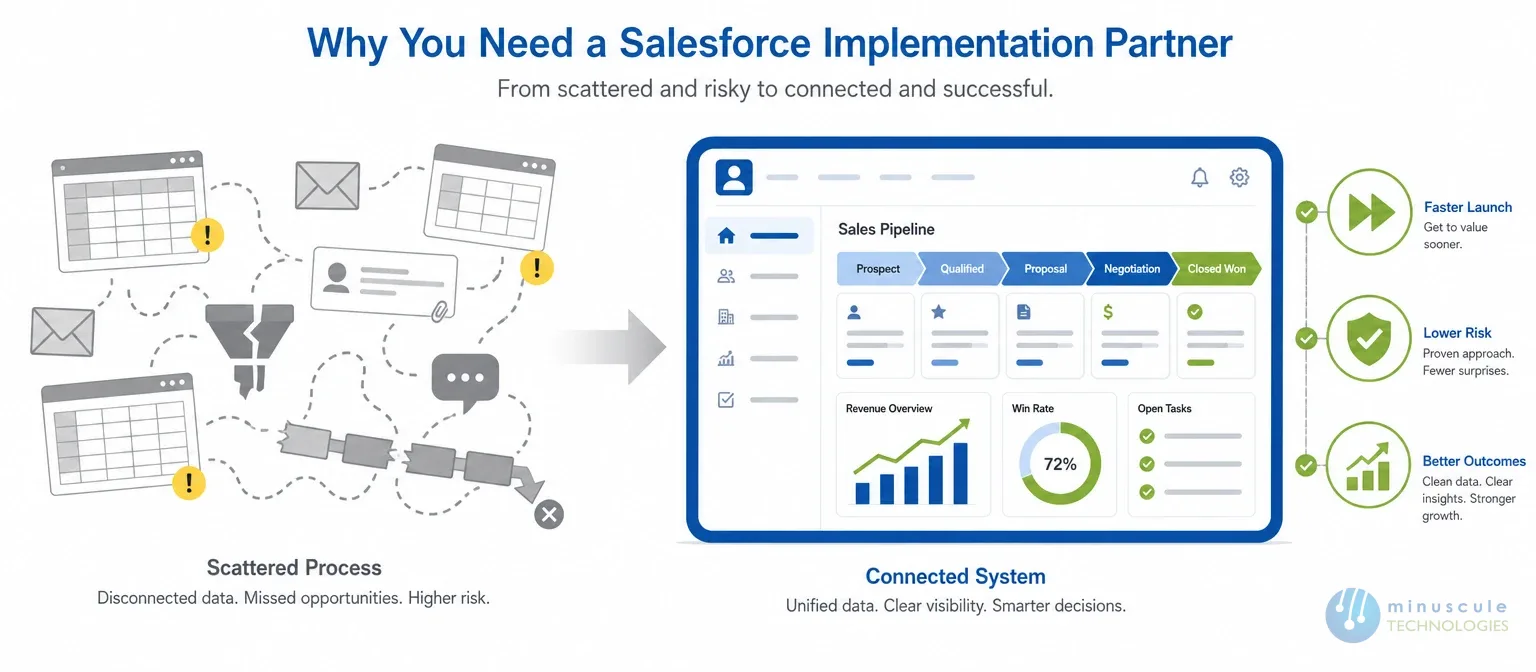
Salesforce is flexible enough to run almost any business process, and that flexibility is exactly why so many self-led projects stall. Without someone who's configured dozens of orgs before, teams tend to over-build features nobody uses, under-plan the data migration, or skip user training until it's too late.
A Salesforce implementation partner has already made those mistakes on someone else's project, so you don't have to make them on yours. They bring a repeatable delivery method, pre-built accelerators for common business processes, and hands-on experience with the exact edge cases your industry runs into.
There's also a speed argument. An internal admin learning Salesforce Flow, validation rules, and page layouts for the first time might take months to reach a working release. A partner's team, made up of people who work in the platform daily, typically compresses that same build into weeks.
And the support doesn't stop at go-live. In our experience, the projects that struggle after launch aren't the ones with the wrong technology, they're the ones without anyone accountable for keeping it healthy. A good partner stays close through user adoption, release management, and the inevitable "can we also automate this?" requests that show up in month two.
"Salesforce implementation services" covers a wider set of work than most buyers expect. A full-scope engagement usually includes the following, though smaller projects may need only a subset:
Some partners specialize narrowly, offering only Salesforce data migration or only Sales Cloud configuration. Others, including Minuscule, run the full Salesforce implementation services lifecycle from strategy through managed support, which matters if you'd rather manage one vendor relationship than three.
If you want to see how a full build is sequenced week by week, Apex Hours runs recorded sessions on implementation methodology that are worth watching before your kickoff call.
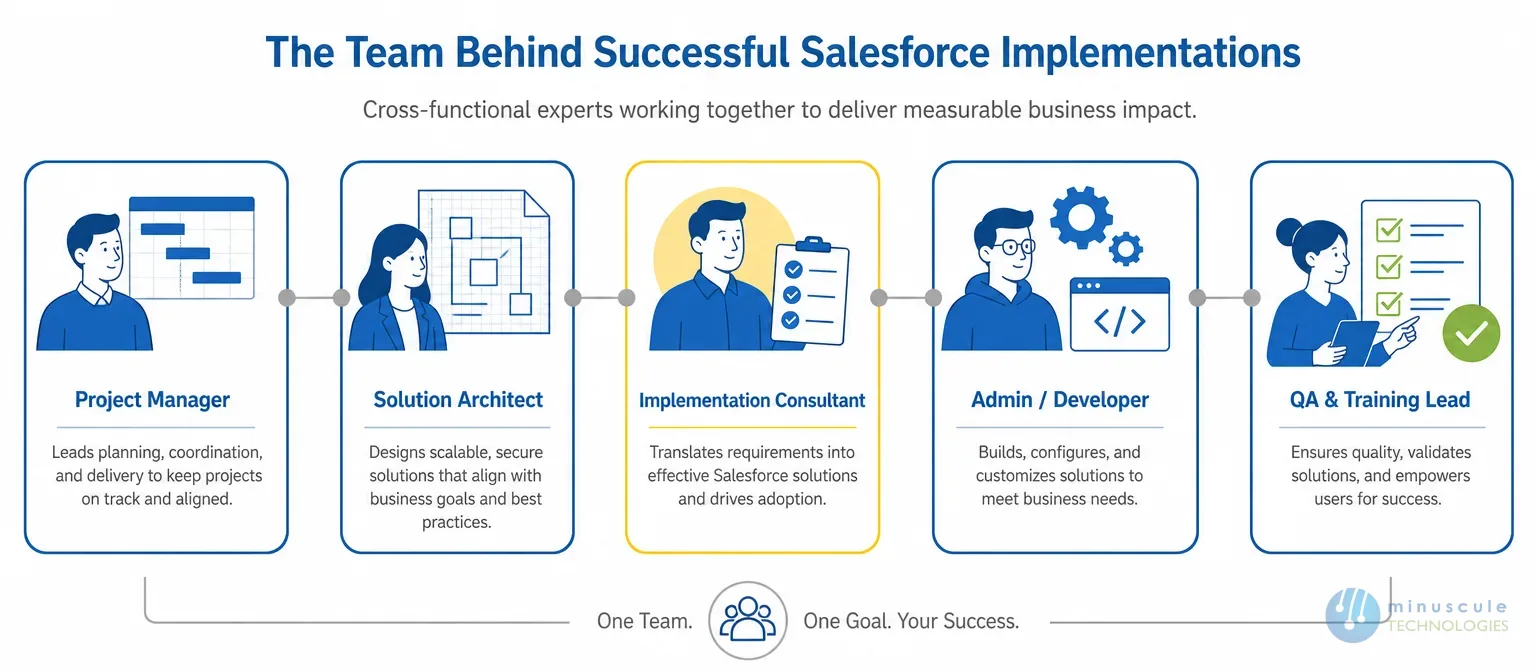
A Salesforce implementation partner isn't one person, it's a small team, and each role covers a different part of the project.
Owns the timeline, budget, and communication between your business and the technical team. This is your main point of contact when something needs a decision.
Designs the technical approach: data model, security model, integration architecture, and how automation will handle your business logic. On complex projects, this person also flags where a custom build makes more sense than an out-of-the-box feature.
Translates your business requirements into a configuration plan. A strong Salesforce implementation consultant asks "why" before "how," pushing back on requests that would overcomplicate the org just because a competitor's system worked a certain way.
Builds the actual configuration, custom fields, Flows, and code (when Apex or Lightning components are needed). This is the hands-on-keyboard role. If your team wants a plain-language primer on what Flow can and can't do before that conversation starts, Salesforce Codex has straightforward breakdowns worth a skim.
Tests the build against real business scenarios before go-live, then runs the training sessions that get your team comfortable using it.
On smaller engagements, one person may wear two or three of these hats. On enterprise rollouts, each role is usually staffed separately, sometimes with more than one person per role.
Hiring the partner is the easy part. Getting real value out of the engagement depends on how your team works with them day to day.
Governance matters here too. A well-run engagement follows the same change-tracking discipline you'd expect from any admin team, which is worth reviewing against Salesforce Admins' guidance on release and sandbox management before your build begins.
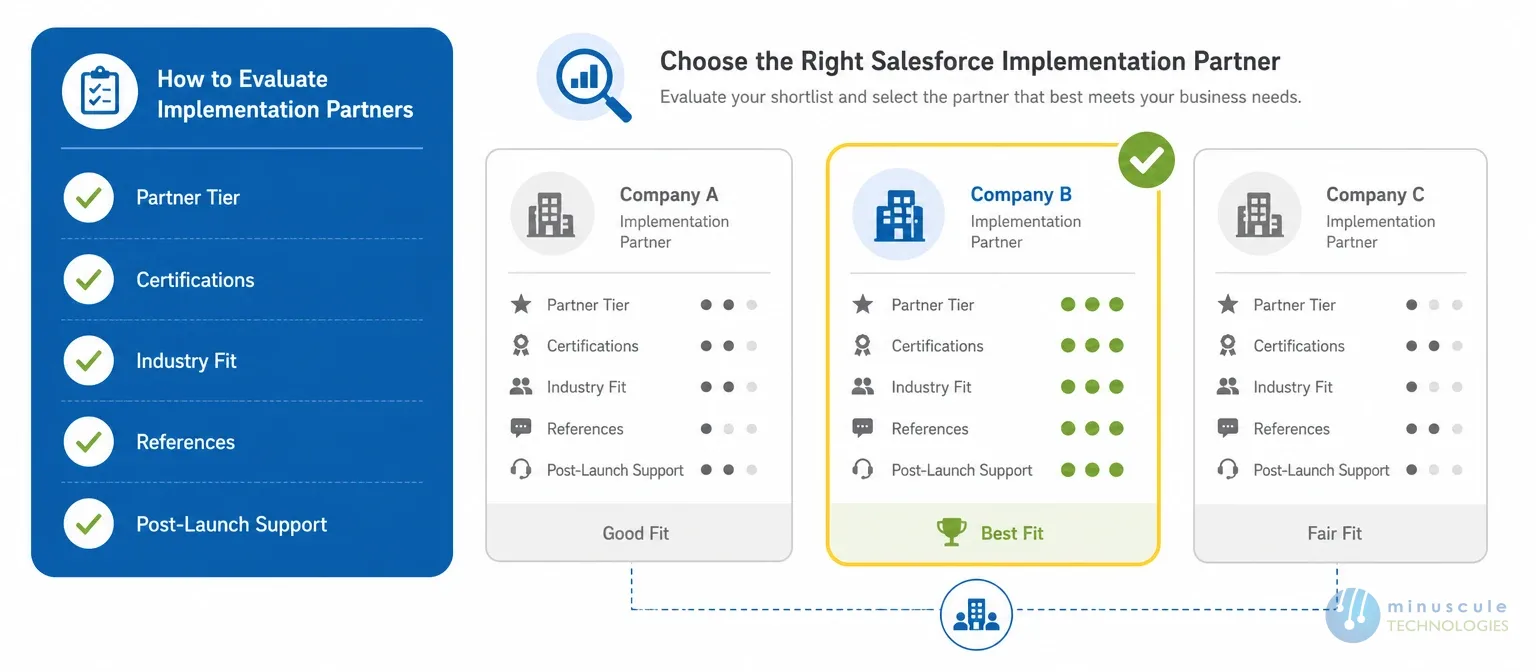
Not every one of the thousands of Salesforce implementation companies listed on AppExchange is a fit for your project. A few filters narrow the list quickly.
Start with partner tier and certification count, since both signal how much hands-on delivery experience a firm actually has, not just how long they've been in business. Then check industry fit: a partner who has already built loan approval flows for a lender, or dealer incentive tracking for a manufacturer, will move faster than one starting from zero on your industry's quirks.
Ask every finalist for a reference from a project similar in size and scope to yours, and ask that reference specifically about post-launch support, not just the go-live date. A smooth launch followed by months of unanswered support tickets is a common complaint, and it rarely comes up unless you ask directly.
We cover the full evaluation checklist, including questions to ask in the sales process and red flags to watch for, in our dedicated guide on how to choose a Salesforce implementation partner. If you're at the shortlist stage, that's the next read.
Salesforce implementation costs in the United States vary widely because "implementation" can mean a two-week Sales Cloud setup or a year-long multi-cloud rollout across a global org. Licensing is billed separately by Salesforce; the implementation cost covers the partner's discovery, build, migration, and training work.
The table below gives a general range based on common project types. Treat it as a planning benchmark, not a quote, since your data volume, number of integrations, and customization needs will move the number in either direction.
Beyond the base build, budget for a few line items teams often miss: ongoing managed services after launch, a contingency for scope discovered mid-project, and license costs that rise as headcount grows. Working with Salesforce implementation experts during the scoping call, before you sign a statement of work, is the easiest way to avoid a mid-project surprise on price.
For a deeper breakdown of what drives cost up or down, SaaSGuru publishes practical estimating guides worth cross-checking against any quote you receive.
A Salesforce implementation partner is a certified consulting firm that designs, builds, and deploys Salesforce for a business, then supports the team through adoption. Partners hold official Salesforce certifications and partner tier status, which sets them apart from a freelancer or an internal admin working alone.
Think of them as your build team and your safety net in one. They scope the project, configure the org, move your data over safely, and stay reachable after launch, so a broken Flow or a new business requirement doesn't turn into weeks of downtime.
Beyond checking certifications, ask two things a sales deck won't answer: how they price change requests once the statement of work is signed, and how fast they respond to a support ticket after go-live. Those two questions reveal more about the working relationship than a portfolio ever will.
Beyond a faster launch, you get an org built to handle growth without a rebuild in two years, fewer workarounds because the automation matches how your team actually operates, and a partner who already knows the fix the first time an integration breaks.
Budget $10,000 to $35,000 for a single-Cloud setup, $40,000 to $120,000 for a mid-market rollout with a few integrations, and $150,000 or more for a multi-cloud enterprise build, not including Salesforce license fees.
Yes. Experienced partners maintain playbooks and pre-built accelerators for specific industries, such as dealer incentive tracking for automotive or loan lifecycle visibility for lenders, which speeds up configuration compared to building from a blank org.
A Salesforce implementation partner is the difference between a system your team fights with and one that actually runs your business. The roles, services, and cost ranges above give you a real starting point for that conversation, not a generic sales pitch.
Minuscule Technologies runs Salesforce implementations end to end, and we speed up the build further with pre-built accelerators like B2B Marketplace for distribution and dealer commerce, and the WhatsApp Salesforce Accelerator for customer engagement, alongside industry-customized starter packs for manufacturing, BFSI, real estate, and healthcare teams.
If you're scoping a project or comparing partners right now, schedule a free strategic Salesforce call with our team. We'll look at your process and tell you honestly what a right-sized implementation should include, before you commit to a statement of work.
You've seen what's possible. Now, let's make it happen for your business. Whether you need an end-to-end Salesforce solution, a complex integration, or ongoing managed services, our team is ready to deliver.

Schedule a Free Strategic Call


