From the Control Room to the Last-Mile Field Team
Power companies, utility providers, and energy organizations can't afford disconnected systems. Without up-to-date information, buyer trust erodes rapidly. Minuscule Technologies delivers Salesforce solutions that connect your customer service, dispatch, field operations, and asset management into a single platform—boosting trust, response speed, and operational reliability.




Whether you run a school network, a university admissions team, or an immigration and education consultancy, the root problems are almost always the same: too many channels, too many manual steps, and too little visibility for the people who need to act.
Customer location grouping in Excel
Field zones are defined manually within spreadsheets. Errors accumulate. High-priority work orders are routed to the wrong crew. Productivity suffers before the day even starts.
Paper-based vehicle inspections
Supervisors can't see fleet conditions until inspection forms come back to the office — hours later. Safety risks go undetected. Compliance documentation is a manual exercise.
Case distribution by gut feel
Dispatchers assign work orders by memory and phone calls. Case type, urgency, and technician skill rarely align. Completion rates plateau, and rework climbs.
Field workers rely on SMS updates
No proof of work. No location tracking. Status updates sent via text. Managers make resourcing decisions from information that's already 30 minutes old.

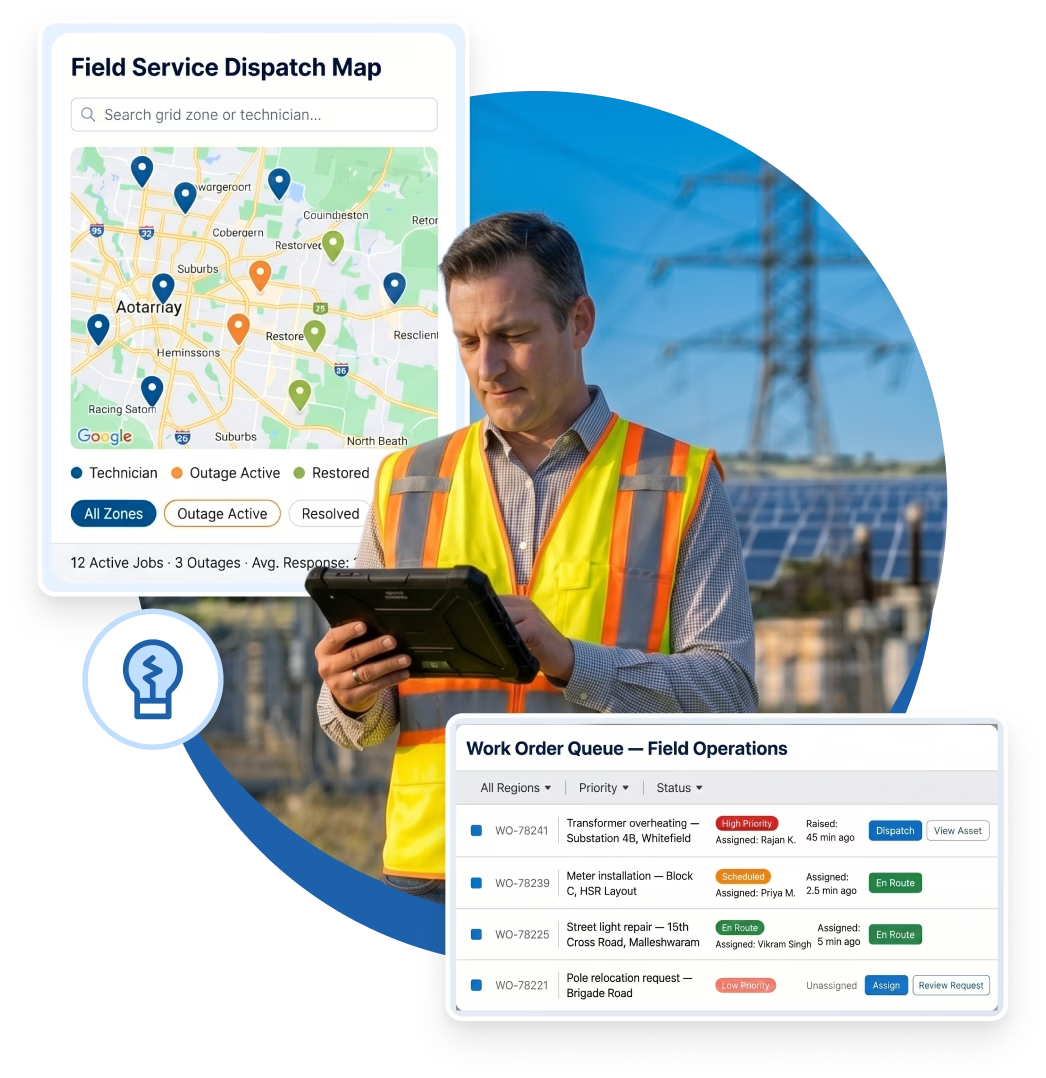
Customer locations are automatically grouped by latitude and longitude in Salesforce. Work orders are assigned to the nearest qualified technician in real time — no manual operation.

We automate case distribution rules based on case type, customer group objects, and technician skill sets — resulting in a 24% boost in case completion rates during a live utility deployment.

Technicians complete vehicle inspections on the Salesforce mobile app. Fuel quantities, tire pressure, and oil readings are logged in real time. Supervisors see fleet status from the dispatcher console — live.

Technicians update job status, upload photo evidence, and receive location-based task recommendations through the Salesforce mobile app. Dispatchers see everything live on the dispatcher console — no guesswork.
Salesforce services across the full energy & utilities operations stack
No matter your operations—electric, gas, water, or renewables—we tailor Salesforce to your field, dispatch, and customer service team workflows.
We engineer Salesforce Field Service Lightning end-to-end: work order lifecycle management, geo-fenced dispatch, skill-based technician assignment, asset tracking, and mobile app deployment. Field teams get the right job information before leaving the depot, and dispatchers see every technician's status and location in real time.
We engineer latitude/longitude-based customer location grouping within Salesforce, replacing Excel-based zone management with dynamic, rule-driven territory structures. Work orders reach the right crew faster, and supervisors gain visibility into case distribution over the full-service area briefly.
We build and configure the Salesforce dispatcher console for supervisors to track technician location, job status, break periods, and case updates in real time. Photo uploads, check-in timestamps, and job completion records are automatically sent back from the field—no manual reporting required.
We automate work order creation, prioritization, and assignment based on case criticality, asset type, and history. With all asset data in Salesforce, field teams arrive informed—accelerating issue resolution and reducing repeat visits.
We configure Salesforce Service Cloud so customer service agents can handle billing queries, outage reports, service requests, and payment reconnections from a single unified view—with full account history, asset data, and live field status available. Customers receive faster, more consistent answers across every channel.
We build automated disconnection and reconnection workflows in Salesforce—triggered by payment status, with photo evidence requirements, automated customer notifications, and dispatcher visibility into every step. Payment confirmation automatically generates a new work order, closing the reconnection loop.
We configure Einstein Analytics and AI in Salesforce to detect usage anomalies, flag assets approaching failure thresholds, and surface maintenance recommendations before faults occur. Field teams shift from reactive repair to planned maintenance, cutting emergency callout costs, and reducing service disruption.
We build digital vehicle inspection workflows in the Salesforce mobile app to capture fuel levels, tire pressures, oil readings, and safety checks at the start of every shift. Supervisors can view fleet conditions in real time, with inspection records automatically stored in Salesforce for compliance and audit purposes.
We build customer portals on Salesforce Experience Cloud so energy consumers can view usage data, report outages, track service request status, manage billing, and enroll in clean energy programs—without waiting on an agent. Contact Center for volume drops while customer satisfaction improves.
We connect Salesforce with your Customer Information System, billing platform, ERP, and legacy operations tools using MuleSoft and direct API frameworks so customer account data, usage history, and payment status flow into Salesforce without manual reconciliation. Gain one view of every customer without data jumping between platforms.
We configure Salesforce to manage clean energy program enrollment, incentives, solar campaigns, and partnerships. Customers enroll and receive automated updates, enabling your team to efficiently track and report ROI.
We build Einstein Analytics (Salesforce's data analytics tool) and Tableau dashboards that give operations leaders real-time visibility into field productivity, case completion rates, SLA (Service Level Agreement) adherence, technician utilization, and asset performance — across every substation, zone, and region. Decisions are made from live data, not weekly reports.
Ready to Transform Your Salesforce Experience?
Let’s build a platform that grows with you.
End-to-end field operations digitized on Salesforce
A national utility operator was grouping customer locations in Excel, assigning field tasks manually, and running paper-based vehicle inspections with no real-time supervisor visibility. We built location grouping by lat/long, automated case distribution by case type and customer group, a digital vehicle inspection system, and a real-time dispatcher console with geo-fencing — all inside Salesforce Field Service and the Salesforce mobile app.
Outcome → 24% higher case completion rate, live field visibility
Disconnection-to-reconnection loop automated end-to-end
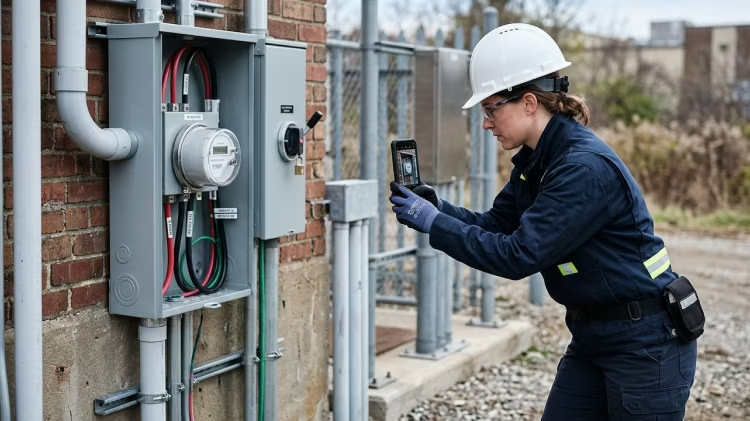
Defaulting customers triggered manual disconnection processes — field teams were dispatched without the entire context, and reconnection depended on email-based coordination. We built automated work order generation from payment default data, photo evidence uploads requirements, dispatcher console visibility, and payment-triggered reconnection workflows. The entire loop — from default identification to reconnection confirmation — now runs inside Salesforce.
Outcome → Faster reconnections, full audit trail, zero manual coordination
Field workers off SMS and onto a real-time mobile platform
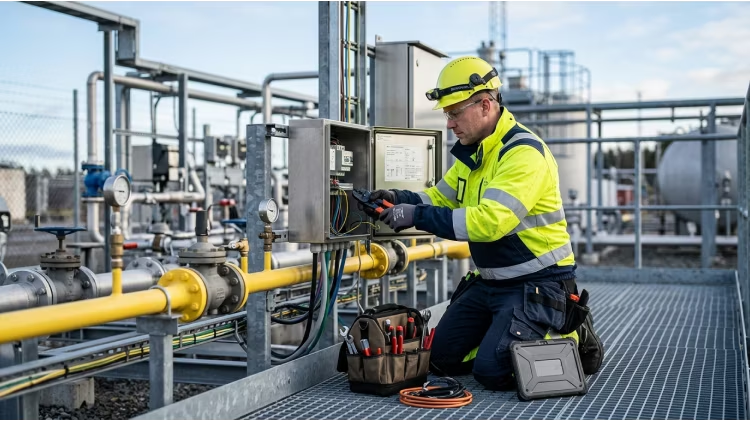
Field workers relied on SMS to receive job assignments and report completion — no proof of work, no location tracking, no visibility into task urgency. We deployed a Salesforce mobile app with real-time job updates, status tracking (en route / on-site / complete / on break), photo upload as proof of completion, and location-based task recommendations. Dispatchers see everything live without a single phone call.
Outcome → Real-time field visibility, verifiable proof of work
We're not Salesforce consultants. We're your engineering partner
Field operations engineering is harder than it looks — here's what we bring to it.
Mobile-first: We build the technician in the field — not just the manager at the desk. Every workflow is tested on the mobile before it goes live.
Integration-deep: CIS, billing, ERP, telematics, and legacy OT systems — we connect what field operations and customer service depend on.
AI-powered: Einstein AI for forecasting maintenance and anomaly detection. Agentic DevOps for continuous delivery. AI is in how we build, not just what we pitch.
Proven output: We've achieved measurable field-efficiency gains in live utility environments — not in pilot programs, but in production systems running at scale.
One promise: Salesforce that fits your business.
08
Industries
200+
Implementations
One partner, all clouds. Our expertise ensures each Salesforce product delivers maximum ROI.

Energy & Utilities Cloud sits on top of Sales Cloud and Service Cloud and adds a utility-specific data model — customer and premise data structures, prebuilt CIS integration connectors, field service workflows designed for meter work and infrastructure maintenance, and utility-specific program management for clean energy and EV adoption. Standard Service Cloud requires you to build all of that from scratch. For most electric, gas, water, and renewable energy companies, Energy & Utilities Cloud substantially reduces build time. For smaller utility operations or retail energy suppliers with primarily commercial use cases, the standard Sales and Service Cloud often makes more sense. We scope this honestly in a first conversation.
Yes. We connect Salesforce with Customer Information Systems, billing platforms, ERP tools, and legacy operational technology using MuleSoft, prebuilt Energy & Utilities Cloud connectors, and direct API frameworks. The approach depends on your data volumes and how real-time you need the sync — high-frequency operational data like outage feeds and meter readings uses event-driven patterns, while customer account and billing data typically syncs on a near-real-time schedule. Integration scope is always phased to match your first release priorities, so you go live with what matters most, not everything at once.
We focus on three things field teams need: the right job information before they leave, live status visibility for dispatchers while they're out, and easy ways to log completion without paperwork. Practically, that means work orders with full asset history, geo-fenced assignment rules that assign the nearest qualified technician to each job, a mobile app where technicians update status and upload photo evidence, and a dispatcher console where supervisors see everything live. In a live utility engagement, this approach improved case completion rates by 24% compared to the previous manual dispatch process.
A focused Field Service deployment — work order management, dispatcher console, mobile app, and basic CIS integration — typically goes live in 8–12 weeks. Broader implementations, including customer self-service portals, predictive maintenance AI, clean energy program management, and multi-system integrations, are phased over 4–6 months. We define a delivery roadmap upfront so field teams see value at each phase, not just at the end of a long project. Our prebuilt field service accelerators also reduce the initial configuration time compared to starting from scratch.
Yes. We work across electric, gas, water, and renewable energy organizations — including solar providers, EV charging network operators, and retail energy suppliers. Clean energy companies often need different Salesforce configurations to traditional utilities: program enrolment management, trade ally portals, incentive tracking, and D2C digital journeys for customer acquisition. We scope each engagement to match your specific market model rather than applying a traditional utility template to a business that doesn't operate like one.
Health and regulatory compliance in utility field operations typically means pre-work briefings with asset and hazard data before technicians arrive on site, digital vehicle inspection records logged before shift start, photo evidence requirements for completed work, and full audit trails on every work order from creation through closure. We build all of these into the Salesforce Field Service configuration — they're workflow requirements, not optional features. Our 30+ automation testing specialists also validate that every field workflow performs correctly under real working conditions before go-live.
Tell us where the friction is — whether it's in dispatch, customer service, asset management, or legacy system integration. Our engineers will give you a straight answer on what Salesforce can solve and how we'd approach it.
Schedule a Free Strategic Call