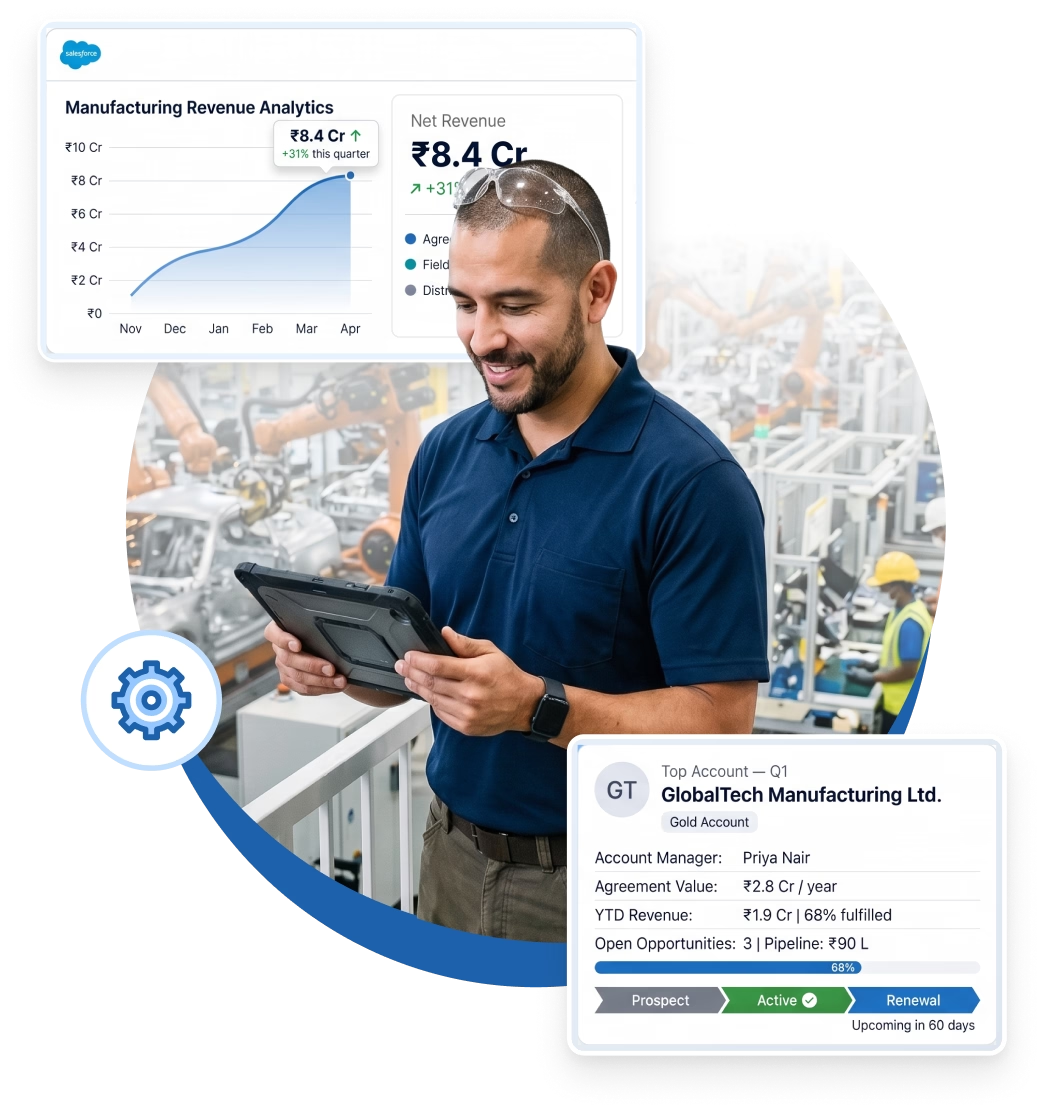
If any of this sound familiar, your Salesforce isn't the problem — the way it was set up is.

Your sales and production teams use different systems. Sales close a deal; operations hear about it two days later.

You've paid Salesforce licenses for over a year, but most of your team opens them once a week—if that.

Your last implementation partner built something so complicated that even your Salesforce admin can't explain it. And that consultant is long gone.

You had a go-live — and then nothing. No training follow-up, no adoption check, no one to call when something breaks.

Your distributors and dealers update orders via email, WhatsApp, or phone. Salesforce has no idea if they exist.

Your sales forecasts are educated guesses. Nobody fully trusts the pipeline numbers, so planning becomes a meeting where everyone argues about the spreadsheet.

Your ERP knows everything about production. Your CRM knows nothing about it. The two systems have never spoken.
Full data migration from your legacy CRM or spreadsheets — cleaned, validated, and mapped.
Documented Salesforce org — every customization explained and handed over.
User training for your sales team, service team, and Salesforce admin
90-day post-launch hypercare — bugs fixed, adoption tracked, quick improvements shipped.
Managed services available beyond 90 days — SLA-backed support, monthly health dashboards, and release management.
.avif)
Automotive components are nothing like FMCG. Heavy equipment isn't a field service. Every manufacturing vertical has different sales motions, different service models, and different data that needs to live in Salesforce. Here's how we approach the types of manufacturing we know best.
Here, the challenge involves managing dealers and distributors at scale. Hundreds of dealers update orders in various systems. Sales manage volume agreements, which are tracked against purchase data. Field service engineers need asset history before arriving on site.
Dealer portals built on Experience Cloud — order submissions, incentive tracking, and performance dashboards.
Sales agreement management in Manufacturing Cloud — track actual vs. planned volume against every customer contract.
Field rep location tracking and automated trip summaries.
Dealer incentive automation — policy configuration, automated payout calculations, and KPI upload from external systems.
The pain here is usually the gap between sales and production. Sales commit to a delivery date. Production finds out late. The customer hears nothing until it ships.
Sales and operations alignment — connect the Sales Cloud pipeline to production forecasts, so both teams work from the same numbers.
CPQ (configure, price, quote) for complex product catalogs — custom pricing rules, automated approvals, and quote generation.
B2B marketplace lead automation — JIT imports from IndiaMART and regional platforms, deduplicated, and routed to the right sales rep automatically.
Real-time field job tracking — dispatcher consoles, photo proof-of-work, and status updates for field technicians.
Field operations running on SMS and spreadsheets can't be scaled. The problem isn't the people — it's that managers have no visibility into what's happening until someone calls them.
End-to-end field process automation — task assignment based on engineer location, real-time status updates, and centralized dashboards for managers.
Case distribution automation — automatic routing based on case type, boosting field completion rates.
Customer location grouping via GPS coordinates — replacing manual Excel mapping with automated zone assignment.
Live chat and case routing — replacing call-based query handling with web chat, smart routing to designated teams, and case continuity via email.
When you sell complex machinery, the customer relationship doesn't end at delivery. Warranty claims, preventive maintenance, parts ordering, and service SLAs all need to be managed. Without a system, it's reactive to firefighting.
Warranty lifecycle management — automated warranty setup, claim processing, and renewal alerts.
Asset-centric service Cloud — 360-degree view of every installed machine, service history, and open cases in one place.
Preventive maintenance scheduling — automated work orders triggered by asset age, usage data, or customer contract terms.
Partner relationship management — replace your legacy distributor portal with a scalable Salesforce-native solution.
Here’s what sets us apart—transparent pricing upfront, with all services clearly included, and no surprise fees or add-ons.
Salesforce Clouds we configure for manufacturing.
Sales Cloud: Pipeline management, dealer/distributor relationship tracking, lead and opportunity workflows.
Manufacturing Cloud: Sales agreements, volume run-rate business, account-based forecasting, and production alignment.
Service Cloud: Case management, warranty tracking, SLA automation, and customer support workflows.
Field Service Lightning: Work order management, field engineer scheduling, real-time job dispatch, and location tracking.
Experience Cloud: Dealer portals and distributor-facing collaboration tools — so your channel partners can submit orders, check inventory, and raise cases without picking up the phone.
Revenue Cloud (CPQ): Configure, price, and quote — built for complex product catalogs with custom pricing rules.
Agentforce: AI-assisted automation for sales, service, and operations workflows.

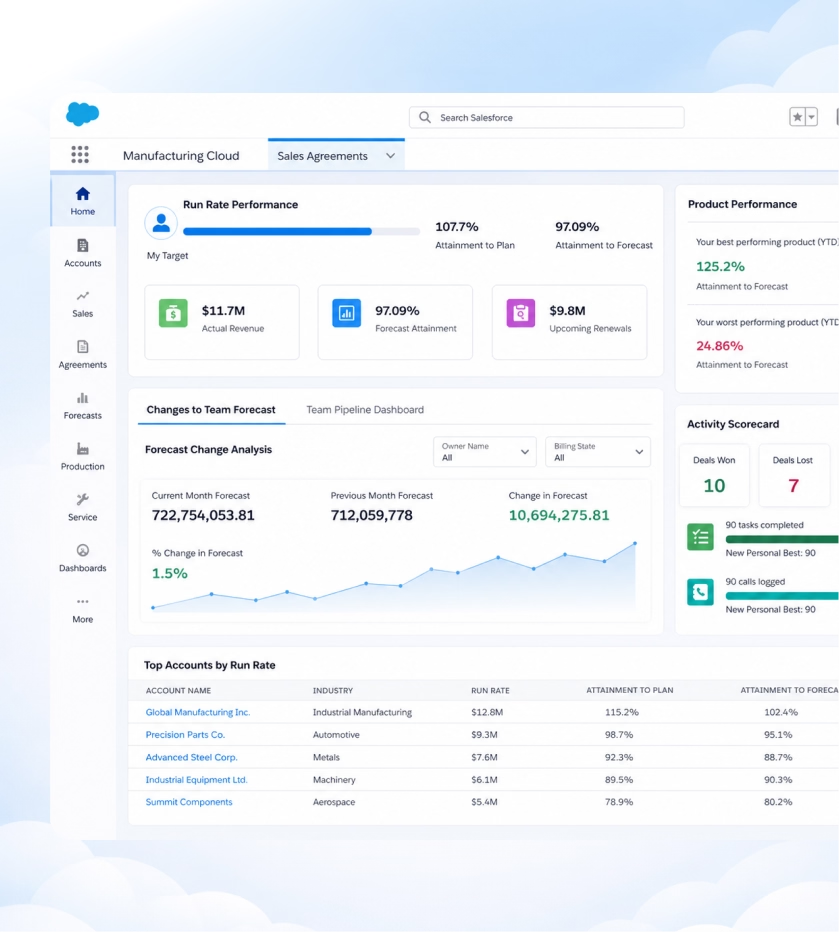
Most CRMs suit software firms. Salesforce Manufacturing Cloud is designed for manufacturers—enabling volume deals, run-rate business, long-term distributor contracts, and mobile service teams.
When set up correctly, Salesforce connects your sales pipeline to production forecasts, brings dealers and distributors onto a single platform, and equips service engineers with customer and asset history before site visits. Integration with your ERP ensures that all teams use the same data.
The key: proper setup: Most issues stem from setup, not the software. The right partner is essential.
Unlike most partners, we communicate clear, experience-based timelines tailored to mid-sized manufacturers, so you always know what to expect. Our honest approach means you’re never left guessing about project progress.

Request a personalized timeline for your Salesforce implementation—contact us for details based on your business needs. Share your company size, current systems, and goals. We'll respond within 24 hours with a custom solution and timeline.
Go-live is not the finish line. It's the starting gun for adoption. Most Salesforce implementations don't fail during build — they fail in the first 90 days after launch, when the consultant disappears, and the team doesn't know how to use what they've been given.
Here's what your first 90 days with Minuscule Technologies look like after go-live
Hypercare monitoring. Our team is closely monitoring your Salesforce error logs, adoption metrics, and workflow failures. If something breaks or doesn't work as expected, it gets fixed within hours, not days.
Adoption review. We review who's using Salesforce and who isn't, and why. We run targeted meetings with teams that are struggling. Small fixes and quick automations that improve day-to-day usability get shipped in this window.
Optimization sprint. Based on real user behavior, we identify what's working, what's being worked around, and what needs to change. We run a focused build sprint to tighten up the most-used parts of the system.
Managed services. For companies that want ongoing support, we offer SLA-backed L2/L3 support, monthly health dashboards, and Salesforce release management — so every new Salesforce update gets reviewed and applied without breaking your present workflows.
Ready to Transform Your Salesforce Experience?
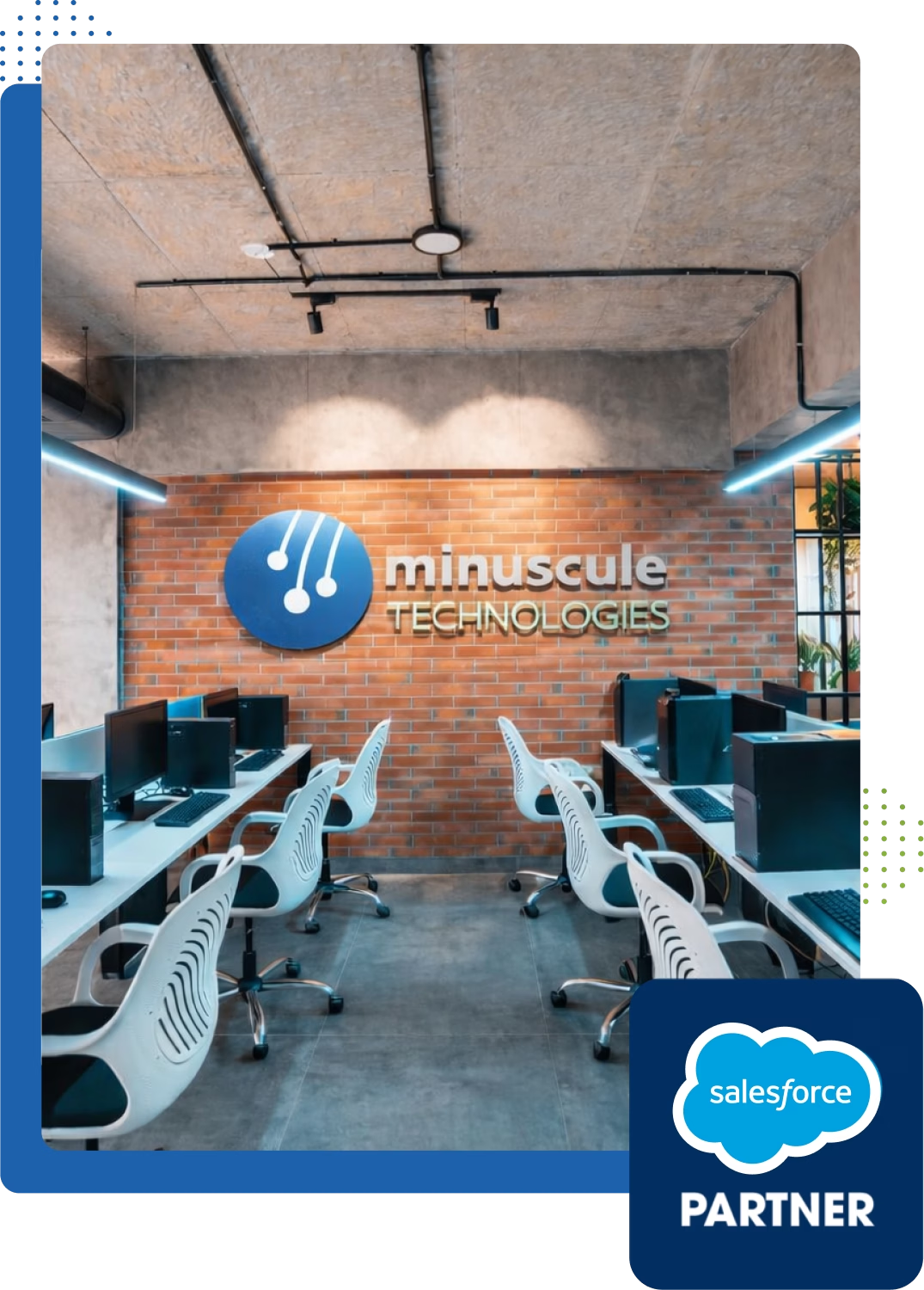
We let our work speak for itself. Every point below is based on real results and commitments you can verify with us directly.
Senior consultants on your account: Our senior consultants both design and build your solution, ensuring your project is led by experts from start to finish—no hand-offs or substitutions.
160+ Salesforce-certified consultants: Every person who works on your project holds current Salesforce certifications. Across Sales Cloud, Service Cloud, Manufacturing Cloud, Field Service, Revenue Cloud, Experience Cloud, and Agentforce.
We know manufacturing specifically — not just Salesforce in general We've worked with automotive dealers, heavy equipment: manufacturers, automation machinery companies, and energy field teams. We know what a sales agreement is. We know what dealer incentive management looks like. You won't spend your first two weeks explaining your business to us.
Three offices across your time zones: Chennai (India), Katy, TX (USA), and Kuala Lumpur (Malaysia). If you're in the GCC or ASEAN, someone is available during your working hours — not a 10-hour response lag.
We push back when you're about to make a mistake: If you're asking for something that will make your Salesforce harder to maintain in 18 months, we'll tell you — before we build it, not after.
Post-launch isn't a separate conversation: Hypercare and managed services are built into how we work, not a paid add-on you have to negotiate after go-live.
One promise: Salesforce that fits your business.
09
Industries
75+
Implementations
One partner, all clouds. Our expertise ensures each Salesforce product delivers maximum ROI.
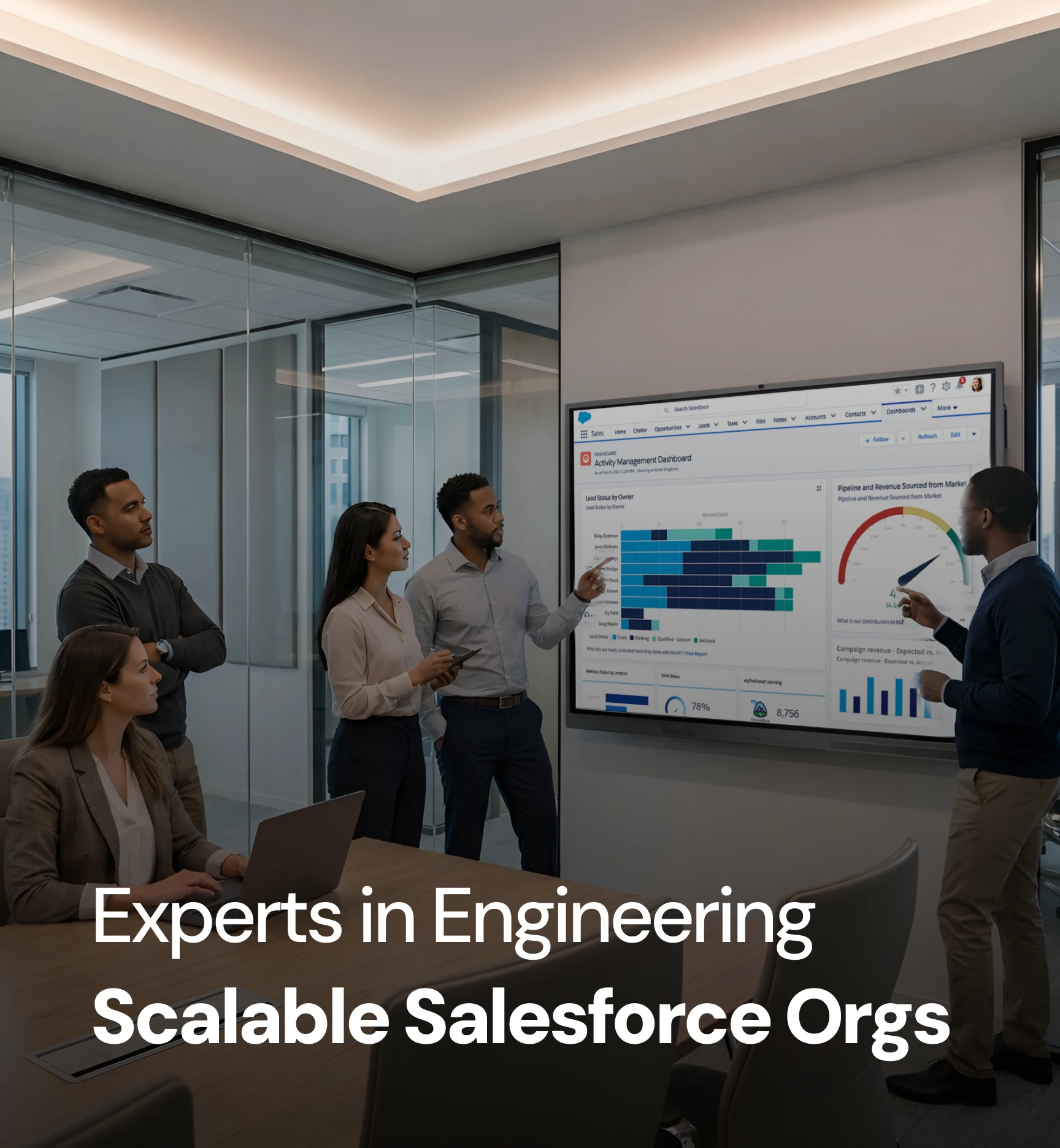
You probably have a pretty specific problem — a Salesforce that isn't being used, an ERP that doesn't talk to your CRM, a dealer network that's impossible to manage, or a field team that's still doing everything on paper.
A 30-minute call with one of our senior manufacturing consultants will tell you: what's causing the problem, whether Salesforce is the right fix, and what a realistic timeline and cost looks like. No commitment is required.
Request Demo


Plot No. 4, Sridevi Amman Street, Perumal Nagar Extension, Old Pallavaram, Chennai, Tamil Nadu 600117, India.