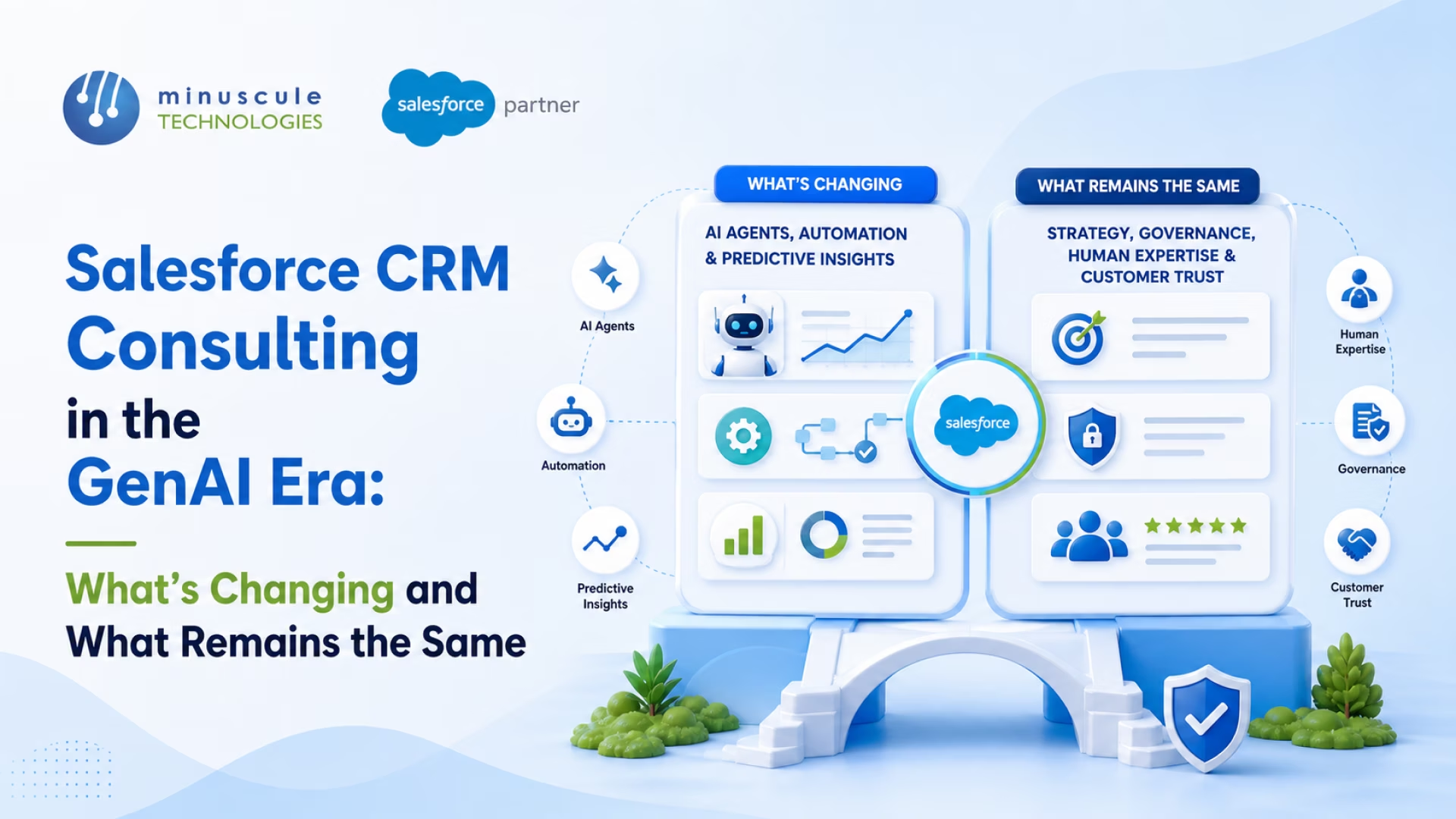
Generative AI isn't just another feature it's the new user interface for the entire Salesforce platform. The way we interact with CRM data is changing forever.
Business leaders are overwhelmed by AI hype. You know adaptation is necessary, but distinguishing reality from noise becomes harder when millions of dollars in Salesforce services investments hang in the balance.
This article cuts through that noise. We will explore what the GenAI revolution means for your organization and how it redefines Salesforce consulting services.
You will discover what's evolving (the tools, the speed, the strategy) and what remains constant (the fundamentals that always matter).
Understanding Generative AI: Beyond the Buzzwords
- Generative AI goes beyond "creating content." It's a system that understands intent and generates relevant outputs of text, code, images, and workflows - based on massive datasets known as Large Language Models.
- Think of it this way: Classic AI is predictive. It tells you that a customer will likely churn. Generative AI is creative. It drafts the email to stop them from churning.
Key Technologies Driving This Shift
- Large Language Models (LLMs) serve as the brain powering these systems. They process natural language and generate human-like responses on a scale.
- Prompt Engineering represents the new critical skill of asking AI the right questions to get the right results. The quality of your output depends entirely on how you frame your input.
- Data Cloud forms the essential foundation. GenAI without clean, unified, real-time data is useless. Your AI needs context grounded in actual business information, not generic responses.
Business Benefits That Matter
- Hyper-personalization becomes achievable at scale. Every customer interaction can be tailored without exponentially increasing workload.
- Productivity amplifies across teams. Automating busy work summaries, emails, reports free people focus on value work, such as strategy and relationship building.
- Development accelerates dramatically. AI helps build code, flows, and test cases, reducing implementation timelines from months to weeks.
The Salesforce AI Journey: From Prediction to Creation to Action
Salesforce didn't arrive at GenAI overnight. Understanding this evolution helps you see where the platform is heading.
2016–2021: The Predictive Era (Einstein)
- Salesforce launched Einstein in 2016, following initial AI research in 2014. This first wave focused on predictive insights through discriminative models.
- Einstein analyzed data to forecast what would happen next. Lead scoring, opportunity scoring, and automated email replies became standard. The platform now makes over 200 billion predictions daily.
- Key milestones included Einstein Vision (2017) for image recognition, Einstein Voice (2018) for natural language commands, and Einstein Bots (2018) for handling standard customer queries. The 2019 Tableau acquisition strengthened analytics capabilities, while Einstein Automate (2021) pushed toward workflow automation.
2023: The Generative Pivot (Einstein GPT & AI Cloud)
- March 2023, marked Salesforce's major entry into powerful GenAI with Einstein GPT. This tool brought Generative Pre-trained Transformers directly into the core CRM platform.
- Three months later, on June 2023, Salesforce unveiled AI Cloud, a game-changing platform explicitly designed for CRM. It unified AI, data, analytics, and automation to deliver real-time generative AI across all clouds.
- Sales GPT and Service GPT followed in July 2023, bringing GenAI capabilities to specific departments.
Late 2024–Present: The Agentic Shift (Agentforce)
Agentforce represents the most significant directional change since Einstein's original launch. This isn't about generating content anymore; it's about autonomous, intelligent agents that, for that reason, act and complete complex multi-step tasks.
- Agentforce 1.0 (October 2024) launched the enterprise agent platform with basic automated tasks in Service and Sales.
- Agentforce 2.0 (December 2024–February 2025) added the Atlas Reasoning Engine for more innovative thinking and deep MuleSoft integration to connect agents with external systems.
- Agentforce 2dx (March–May 2025) made agents proactive. They now act when data changes, not just when users request action.
- Agentforce 3.0 (June 2025) focused on enterprise readiness, introducing the Agentforce Command Center for tracking and control.
- Agentforce 360 (October 2025, revealed at Dreamforce) unified the agent platform with Data 360 and introduced Agentforce Voice.
Current Core AI Components: The New Stack
Understanding what's available today helps you evaluate what your Salesforce consulting partner should know.
1. Einstein Copilot: Your AI Assistant
Einstein Copilot functions as a conversational assistant that works within your workflow. It drafts tailored content, surfaces insights from call transcripts, and strings together actions to do work, not just suggest it. Copilot is grounded in your CRM data and protected by the Einstein Trust Layer, ensuring security and privacy.
2. Agentforce: Autonomous Action
Agentforce moves beyond content creation to autonomous execution. These intelligent agents can automatically qualify sales leads, generate price quotes, provide real-time coaching to salespeople, and resolve service issues before customers report them. The system includes both assistive functions ("help me do a job") and agentic functions ("complete a job for me"). Real estate teams can apply these ideas too, as our post on AI-powered Salesforce for real estate explains.
3. Data Cloud (Data 360): The Foundation
Data Cloud ingests, harmonizes, and unifies structured and unstructured data into dynamic customer profiles. All GenAI services integrate with Data 360 to ensure accuracy and contextualization. Without this unified data layer, your AI generates generic responses rather than business-specific intelligence.
4. Einstein Trust Layer: The Security Blanket
The Trust Layer handles governance, privacy, security, and ethical integrity. It manages data access, masks sensitive information such as PII before sending data to GenAI models, checks outputs for toxicity, and enforces zero data retention with external LLMs. Your data never becomes training material for general AI models.
5. Agent Studio: The Customization Toolkit
Agent Studio provides the tools (Prompt Builder, Model Builder, Agent Builder) that let you customize existing agents or build new ones. These low-code interfaces empower your team to create GenAI use cases tailored to your specific needs.
Impact Across Salesforce Clouds: What This Means for Your Department
Sales Cloud: From Data Entry to Strategic Selling
- Salesforce Sales Cloud with GenAI revolutionizes sales by drafting personalized emails, summarizing customer calls, and automatically updating pipelines based on conversation context. Einstein Lead Scoring and Opportunity Scoring prioritizes the right leads with clear explanations.
- Agentforce for Sales takes independent action, automatically qualifying leads, generating price quotes, and coaching salespeople in real time throughout the sales process.
- Sales teams using AI are 1.3 times more likely to see revenue growth.
Service Cloud: From Reactive to Proactive Support
- Salesforce Service Cloud, powered by AI-powered chatbots and virtual assistants, provides prompt resolutions to common queries, dramatically reducing response times. The system generates multilingual answers and customized responses based on ongoing conversations. Learn to use the Einstein generative AI tools in Service Cloud.
- Agentforce for Service focuses on proactive support—predicting and solving problems before customers report them. The Service Agent acts as an innovative assistant offering suggested responses and context reminders.
Marketing Cloud: Hyper-Personalization at Scale
- Agentforce for Salesforce Marketing Cloud dynamically creates entire campaigns—email copy, ad text, landing pages by analyzing customer groups in real-time using Data 360. Explore the trends shaping Marketing Cloud next.
- The system generates captivating subject lines, personalized email content, and web advertising based on customer preferences and behavior. This results in boosted conversion rates and enhanced brand loyalty.
Commerce Cloud: Real-Time Shopping Experiences
- Agentforce for Commerce creates highly personalized shopping experiences by dynamically changing content and pricing across all channels online, mobile, and in-store.
- The system generates product descriptions from instructions and creates customer-specific purchase recommendations via chatbots.
Cross-Cloud Components: Intelligence Everywhere
- Tableau Pulse delivers automated, proactive insights. It transforms dashboards into AI-generated summaries, anomaly detection, and metric digests delivered via Slack or mobile, allowing leaders to act before minor issues escalate.
- Salesforce Chatter leverages GenAI to generate automated, contextually relevant responses and summarize content such as sales reports and knowledge articles.
Platform Architecture: How It Actually Works
- Understanding the architecture helps you evaluate security, ask better questions, and make informed decisions.
The Trust Layer: Non-Negotiable Security
The Einstein Trust Layer ensures GenAI operates safely:
- Data Masking detects and replaces sensitive information, such as PII, with placeholders before sending data to GenAI models. Your sensitive data never reaches the engine.
- Zero Data Retention means processed data is promptly removed after queries are complete. External LLMs don't save or access your customer data beyond specific interactions.
- Toxicity Detection filters biased or inappropriate content. Generated responses undergo sentiment analysis before being delivered to users.
- Audit Trails track interactions, recording when prompts are created, modified, or accessed, providing transparency and accountability.
The Model Ecosystem: Flexibility and Choice
- The architecture accommodates diverse GenAI foundation models—native Salesforce models, fine-tuned versions, and external partners like OpenAI, Meta, Amazon, and Google.
- You can bring your own model (BYOM), allowing flexibility to choose the best tool for specific use cases.
Prompt Architecture: Quality Through Structure
- Well-structured prompt architecture manages prompts to enhance content quality and relevance.
- Dynamic Grounding integrates prompt engineering with Data Cloud, providing contextual data that reduces hallucinations. Your AI responses stay accurate and relevant.
- Predefined Templates offer starting points, while Prompt Builder provides a user-friendly, low-code interface for customization.
Data Cloud Integration: Context is Everything
- All GenAI capabilities rely on Data Cloud, providing unified, real-time customer data. The system uses Retrieval-Augmented Generation (RAG) to incorporate relevant structured and unstructured data directly into prompts.
- This integration ensures AI answers are grounded in your business context, not generic information.
Governance: Managing Risk and Driving Adoption
GenAI-Specific Controls
New governance mechanisms regulate customer data access and usage:
- Role-based permissions and access controls determine who can create, modify, or utilize prompts.
- Data retention policies complement architectural safeguards.
- Disclosure mechanisms ensure transparency Agentforce clearly states when content is AI-generated.
- Service agreements with external providers ensure data privacy and the immediate removal of processed queries.
Strategic Partnerships and Investment
- Salesforce has forged partnerships with leaders like OpenAI, Google, and Amazon. Strategic acquisitions include Airkit.ai (to develop Agentforce) and Tenyx (for voice agent capabilities).
- These partnerships ensure access to cutting-edge GenAI technologies without forcing customers to manage multiple vendor relationships.
Customer Education and Training
Platform adoption requires investment in education:
- Advisory services clarify GenAI use cases and deliver proofs of concept.
- Tailored educational packages cover advances in GenAI and best practices.
- Prompt Engineering training teaches teams how to write effective prompts to achieve accurate results.
The Role of Salesforce Consulting: What's Changing
The traditional consulting playbook no longer works. Clients seek AI-native strategies, data readiness, and intelligent orchestration.
1. From Configuration to Intelligent System Design
Salesforce implementation services have evolved from basic configuration to intelligent ecosystem design. Consultants now develop data models ready for immediate AI interpretation, design processes where AI initiates business action, and embed feedback loops for ongoing AI development.
2. From Declarative Builder to Prompt Engineer
The focus shifted from building complex flows to crafting effective prompts and AI actions in Copilot Studio. Creating clear, targeted instructions to guide Salesforce AI agents became a core skill. Consultants must master Prompt Builder, understand how agents use real-time data and natural language models, and customize agent behavior in flows.
3. From Implementation to AI Strategy
Conversations changed from "Can you build this report?" What is the proper AI-driven process to solve this business problem?
Salesforce certified consultants provide personalized advisory services to clarify GenAI use cases, deliver quick-win deployments, and align every CRM solution with long-term business goals.
4. From Training to AI Change Management
Training evolved beyond explaining what buttons do. It's about teaching teams to think alongside and trust an AI partner. Consultants must drive adoption, provide ongoing support, and guide organizations through ethical AI use. These human-centric skills remain irreplaceable.
5. Data Quality is Job Zero
Consultants must be experts in data unification via Data Cloud. Clean, connected data is the prerequisite for all GenAI success. Fragmented pipelines, poor metadata hygiene, and siloed systems limit performance even with advanced AI. Salesforce integration services—connecting cloud, on-premises, and third-party data are more essential than ever. Salesforce data migration services ensure legacy data is properly cleansed, transformed, and unified within the Data Cloud architecture.
6. New Essential Roles
The consulting scope expanded dramatically beyond traditional developers and administrators:
- Low-code AI builders create solutions using Agent Studio tools.
- Code-gen professionals leverage AI to accelerate development.
- AI adoption strategists drive organizational change and measure success.
- Consulting value now lies in training models, generating intelligent outputs, and designing autonomous workflows.
What Remains Constant: The Non-Negotiables
Despite transformative technology, fundamental principles endure.
Customer-Centric Strategy
- CRM initiatives must still begin and end with the customer. Strategy must be rooted in real human needs and the challenges customers face.
- Top consultants use AI tools to elevate not replace the customer-first mindset.
Clean, Connected Data
- AI output is only as good as the data it's trained on. This truth became amplified, not diminished.
- Garbage in, AI-generated garbage out. Data architecture, quality, and integration remain in paramount consulting skills.
Strategic Alignment and Long-Term Vision
- While quick wins with GenAI are tempting, sustainable success demands strategy. Every CRM solution must align with long-term business goals.
- Start by asking "why," not "how," when evaluating implementations.
Human Expertise Powers AI Success
- Despite AI's capabilities, it cannot replace human judgment in complex enterprise use cases.
- Skilled consultants combine technical expertise with deep business understanding. They negotiate with stakeholders, navigate organizational politics, and drive adoption—things AI cannot do.
- Consultants add crucial value by guiding ethical AI use and ensuring that technology serves business goals, not the other way around.
System Thinking
- Salesforce isn't a standalone implementation. It's a component of your broader digital ecosystem.
- The right consultant views CRM as an integral part of your entire technology landscape, ensuring seamless integration and data flow.
The Qualities of the Right Consultant in 2026
Choosing the right consulting partner has become both more critical and more complex.
Technical Mastery
- AI-Maturity Readiness: Your Salesforce consultant must develop AI-powered business solutions, not just implement widgets with GPT capabilities.
- Prompt Engineering Expertise: They should master creating clear instructions that guide AI agents to deliver accurate results.
- Agent Mastery: Understanding the inner workings of Salesforce AI agents—how they use real-time data, Prompt Builder, Einstein Copilot, and natural language models—is essential.
- Integration Prowess: They must ensure all data sources are connected, synchronized, and AI-ready through robust Salesforce integration services.
Strategic Acumen
- Holistic View: The right consultant sees Salesforce as part of your broader digital ecosystem, not an isolated system.
- Strategic Alignment: They ensure every solution aligns with long-term business goals, not just immediate tactical wins.
- Change Management Capabilities: Driving adoption, providing training, and ensuring teams embrace new AI tools requires specialized skills.
- Thought Leadership: Look for consultants who share knowledge, publish insights, and position themselves as experts in Salesforce AI services.
Governance and Accountability
- Data Ethics and Governance: Your consultant must help create systems that are effective and subject to audits and accountability.
- Security Expertise: Understanding the Trust Layer, data masking, and compliance requirements is non-negotiable.
- Accelerators and IP: The right Salesforce partner brings industry templates, AI-ready playbooks, or reusable assets that expedite safe implementation.
Moving Forward: Your Next Steps
The GenAI revolution on the Salesforce platform is real, transformative, and accelerating. Organizations that adapt strategically will gain competitive advantages. Those who treat it as hype or delay adaptation will fall behind.
The role of Salesforce consultants has evolved from implementers to strategic partners who bridge technology and business outcomes. The fundamentals of customer focus, data quality, strategic alignment, and human expertise remain as important as ever. They are now amplified by AI, not replaced by it.
Your next move determines whether AI becomes a force multiplier or an expensive distraction.
Are you ready to move beyond the hype and build a real-world GenAI strategy?
At Minuscule Technologies, we combine engineering expertise with strategic business acumen to deliver Salesforce services that maximize AI's potential while respecting the fundamentals that drive success. As a Salesforce-certified partner, our team specializes in Agentforce implementation, Data Cloud unification, and prompt engineering, delivering measurable results.
We offer comprehensive Salesforce customization, administration, and managed services to ensure your AI-powered CRM runs optimally.
Contact us for an AI Readiness Workshop to evaluate where your Salesforce org stands and identify the highest-impact opportunities for GenAI adoption.