We are at Dreamforce 2026, Industry Pavilion at San Francisco


June 5, 2026
Salesforce implementation is the end-to-end process of setting up, configuring, and rolling out Salesforce so it matches how your business actually works. A successful Salesforce implementation comes down to a handful of things done well: a clear business goal, clean data, thoughtful configuration over heavy custom code, real user adoption, and an experienced partner guiding the build. Get those right and the platform pays for itself. Get them wrong and you own an expensive address book nobody trusts.
Here's what a successful rollout depends on:
Picture a sales team that just got handed a shiny new CRM. Three months in, reps still live in spreadsheets, managers can't trust the pipeline numbers, and leadership is asking why they signed a six-figure contract. The software wasn't the problem - the rollout was. This guide walks through the best practices, strategies, costs, and partner decisions that separate a Salesforce rollout people love from one they quietly abandon.
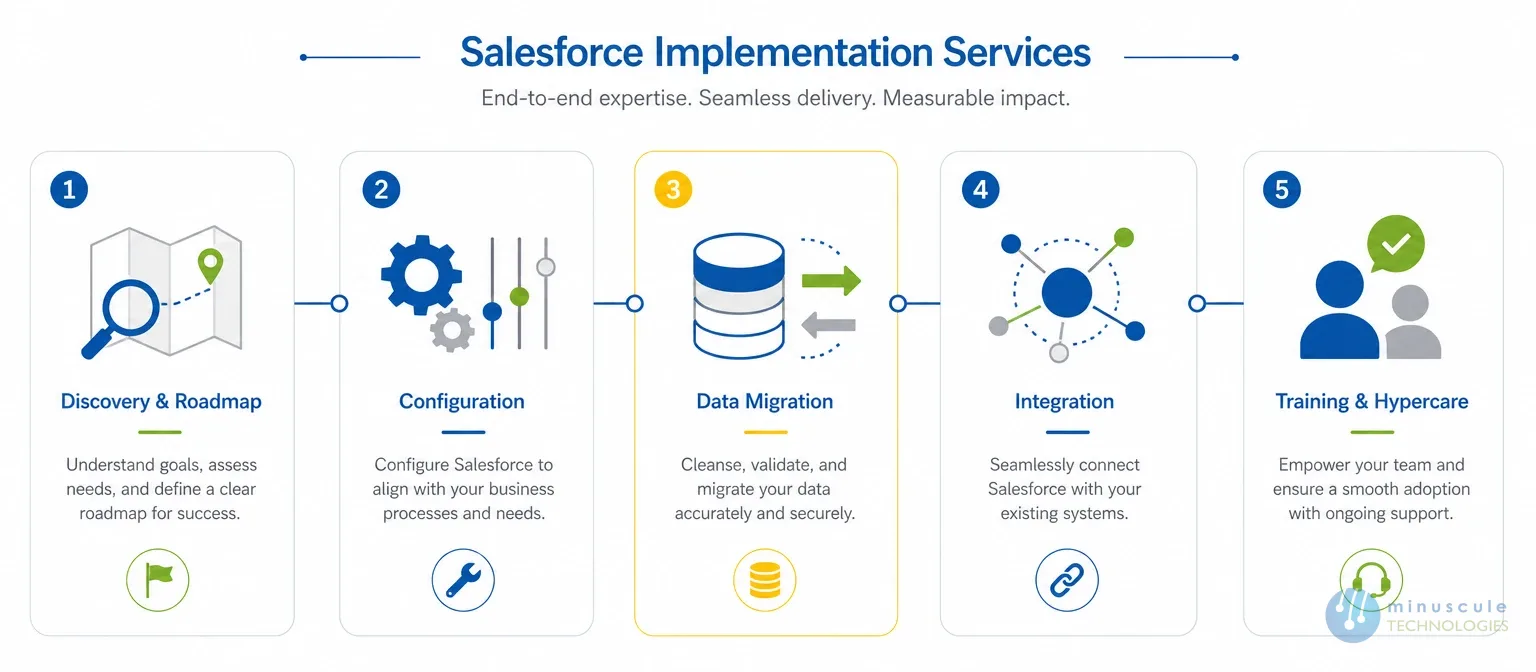
Salesforce implementation services cover the full journey of getting Salesforce live and working — from mapping your processes to configuring the org, migrating data, building integrations, training users, and supporting the platform after go-live. Think of it as the difference between buying lumber and hiring a builder. The license gives you the raw material; the service turns it into something your teams can actually run their day on.
Most engagements bundle a few core workstreams together. A typical scope of Salesforce implementation services includes:
When people search for Salesforce CRM implementation services, this is what they're really after: a team that handles the messy middle between signing the contract and seeing value. Some firms sell only the setup; the stronger ones stay through adoption, because a CRM nobody uses is worse than no CRM at all.
A Salesforce CRM implementation is rarely cheap, and the gap between a good one and a bad one is enormous. Done well, it shortens sales cycles, gives leaders a pipeline they can forecast against, and frees reps from busywork. Done poorly, it becomes shelfware - paid for, logged into once a quarter, and blamed for problems it never caused.
The uncomfortable truth is that a large share of CRM projects miss their goals. Most failures trace back to the same root causes: no clear business objective, dirty data carried over from the old system, over-engineering, and weak user adoption. None of those are Salesforce problems. They're rollout problems, and they're all preventable with the right approach.
What makes the difference is treating implementation as a business initiative, not an IT installation. The org chart, the incentive structure, and the daily habits of your reps matter more than any field or flow. That's why the best practices below start with people and process, not technology.
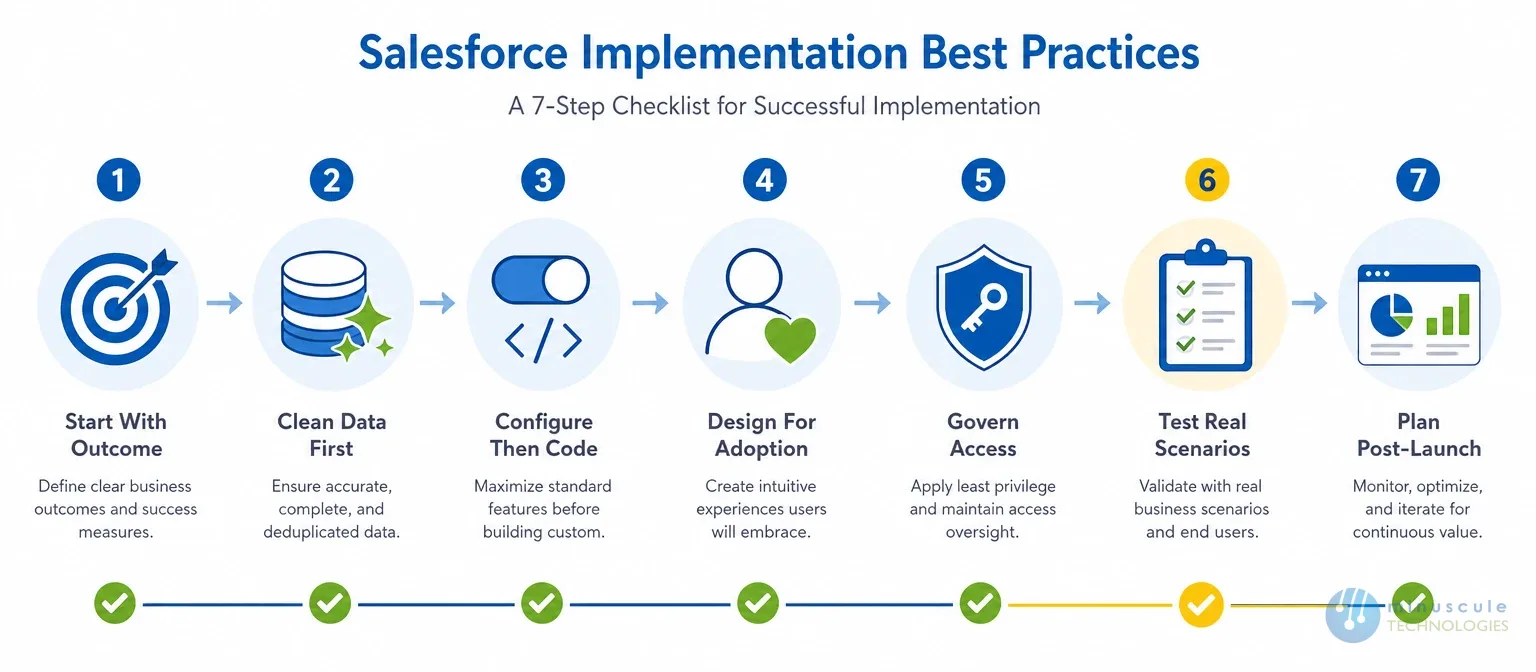
These are the practices that consistently separate smooth rollouts from stalled ones. None of them are exotic - the hard part is discipline, not discovery.
In our experience, teams that nail data quality and adoption planning rarely have "failed" implementations - even when the technical build is modest. The reverse is also true: a beautiful org with dirty data and no training is a slow-motion write-off. For a deeper library of patterns, Salesforce Ben publishes practical implementation walkthroughs worth bookmarking.
Best practices tell you what to do. Strategy tells you how to sequence it. The biggest strategic decision in any SFDC implementation is your rollout model - do you launch everything at once, or roll out in waves?
For most mid-market and enterprise builds, a phased rollout wins. It lets you prove value on one team, learn from real usage, and carry those lessons into the next wave. A few more strategies that pay off:
Every rollout hits friction. What separates a rough launch from a failed one is whether you've seen the problem before. A seasoned Salesforce implementation partner has - many times -and that pattern recognition is most of what you're paying for.
The through-line is preparation. A partner who has delivered dozens of orgs solves these problems in the design phase, where they're cheap to fix, instead of in production, where they're expensive and public. That's also where strong Salesforce integration work quietly earns its keep - clean data flows prevent most of the finger-pointing that follows a bad launch.
Salesforce implementation cost depends on scope, complexity, and who does the work - but most projects fall within a broad range, from roughly USD $5,000 for a light QuickStart to $250,000 or more for a complex, multi-cloud enterprise build. Treat the figures below as planning ranges, not fixed quotes; licenses are separate and ongoing, and the ranges cover the implementation work itself.
A few line items drive most of the variance. Data migration commonly runs in the $5,000 to $50,000 range depending on volume and messiness. Integrations land in a similar $3,000 to $50,000 band. On rates, US consulting firms typically bill $90 to $300 per hour, while independent freelancers range from $25 to $250 per hour - cheaper up front, but usually riskier on complex builds. These are ranges to plan around, not fixed price tags.
The smartest way to control Salesforce implementation cost isn't to buy the cheapest hours - it's to scope tightly, phase the rollout, and right-size your licenses. Paying for edition tiers or seats your teams don't use is one of the most common sources of waste, and a good partner will flag it before you sign.
Plenty of teams try to self-implement, and for a tiny org with a simple use case that can work. But there are clear signals that it's time to bring in a Salesforce implementation partner or one of the specialist Salesforce implementation companies rather than white-knuckle it internally.
If two or more of those sound familiar, the math usually favors a partner. The cost of expert help is almost always smaller than the cost of a failed or delayed rollout - and far smaller than the opportunity cost of a sales team stuck in spreadsheets.
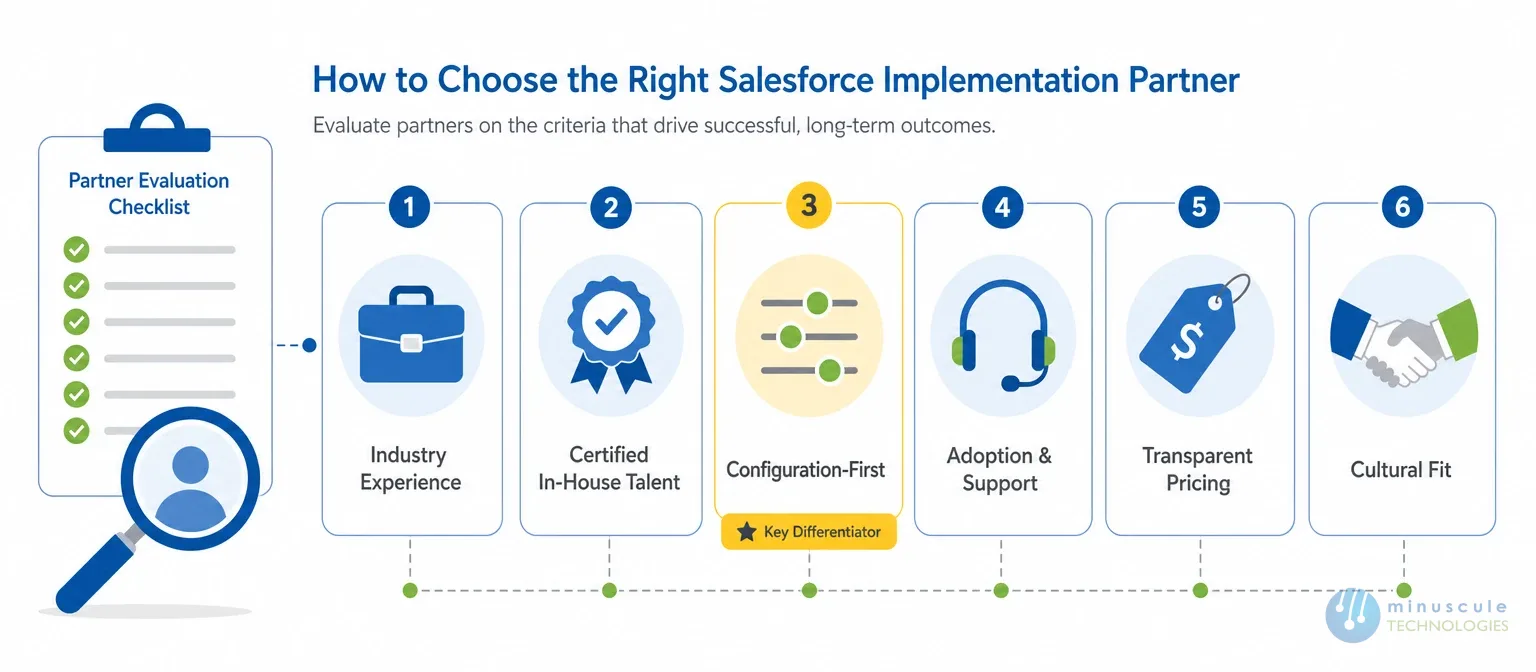
Not all Salesforce implementation consultants are equal, and the certification badge on a website tells you very little. The firms worth hiring show proof, ask hard questions about your process before quoting, and stay accountable through adoption. Here's what to check before you sign.
One practical tip: ask a shortlisted partner to walk you through how they'd handle your messiest process. The consultants who light up at that question - and push back on your assumptions - are usually the ones who'll deliver. For self-paced upskilling of your own team, Trailhead is the standard starting point.
Salesforce implementation is the process of setting up, configuring, and deploying Salesforce so it fits your business processes and gets adopted by users. It spans discovery, configuration, data migration, integration, testing, training, and post-launch support. The goal isn't just a working org — it's one your teams actually use.
A simple QuickStart can go live in two to six weeks, while a mid-size rollout usually takes two to four months. Complex, multi-cloud enterprise builds with heavy integration and data migration can run four to nine months or more. A phased approach lets you deliver value in the early weeks instead of waiting for a single big launch.
A Salesforce implementation partner plans and executes your rollout end to end - mapping processes, configuring the org, migrating and cleaning data, building integrations, training users, and supporting the platform after go-live. The strongest partners also prevent the common failure points, like dirty data and low adoption, before they reach production.
SFDC implementation means the same thing as Salesforce implementation - "SFDC" stands for Salesforce.com, a long-standing shorthand in the developer and admin community. You'll see the terms used interchangeably in job posts, statements of work, and consultant proposals.
Salesforce implementation cost typically ranges from about $5,000 for a QuickStart to $250,000 or more for a complex enterprise build, on top of ongoing license fees. Data migration, integrations, and customization drive most of the variance. Scoping tightly and phasing the rollout are the best ways to keep the cost in check.
A successful Salesforce implementation isn't about the flashiest configuration - it's about clean data, disciplined scope, real adoption, and a partner who has walked this road in your industry before. Nail those, and the platform stops being a cost center and starts driving the numbers you bought it for.
That's exactly where Minuscule Technologies fits. As a trusted Salesforce engineering partner, we pair full-scope Salesforce implementation services with pre-built accelerators that get an industry live faster - starter packs like the B2B Marketplace accelerator for manufacturing and distribution, the Field Visit accelerator for field teams, and the Loan Lifecycle Visibility accelerator for lending. Each one is customized to your vertical so you skip the blank-slate build and start from a proven foundation.
Want to know whether your rollout is set up to succeed - or where it might be at risk? Schedule a free strategic Salesforce call with our team, and we'll walk through your goals, data, and roadmap, and show you the fastest safe path to go-live.
You've seen what's possible. Now, let's make it happen for your business. Whether you need an end-to-end Salesforce solution, a complex integration, or ongoing managed services, our team is ready to deliver.

Schedule a Free Strategic Call


