We are at Dreamforce 2026, Industry Pavilion at San Francisco


June 2, 2026
A Salesforce integration service connects Salesforce with the other tools your business runs on - ERP, marketing platforms, telephony, billing, and data warehouses - so information moves between them automatically instead of by hand. The best Salesforce integration service providers and partners in the USA pair certified Salesforce engineers with real middleware skill to build connections that stay reliable as your data grows. Our top picks for 2026 start with Minuscule Technologies, followed by Ascendix Technologies, Coastal Cloud, Cyntexa, and Girikon.
What separates a strong provider from a risky one usually comes down to a few things:
Picture a mid-size lender in Texas. Sales works in Salesforce, finance works in an ERP, and the two never talk. Reps re-key loan data by hand, numbers drift, and month-end reconciliation turns into a fire drill. That is the exact problem a good integration partner removes - and choosing the right one is the difference between a clean, quiet data flow and a project that stalls halfway.
This guide lists ten strong Salesforce integration service providers in the USA, explains what separates the best from the rest, and gives you a simple framework to choose the right fit for your own org.
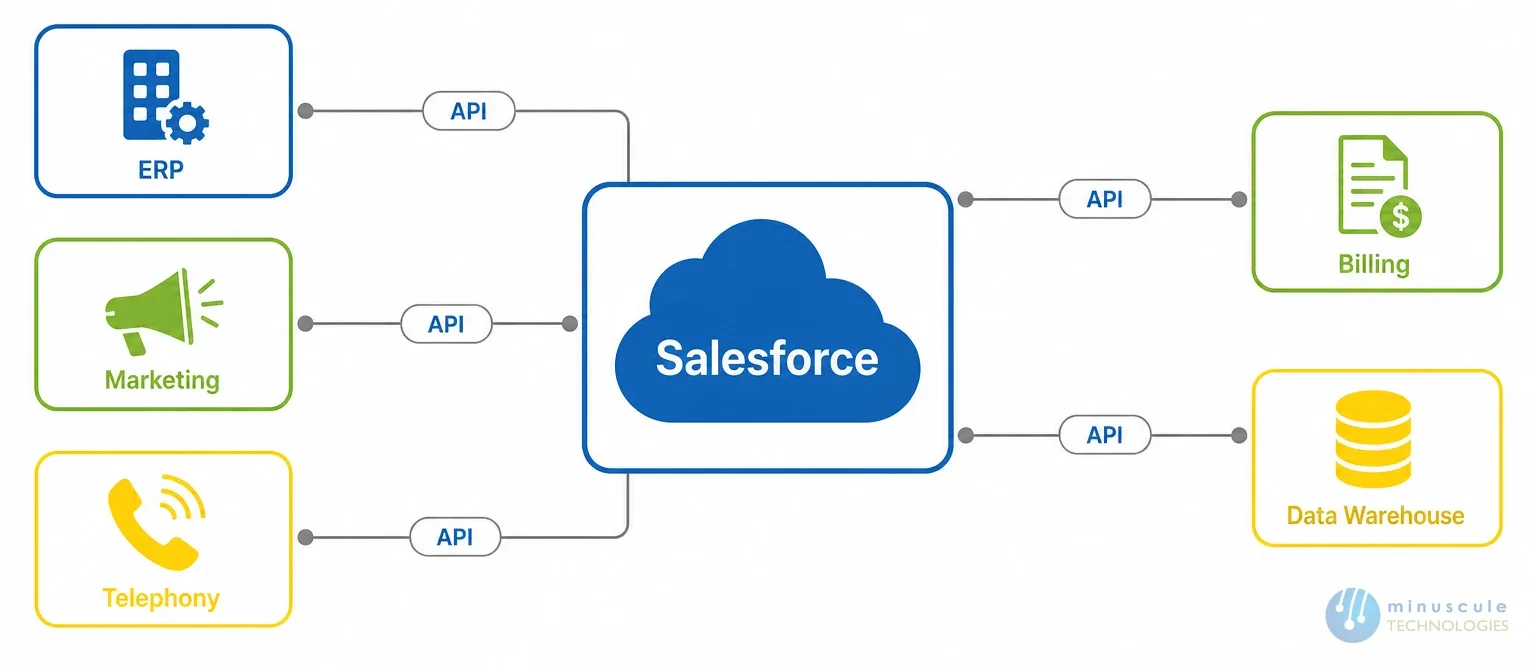
Salesforce integration services cover the full job of connecting Salesforce to the rest of your stack - the design, the build, and the ongoing support that keeps data flowing both ways in near real time. Instead of one team living in Salesforce and another in a separate app, everyone sees the same customer record, the same order status, and the same numbers.
In practice, that means wiring Salesforce to platforms like SAP, NetSuite, a payment gateway, a marketing tool, or a phone system. The work covers the connection method (usually an API), the rules for what data syncs and when, and the safeguards that keep a failed sync from quietly corrupting records. A provider that does this well treats integration as an engineering discipline, not a one-time script.
Most companies do not run their whole business inside Salesforce. Finance sits in an ERP, support sits in a ticketing tool, and marketing sits somewhere else again. When those systems stay disconnected, people copy data between them by hand - and that is where errors, delays, and stale reports creep in.
Good Salesforce integration services fix that gap. They give sales, service, and finance one trusted version of the truth, cut the manual re-keying that eats a rep's day, and make automation possible because the data it depends on is finally accurate. In our experience, the teams that skip integration end up paying for it later in bad forecasts and slow month-end closes.
The payoff from a solid Salesforce integration shows up across the whole company, not just in IT. Here are the gains teams notice first:
Minuscule Technologies builds its Enterprise Integrations practice around exactly these outcomes, connecting ERP, CRM, and data warehouses without leaving silos behind.
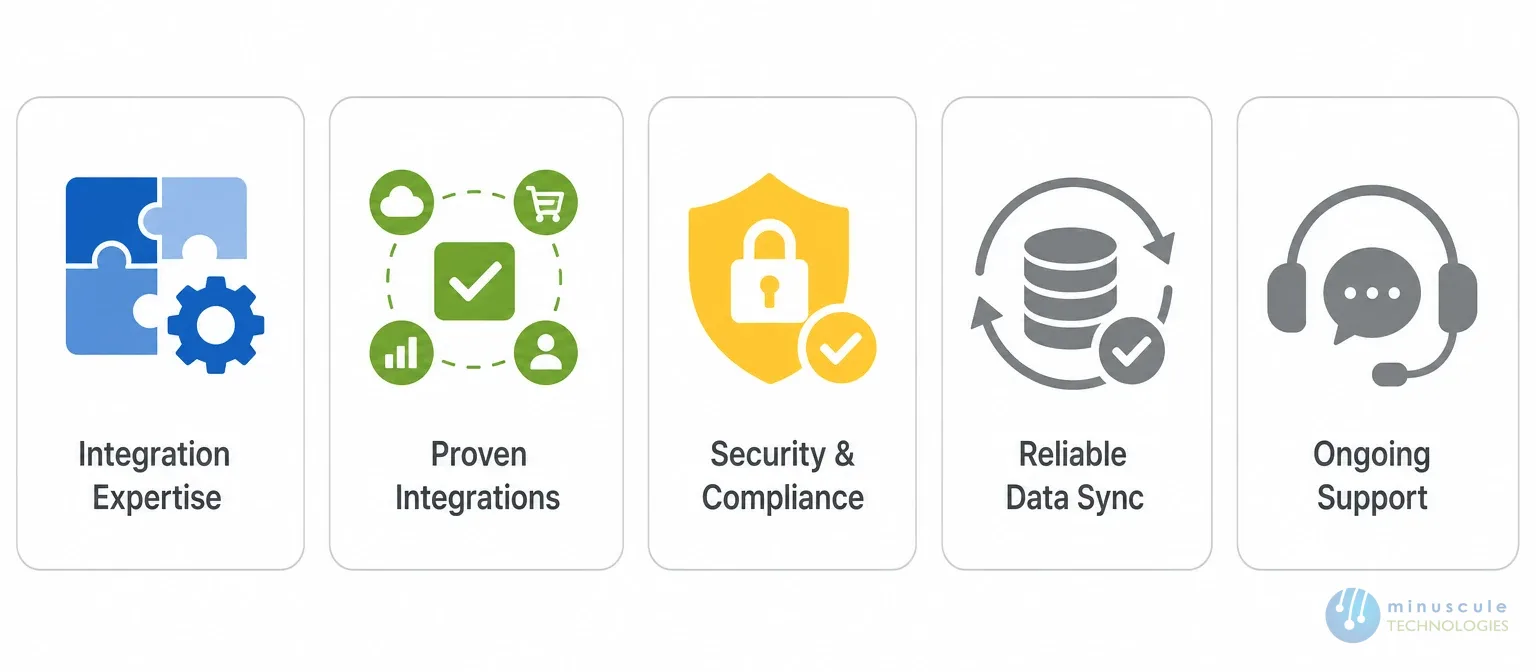
Size is not the thing to judge on. A large Salesforce integration company can still deliver a clumsy build, and a focused boutique can run circles around it. Judge a provider instead on the things that actually predict a successful project.
A few signals matter more than the rest:
The ten providers below cover a mix of large partners and specialist shops, each strong for a different kind of buyer.
Here are ten Salesforce integration service providers worth a shortlist in 2026. We lead with our own team, then list the rest by the type of buyer they fit best rather than a strict scoreboard.
Minuscule Technologies is a Trusted Salesforce Engineering Partner based in Katy, Texas and serving US clients, with a team of 125+ Salesforce experts. The group has shipped integrations with SAP, MuleSoft, Yardi, DocuSign, PeopleSoft, Microsoft Dynamics, telephony platforms, and WhatsApp - the connections enterprises actually ask for. What sets them apart is an engineering-first approach: they treat integration as part of re-engineering the org for efficiency, with monitoring and error handling built in from day one rather than bolted on later. They work across manufacturing, real estate, and BFSI, and back projects with SLA-based support once the build goes live. If you want a partner that plans the architecture first and then builds it cleanly, they are a strong first call - see their manufacturing solutions for examples of ERP-heavy integration work.
Based in Dallas, Texas, Ascendix is a long-standing Salesforce consulting and product firm with deep roots in real estate and other CRM-heavy industries. They handle custom API work, data migration, and customer portals, and they also build their own Salesforce products, which gives their team real depth in extending the platform. That mix makes them a strong fit when your integration project sits alongside a larger customization or portal effort rather than standing on its own. Buyers who want thorough discovery and clear documentation before the build tend to like working with them.
Coastal Cloud is a fully onshore US partner headquartered in Florida, well known for public sector, nonprofit, and mid-market work. Because every consultant is US-based, they are a common shortlist pick for organizations with compliance, data-residency, or time-zone requirements that rule out offshore delivery. Their teams handle ERP, service cloud, and finance-system integrations, and they lean on strong project governance to keep multi-system builds on track. If onshore delivery and predictable process matter more to you than the lowest hourly rate, they are worth a close look.
Cyntexa is a Salesforce Summit-tier partner with offices in the US and India and a broad bench of certified consultants and developers. They cover marketing, ERP, and app-to-app connections across most Salesforce clouds, which makes them a reasonable choice for companies that want full-cycle work under one roof. Their size means they can staff larger programs quickly and support several clouds at once. Teams that prefer a single vendor for consulting, development, and integration often shortlist them for that reason.
Headquartered in Phoenix, Arizona, Girikon is a Gold Salesforce partner that pairs integration work with strong managed services and admin support. Their focus on the long tail — keeping connections healthy, tuning flows, and handling change requests — suits teams that want an ongoing partner rather than a one-off build. They also work across data and AI projects, so an integration engagement can grow into wider platform support over time. Companies without a large in-house Salesforce team tend to value that steady, hands-on model.
Silverline is an established US Salesforce partner with strong ties to insurance, healthcare, and Financial Services Cloud. Their deep vertical knowledge means integration projects come with an understanding of the regulations and processes those industries run on, not just the technical wiring. They handle data sync, FSC rollouts, and managed services, and they are used to the security and audit demands regulated firms carry. For a bank, insurer, or health system, that industry fluency can matter as much as the integration skill itself.
VRP Consulting is a global Salesforce partner with US operations and a clear product-build mindset. They take on MuleSoft work, revenue and CPQ systems, and custom application development, and they suit companies that treat Salesforce as a platform to build on rather than a fixed tool. Their global delivery model gives them flexibility on cost and coverage across time zones. Product and engineering-led teams that want a partner comfortable with complex, custom builds are their natural fit.
Synebo is a highly rated Salesforce consulting firm serving US clients with EU-based delivery. Their strength is custom development and app-to-app API work, which makes them a good match for teams with unusual or heavily customized requirements that off-the-shelf connectors cannot cover. Strong AppExchange reviews point to consistent delivery quality and clear communication. Companies that want senior developer talent at a mid-market price often find them a sensible middle ground between onshore boutiques and large offshore shops.
TechForce Services works across the US and Australia with a focus on public sector and data-heavy programs. Data integration, identity management, and MuleSoft work sit at the core of what they do, so they fit organizations moving large volumes between systems or standing up single sign-on across many apps. Their experience with government and enterprise clients means they are comfortable with strict security and procurement requirements. If your project is more about data plumbing and identity than front-end customization, they are a solid candidate.
Codleo serves US clients with India-based delivery and a focus on small business and nonprofit organizations. They cover marketing, telephony, and CRM connections at a friendly price point, which suits leaner budgets and teams taking on their first Salesforce integration. As a Ridge/Crest-level partner, they bring certified talent without the overhead of the largest firms. For a growing company that needs a practical, cost-aware first integration, Codleo is an approachable starting point.
Use this table to match a provider to your situation at a glance - where they deliver from, who they fit best, and what integration work they are known for.
| Provider | HQ / US Presence | Best For | Integration Strengths |
|---|---|---|---|
| Minuscule Technologies | Katy, Texas, US (US clients) | Enterprise Salesforce re-engineering & integration | SAP, MuleSoft, Yardi, DocuSign, telephony, WhatsApp |
| Ascendix Technologies | Dallas, Texas | Real estate & CRM-heavy orgs | Custom APIs, data migration, portals |
| Coastal Cloud | Palm Coast, Florida (onshore US) | Public sector & mid-market | Onshore delivery, ERP & service integrations |
| Cyntexa | US & India offices | Full-cycle Salesforce delivery | Marketing, ERP, and app-to-app connections |
| Girikon | Phoenix, Arizona | Managed services & admin support | ERP, finance, and middleware work |
| Silverline | US-based (financial services roots) | Insurance, healthcare & FSC | Financial Services Cloud, data sync |
| VRP Consulting | Global with US operations | Product & platform builds | MuleSoft, revenue systems, custom apps |
| Synebo | US clients, EU delivery | Custom development | App-to-app APIs, AppExchange builds |
| TechForce Services | US & Australia | Public sector & data | Data integration, identity, MuleSoft |
| Codleo | US clients, India delivery | SMB & nonprofit | Marketing, telephony, and CRM connections |
Almost every Salesforce integration project connects to one of a handful of system types. Knowing which bucket yours falls into helps you brief a provider quickly.
This is the most common request. A Salesforce CRM integration with an ERP like SAP or NetSuite keeps orders, invoices, and customer records in sync, so sales and finance stop arguing over whose number is right. It is also the hardest to get wrong quietly, which is why error handling matters so much here.
Marketing automation, ticketing platforms, telephony, and messaging apps like WhatsApp are the next most common. These connections push leads in, log conversations, and give agents full context on one screen. Minuscule's WhatsApp Salesforce Accelerator is one example of a pre-built connector that cuts this work down.
Salesforce integration architecture is simply the plan for how systems talk: which system triggers the exchange, what format the data takes, and how often it moves. Salesforce Ben and the wider community group the common patterns into remote calls, event-driven flows, batch data loads, and shared user interfaces. Picking the right pattern up front is what keeps a build from buckling later.
Most modern work runs through a Salesforce API integration. REST APIs handle lightweight, real-time calls; SOAP suits older enterprise systems; and the Bulk API moves large data sets efficiently. A good provider chooses the API based on volume and timing, not habit - a real-time REST call is wrong for a nightly million-record load, and Bulk is overkill for a single record update.
Providers reach for different tools depending on complexity and budget. The common ones include:
The tool matters less than the hands using it. A skilled team with native APIs will beat an inexperienced one armed with the priciest platform.
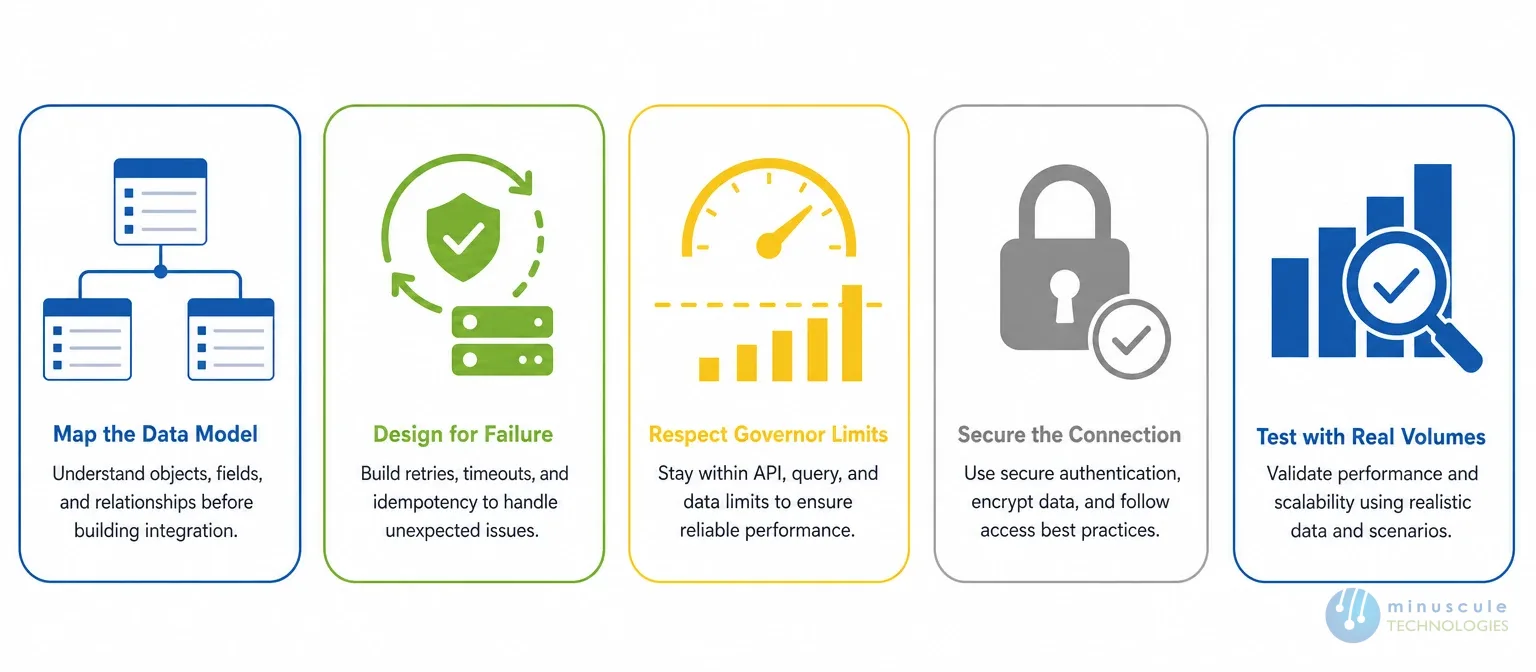
Whether you build in-house or hire a Salesforce integration company, the same habits separate smooth projects from painful ones.
This is where Salesforce integration consulting earns its keep. A partner who plans the model and pattern before building saves you from the expensive rework that follows a rushed start. You can dig into the technical side further on Salesforce's integration patterns guide and by working through the API Basics module on Trailhead.
Two shifts are reshaping how integrations get built. First, AI features like Agentforce and Data Cloud only work when clean, connected data feeds them - so integration is moving from a nice-to-have to a prerequisite for anything AI-driven. Second, event-driven and real-time patterns are replacing nightly batch jobs as customers expect instant updates.
The practical takeaway: build integrations now with data quality and real-time flow in mind, because the AI tools arriving next year will only be as good as the data plumbing underneath them. Training resources like Apex Hours and community news from Salesforce Ben are good places to keep up as these patterns mature.
A Salesforce integration service is professional work that connects Salesforce to other business systems — like an ERP, marketing tool, or phone system — so data moves between them automatically. It covers the design, the build, and the ongoing support that keeps those connections reliable.
A simple two-system sync can take a few weeks, while a multi-system enterprise build with MuleSoft often runs a few months. The timeline depends on data volume, how many systems are involved, and how clean your current data is. A short discovery phase up front usually gives you a firm estimate before the main build starts.
Cost depends on the number of systems, data volume, and how custom the logic is. A simple two-system sync can be a small fixed-price project, while a multi-system enterprise build with MuleSoft runs much higher. Most US providers scope it after a short discovery, and prices are quoted in USD.
Look for certified Salesforce and MuleSoft talent, real integration experience with your specific systems, clear error handling, and support that lasts past go-live. A short paid discovery is a good way to test how well a provider plans before you commit to a full build.
The right Salesforce integration service provider is the one whose strengths line up with your systems, your industry, and your delivery needs - not simply the biggest name on the list. Shortlist two or three, run a small paid discovery, and see who plans the architecture most clearly before they build.
If you want a head start, Minuscule Technologies offers pre-built accelerators that cut integration time-to-value: the B2B Marketplace accelerator for distribution and dealer commerce, and the WhatsApp Salesforce Accelerator for messaging-driven engagement. Each ships as an industry-customized starter pack, so your team goes live faster instead of building every connector from zero.
Ready to connect Salesforce to the rest of your stack the right way? Book a Salesforce integration readiness review with Minuscule Technologies and get a clear, engineered plan before a single line of code is written.
You've seen what's possible. Now, let's make it happen for your business. Whether you need an end-to-end Salesforce solution, a complex integration, or ongoing managed services, our team is ready to deliver.

Schedule a Free Strategic Call


