We are at Dreamforce 2026, Industry Pavilion at San Francisco


June 14, 2026
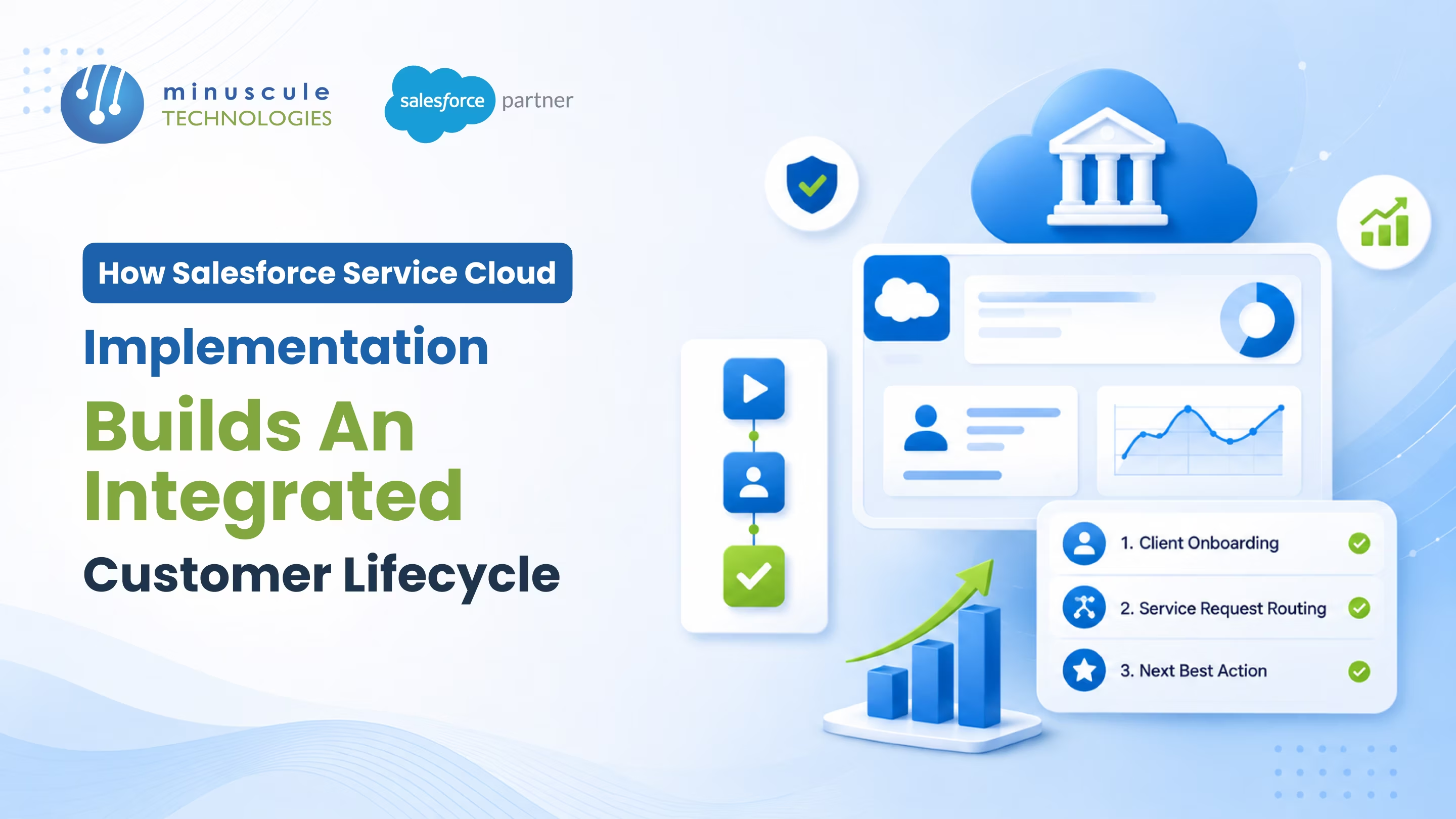
Salesforce Service Cloud Implementation is the process of setting up and configuring Service Cloud - Salesforce's customer-service platform - so your support, sales, and success teams work from one connected view of every customer. It matters because disconnected tools create disjointed service: agents miss context, cases slip through the cracks, and customers repeat themselves. A well-run implementation ties each stage of the customer lifecycle - onboarding, support, renewal - into a single, integrated flow.
Think about the last time you contacted a company and had to explain your issue three times to three different people. That's what a fragmented setup feels like from the outside. Inside the business, it's worse — siloed data, manual handoffs, and no clear picture of the customer's history. A proper Service Cloud implementation fixes that at the root. It unifies case management, knowledge, automation, and channels like phone, chat, email, and Service Cloud Voice into one workspace, so every interaction builds on the last instead of starting from zero.
What follows is how that integrated lifecycle actually comes together - the core components, the setup steps, the pitfalls that derail projects, and the signs your implementation is working - so you can turn scattered support into a connected experience that keeps customers longer.
Salesforce Service Cloud is the customer-service platform in the Salesforce Customer 360 suite. It gives support teams one place to manage cases, automate workflows, connect every channel, and see each customer's full history. Whether you call it Service Cloud or SFDC Service Cloud, the goal is the same: faster, more consistent, more personal support.
On its own, the platform is powerful. But the software isn't the win - the implementation is. A strong Salesforce Service Cloud implementation configures the platform around how your teams actually work, then wires it into your other systems so data flows instead of sitting in silos. That's what turns a licence into a lifecycle engine. Salesforce's own Service Cloud guide is a good primer on the platform's scope.
The customer lifecycle is the full journey - from first contact to onboarding, everyday support, renewal, and growth. In most companies, those stages live in different tools owned by different teams. Sales uses one system, support another, and nobody sees the whole picture.
An integrated lifecycle removes those seams. Every team works from the same customer record, so a support agent sees the sales history, and an account manager sees open cases. Context follows the customer wherever they go. That's the real payoff of a Service Cloud implementation - not just faster tickets, but a business that treats each customer as one continuous relationship instead of a series of disconnected transactions.
Here's where the platform earns its keep. A well-configured Salesforce Service Cloud maps a specific capability to each stage of the customer journey.
The thread running through every row is data. When onboarding, support, and account history sit in one place, each stage feeds the next. A recurring support issue becomes a product insight; a happy resolution becomes an upsell opening. That's an integrated lifecycle in action, and it only happens when the implementation connects the data, not just the features.
A complete Service Cloud implementation brings several building blocks together. Each one supports the lifecycle above.
Tie these to your ERP, billing, and communication tools through a clean Salesforce integration, and agents get the full context they need to resolve issues on first contact.
A dependable rollout follows a clear sequence. Rushing any step is where projects go wrong.
Because this spans strategy, configuration, code, and change management, many teams bring in expert Salesforce implementation services rather than learning on a live org. Salesforce's optimization handbook is a useful companion here, and Trailhead covers the admin fundamentals.
Most failed rollouts share the same handful of mistakes. Watch for these.
It's the process of setting up and configuring Service Cloud to fit your support operation - case management, omnichannel routing, knowledge, automation, and integrations. Done well, it connects your customer data across teams so support runs on a single, shared view of each customer.
It depends on scope. A single-team setup with standard features can go live in a few weeks, while a multi-channel, multi-integration rollout for a large org takes a few months. Clear objectives, clean data, and a phased pilot keep the timeline predictable.
Service Cloud Voice brings telephony directly into the Service Console, so calls, real-time transcripts, and case data sit in one place. Agents handle voice, digital channels, and case work without switching tools, which speeds resolution and keeps the customer record complete.
Not always, but it helps for anything beyond a basic setup. A Salesforce Service Cloud implementation partner brings configuration, integration, and change-management experience that prevents costly rework. For complex, multi-system rollouts, that expertise usually pays for itself.
It puts support, sales, and success teams on one platform with a shared view of every customer. As cases, history, and interactions connect in a single record, each stage — onboarding, everyday support, retention, and growth — feeds the next instead of standing alone. That's what turns scattered touchpoints into one continuous relationship, which is the real goal of a Service Cloud implementation.
A Salesforce Service Cloud Implementation done right doesn't just speed up tickets - it stitches your customer lifecycle together. Onboarding, support, retention, and growth stop being separate stages owned by separate teams and become one continuous relationship built on shared data. That's the difference between software you own and a platform that compounds value with every interaction.
Getting there takes more than switching features on. It takes clear objectives, clean data, thoughtful integration, and an implementation designed around how your people actually work. Weigh any partner on those fundamentals — engineering depth, integration skill, and real support after go-live - because the rollout matters as much as the platform.
That's exactly how Minuscule Technologies delivers. As a trusted Salesforce engineering partner with 160+ certified experts and a U.S. presence, we implement Service Cloud end to end — configuration, integration, automation, and adoption — and where a proven pattern fits, our prebuilt accelerators and starter packs get you live faster and cleaner than a from-scratch build. Ready to connect your customer lifecycle? Schedule a free strategic Salesforce call, and we'll map the right implementation path for your team.
You've seen what's possible. Now, let's make it happen for your business. Whether you need an end-to-end Salesforce solution, a complex integration, or ongoing managed services, our team is ready to deliver.

Schedule a Free Strategic Call


