We are at Dreamforce 2026, Industry Pavilion at San Francisco


June 18, 2026
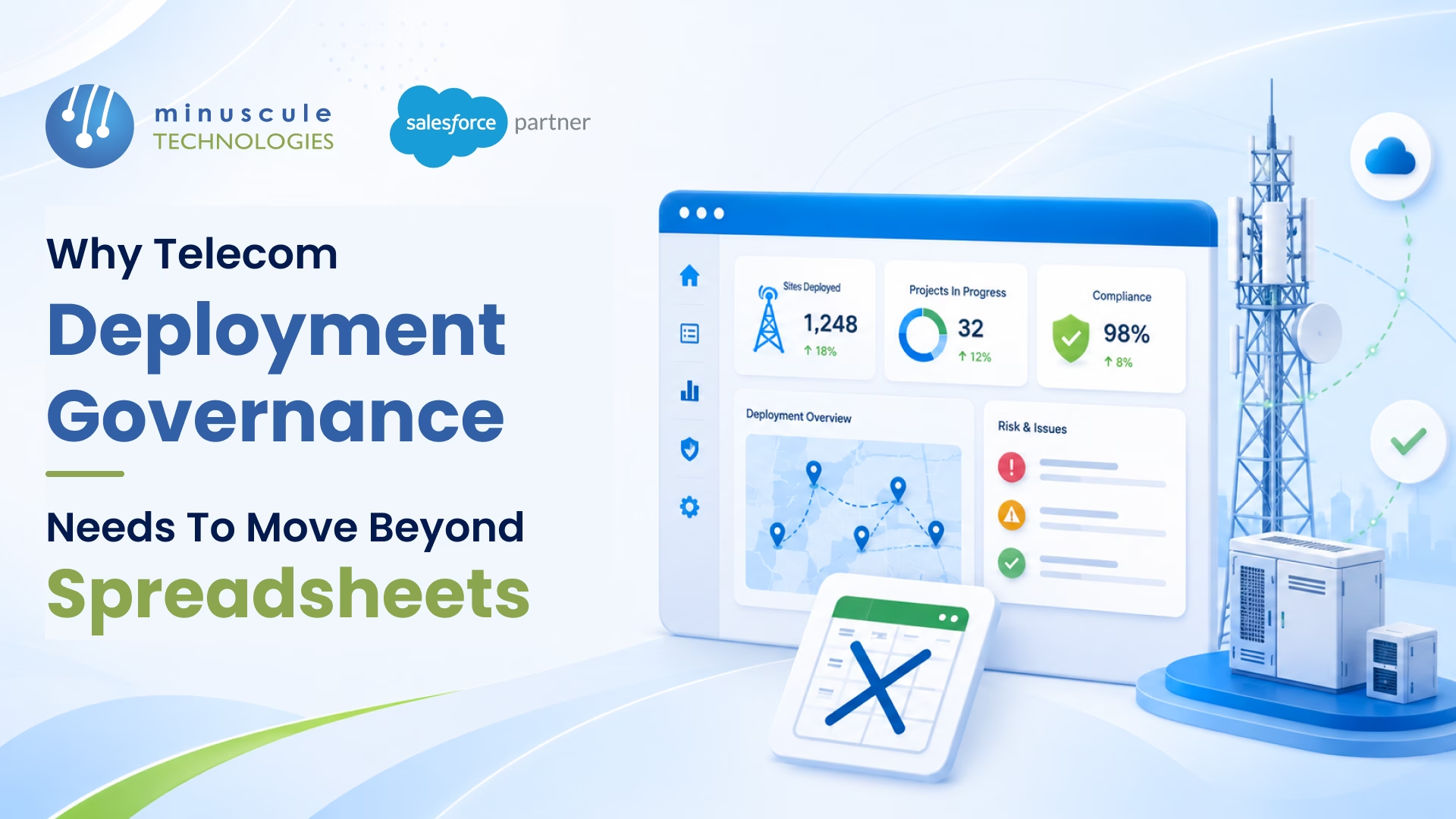
Picture this: It's Monday morning. Your program manager opens the master tracker - a spreadsheet that started as a clean 12-column file eight months ago and now runs to 47 tabs, 11 hidden columns, and a color-coding system that only two people fully understand.
She scans the "operator approvals" tab. Fourteen sites say "pending." She doesn't know which ones have been pending for three days and which ones have been pending for three weeks. There's no timestamp. No owner. No escalation path. Just a cell that says "pending."
That's not a tracking problem. That's a governance problem. And it's one of the most common - and most expensive - failures in telecom deployment programs today.
Telecom deployments involving RAN, DAS, small cell, neutral host, shared RAN, private 5G, CBRS, or enterprise connectivity rollouts are complex enough without your governance system working against you. This post explains exactly why spreadsheets fail at scale, what structured governance actually requires, and what your delivery platform needs to do beyond storing a status.
Nobody makes a bad decision when they open a spreadsheet to manage a telecom deployment. At 10 sites with one operator and a small delivery team, a well-maintained tracker works perfectly well. Status is visible. Updates are fast. Everyone knows which cell to look at.
The spreadsheet earns its place. And then the program grows.
Somewhere between 30 and 50 concurrent sites - sometimes sooner - the spreadsheet stops being a governance tool and starts being a liability. Not because the data is wrong. Because the data can't do what the program now needs it to do.
It can't enforce a stage transition. It can't validate that a commissioning document is uploaded before a closeout is triggered. It can't start a timer when an operator review begins and alert the program manager when that timer is running past its SLA window. It can't give your customer a live view of their site's progress without someone first exporting, formatting, and emailing a report.
What started as a simple tracker has become the unofficial system of record for opportunity status, site survey progress, RF design revisions, operator approvals, vendor dependencies, installation milestones, punch list items, and closeout packages - all in a file that one person owns, that lives in a shared drive, and that nobody has the time to maintain with full discipline.
That's not a data problem. That's a structural one.
Here's the honest reality of spreadsheet-based governance in telecom programs: the status you see is almost never the status that's true.
Your tracker shows an RF design revision as "submitted." What it doesn't show is that the submission went to the wrong contact at the operator, that no confirmation was received, and that the SLA clock started 11 days ago. The cell says submitted. The reality is that nothing is happening.
Your tracker shows a site survey as "complete." What it doesn't show is that the access agreement with the landlord was never confirmed, that a critical structural detail from the survey was missing from the report, and that the RF team is waiting on data they don't know is missing.
Your tracker shows a commissioning report as "uploaded." What it doesn't show is that it was uploaded to the wrong folder, that the acceptance team hasn't seen it, and that three weeks have passed.
The fundamental limitation of a spreadsheet is that it records outcomes without capturing the process that should have produced them. A field says "approved." It doesn't tell you who approved it, when, what version they approved, or whether the approval was conditional.
That missing context is the gap between tracking and governing. And in telecom deployments with multiple operators, SIs, vendors, and SLA commitments, that gap is where delays live.
The business case for moving beyond spreadsheets isn't built on a single catastrophic failure. It's built on the slow accumulation of costs that never get attributed to governance.
Field crew mobilization when a site wasn't ready for survey - because nobody confirmed the access agreement was in place. RF design rework cycles triggered after permits were pulled - because an earlier revision hadn't been formally approved before execution began. Escalation hours spent assembling a status report from five different files when a customer asked a question. SLA penalties absorbed because process clocks were never tracked against commitments.
These costs live in project budgets, escalation logs, and delivery team morale. They rarely get traced back to governance failure. But that's exactly what they are.
Weekly status calls. Consolidated reports. Email threads. All of these are useful. All of them are also retrospective by nature.
By the time your leadership receives status information through these channels, the risk it describes has already matured. The approval that's been pending for 19 days was already a problem 12 days ago. The commissioning report that's sitting unreviewed has been there for three weeks. Manual tracking systems tell you what happened. They don't help you prevent what's about to.
The shift from tracking to governing comes down to one thing: does your platform enforce what needs to happen, or does it only record what did happen?
Governance means your system can prevent a site from advancing to implementation if the RF design package hasn't been approved. It means a commissioning checklist can't be marked complete if required documents are missing. It means every stage transition creates a log entry - who made it, when, and what the state of the record was at that moment.
That's not what a spreadsheet does. That's what a governed delivery platform does.
In a telecom deployment, your customer wants to know when their coverage will be live. Your operator wants to see which approvals are pending on their side. Your vendor wants to know which tasks are assigned and what dependencies exist. Your program manager wants to see which sites are at risk across the full portfolio.
A spreadsheet can serve one of these audiences at a time - with manual export and reformatting for each. A governance platform serves all of them simultaneously, with each stakeholder seeing exactly what they need and nothing they don't.
A telecom deployment generates a large volume of data. The problem most programs have isn't that data is missing - it's that the data isn't connected.
Your opportunity record doesn't know which RF design package version is current. Your implementation task record doesn't know whether the PO that funds it has been executed. Your commissioning record doesn't know whether all required documents have been uploaded before closeout can be triggered.
When these records are isolated - spread across spreadsheet tabs, shared folders, and email threads - you can have all the data and still have no visibility. You have files, not governance.
A governed object model connects every artifact in the deployment lifecycle: opportunity, venue, floor plan, coverage zone, prequalification response, site survey, RF design package, BOM, RFQ, quote, contract, PO, implementation task, commissioning checklist, closeout package, and acceptance record.
Each of these records knows where it sits in the lifecycle. Each knows what it depends on. Each knows what stage transition it controls. And because they're connected, your platform can answer the questions your current tracker can't: Which sites in this program are blocked by a missing document? Which operator approvals have exceeded their SLA window? Which closeout packages are complete and ready for acceptance sign-off?
Those answers, in real time, without someone compiling them - that's what governance actually produces.
No more Monday morning spreadsheet archaeology. You open a dashboard that shows stage distribution across the full portfolio, sites with overdue actions flagged by priority, SLA timers approaching their limits, and pending approvals broken out by operator. You didn't request this information. The system surfaced it because it knew what you needed to see.
When a commissioning checklist is submitted incomplete, you're notified immediately - not during an acceptance review three weeks later. When a site has been in survey scheduled for longer than the defined SLA window without a confirmed date, it surfaces automatically. You spend your day resolving blockers, not discovering them.
Every pending design revision is visible in a single view - with submission date, operator review status, version history, and days remaining against SLA. No inbox archaeology. No chasing confirmations. The status is live because the record is governed.
Leadership sees a live deployment pipeline by stage, operator, account, and region - without waiting for a program manager to compile and format a weekly report. When a cluster is at risk of missing its activation window, that information is visible before the conversation with the customer happens — not after.
This is the practical difference between a tracker and a governance platform. Not cleaner data. Faster decisions, earlier risk identification, and accountable delivery across every stakeholder in the program.
Spreadsheets record status. They can't enforce workflows, validate documents, track SLA clocks, or give each stakeholder the right view of what's happening on their sites. At scale, that's not a minor limitation - it's where program risk lives.
The root failure of manual tracking isn't inaccurate data. It's the absence of ownership, traceability, and enforcement. When your governance model can't prevent a site from advancing without a completed design approval, it's not a governance model - it's a log.
The costs of spreadsheet-based coordination - rework, mobilization failures, SLA penalties, escalation time - rarely get attributed to governance. But that's where they originate. Making them visible is the first step to eliminating them.
A connected object model turns deployment data into deployment intelligence. When every artifact from opportunity to acceptance is linked, your platform can answer risk questions in real time instead of requiring someone to assemble the answer manually.
The shift from tracker to governance platform isn't a technology change - it's an operational one. When your system enforces what should happen, your team stops managing the gap between what the tracker says and what's actually true.
Spreadsheets record status but can't enforce it. At small scale, manual discipline fills the gap. As site count, operator complexity, and stakeholder count grow, that discipline becomes impossible to maintain consistently - and the gaps between recorded status and actual program state become the source of delays, rework, and SLA exposure.
A tracker records what happened. A governance platform manages what should happen - enforcing stage transitions, validating document completeness, triggering escalations, tracking SLA clocks, and providing role-based visibility. Governance includes tracking but adds the enforcement layer that turns data into accountability.
It's a connected data structure where every artifact in the deployment lifecycle - from opportunity and site survey through commissioning checklist and acceptance record - is linked and traceable. Each record knows its position in the lifecycle, what it depends on, and what conditions need to be met before the next stage can proceed.
Through process clock tracking - configurable timers that start at stage transitions and alert when SLA windows are approaching or exceeded. When an operator review has been open for 16 days against a 10-day SLA, the platform surfaces that risk automatically. Program managers don't discover it on a status call - they act on it before the commitment is missed.
Role-based visibility. Customers see their site's live progress. Operators see their pending approvals. Vendors see their assigned tasks and dependencies. Program managers see portfolio health across regions and accounts. Each stakeholder sees what's relevant to their role — without manual export, reformatting, or a report request.
Prequalification responses, site survey reports, RF design packages with full revision history, BOMs, RFQs, quotes, contracts, purchase orders, implementation task completions, commissioning checklists, as-built documentation, closeout packages, and operator or customer acceptance sign-offs. In a governed model, each document is linked to the site record and validated against stage requirements before a transition can occur.
Your customer relationships, partner accounts, and opportunity pipeline already live in Salesforce. Extending deployment governance into the same platform means delivery data is connected to commercial data from the start - no parallel tracker, no reconciliation between two systems, no CRM export feeding a separate project tool. Program health and customer-facing reporting are built on the same records.
Process clock tracking automatically starts a timer when a stage transition occurs. If the stage isn't resolved within the defined SLA window, the platform flags it - to the responsible owner and the program manager. This transforms SLA management from a manual follow-up exercise into an automated accountability layer.
Field mobilization costs when sites aren't ready. RF design rework triggered by approvals that weren't formally captured. Escalation hours spent compiling status across files and inboxes. SLA penalties from process clocks that nobody was tracking. These costs are typically absorbed as "how deployment works" rather than attributed to governance failure - which is exactly why they keep recurring.
A platform that connects all deployment artifacts in a single governed object model, enforces stage transitions based on documented criteria, tracks SLA clocks automatically, provides configurable role-based visibility, and generates live dashboards without manual report compilation. A Salesforce-native solution has the added advantage of connecting delivery governance to existing customer and partner data without a separate integration layer.
If your telecom program is still running on spreadsheets, shared folders, and weekly status calls, you're not just tracking deployments - you're managing the gaps between what your tracker says and what's actually happening on the ground.
Minuscule Technologies, Trusted Salesforce Partner, helps telecom organizations move beyond spreadsheet-based coordination with a Salesforce-native deployment governance platform - covering opportunity through acceptance with enforced workflows, automated SLA tracking, role-based stakeholder visibility, and audit-ready documentation.
You've seen what's possible. Now, let's make it happen for your business. Whether you need an end-to-end Salesforce solution, a complex integration, or ongoing managed services, our team is ready to deliver.

Schedule a Free Strategic Call


