We are at Dreamforce 2026, Industry Pavilion at San Francisco


June 1, 2026
A Salesforce Consultant is a certified expert who checks your CRM setup, builds a plan to fix what isn't working, and either builds the fix or guides your team through it. You need one when your org can't keep up with your business anymore. Common warning signs include falling user adoption, reports that don't answer real questions, or a big project like a migration with no one ready to lead it.
Below, you'll find the six signs businesses in the United States run into most, what a Salesforce Consultant actually does, real cost ranges, and how to pick the right partner.
Picture a 40-person sales team that adopted Salesforce three years ago. There was no real rollout plan, and custom fields got added here and there. Half the reps built their own workarounds in spreadsheets.
By year three, the org carries more technical debt than a system twice its age. This isn't rare. It's what happens when a company treats Salesforce as a one-time purchase instead of a system that needs ongoing care.
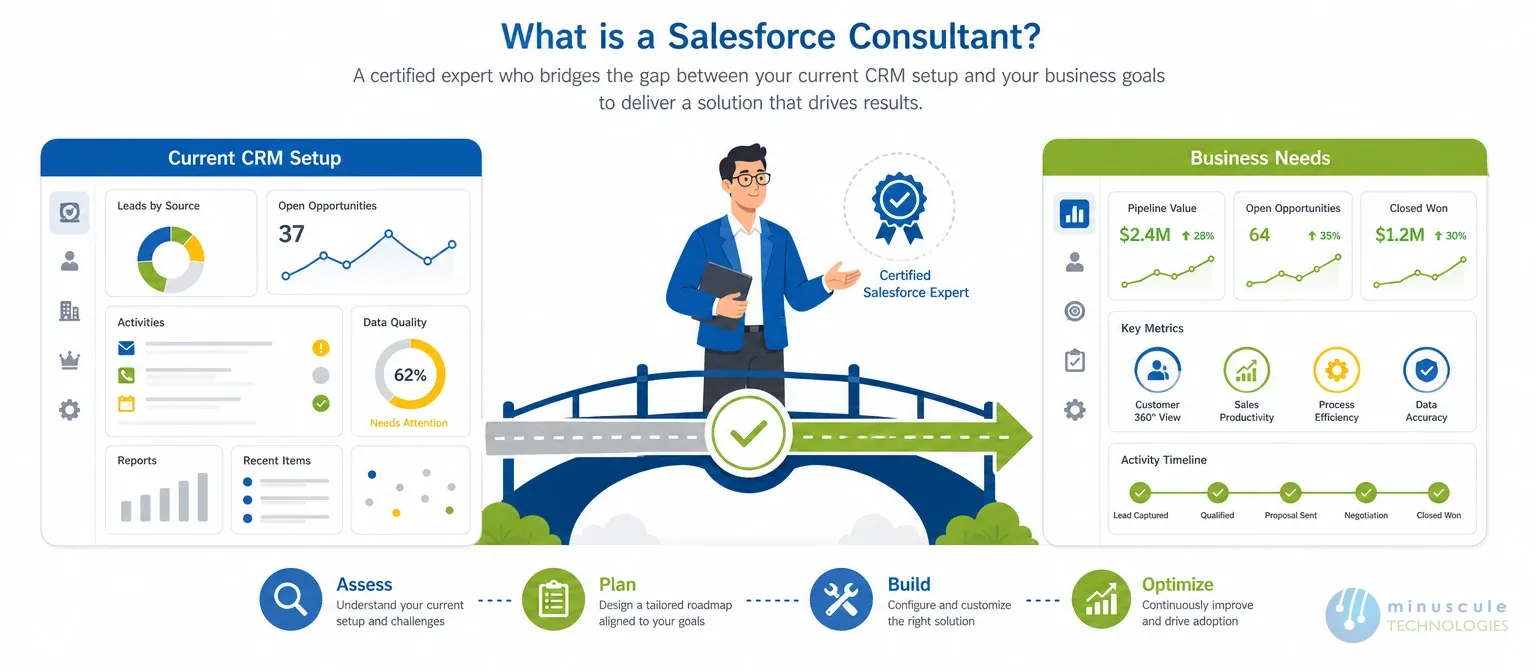
A Salesforce Consultant is a specialist, usually certified directly by Salesforce. They look at how your business uses the platform, then recommend or build the changes you need. The goal: close the gap between what your org does today and what your business actually needs.
That's different from a Salesforce Administrator, who handles day-to-day upkeep, and different from a developer, who writes custom code. A consultant sits above both roles. They find the problem, match it to what Salesforce can do, and hand your team a plan or build it for you.
Always confirm you're hiring a certified Salesforce consultant. At minimum, look for an Administrator credential plus a cloud-specific Consultant certification, like Sales Cloud Consultant or Service Cloud Consultant. Salesforce's own Trailhead credential library lists the full certification path.
Consultants specialize too. A Salesforce CRM consultant usually focuses on Sales Cloud and Service Cloud, the core CRM functions. Others focus on Marketing Cloud, Revenue Cloud (CPQ), or Experience Cloud. Match the specialty to your actual problem, not just the job title on their profile.
A Salesforce Consultant's work breaks into five stages. Most projects touch all five, even when the original ask sounds small.
Discovery and assessment come first. The consultant talks to stakeholders, reviews your current org, and finds where the platform and your process have drifted apart.
Solution design comes next. This means mapping the fix to Salesforce's data model, automation tools, and licensing, so the plan actually holds up. If the work involves a ground-up build, look for a Salesforce implementation consultant with recent go-live experience in your industry.
Execution follows: configuration, custom development where needed, and integration with your other systems, like ERP, marketing automation, or finance tools.
Change management and training come next. Most internal teams underestimate this stage. But Salesforce Admins resources consistently flag it as the difference between real adoption and a shelved system.
Ongoing optimization comes last. A good consultant doesn't disappear at go-live. They set a regular schedule to revisit the org as your business changes.
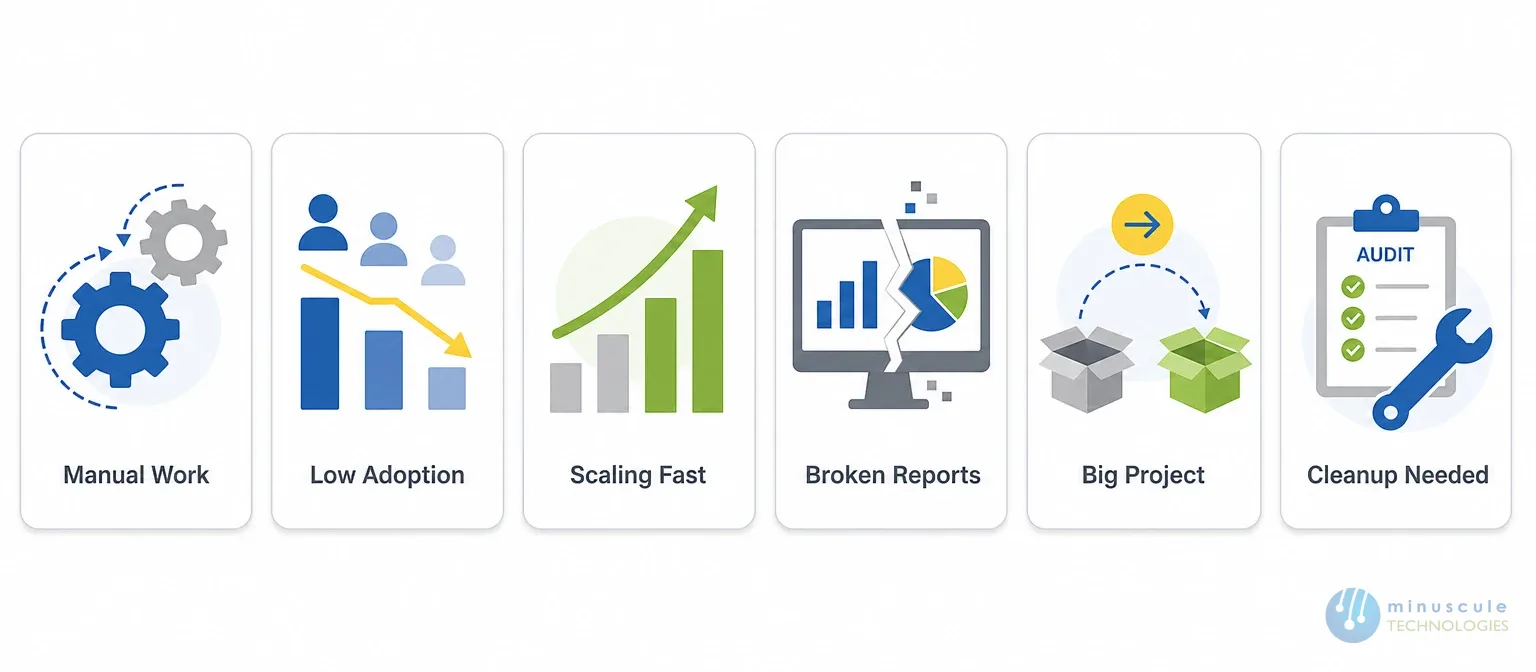
Most businesses don't wake up one day and decide to hire a Salesforce consultant out of nowhere. It's usually one, or several, of these six problems building up slowly, until the cost of ignoring it outweighs the cost of fixing it.
Run through this list with your own team. If two or more sound familiar, that's less a maybe and more a when.
Reps re-enter the same data across multiple screens. They build the same report by hand every Monday, or chase approvals through email instead of a Salesforce flow. That's not a training gap - it's a configuration gap.
A consultant can automate most of this in weeks, not months. That frees your team to sell and support customers instead of doing admin work by hand.
Low adoption almost never means your team is lazy. It usually means the org doesn't match how people actually work, so they find workarounds.
A consultant digs into usage data and talks to the reps who quietly went back to spreadsheets. Then they rebuild the parts of the interface and process that work against your users.
An org built for 15 users rarely holds up cleanly at 150. New territories, new business units, or a recent acquisition all strain a setup that wasn't built for that load. A consultant rebuilds the data model and permissions structure before growth turns into a bigger problem.
Say your leadership team asks a simple pipeline or forecasting question. If the answer takes three exports and a spreadsheet to put together, your reporting layer is broken, not your data.
A consultant rebuilds your report types and dashboards, so the answer is one click away, not a Friday-afternoon project.
Data migrations, new ERP integrations, or a new cloud rollout (Service Cloud, Experience Cloud, Revenue Cloud) all carry real risk. You could lose data, face downtime, or end up with a rollout nobody uses.
This is where specialized implementation support earns its cost back. A consultant who has done your exact type of project has already made those mistakes, and fixed them. You get to skip that part.
Not every consulting engagement goes well. Maybe a previous Salesforce consulting firm left you with undocumented automation, broken integrations, or a system nobody on your team understands.
A new consultant's first job is a cleanup audit before anything else gets built. This is one of the more common, and more expensive, reasons US businesses go back to the market for a second consultant.
Deciding to hire a Salesforce consultant is rarely about the software failing. It's about your processes outgrowing a self-managed setup. Businesses that bring in outside expertise at the right moment tend to see the same handful of benefits, no matter their industry or size.
Weigh these benefits against the cost of doing nothing. A stalled rollout doesn't just sit still. It keeps generating manual work, bad data, and frustrated reps, week after week, and that cost adds up quietly.
"Salesforce consulting" covers more ground than most buyers expect. A full-scope engagement typically spans platform assessment, implementation, and custom development. It also covers integration with your other systems, data migration, and ongoing managed support after go-live.
Some firms package all of this as Salesforce professional services. That's a single contract covering advisory, build, and post-launch support, instead of billing each phase separately. Ask about this up front - it usually costs less than piecing the same scope together across multiple vendors.
Minuscule Technologies' own Salesforce consulting services follow this model: one team, one roadmap, from the first audit through post-launch optimization.
Whatever scope you land on, get it in writing before the work starts. Vague statements of work are the single biggest cause of budget overruns in Salesforce projects. It's rarely the technology, or the consultant's skill.
It also helps to separate one-time work from ongoing work before you sign anything. An assessment, a migration, or a new implementation has a clear end date. Support and admin coverage are ongoing needs, usually priced better as a monthly retainer than a string of one-off invoices.
Cost depends heavily on the engagement model you choose, and each one fits a different situation. Here's how the four most common options in the United States market typically compare.
| Engagement Model | Typical US Cost Range | Best For |
|---|---|---|
| Independent freelance consultant | $100–$175 per hour | Small, well-defined fixes or short audits |
| Boutique consulting company | $150–$225 per hour, or $15,000–$75,000 per project | Focused implementations, single-cloud rollouts |
| Enterprise Salesforce consulting firm | $200–$350+ per hour, or $75,000–$300,000+ per project | Multi-cloud, multi-region, or complex integration projects |
| In-house Salesforce hire | $85,000–$140,000 annual salary (Admin to Consultant level) | Ongoing, day-to-day platform ownership |
These ranges shift based on how complex the clouds are, how many integrations are involved, and how fast you need the work done. As a rule of thumb, a rushed timeline costs more than a realistic one, and a vague scope costs more than either.
Get a fixed-scope quote wherever you can. Treat an open-ended hourly estimate as a signal to ask more questions before you sign.
Location also matters more than most buyers expect. US-based consultants cost more than offshore or nearshore teams. A hybrid model pairs a US-based lead consultant with an offshore delivery team. It often lands in the middle of these ranges, while keeping one accountable point of contact.
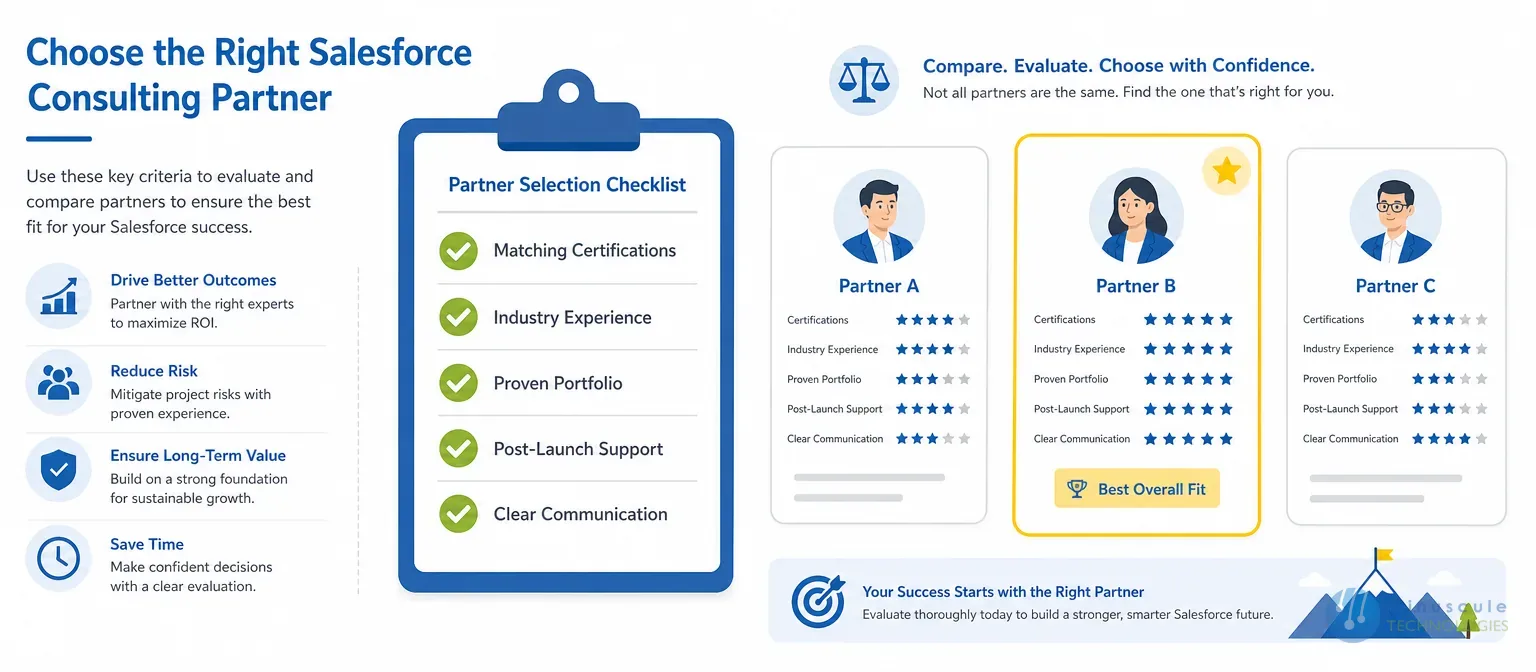
Once you've decided to hire a Salesforce consultant, the harder part is picking the right one. Whether you're evaluating an individual or a full Salesforce consultant company, the same checklist applies.
Community sites like Salesforce Ben regularly publish independent guidance on vetting Salesforce partners. They're worth a read before you commit to a longer engagement.
Watch for a few red flags, too. Be careful of a company that quotes a fixed price before any discovery work, or one that can't name the certifications of the consultant assigned to you.
Documentation treated as an afterthought is another warning sign. Any of these usually predicts a rocky engagement, well before the contract is signed.
Salesforce consulting isn't one single service. It's a spectrum that runs from a two-week audit to a multi-year managed partnership, and the right entry point depends on which of the six signs above matches your situation.
Start narrow if you only have one clear problem. Start with a broader assessment if you suspect there are several problems you haven't found yet.
If you need ongoing platform ownership, not just a one-time project, managed Salesforce services are worth exploring as an alternative to a full-time in-house hire.
Career-focused resources like SaaSGuru are also useful here. They can help you weigh building internal Salesforce expertise instead of, or alongside, an outside consultant.
A Salesforce Consultant is a certified expert who checks your Salesforce setup against your business needs. They either design or build the changes needed to close the gap. Most hold at least one Salesforce certification beyond the base Administrator credential.
Any business seeing stalled user adoption, manual workarounds instead of automation, or unreliable reporting should consider bringing one in. So should any business growing faster than its current setup can handle, or facing a big project like a migration or new cloud rollout. Company size matters less than most people assume — the same problems show up at any size.
A certified Salesforce consultant has passed Salesforce's own proctored exams for their credential level, which verifies real, hands-on platform knowledge. A non-certified consultant may still be skilled, but you have no independent way to check their expertise before the work starts.
Independent consultants typically run $100–$175 per hour. Boutique firms charge $150–$225 per hour or a fixed project fee. Enterprise consulting firms charge $200–$350 or more per hour for complex, multi-cloud work. An in-house hire typically costs $85,000–$140,000 in annual salary depending on seniority.
No. An administrator maintains and runs an existing Salesforce org day to day. A consultant usually comes in for a defined project and often works alongside your administrator instead of replacing that role. Many businesses keep both.
None of the six signs above are a verdict on your team. They're a signal that your Salesforce org has outgrown the way it's being managed.
The fix isn't a bigger software budget. It's the right Salesforce consultant, in the room, at the right time.
Minuscule Technologies pairs certified Salesforce consultants with pre-built accelerators. Two examples: the B2B Marketplace accelerator for distribution-heavy sales teams, and the WhatsApp Salesforce Accelerator for customer engagement. We also offer industry-tailored starter packs for manufacturing, BFSI, real estate, and healthcare that get you live faster than a from-scratch build.
If any of the six signs above sound familiar, book a free strategic Salesforce call and walk away with a scoped plan, not just a sales pitch.
You've seen what's possible. Now, let's make it happen for your business. Whether you need an end-to-end Salesforce solution, a complex integration, or ongoing managed services, our team is ready to deliver.

Schedule a Free Strategic Call


