We are at Dreamforce 2026, Industry Pavilion at San Francisco


June 19, 2026
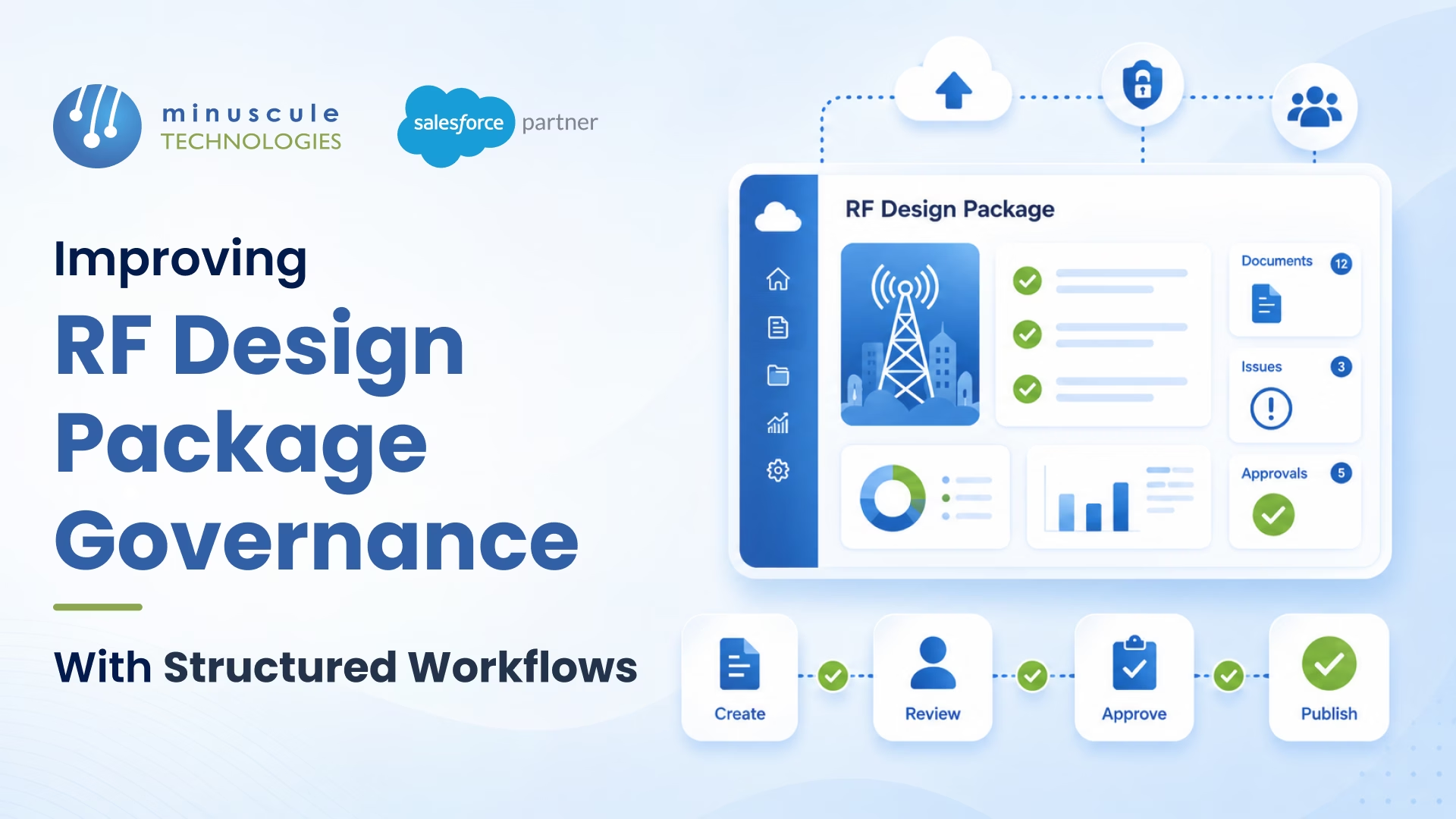
An RF design lead at a regional integrator told us last month that her team had finalized - by her count - eleven design packages in the previous quarter. By the time we walked through her file structure, the actual number was four. The other seven were either still in revision, awaiting operator comments she hadn't received, or sitting in an inbox somewhere with a version label nobody could verify.
She wasn't disorganized. She had a folder structure, a naming convention, and a weekly review cadence. What she didn't have was RF design package governance - a system that knew which version of the propagation output had been approved by which operator on which site, what the resolution status of each comment was, and whether the next implementation step could actually proceed.
The RF design stage is where most telecom deployment delays are seeded. It's also where most program managers underestimate the coordination overhead. This post is for the design leads, project managers, and operations directors who are tired of opening email threads to figure out what the current version of anything is.
RF design isn't a single document. It's a package - floor plans, coverage maps, propagation outputs, antenna placements, power level calculations, BOM assumptions, and operator-specific commentary. Each artifact has its own version history. Each gets reviewed by stakeholders with different priorities. Each can trigger ripple revisions across the rest of the package.
When this volume of versioned material flows through email and shared folders, three failure modes emerge:
The friction points in RF design workflows are predictable. They show up in every program where governance is informal:
It's tempting to think the fix is a better shared drive - better folder structure, better naming conventions, better discipline. It's not. The problem isn't file storage. It's that design artifacts aren't connected to the rest of the deployment lifecycle.
When the design package is a file in a folder, it has no relationship to the site record, no relationship to the operator participation record, no relationship to the BOM that depends on it, and no relationship to the commissioning checklist that has to validate against it. This is the same fundamental issue we covered in why telecom deployment governance needs to move beyond spreadsheets - only with PDFs and iBwave files instead of cells.
Governance means turning the design package into a connected object - with version history, approval records, comment threads, and downstream dependencies all tracked as data. Not as files someone has to remember to open.
A governed RF design workflow isn't a project tracker. It's a connected lifecycle for the design package itself - from request through approval through downstream consumption by BOM, RFQ, proposal, and commissioning workflows.
Every design starts with a request that captures venue details, coverage requirements, operator scope, hardware assumptions, and stakeholder roles. Governance means this request is validated against an input checklist before the design team accepts it. Incomplete inputs get flagged immediately - not three weeks into design when the gap surfaces. This input discipline is where most rework cycles get prevented.
Once design work begins, every package iteration is versioned in the platform - not in a folder. Each version is linked to the site record and the operator participation records it serves. Internal review happens against the platform version. Stakeholder review routes through a controlled approval workflow rather than through email forwarding.
Operator review is the stage where governance shows the most return. Submission timestamps are captured automatically. Comments are logged against the specific design version they apply to. Comment resolution is tracked - who responded, what changed, which comments are still open, which ones have been formally resolved. The same multi-operator data model applies - each operator's review queue is separate, but the master design package is unified.
When a design revision is triggered - by an operator comment, a venue change, or a stakeholder update - governance tracks what changed and what downstream artifacts are affected. If the revised version invalidates an already-approved operator version, the platform surfaces that conflict instead of letting it propagate silently. This is the discipline that prevents commissioning failures caused by design drift.
The design package's downstream consumers - BOM, RFQ, proposal, implementation task lists, commissioning checklists - all link to the specific design version they were generated from. When a design changes, the platform shows which downstream artifacts may need to be updated. This connects RF governance to the full Lead-to-Live telecom deployment lifecycle rather than treating design as an isolated stage.
The same Salesforce-native architecture covered in how Salesforce governs RAN deployment execution end to end provides the platform foundation -with custom design package objects, Flow-driven approval routing, and Experience Cloud portals for operator review.
When RF design governance works, the value lands in three measurable places.
Rework reduction. When inputs are validated at design start and operator comments are tracked against specific versions, the rework cycles that consume design team capacity get cut significantly. Programs we've worked with typically see 30 to 50 percent fewer design revisions per site once governance is in place - because the revisions that do happen are surgical, not regenerative.
Approval cycle compression. When operator review queues are governed with SLA timers and escalation routes, average approval cycle time drops. A program operating on 18-day average review cycles can routinely move to 10–12 days once the queue is structured and visible. That's three to six weeks of program time recovered per site across a portfolio.
Audit defensibility. When every design version, comment, and approval is logged with timestamps and ownership, acceptance disputes and post-deployment audits become defensible exercises rather than archaeological expeditions through old inboxes.
For an integrator running 20 to 50 concurrent sites, the combined impact is meaningful - both in program delivery and in the design team's capacity to take on new programs without expanding headcount.
At Minuscule Technologies, we help telecom design teams, integrators, and program owners run RF design workflows inside a Salesforce-native governance platform. Design packages live as connected objects - linked to sites, operator participations, BOMs, and commissioning checklists - with version control, approval history, comment threads, and SLA timers built into the lifecycle.
Operators review through Experience Cloud portals. Internal teams work against governed versions, not file copies. Downstream artifacts trace back to the specific design version they were generated from. Executive dashboards show design pipeline health across the program in real time. The same Salesforce-native deployment governance model extends naturally into design package management - because design is part of the lifecycle, not separate from it.
RF design package governance is the structured management of the full RF design lifecycle - from design request through input validation, version control, internal review, operator approval, comment resolution, and downstream integration with BOM, proposal, and commissioning workflows. It treats the design package as a connected data object with version history, approval records, and dependency tracking - not as a file in a shared folder.
The most common cause isn't design quality - it's coordination overhead. Operator review queues without SLA timers, comments arriving through email instead of against design versions, revision impact going untracked, and downstream artifacts referencing stale design versions. These coordination failures consume more time than the design work itself, especially in multi-operator programs.
Each operator's review queue runs independently on the same master design package. Comments are logged against the specific version under review. When one operator triggers a revision, the platform identifies which other operators' already-approved versions may be affected — surfacing conflicts before they propagate into commissioning. This is the same parent-child data model used across multi-operator telecom deployment governance.
A governed RF design platform connects to design tools (iBwave, Atoll, Forsk, custom propagation tools) for design artifact storage and versioning, but the governance layer - request management, approval routing, comment tracking, SLA timers, downstream linkage - lives in the deployment platform itself. The design tools handle the design. The governance platform handles the lifecycle.
Version control means every iteration of a design package is captured as a discrete record - with timestamp, author, scope of change, and approval status - and linked to the site and operator records it serves. When stakeholders refer to "the latest version," the platform identifies it definitively rather than relying on file naming conventions or recent email attachments.
When the BOM, implementation task list, and commissioning checklist all link to the specific design version they were generated from, design drift is impossible to hide. If a design revision happens after BOM procurement, the platform flags the impact. This prevents field teams from installing against a design that has since changed - a recurring cause of commissioning failures in informally governed programs.
Yes. Salesforce supports custom design package objects with version history, related artifacts, approval workflows, and Experience Cloud portals for operator review. The same architecture we use for Salesforce-native RAN deployment governance extends to design package management - making design a connected stage in the lifecycle rather than an isolated workflow.
Programs with structured RF design governance typically see 30–50 percent fewer design revisions per site, compressed operator approval cycles (often moving from 18-day to 10–12 day averages), and recovered design team capacity that allows the same headcount to support more concurrent programs. Audit defensibility - separate from cycle time - also improves dramatically.
The fastest way to compress your deployment cycle isn't to push the field team harder. It's to fix the design stage where most delays are quietly seeded.
If your RF design workflow is still running on email attachments, folder versions, and weekly review meetings, governance discipline is the upgrade that compounds across every site in your program. Schedule an RF design governance walkthrough
You've seen what's possible. Now, let's make it happen for your business. Whether you need an end-to-end Salesforce solution, a complex integration, or ongoing managed services, our team is ready to deliver.

Schedule a Free Strategic Call


