We are at Dreamforce 2026, Industry Pavilion at San Francisco


June 18, 2026
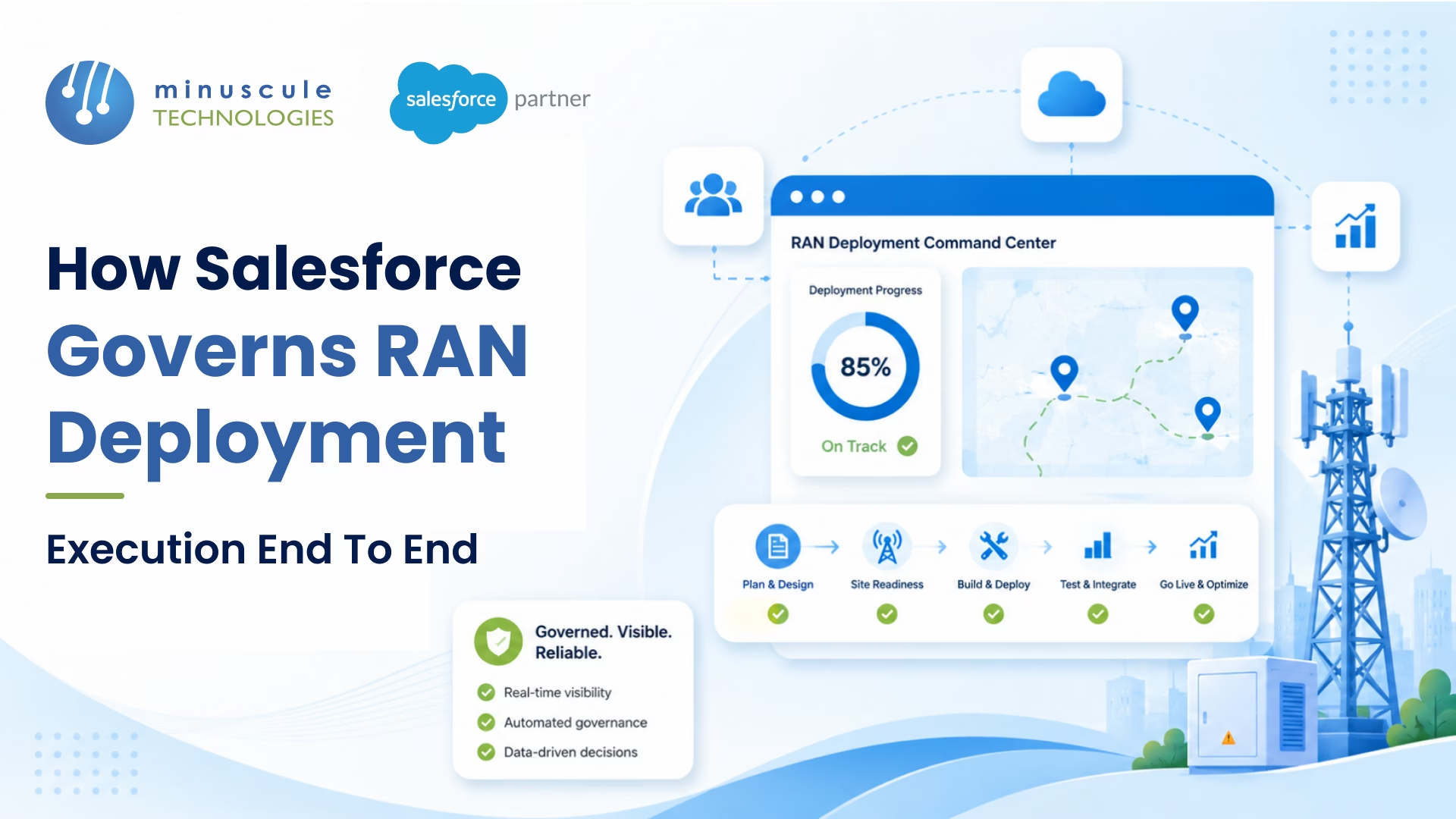
Most telecom organizations already run their commercial operations on Salesforce. Opportunities live there. Accounts live there. Partner relationships, RFP tracking, and customer commitments all live there. What usually doesn't live there is the actual delivery - the part where a committed RAN site becomes a live cell.
That gap between commercial Salesforce and operational delivery is where governance breaks down. The opportunity record shows a site as sold. Six weeks later, your customer asks for a status update, and your team has to assemble the answer from three other systems, four shared folders, and one project tracker that someone exported into a spreadsheet.
This post explains how Salesforce extends beyond CRM into structured RAN deployment governance - what the platform actually needs to do, what objects and workflows it needs to handle, and what changes when commercial and delivery data finally share a system of record.
In most telecom organizations, the same boundary keeps appearing. Sales teams work in Salesforce. Account managers work in Salesforce. RFP responses, partner registrations, and commercial commitments all flow through Salesforce.
Then a RAN deployment gets committed, and execution moves somewhere else.
The site survey lives in a shared drive. The RF design package gets emailed between the design team and the operator. The implementation tasks live in a project tracker. The commissioning evidence sits in a vendor's folder. The acceptance documentation gets compiled at the end by whoever has time. None of it talks to the Salesforce record where the deployment was originally committed.
That separation costs you visibility. When your account director needs to give a customer a real status update, she's reconstructing it from systems she doesn't own.
The cost of disconnected delivery isn't theoretical. It's measurable. It shows up as duplicated data entry - the same site information typed into the CRM, the project tracker, the RF design tool, and the commissioning report. It shows up as reconciliation effort - program managers stitching together status from four sources before a leadership review. It shows up as customer escalations triggered by status mismatches between what the account team reports and what the field is actually doing.
A Salesforce-native RAN deployment governance model closes this gap by extending the platform from commercial engagement into technical and operational execution. Same system. Same record. Same source of truth.
There's a difference between integrating a project tool into Salesforce and building deployment governance inside Salesforce. Integration syncs data across systems. Native governance means the deployment lifecycle is modeled on the platform itself - using Salesforce objects, workflows, automation, and reporting.
That distinction matters because integration always leaves gaps. The fields don't line up. The sync runs on a schedule, which means your dashboard is always slightly behind reality. The escalation logic lives in the external tool, not in the platform your team actually uses. Native governance eliminates those friction points by making Salesforce the place where deployment lives - not just a system it reports to.
A Salesforce-native RAN governance platform needs to handle the full operational scope of a deployment program:
When all of these live in Salesforce - connected, queryable, and visible - you have a governance platform, not a project tracker.
The reason most telecom programs can't get a real-time view of deployment health isn't that the data doesn't exist. It's that the data isn't connected.
A governed RAN deployment data model establishes parent-child relationships between every artifact in the lifecycle. The opportunity record is the parent of the site record. The site record is the parent of the survey, design package, BOM, implementation tasks, and commissioning checklist. Each of those records knows its position in the lifecycle and what stage transitions it controls.
When you query a site record, you don't just see its current status - you see every artifact attached to it, every approval in its history, every document required for closeout, and every SLA timer that's running against it.
Salesforce's flexibility is part of what makes this possible. The platform supports custom objects for telecom-specific entities — site, venue, floor, coverage zone, RF design package, commissioning checklist - alongside standard CRM objects for opportunity, account, and contact.
Relationships between these objects are defined through lookup and master-detail fields. Workflows are built using Flow, validation rules, and approval processes. Stage transitions are enforced through record types, page layouts, and field-level security. None of this requires custom code in most cases — though Apex extends the model where standard configuration runs out.
That extensibility is why Salesforce works as a RAN governance platform rather than just a CRM with deployment data bolted on.
A RAN deployment isn't an internal project. It involves operators who own the spectrum, system integrators who execute the build, vendors who supply the equipment, neutral host providers, venue owners who control the access, and customers who are paying for the coverage.
These stakeholders need to see your deployment data. More importantly, they need to act on it - submit approvals, upload documents, respond to information requests, review commissioning evidence, and sign off on acceptance. In most programs, this collaboration happens over email. Which means it's slow, untracked, and impossible to govern.
Experience Cloud changes the model. You give each external stakeholder controlled access to a Salesforce portal where they can see only what's relevant to them — their pending approvals, their assigned tasks, their open requests. The operator logs in and sees the RF design packages awaiting their review. The vendor logs in and sees the equipment delivery confirmations they need to upload. The venue owner logs in and confirms an access window.
The structural advantage of Experience Cloud isn't just convenience for external stakeholders - it's traceability for your internal team. Every interaction becomes a record. Every submission has a timestamp, an owner, and a version history. Every approval is logged against the right artifact.
When an operator approval comes through Experience Cloud instead of email, you know exactly when it was submitted, what version of the design was approved, and who approved it. That's not just better collaboration - it's the audit trail your acceptance team needs at closeout.
The capability that turns a Salesforce CRM into a RAN governance platform is automation. Flow, approval processes, and process clock tracking let your delivery model move from passive recording to active enforcement.
A process clock starts when a site moves from "survey complete" to "RF design in progress." If the design package isn't submitted within the SLA window, Flow surfaces the risk to the program manager - automatically, without anyone checking. An approval process routes an RF design submission to the operator contact, tracks response time, and triggers escalation if the SLA is exceeded.
For programs with operator SLA commitments, this isn't a nice-to-have. It's the layer that prevents missed commitments from becoming customer escalations.
Standard Salesforce approval processes are built for typical sales motions. RAN deployment governance needs more — multi-stage approvals across operator, customer, and internal stakeholders. Conditional logic based on deployment type (a private 5G workflow looks different from a macro RAN workflow). Dependency tracking so an implementation task can't be marked complete until its prerequisite design approval is in place.
All of this is configurable in Salesforce. The challenge isn't whether the platform supports it - it's designing the workflow logic to match how your delivery operation actually works. Which is exactly what implementation partners with telecom domain experience are for.
The most visible payoff of Salesforce-native RAN governance is reporting. When deployment data lives in the same system as commercial data, your executive reports stop being weekly compilations and start being live dashboards.
Account-level deployment history. Regional performance against committed activation timelines. Vendor responsiveness measured by approval cycle time. SLA adherence across operators. Project health by deployment type. Acceptance status by customer and region.
All of this is built on Salesforce reports and dashboards — the same reporting infrastructure your sales leadership already uses. No separate BI tool. No nightly batch refresh. No reconciliation between what the project tracker says and what the CRM shows.
When deployment health is visible at the executive layer in real time, the conversations change. Quarterly reviews stop being status-collection exercises and start being decision meetings. Customer escalations get resolved with confidence because everyone is working from the same data. Capacity planning becomes accurate because you can see the actual flow of sites through each stage of delivery - not the perceived flow that gets reported up the chain.
That's what RAN deployment governance turns into when it lives where the rest of your business already does.
The path from CRM-only Salesforce to a RAN deployment governance platform isn't a single project - it's a phased build. Most telecom organizations get the highest return by sequencing it this way:
Start with the site object. Build the central record that connects opportunity, customer, venue, and deployment metadata. This is the spine the rest of the model attaches to.
Add the lifecycle stages. Configure stage transitions, validation rules, and required fields for prequalification through acceptance. Make sure each stage has clear entry and exit criteria.
Build the approval workflows. Configure operator approval, RF design review, and acceptance sign-off as structured processes — not as email threads logged into Salesforce after the fact.
Layer in process clocks. Configure SLA timers for each stage transition and connect them to escalation logic in Flow.
Bring stakeholders in through Experience Cloud. Roll out controlled portals for operators, vendors, customers, and SIs based on the workflows that already work internally.
Build the executive dashboards. Use Salesforce reports and dashboards to give leadership a live view of deployment pipeline by region, account, operator, and stage.
Each phase delivers value before the next one starts. You don't need the full platform on day one - you need the right sequence.
Most telecom organizations already run Salesforce for commercial workflows. The gap between commercial Salesforce and operational delivery is where governance breaks down - and where customer escalations originate.
Salesforce-native RAN deployment governance means modeling the full lifecycle inside the platform - not integrating an external project tool. The difference is meaningful: integration always leaves gaps, native governance eliminates them.
The Salesforce data model - custom objects, lookup relationships, Flow, approval processes, and reports - supports the full operational scope of RAN deployment, from prequalification through acceptance.
Experience Cloud brings operators, vendors, SIs, customers, and venue owners into the governance model with controlled portal access - replacing email-based collaboration with traceable, time-stamped records.
Process clocks and SLA timers turn Salesforce from a passive recording system into an active enforcement layer. When timers run automatically against committed SLAs, risk surfaces before it becomes escalation.
Executive reporting on live deployment data - built on the same Salesforce reporting your sales team already uses - replaces weekly status compilation with continuous visibility into program health.
Salesforce supports custom objects, workflows, approval processes, and external stakeholder portals - all of which extend the platform far beyond CRM. For RAN deployment governance specifically, telecom organizations build custom objects for site, venue, RF design package, commissioning checklist, and acceptance record, then connect them to standard CRM objects like opportunity and account. The result is a single governance platform that handles both commercial and delivery workflows.
Integration syncs data between Salesforce and an external tool — which means two systems, sync delays, field mapping issues, and split ownership of workflow logic. Native governance means deployment lifecycle objects and automation live inside Salesforce itself. There's one record, one source of truth, and one place where escalation logic and reporting are built.
Custom objects for telecom-specific entities, Flow for workflow automation, approval processes for multi-stakeholder reviews, validation rules for stage transition enforcement, Experience Cloud for external stakeholder portals, and reports and dashboards for executive visibility. Apex extends the model when standard configuration isn't enough — though most governance logic can be built without custom code.
Experience Cloud gives external stakeholders — operators, vendors, system integrators, neutral host providers, venue owners, and customers — controlled portal access to the Salesforce records relevant to them. Operators can review and approve RF design packages. Vendors can upload delivery confirmations. Venue owners can confirm access windows. Customers can see live site progress. Every interaction is recorded against the right object, creating an audit trail that email-based collaboration can't provide.
A process clock is an automatic timer that starts when a record moves between defined stages. In Salesforce, this is built using Flow combined with date-tracking fields and scheduled actions. When the clock approaches or exceeds the SLA window, Flow triggers notifications, escalations, or visual indicators on dashboards. For RAN programs with operator SLA commitments, this turns SLA management from manual follow-up into automated enforcement.
Yes. Salesforce record types and conditional logic let you configure different workflows for different deployment types without maintaining separate systems. A macro RAN site can follow one approval path while a private 5G enterprise site follows another, all within the same data model. Record type determines which page layouts, validation rules, and approval processes apply.
Because deployment data lives in Salesforce alongside commercial data, executive reports and dashboards are built on live records - not compiled weekly from external sources. Leadership sees account-level deployment history, regional performance, SLA adherence, vendor responsiveness, and acceptance status in real time using standard Salesforce reporting tools. The same dashboard infrastructure your sales leadership uses extends to deployment health.
A phased build typically starts with the site object as the central record, layers in lifecycle stage workflows and validation rules, configures approval processes for operator and acceptance sign-offs, adds process clock automation, rolls out Experience Cloud portals for external stakeholders, and finishes with executive dashboards. Each phase delivers value independently - you don't need the full platform on day one.
Most of the model can be built with standard configuration - custom objects, Flow, approval processes, validation rules, reports, and Experience Cloud. Apex extends the model for cases where standard tools aren't sufficient, such as complex calculations, integration with external systems, or specialized UI components. The 80/20 split typically favors configuration over code.
Salesforce can integrate with field execution platforms - work order management, RF design tools, commissioning systems — through APIs, MuleSoft, or middleware. The recommended approach is to make Salesforce the system of record for governance data (stage status, approvals, SLA timers, acceptance records) while specialized tools continue to handle their core function. The integration brings field execution outcomes back into the governed record without forcing every tool into Salesforce.
If your commercial operations already run on Salesforce, your delivery operations should run there too. Disconnected delivery is what turns committed sites into customer escalations.
Minuscule Technologies builds Salesforce-native RAN Deployment Governance Platforms that connect commercial, technical, field, and operational workflows in one governed lifecycle - covering opportunity through acceptance with custom objects, Experience Cloud portals, process clock automation, and live executive dashboards.
You've seen what's possible. Now, let's make it happen for your business. Whether you need an end-to-end Salesforce solution, a complex integration, or ongoing managed services, our team is ready to deliver.

Schedule a Free Strategic Call


