We are at Dreamforce 2026, Industry Pavilion at San Francisco


June 19, 2026
A VP of Network Operations at a global manufacturing group told us recently that her board had signed off on a private 5G program for three of their plants nine months earlier. The technology decision was clean - vendor selected, spectrum strategy approved, integration partner contracted. The board expected coverage live by Q3.
By the time we spoke, only one site was at acceptance. The other two were stuck - not because the tech wasn't working, but because nobody had built the operating discipline to move them through it. Vendor documentation was incomplete. RF design revisions were circulating in email. Acceptance criteria hadn't been agreed with the plant operations team. The CIO was getting questions she couldn't answer with confidence.
This is the pattern we see across most enterprise private 5G deployment governance conversations. The technology is rarely the bottleneck. Execution is. And the gap between a signed-off private 5G strategy and a live, accepted network is where boards lose patience and program owners lose credibility.
This post is for the operations leaders, integrators, and program owners who already know which technology they're deploying - and now have to actually deliver it.
Private 5G and CBRS deployments are sold on outcomes - performance, latency, mobility, security, control. Boards approve them based on those outcomes. The execution layer underneath - the venue surveys, RF design packages, vendor BOMs, SI coordination, commissioning evidence, and acceptance criteria - rarely gets boardroom attention until something is late.
That's where most enterprise programs lose time. The technology partner delivers their scope. The systems integrator delivers theirs. The RF design team delivers theirs. And in between, the handoffs go undocumented, the dependencies go untracked, and the responsibility for resolving conflicts sits with whoever raises their hand first.
The friction points in enterprise private 5G deployment governance are predictable. Knowing them lets you design against them:
Most enterprise private 5G programs are first-time deployments. The organization has never built one before. The integrator has done a few. The vendor has done many. But none of them have done this program, in this venue, for this enterprise's operational context.
That experience asymmetry shows up as miscommunication. The vendor assumes the enterprise understands what acceptance evidence looks like. The integrator assumes the enterprise has signed off on coverage zones. The enterprise assumes the integrator is tracking the FCC and SAS dependencies. None of these assumptions are documented - and the gap between them is where weeks of program time get absorbed.
Structured execution governance closes those gaps. The same Salesforce-native governance model we've covered in how Salesforce governs RAN deployment execution end to end applies - adapted for enterprise stakeholders, CBRS-specific dependencies, and the operational acceptance criteria private networks demand.
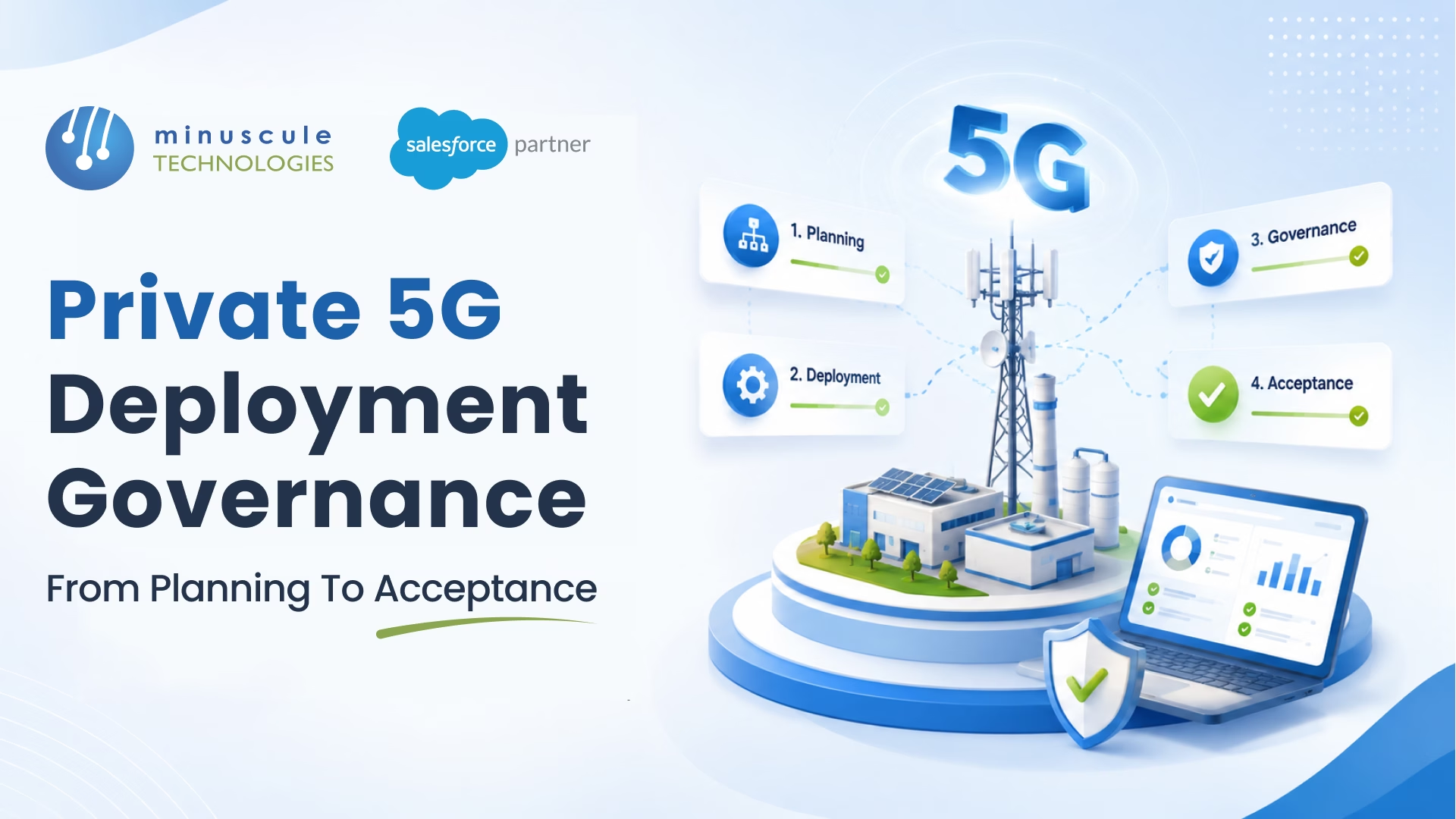
A governed private 5G deployment isn't just a project tracker with 5G fields. It's a connected lifecycle covering planning, design, implementation, commissioning, and acceptance - with the dependencies between them captured as data, not as commentary.
The platform has to handle four execution layers simultaneously:
Before a single dollar is spent on equipment or installation, planning governance captures the inputs that determine whether the program can succeed: venue floor plans, business use cases by zone, user and device density forecasts, RF environment constraints, integration touchpoints with existing IT infrastructure, security and compliance requirements, and explicit stakeholder roles. Without this prequalification discipline, feasibility risks surface during execution - when they're 10x more expensive to resolve.
Once planning is locked, governance shifts to controlling RF design packages, BOMs, vendor selection, SI coordination, installation tracking, and test evidence. Each artifact has a named owner, a version history, and approval status. The same multi-stakeholder data model we use for shared deployments applies - extended for enterprise IT, security, and operations approvers.
For CBRS deployments, this layer also has to track Spectrum Access System (SAS) configuration, GAA channel availability, PAL authorization status, and any FCC-related dependencies. These aren't generic telecom workflow items - they're CBRS-specific governance points that determine whether the network can legally operate.
Acceptance can't be a final administrative step. It has to be designed from the planning stage - with explicit test criteria, evidence requirements, closeout package rules, and SLA expectations agreed before installation begins. Otherwise, you arrive at acceptance with the network installed, the technology working, and nobody able to formally sign off because the criteria were never aligned.
Most enterprise private 5G programs underbuild this stage. The network goes live, the program team disbands, and the enterprise's IT or operations team inherits a system they don't fully understand. Governance has to treat managed service transition as a discrete deliverable - alarm monitoring, performance baselines, escalation paths, billing data, support contacts - all documented and handed over with formal acceptance.
The neutral host orchestration model covers the managed service transition pattern in detail; enterprise private 5G programs follow the same discipline.
When private 5G governance works, the impact lands in three places your CFO and board care about.
Program credibility. Enterprise programs that miss committed activation dates lose internal sponsorship. Governance discipline protects the credibility of the program owner - which determines whether the next program gets funded.
Time to Value. Every week a private 5G program slips is a week the operational use case (predictive maintenance, AGV deployment, mobile workforce enablement) isn't generating ROI. For a manufacturing plant where the business case depends on $4M of annual operational savings, a six-week slip is roughly $460K of value left on the table.
Acceptance defensibility. When acceptance criteria, test evidence, and SLA performance are governed in a system of record, sign-off is defensible. When they aren't, acceptance disputes drag for months - affecting vendor payments, SI relationships, and enterprise satisfaction.
This is why structured execution governance - not better technology - is what separates enterprise private 5G programs that hit their dates from the ones that quietly stretch into the next fiscal year.
At Minuscule Technologies, we help enterprises, system integrators, and telecom stakeholders run private 5G and CBRS deployments inside a single Salesforce-native governance platform - from planning through managed service transition. The same lifecycle model we've built for Lead-to-Live telecom deployment governance extends into the enterprise private network context, with stakeholder views configured for IT, security, operations, integrators, and vendors.
Our approach connects every artifact - venue surveys, RF designs, BOMs, vendor approvals, commissioning evidence, acceptance records, and managed service handover documentation - into one connected record. Process clocks track stage-level SLA exposure automatically. Experience Cloud gives each stakeholder controlled access to what they own. Executive dashboards show program health in real time.
That's the difference between deploying private 5G with confidence and deploying it with hope.
Private 5G deployment governance is the structured discipline of managing every stage of an enterprise private network rollout - planning, design, vendor coordination, implementation, commissioning, acceptance, and managed service transition - through a connected platform rather than through email, spreadsheets, and shared folders. It ensures every artifact has an owner, every stage has acceptance criteria, and every dependency between stakeholders is visible before it becomes a delay.
The technology rarely fails. Execution does. Most slippage happens at the handoffs between the enterprise, the systems integrator, the RF design team, the vendors, and the operations stakeholders - where assumptions go undocumented and dependencies go untracked. Without governance discipline, these handoff gaps absorb weeks of program time before anyone realizes the date is at risk.
CBRS adds spectrum-specific dependencies that don't exist in licensed 5G deployments - Spectrum Access System (SAS) configuration, GAA channel availability, PAL authorization, and FCC-related compliance checks. Governance has to track these as discrete stages with their own SLA timers and ownership. Otherwise, a CBRS network can be physically deployed and still unable to operate legally.
A typical enterprise private 5G program involves the enterprise's IT, security, and operations teams, the systems integrator, the equipment vendor, the RF design partner, and (for CBRS deployments) the SAS provider. Each has its own approval cycle, documentation requirements, and acceptance criteria — which is exactly why structured governance matters.
Acceptance criteria should be defined during planning — before installation begins, before equipment is procured, and before commissioning is scheduled. When acceptance is treated as a final administrative step, programs arrive at acceptance with the network technically functional but no one able to formally sign off because the criteria were never aligned across IT, operations, and the integrator.
Managed service transition is the formal handoff from program delivery to ongoing operations - alarm monitoring, performance baselines, escalation paths, support contacts, and billing data. Most enterprise private 5G programs underbuild this stage, which leaves the operations team inheriting a system they don't fully understand. Governance treats this transition as a discrete deliverable with its own documentation, acceptance criteria, and sign-off — not as an afterthought of network commissioning.
Yes. The same Salesforce-native architecture we use for RAN, DAS, and multi-operator deployment governance extends naturally into enterprise private 5G — with custom objects for venue, site, RF design package, BOM, commissioning checklist, and acceptance record, plus Experience Cloud portals for enterprise stakeholders, integrators, and vendors. Process clocks track SLA exposure across stages, and executive dashboards report on program health from live data.
Every week a private 5G program slips is a week the operational use case isn't generating value - predictive maintenance not running, AGVs not deployed, mobile workforce not enabled. For a program built on $4M of annual operational savings, a six-week slip translates to roughly $460K in deferred value. Governance discipline protects the activation date, which protects the ROI window.
Private 5G success rarely comes down to which vendor you picked or which spectrum strategy you chose. It comes down to whether you can govern the execution that connects planning to acceptance - across enterprise IT, integrators, RF teams, vendors, and operations stakeholders.
If your private 5G program is approaching planning, in mid-execution, or stuck somewhere between commissioning and acceptance, structured governance is what moves it forward.
You've seen what's possible. Now, let's make it happen for your business. Whether you need an end-to-end Salesforce solution, a complex integration, or ongoing managed services, our team is ready to deliver.

Schedule a Free Strategic Call


