We are at Dreamforce 2026, Industry Pavilion at San Francisco


June 19, 2026
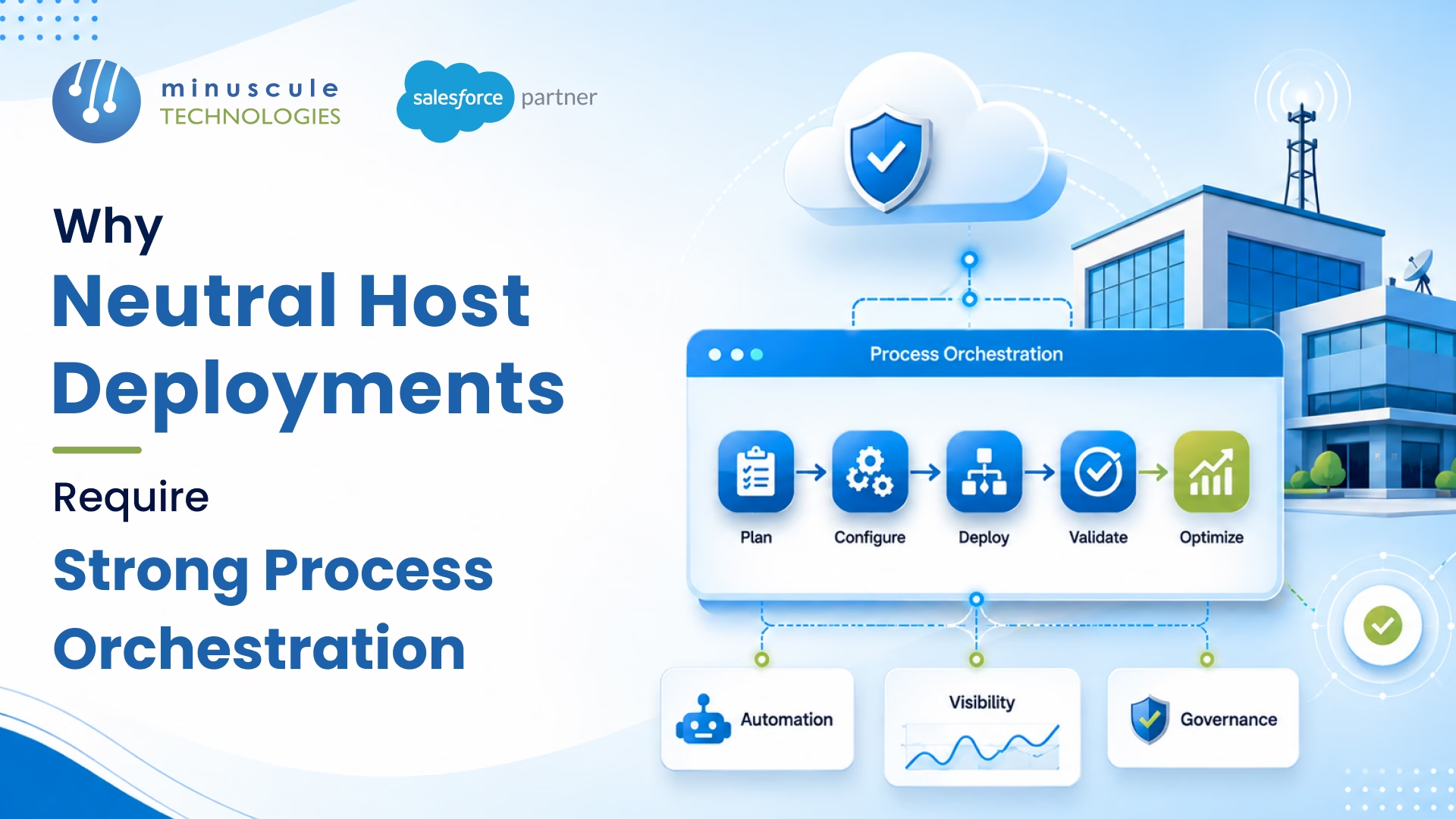
A traditional telecom rollout has a clear hierarchy. One operator owns the site. One delivery partner builds it. One acceptance criterion determines when it's done.
A neutral host deployment doesn't work that way. The provider sits in the middle of an ecosystem - venue owners on one side, multiple operators on another, vendors and integrators executing the build, RF teams designing for shared infrastructure, and managed service teams running the site long after deployment ends. No single stakeholder owns the outcome. Everyone owns part of it.
That structural difference is why neutral host orchestration is harder than the deployment work most program managers have done before. It's also why governance discipline matters more here than almost anywhere else. This post explains the neutral host commercial model, where orchestration actually breaks down, and what process governance has to do to hold the model together - from opportunity through operations.
It's easy to describe neutral host as "DAS or small cell deployment with multiple operators." That's accurate in a technical sense. But it misses what makes the model commercially distinct.
In a traditional model, an operator commissions a build, owns the infrastructure, and consumes the coverage. In a neutral host model, the neutral host provider owns the infrastructure and offers it as a service - to operators, to enterprise customers, or to both. Operators pay to participate. Enterprises pay for coverage outcomes. The provider monetizes the asset over its lifetime.
That changes what "successful deployment" means. The build isn't the product - the service is. Which means orchestration has to extend beyond commissioning into the operational handoff that makes the service viable.
A neutral host site typically involves at least six distinct stakeholder types: the venue owner (who controls access and physical space), the participating operators (each with their own RF, spectrum, and acceptance requirements), the enterprise customer (if it's a private network or coverage-as-a-service deployment), the RF design and integration team, the equipment vendors, and the managed service organization that runs the site post-acceptance.
Each of these stakeholders has their own commercial relationship with the neutral host provider, their own data requirements, their own SLA expectations, and their own definition of done. Coordinating them isn't just project management - it's running a multi-party agreement in real time.
In a traditional deployment, handoffs happen between functions inside one organization - sales to delivery, delivery to operations. The cultural overhead is real but contained. In a neutral host deployment, handoffs happen between companies. Information that should flow from the venue owner to the RF design team has to cross an organizational boundary. Data the operator needs from commissioning has to cross another.
Every handoff is a place where information slows down, gets reformatted, or gets lost entirely. The orchestration challenge isn't keeping any single workstream moving - it's preventing the gaps between workstreams from absorbing the project's time and budget.
This is structurally the same problem we covered in why telecom deployment governance needs to move beyond spreadsheets - but amplified, because the stakeholders aren't even on the same team.
Email-based coordination works when most participants are inside the same organization with shared context. In a neutral host deployment, none of that holds. The venue owner has no insight into the operators' approval queues. The operators have no visibility into the integration team's installation schedule. The vendors don't know whether the RF design they're equipping has been approved by every operator yet.
Without a governance platform that provides each stakeholder their own controlled view of the site - and surfaces dependencies between them - the orchestration collapses into status meetings, email threads, and shared folders that nobody fully trusts. The multi-operator governance model provides the data structure for this, but neutral host adds the venue and managed service layers on top.
Neutral host orchestration fails at predictable points. Each is a handoff between organizations, and each is where governance discipline either holds or doesn't.
Venue data collection. The provider needs floor plans, access agreements, structural details, electrical capacity, and existing infrastructure maps from the venue owner. When this data is incomplete or arrives in pieces, the survey and design workstreams stall. Worse, partial data often gets accepted as complete - and the gaps surface during field execution.
Operator willingness confirmation. The neutral host model only works if operators commit to participate. Provisional willingness is fast; binding participation is slow. Sites have been known to advance through design and into pre-construction before a final operator commitment arrives — which means rework is built into the timeline.
RF design alignment across operators. Each operator has its own RF expectations, spectrum bands, and design tolerances. The neutral host's master design package has to satisfy all of them simultaneously. When one operator's review comes back with changes, the design ripples — affecting every other operator's already-approved version.
Vendor BOM clarification. Shared infrastructure means a single BOM serves all operators. But equipment compatibility, certification, and approval routes differ across operators. Vendors often need clarifications mid-procurement that nobody can answer until every operator confirms its position.
Installation access coordination. The venue owner controls access. Operators control approval to install on their behalf. The system integrator controls field execution. Aligning these three on a single installation window — especially in operating venues like stadiums, hospitals, or transit hubs — is where weeks routinely disappear.
Per-operator commissioning evidence. Installation may be unified, but commissioning evidence has to be captured and delivered separately per operator. When this isn't tracked at the document level, acceptance disputes follow.
Managed service readiness. The site has to be ready not just for technical acceptance but for ongoing operations — alarm monitoring configured, performance baselines established, escalation paths defined, billing data flowing. This handoff often gets treated as an afterthought, even though it's where the neutral host's recurring revenue actually begins.
Governance can't eliminate handoffs in a neutral host model. The model requires them. What governance can do is make every handoff visible, owned, and bounded by time - so when a venue document is overdue, when an operator's commitment hasn't been confirmed, when commissioning evidence hasn't been submitted, the platform surfaces the gap before it becomes a delay. This is where process clock governance [link → Process Clock Governance spoke when published] earns its place in a neutral host program.
A neutral host orchestration model needs governance across stages most deployment trackers don't capture cleanly:
Prequalification. Site qualification has to include venue suitability, operator interest sounding, and commercial viability - not just physical assessment.
Venue hierarchy and access management. A venue isn't a single site - it's often a building with multiple floors, zones, and physical infrastructure tiers. Governance has to model the venue, the sites within it, the coverage zones across sites, and the access agreements that bind them.
Stakeholder identification and onboarding. Every stakeholder - venue, operators, enterprise customers, vendors, integrators - needs to be identified with explicit roles, responsibilities, and commercial terms captured at the start.
Willingness confirmation. Operator interest, provisional commitment, and binding participation each need their own captured stage with timestamps and conditions.
Design package review. The master RF design package needs governed multi-operator review, with each operator's comments tracked, resolved, and re-approved on revision.
RFQ, proposal, and commercial alignment. Each operator and enterprise customer has a distinct commercial agreement that needs version tracking and consistency with the technical design.
Implementation and per-operator commissioning. Field execution is unified; commissioning evidence and acceptance criteria diverge per operator.
Closeout and acceptance. Per-operator acceptance plus consolidated venue and provider closeout — both required, tracked separately, both feeding into managed service handoff. This is the closeout governance discipline [link → Closeout & Acceptance Governance spoke when published] applied to a multi-party model.
Managed service transition. The handoff from deployment delivery to ongoing operations — easily the most underbuilt stage in most neutral host programs.
Each stage needs explicit ownership, status tracking, document validation, and process clock visibility. Without governance at the stage level, the model becomes a chain of "we'll figure it out when we get there" — which is exactly how neutral host deployments slip from quarter to quarter.
Managed service transition is the handoff from deployment delivery to ongoing operations. In a traditional model, this transition is simple - the operator who built the site is also the one running it. In a neutral host model, this transition is between teams (sometimes between companies) with completely different operating models.
The deployment team's job ends at acceptance. The managed service team's job begins with operations - alarm monitoring, performance baselines, SLA monitoring against the participating operators, billing data flow, escalation routes, fault response protocols, and ongoing optimization. Everything the managed service team needs to operate the site has to be captured during deployment and handed over cleanly.
When this handoff isn't governed, the managed service team inherits incomplete documentation, undefined baselines, misconfigured monitoring, and unresolved punch list items. The site goes live commercially but operationally limps - generating customer complaints, missed SLAs, and recurring rework that erodes the neutral host's economics.
A structured managed service transition needs to deliver: complete as-built documentation per operator and consolidated for the site, configured alarm and monitoring infrastructure with established baselines, defined SLA monitoring rules per participating operator, billing and revenue data feeds operational, escalation and fault response procedures documented with named owners, and a closed-out punch list with zero deferred items.
When governance treats managed service transition as a discrete stage - not as the side-effect of acceptance - these handovers happen cleanly. When governance ignores it, the model breaks at exactly the point where it should start generating recurring revenue.
The compounding value of structured neutral host governance shows up across deployments. When venue characteristics, operator participation patterns, vendor performance, integration team productivity, SLA adherence, acceptance quality, and ongoing operational issues are all tracked across every site, your organization builds a knowledge base most providers never get.
You can see which venue types consistently deliver on schedule and which routinely run over. You can see which operators are easy participants and which require disproportionate coordination effort. You can see which vendors integrate cleanly and which create downstream issues. You can see which managed service handoffs produce stable operations and which generate recurring tickets.
This isn't retrospective reporting. It's input for forward decisions. When you're scoping the next venue opportunity, you can price it based on actual coordination cost for similar venues - not optimistic estimates that ignore historical reality. When you're deciding which operators to bring into a new build, you can weigh participation cost against revenue contribution. When you're staffing the managed service team, you can size it based on the actual operational load historical sites have generated.
This is the long-term value structured governance unlocks that ad-hoc neutral host orchestration never can.
Neutral host is a different commercial model, not just a different deployment type. The provider owns the infrastructure and monetizes it over its lifetime - which means orchestration has to extend beyond commissioning into ongoing operations.
The neutral host stakeholder economy involves at least six distinct parties - venue, operators, enterprise customers, RF and integration teams, vendors, and managed service organizations - each with their own commercial terms, data requirements, and SLA expectations.
Orchestration is structurally harder than traditional deployment governance because handoffs happen between companies, not just between functions. Every cross-organization boundary is where information slows or breaks down.
Predictable failure points include venue data collection, operator willingness confirmation, RF design alignment, vendor BOM clarification, installation access coordination, per-operator commissioning evidence, and managed service readiness. Governance has to surface gaps at each of these points before they become delays.
Managed service transition is the most underbuilt stage in most neutral host programs - and it's exactly the point where the model has to deliver to generate recurring revenue. Governance has to treat it as a discrete stage, not an afterthought of acceptance.
Historical intelligence across venues - coordination effort, operator participation patterns, vendor performance, managed service load - turns neutral host pursuit and pricing from estimation into evidence-based decision-making.
A neutral host deployment is a shared infrastructure model where one provider builds and operates connectivity infrastructure - typically DAS, small cell, or multi-operator radio - that multiple operators or enterprise customers use. The neutral host owns the assets and offers them as a service rather than as a delivered product, monetizing the infrastructure over its operating lifetime.
Traditional deployment management coordinates handoffs between functions inside one organization - sales, delivery, operations. Neutral host orchestration coordinates handoffs between organizations - venue owners, multiple operators, vendors, integrators, and managed service teams. Every cross-organization handoff is a place where information slows, gets reformatted, or breaks down - which makes structured governance non-negotiable in a way it isn't for single-organization deployments.
A neutral host deployment typically involves the neutral host provider, the venue owner who controls physical access, multiple participating operators (each with their own approval workflows), the enterprise customer if it's a private network or coverage-as-a-service offering, RF design and integration teams, equipment vendors, and the managed service organization responsible for ongoing operations.
Managed service transition is the handoff from deployment delivery to ongoing operations. It requires complete as-built documentation per operator, configured monitoring infrastructure with established baselines, defined SLA rules, operational billing and revenue feeds, documented escalation and fault response procedures, and a fully closed-out punch list. When governance treats this transition as a discrete stage, handovers happen cleanly. When it doesn't, the managed service team inherits incomplete documentation and the site limps operationally.
Predictable failure points include venue data collection (incomplete information from the venue owner), operator willingness confirmation (provisional vs binding participation), RF design alignment across operators (ripple effects when one operator requests changes), vendor BOM clarification (compatibility issues across operator requirements), installation access coordination (aligning venue owner, operators, and integrators on a single window), per-operator commissioning evidence (documentation gaps that surface at acceptance), and managed service readiness (handoff to operations).
Most deployment teams measure success at acceptance - physical installation complete, commissioning evidence submitted, operator sign-off received. Managed service readiness happens after that milestone, which means it's often treated as the next team's problem rather than as a deployment-stage requirement. The result is that sites go live commercially but operationally struggle - which directly affects the neutral host's recurring revenue and customer retention.
A venue isn't always a single site. A commercial building, stadium, airport, or hospital is a venue containing multiple sites, coverage zones, floors, and physical infrastructure tiers. Venue hierarchy in governance means modeling the venue as a parent object containing the sites within it, the coverage zones across those sites, and the access agreements that bind everything. Without this hierarchy, multi-floor and multi-zone deployments lose structural clarity in their tracking.
The master RF design package has to satisfy every participating operator's requirements simultaneously. When one operator requests changes during review, every other operator's previously approved version may need to be re-reviewed. Structured governance tracks design package revision history per operator, captures comment resolution, and re-routes affected approvals automatically rather than relying on manual coordination. This is the same principle covered in RF design governance, extended to neutral host's multi-stakeholder context.
Venue performance (coordination effort, schedule adherence, access friction), operator participation patterns (commitment timelines, review cycles, acceptance criteria fulfillment), vendor performance (BOM accuracy, equipment delivery, integration quality), integration team productivity (sites per quarter, rework rates), SLA adherence per participating operator, acceptance quality (punch items at closeout, post-acceptance issues), and managed service operational load (ticket volume, recurring issues per site type).
Salesforce supports a parent-child data model where venues, sites, operator participations, and managed service records are all connected through configurable relationships. Experience Cloud gives each stakeholder type - venue owners, operators, vendors, integrators, managed service teams -controlled access to the records relevant to them. Flow handles process clock automation and stage transition enforcement. Reports and dashboards deliver consolidated and stakeholder-specific views from the same underlying data. This is the platform architecture covered in detail in our pillar on Salesforce-native RAN deployment governance.
If your neutral host program is coordinating venue owners, multiple operators, vendors, integrators, and managed service teams across shared folders, email threads, and ad-hoc status calls, you're absorbing orchestration cost the model wasn't designed to carry.
Minuscule Technologies offers a Salesforce-native governance platform for neutral host and shared infrastructure deployments - covering venue hierarchy, multi-operator participation, RF design coordination, per-operator acceptance, and managed service transition in one connected lifecycle.
You've seen what's possible. Now, let's make it happen for your business. Whether you need an end-to-end Salesforce solution, a complex integration, or ongoing managed services, our team is ready to deliver.

Schedule a Free Strategic Call


