We are at Dreamforce 2026, Industry Pavilion at San Francisco


June 20, 2026
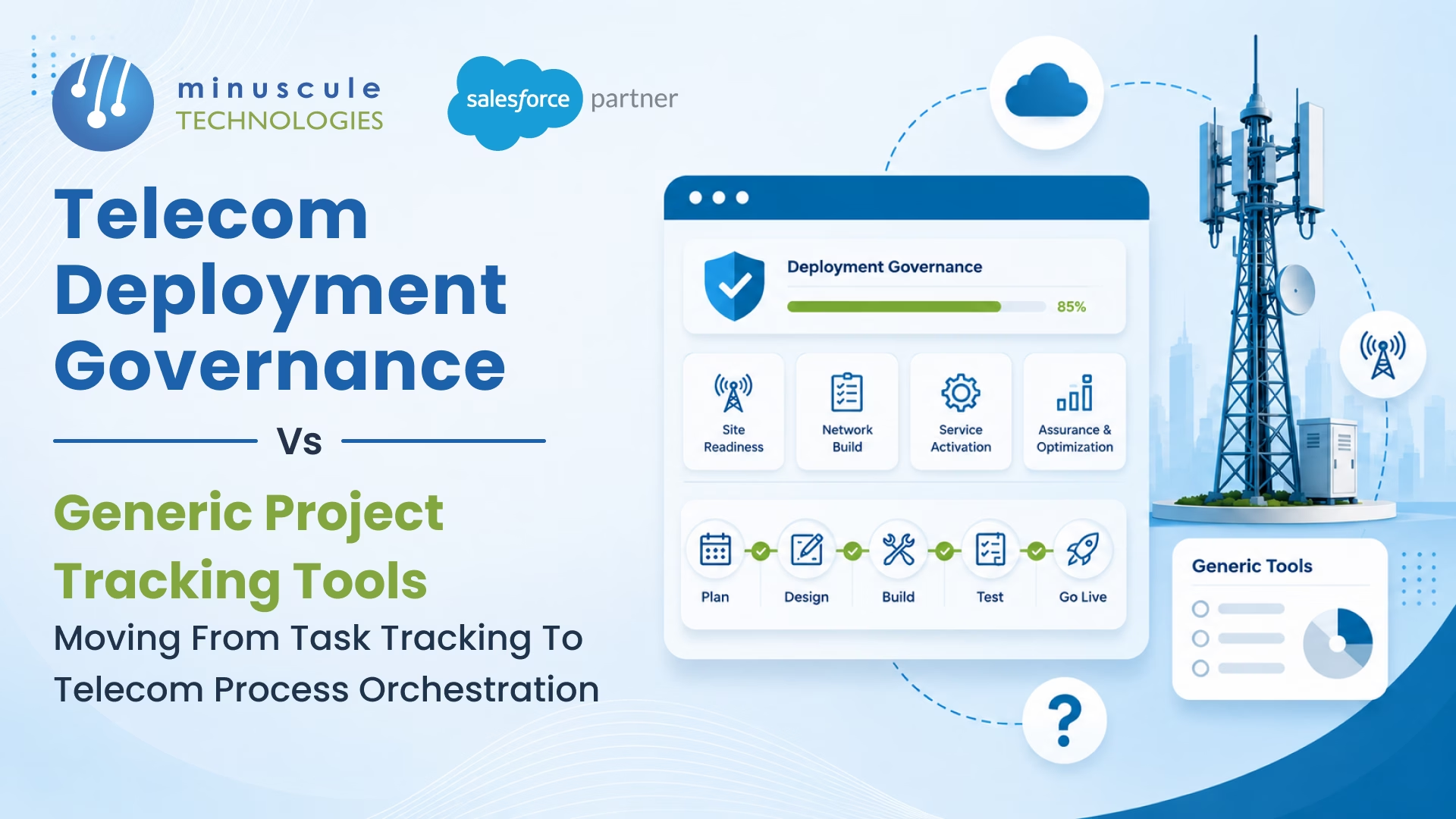
A director of telecom operations at a fast-growing managed services firm walked us through her Monday board. Twelve active deployment programs. 340+ open tasks. Beautiful color-coded labels, status indicators, owner assignments, due dates. Her team had standardized on the platform two years ago and adopted it well.
She had one frustration. "Every Monday I can see what's late. But I can't tell you whether the RF design package we're using on Site 18 is the right version. I can't tell you which operator approval has formally come back. I can't pull together what the acceptance evidence looks like without asking three people."
That's the gap most telecom operations leaders eventually hit with generic project tracking tools. Tools like Asana, Monday, Smartsheet, Jira, ClickUp, and similar platforms are excellent at general task and collaboration management. They were built for that - and for most use cases, they earn their place.
Telecom deployments aren't most use cases. RAN, DAS, neutral host, private 5G, and CBRS programs run on stakeholder-specific approvals, versioned technical artifacts, regulatory dependencies, and acceptance evidence that don't fit neatly into generic task fields.
This post is for the operations leaders and PMO directors whose team is doing fine with their current tracker - but whose program governance is quietly happening in email and shared folders alongside it.
Generic project tracking platforms are deservedly popular. They're flexible, fast to adopt, visually clean, and effective for the use cases they were built for - general task management, team collaboration, Kanban boards, project dashboards, file sharing, and cross-functional coordination. Software teams use them. Marketing teams use them. Operations teams use them. They handle most project work credibly.
The flexibility that makes them work for so many use cases is also what creates the gap in telecom programs.
A task in a generic project tool is, by design, a generic container. You write a title, assign an owner, set a due date, add some comments, attach a file or two, and mark it complete. That structure works when the underlying work is mostly visible - a piece of code shipped, a design deliverable submitted, a campaign launched.
It doesn't work when the underlying work is governance work - work that depends on specific evidence, version control, multi-stakeholder approvals, and regulatory traceability. A task called "RF design approval" in a generic tool might tell you it's marked done. What it can't tell you:
Similarly, a task called "closeout submitted" might be marked complete. What it can't tell you is whether the commissioning evidence is comprehensive, which punch list items have documented closure, what the operator's review status is, and whether the acceptance criteria are demonstrably met.
The cost of the gap isn't visible until something goes wrong. The compliance audit that arrives nine months after a site goes live. The customer dispute over what was committed versus delivered. The renewal conversation where the customer asks for performance history your team can't easily produce.
This is the same structural issue we covered in why telecom deployment governance needs to move beyond spreadsheets and in our Sitetracker comparison post. The category of tool doesn't matter - spreadsheet, MPP file, generic project tracker. If the underlying data structure doesn't model telecom workflows explicitly, the governance happens informally on top of it, and the operational risk lives in the gap.
Generic project trackers give your team strong collaboration capabilities - task assignment, status tracking, comment threads, file attachments, deadline visibility, and cross-functional coordination. For organizations whose primary operational need is task and collaboration management at a general project level, they remain credible tools and don't necessarily need to be replaced.
For telecom programs where the governance work sits in stakeholder approvals, versioned artifacts, regulatory dependencies, and audit-ready acceptance, a Salesforce-native telecom governance platform adds an orchestration layer that generic tools cannot:
Instead of tasks, the platform manages telecom-specific records - opportunity registration, prequalification questionnaire, site survey, ROM estimate, operator participation, RF design package with version history, BOM, stakeholder RFQ, proposal, contract, PO, implementation, commissioning record, closeout package, acceptance record, managed service transition, SLA process clock, and KPI history. Each carries its own data model, evidence requirements, and audit trail.
Telecom programs involve enterprise customers, venue owners, operators/WSPs, neutral host providers, hardware vendors, system integrators, RF design teams, installers, managed service providers, and internal delivery leadership. The multi-operator data model supports per-stakeholder workflows, role-based portal access through Experience Cloud, parallel SLAs, and dependency-aware governance - not just shared task lists.
For deployments involving CBRS spectrum, FCC compliance, operator frequency confirmations, and other regulatory dependencies, the platform captures these as structured records with audit trail - not as comments on generic tasks. The private 5G governance model we've covered illustrates how this works in practice.
SLA timers start automatically with stage transitions. Approaching breaches surface before they happen. Escalation routes are automated. This is fundamentally different from due-date tracking, which only tells you something is late after it already is.
BOM, RFQ, proposal, contract, and PO records connect to the same Salesforce instance where the opportunity, account, and customer relationship live. Commercial commitments carry forward into delivery without a parallel system. The same Salesforce-native architecture we've covered across the pillar content makes this continuity structural.
Closeout packages assembled automatically. Acceptance records with full traceability. Live executive dashboards built on Salesforce reporting infrastructure - the same dashboards your sales leadership already uses, now reporting on deployment health from real-time data.
For many telecom organizations, the right architecture isn't "replace the generic tracker" - it's "let the tracker do what it does well, and add telecom-specific governance for the workflows it doesn't reach." Your team can continue using Asana, Monday, Smartsheet, or Jira for general task coordination and collaboration. The governance platform handles the telecom-specific lifecycle records, approvals, evidence, and accountability underneath.
This coexistence model - same as the one we discussed in our Sitetracker comparison and Microsoft Project comparison - is often the highest-value architecture for organizations whose teams are already productive with their current tools.
When telecom organizations add structured orchestration on top of (or instead of) generic project tracking, the business impact lands in three places that generic tools cannot reach.
Approval visibility and accountability. Instead of "RF design approval - Done," you get versioned approval records with submission dates, response timestamps, version-specific sign-offs, and SLA exposure tracking. When something goes wrong six months later, the answer is queryable in seconds — not reconstructed from comments and task histories.
Reduced manual follow-up. Operations leaders running governance on generic tools spend hours weekly chasing status across email, file sharing systems, and the tracker itself. Telecom-specific orchestration eliminates most of this work - the platform surfaces what needs attention rather than requiring someone to assemble it.
Defensible delivery, not just completed delivery. The compliance audit, contract dispute, or renewal conversation that arrives months after acceptance is where governance defensibility either holds or doesn't. Generic project tools weren't designed to produce defensible records. Telecom-specific orchestration is.
For operations leaders running 30+ concurrent sites with multi-stakeholder complexity, the combined impact of better approval visibility, reduced follow-up overhead, and defensible delivery typically translates to measurable improvements in cycle time, escalation reduction, and customer satisfaction -without forcing the team to abandon collaboration tools they already value.
At Minuscule Technologies, Trusted Salesforce Engineering Patner, we build Salesforce-native telecom governance designed around the records, workflows, and stakeholders telecom programs actually run on. The platform manages opportunity registration through acceptance - with operator approvals, RF design packages, commercial workflows, commissioning evidence, closeout, SLA governance, and executive reporting all modeled as connected telecom objects.
The architecture aligns with our Lead-to-Live deployment governance pillar and Salesforce-native RAN governance pillar. For organizations whose teams are productive with generic project trackers, the governance platform sits as the telecom-specific orchestration layer underneath - so the team keeps the collaboration tool they like, and the organization gains the governance discipline telecom programs require.
The result is operational orchestration purpose-built for telecom, not collaboration software stretched to do governance work it wasn't designed for.
Generic project trackers like Asana, Monday, Smartsheet, Jira, and ClickUp are designed for general task management and collaboration — flexible task fields, customizable views, comment threads, and file attachments. A telecom-specific governance platform is designed for the records and workflows telecom programs actually run on — operator approvals with version control, RF design package governance, BOM and commercial workflows, commissioning evidence, audit-ready acceptance, and SLA process clocks. Different problems, different data models.
For small or simple programs with limited stakeholder complexity, they can manage the task coordination layer adequately. For multi-operator, multi-stakeholder, audit-sensitive telecom programs, the gaps become structural - versioned approvals, regulatory traceability, evidence-linked commissioning, and defensible acceptance records don't fit neatly into generic task containers. The governance work ends up happening in email and shared folders alongside the tracker.
No. The two approaches coexist productively in most cases. Your team can continue using their current project tracker for collaboration and task coordination. The Salesforce-native governance platform handles the telecom-specific records - operator approvals, RF design versions, commercial workflows, commissioning evidence, closeout, acceptance - underneath. This is the same coexistence pattern we cover in our Sitetracker and Microsoft Project comparisons.
Versioned RF design package management with operator review cycles, per-operator approval queues with parallel SLAs, regulatory traceability for CBRS and FCC compliance, commissioning evidence linked to checklist items and design versions, audit-ready closeout package assembly, defensible acceptance records, multi-stakeholder portal access with role-based visibility, and SLA process clock automation with proactive escalation. These workflows depend on structured data models that generic task containers don't provide.
A telecom-specific governance platform models the actual entities and workflows of telecom delivery - opportunity registration, prequalification, site survey, RF design package, operator participation, BOM, RFQ, commissioning record, closeout package, acceptance record, SLA clock, and managed service transition. Generic tools model tasks, projects, and lists. The difference shows up most when audit questions, compliance reviews, or acceptance disputes require defensible records that map to telecom processes - not to generic task histories.
Each stakeholder type - enterprise customer, venue owner, operator/WSP, neutral host provider, hardware vendor, system integrator, RF design team, installer, managed service provider - gets its own governed workflow, SLA timers, and role-based portal access. The same multi-operator data model supports parallel workflows from a single deployment record, rather than forcing all stakeholders into the same task structure.
Organizations running 30+ concurrent sites typically see measurable improvements in approval cycle compression, reduced manual follow-up across email and file systems, lower escalation volume, faster audit and acceptance cycles, and stronger customer satisfaction during execution. For programs where governance work currently happens informally alongside a generic tracker, formalizing the orchestration layer typically translates to meaningful margin improvement - without disrupting the collaboration practices the team already values.
The architectural argument is consistent - telecom-specific orchestration handles workflows that other tools weren't designed to handle. The specific positioning differs across each post. Sitetracker is purpose-built for high-volume deployment operations and site lifecycle management. Microsoft Project is purpose-built for scheduling and timeline management. Generic project tools are purpose-built for collaboration and task coordination. Each plays a role; none of them - by design - provides telecom-specific governance.
Generic project tracking tools are excellent at what they're built for. Telecom deployment governance isn't what they're built for. The gap between "task complete" and "telecom governance complete" is where audit exposure, escalation risk, and acceptance disputes quietly accumulate across every site you deliver.
If your team is doing fine with your current project tracker but governance lives in shared folders and email, the upgrade isn't replacing the tool you like - it's adding the telecom-specific orchestration layer that makes your team's work defensible. See telecom orchestration purpose-built for your workflows - book a Minuscule platform walkthrough.
You've seen what's possible. Now, let's make it happen for your business. Whether you need an end-to-end Salesforce solution, a complex integration, or ongoing managed services, our team is ready to deliver.

Schedule a Free Strategic Call


