We are at Dreamforce 2026, Industry Pavilion at San Francisco


July 29, 2026
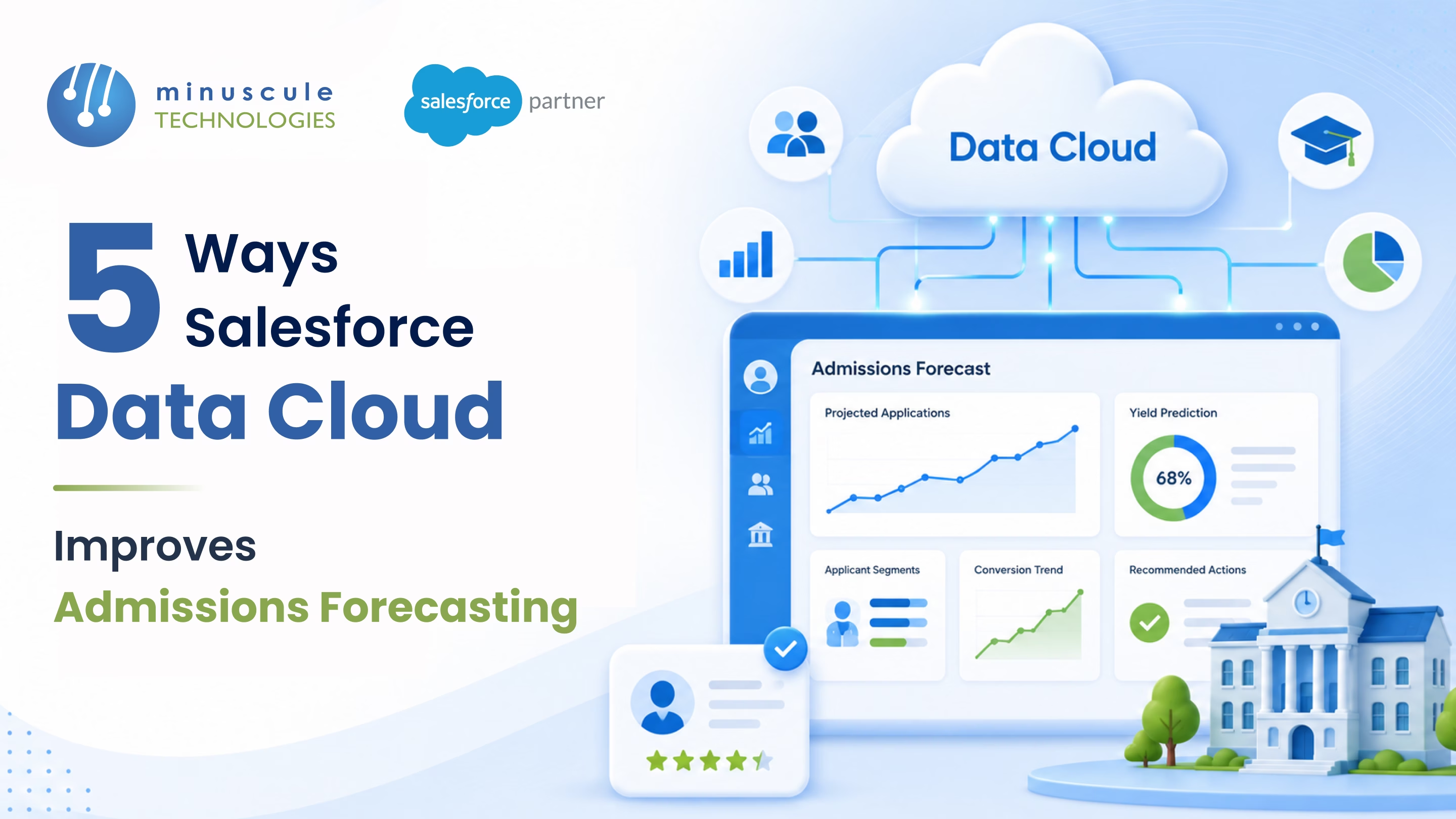
The VP Enrollment opens the forecast meeting. Admit count known. Yield forecast: based on last year's conversion rate. Marketing says open rates are up. The Web says campus tour signups have doubled. Service Cloud shows inquiry volume rising. The admissions dashboard shows none of that. It shows the Application count and Admit count. Six weeks before deposit deadline, the question lands: "Will yield hold this year?"
Nobody can answer with confidence. Marketing data lives in Marketing Cloud. Engagement data in Service Cloud. Web behavior in Google Analytics. Applications in Admissions Connect (Education Cloud). SIS on PeopleSoft. Five systems, five guesses.
This is what happens when admissions forecasting runs on application data alone. The signals that predict yield - engagement intensity, multi-channel touchpoints, financial-aid acceptance, cohort behavior - live in systems that never connect to the forecasting model.
The fix is Salesforce Data Cloud - the unified data layer that pulls every signal into one prospect profile and feeds the forecasting model with real engagement data, not lagging application counts.
Here are five ways Data Cloud improves admissions forecasting.
Six gaps in forecasting that runs on Education Cloud or Sales Cloud only.
Each is fixable in Data Cloud. Together, they're why most admissions forecasts are educated guesses, not models.
Data Cloud ingests data from every system the institution runs.
Education Cloud Applications, Marketing Cloud journeys, Service Cloud Cases, web analytics, SIS records, financial aid systems, third-party enrichment data, social media signals.
Email match, phone match, SSO ID, household match, behavioral fingerprint. Data Cloud resolves the same prospect across systems even when IDs don't match exactly.
One profile per prospect with every interaction - emails opened, pages viewed, events attended, applications started, financial aid disclosed, counsellor calls received - visible to the forecasting model.
Traditional Salesforce engagement scores update overnight. Data Cloud activates engagement scores in real time as signals arrive — virtual tour completed, financial aid letter opened, faculty meeting attended.
A prospect who attends a virtual yield event today reflects tomorrow's forecast model, not next week's report.
Forecasting that captures the inflection points that move yield - not the lagging signals that confirm what already happened.
Same prospect using a personal Gmail to inquire, a school email to apply, a mobile number for SMS opt-in, and a different IP on campus tour. Without identity resolution, the forecasting model sees four prospects.
Deterministic matching (email, phone, SSO ID), rule-based matching, and probabilistic (ML-based) matching merge the four records into one. Engagement scores aggregate across channels. Engagement scores aggregate across channels.
Engagement of intensity reflects reality - every touchpoint counted once, no double-attribution.
With retention policies configured, Data Cloud preserves prior-year admitting cohort data - engagement, financial aid, demographic, and yield outcomes - making it accessible to the current forecasting model for year-over-year comparison.
This year's admit pool engagement at week six vs last year's engagement at week six. Variances flag specific programs or demographics for intervention.
Forecast accuracy improves because the model knows what "normal" looks like every week of the cycle, not just at the end.
Einstein models trained on Data Cloud profiles use every available signal - not just Salesforce records. Engagement, financial aid, geographic, program-level signals all feed the model.
Each admitted student gets a yield probability score. The model identifies which prospects need intervention, which are likely to deposit, which are flight risks.
This year's deposit cohort feeds next cycle's prospect targeting. Lookalike audiences activate via Data Cloud Activation, Marketing Cloud Engagement, and recruitment of territory planning.
Forecasting becomes a leading indicator and an action driver - not just a report on what's already in motion.
Six rules every Data Cloud admission forecasting build needs.
Sample matched profiles, validate the merges are correct, flag false merges (two prospects collapsed into one) and false splits (same prospect treated as two).
Define how stale each source can be before it stops feeding the model. SIS daily, Marketing Cloud hourly, web analytics every fifteen minutes.
Einstein Discovery or Prediction Builder yield models should retrain at least once per admissions cycle, ideally quarterly. As prospect behavior patterns shift each cycle, models trained prior-year data lose predictive accuracy - scheduled retraining keeps the model aligned with current cohort behavior.
Yield models can encode historical bias against demographic groups. Annual bias review with the institution's compliance and DEI team prevents the model from reinforcing inequity.
Not every Data Cloud source is FERPA-cleared. Document which sources contribute to which profiles; restrict FERPA-protected fields from cross-source unification where consent doesn't cover it.
Every forecast logged with its prediction; actual outcomes logged against it. Quarterly review of model accuracy by program, demographic, and term.
No. Basic forecasting runs on Education Cloud alone. Data Cloud becomes necessary when the institution wants real-time engagement scoring, multi-source identity resolution, and predictive yield models. Most mid-size and large institutions reach that need within two admissions cycles.
Data Cloud is Salesforce-native — built into the Customer 360 platform, activates segments directly into Marketing Cloud, Service Cloud, Advertising Studio. Snowflake is general-purpose; institutions running on Snowflake usually pair it with Salesforce via Data Cloud's native Snowflake connector and Zero Copy Data Sharing for Salesforce-side activation.
Yes. Native connectors exist for AWS S3, Snowflake, Google BigQuery, Azure Synapse, and major CSV/ETL platforms. Higher-ed institutions feed Data Cloud from SIS, financial aid systems, web analytics, and learning management systems.
Data Cloud licensing is consumption-based (Data Service Credits), with entry points suited for focused use cases like admissions forecasting. Smaller institutions should evaluate minimum commitment thresholds with their Salesforce account team to confirm fit before architecting a full build. The architecture supports expansion when more sources come online.
Admissions forecasting on application counts is rear-view mirror driving. Data Cloud is the dashboard. Unified prospect profiles across Marketing Cloud, Service Cloud, Education Cloud, and SIS. Real-time engagement scoring. Identity resolution across channels. Cohort comparisons against historical patterns. Predictive yield models powered by Einstein. Six validation rules keep the forecasting honest. Built right, the VP Enrollment opens the forecast meeting with a number that comes from the data, not the consensus.
Minuscule Technologies is a Trusted Salesforce Engineering Partner with 160+ Salesforce experts and 75+ projects delivered globally - including Nasdaq-listed enterprises across BFSI, manufacturing, IT services, and higher education. We architect Salesforce Data Cloud rollouts for higher-ed institutions - identity resolution, multi-source ingestion, Einstein predictive yield models, FERPA-aware data unification - anchored by the Minuscule Education Starter Pack on the Salesforce side.
Map your Data Cloud admissions forecasting build with us, and we'll review your data sources, forecasting requirements, and the Data Cloud architecture that fits your admissions cycle.
You've seen what's possible. Now, let's make it happen for your business. Whether you need an end-to-end Salesforce solution, a complex integration, or ongoing managed services, our team is ready to deliver.

Schedule a Free Strategic Call


