
April 8, 2026
Salesforce consulting services are professional advisory and technical services that help businesses plan, implement, customize, and optimize the Salesforce platform to meet their specific goals. Over 170,000 organizations worldwide now work with certified consulting partners, according to Salesforce's partner ecosystem data - and that number keeps growing. Why? Because getting real value from Salesforce takes more than buying licenses. It takes strategy, architecture, and hands-on technical work that most internal teams haven't done before.
This guide is for IT leaders and Salesforce managers who are weighing whether to bring in outside help. We'll cover what Salesforce consulting services actually include, how they're different from Salesforce's own professional services team, what a typical engagement looks like from kickoff to go-live, and what separates a great consulting partner from an average one.
Think of Salesforce consulting services as the bridge between what your business needs and what the platform can actually do. A good consultant won't just set up fields and flows. They'll sit with your sales ops team, watch how reps actually use the system, spot the workarounds people have invented because the original setup didn't fit - and then rebuild it so it does.
Salesforce consulting services cover the full lifecycle of CRM adoption and optimization. That includes everything from the initial business case and architecture design through deployment, training, and ongoing platform health. The scope depends on where you are in your Salesforce journey - a company launching its first org has very different needs than an enterprise dealing with years of accumulated tech debt across multiple clouds.
In practice, most Salesforce consulting engagements fall into one of two buckets: greenfield projects (building something new) and optimization projects (fixing or improving what's already there). Both require a mix of business analysis, technical architecture, and change management skills that in-house teams often lack simply because they haven't done it before at this scale.
Not every company with a Salesforce license needs a consultant, but most do at some point. Here are common scenarios where bringing in expert help makes a clear difference:
| # | Scenario |
|---|---|
| 1 | You're implementing Salesforce for the first time and need a clean, future-proof setup |
| 2 | Your current org has grown messy — duplicated automations, unused fields, inconsistent data |
| 3 | You're migrating from another CRM (HubSpot, Dynamics, legacy systems) and can't afford data loss |
| 4 | Your team is underusing Salesforce features, and adoption sits below 50% |
| 5 | You need to integrate Salesforce with ERPs, marketing platforms, or custom applications |
| 6 | You're planning to roll out a new cloud (Revenue Cloud, Financial Services Cloud, Service Cloud) alongside existing ones |
| 7 | License costs are climbing, but you're not sure which licenses you actually need |
Salesforce consulting isn't one-size-fits-all. Depending on your situation, you might need one specific service or a combination of several. Here's what each type involves.
Every solid engagement starts here. A strategy consultant sits down with your department heads, walks through how each team uses Salesforce today, and identifies the gaps. The end result? A phased roadmap that spells out what to build first, what can wait until Q3, and how everything connects. If you've got four departments on Salesforce, you'll likely also get a Center of Excellence (CoE) framework and governance model so things don't go sideways after the consultant leaves.
We've seen this play out dozens of times across manufacturing, BFSI, and real estate clients. The teams that skip strategy and jump straight to building almost always end up reworking things six months later. A two-week strategy sprint at the front end? That's the cheapest insurance you'll ever buy on a Salesforce project.
Salesforce implementation services are where the actual building happens. Objects, page layouts, validation rules, automation flows, profiles, permission sets, reports - all of it gets configured during this phase. Bigger projects might involve connecting Sales Cloud with Service Cloud and Marketing Cloud into one unified setup, which adds a layer of complexity that catches a lot of teams off guard.
Here's what separates a great implementation partner from an order-taker: they push back. They'll look at your requirements doc and say, "We built something like this for a manufacturing client last year, and here's what broke after six months. Let's do it differently." That kind of pattern recognition is hard to replicate in-house.
When out-of-the-box Salesforce features don't quite fit, custom development fills the gap. This includes Apex triggers, Lightning Web Components (LWC), Visualforce pages, and custom APIs. The best consultants know when to customize and when to configure - because over-customization is a leading cause of Salesforce technical debt.
Real-world examples include custom dealer incentive calculators for automotive manufacturers, property booking systems for real estate firms, and loan origination workflows for financial services companies. These aren't features you'll find in standard Salesforce - they require deep domain knowledge combined with technical skill.
Most enterprises don't run Salesforce in isolation. Integration consulting connects Salesforce with ERPs (SAP, Oracle), marketing automation tools, data warehouses, telephony systems, and third-party applications. Common integration approaches include MuleSoft, REST/SOAP APIs, middleware platforms, and native connectors.
The complexity here isn't just technical - it's also about data governance. Which system is the source of truth for each data point? How do you handle sync conflicts? What's the fallback when an API call fails at 2 a.m.? Good integration consultants answer these questions before writing a single line of code.
Moving data from a legacy CRM or ERP into Salesforce is deceptively difficult. Data migration services handle extraction, transformation, deduplication, validation, and loading - while preserving relationships between records. A botched migration can mean lost customer histories, broken reports, and months of cleanup.
What we've seen is that data migration projects take 30-40% longer than most teams estimate, primarily because data quality issues in the source system only surface once you start mapping fields. Starting with a data audit before the actual migration saves significant time and frustration.
After go-live, your Salesforce org needs continuous care. Managed services provide ongoing admin support, bug fixes, feature enhancements, release management, and user training. Think of it as an outsourced Salesforce team available on-demand often at a fraction of the cost of hiring full-time specialists for every role.
Managed services are especially valuable for mid-market companies that need L2/L3 support but can't justify hiring a full internal team of admins, developers, and architects.
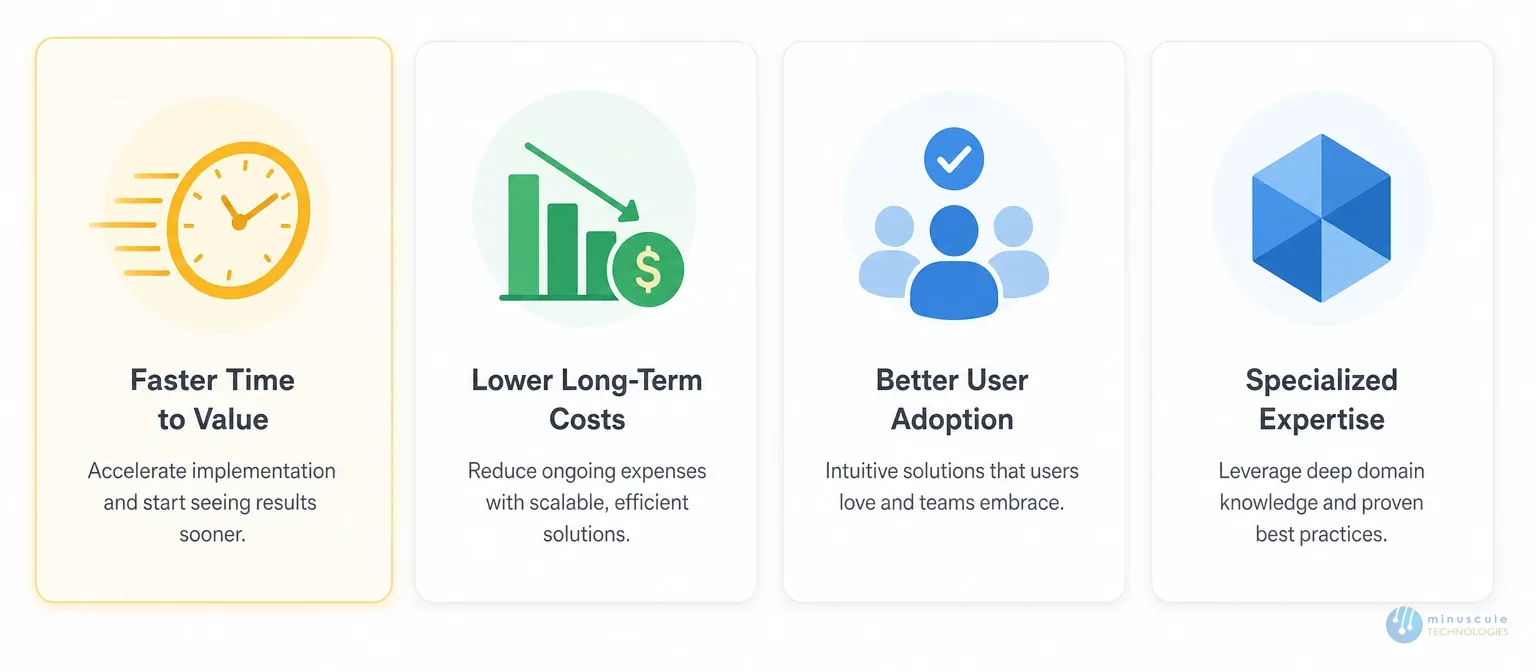
Why not just figure it out internally? You certainly can for simpler use cases. But here's where outside expertise makes a measurable difference.
Experienced consultants have done similar projects before - sometimes dozens of times. They know the common pitfalls, the configuration shortcuts that actually work, and the Salesforce features your team hasn't discovered yet. What might take an internal team 6 months to implement, a seasoned consulting partner can deliver in 8-12 weeks with pre-built accelerators and proven frameworks.
Nobody loves writing a six-figure check for outside help. But here's the math that changes minds: a failed implementation costs two to three times more to fix than it would have cost to do right the first time. Redundant licenses alone can bleed $50K+ per year at mid-size companies. A 2025 Salesforce ecosystem report put a number on it - organizations using certified partners saw 32% higher ROI on their Salesforce investment versus those who tried to go it alone.
The best-configured Salesforce org is useless if your teams won't use it. Good consultants build adoption into the project plan from day one - through stakeholder workshops, user-centered design, phased rollouts, and targeted training. They know that adoption isn't a training problem; it's a change management problem.
Salesforce has over 20 different clouds and thousands of features. No single in-house admin can master all of them. Consulting firms bring teams with deep certifications across specific clouds - Sales Cloud, Service Cloud, Revenue Cloud, Financial Services Cloud, and more. You get the right expert for each part of the project.
This is a common point of confusion. Salesforce itself offers professional services through its own team. So why would you choose an independent consulting partner instead?
| Factor | Salesforce Professional Services | Independent Consulting Partners |
|---|---|---|
| Cost | Premium pricing ($300–500+/hr) | Typically 30–50% lower |
| Flexibility | Standardized methodology | Adapts to your processes and timeline |
| Industry Expertise | Broad but general | Often deep vertical specialization |
| Team Continuity | Resources may rotate across clients | Dedicated team through the project |
| Post-Go-Live Support | Limited unless separately contracted | Often includes managed services |
| Customization Depth | Follows best-practice templates | Builds custom solutions for unique needs |
| Speed | Can have longer lead times due to demand | Typically faster engagement start |
Independent consulting partners are usually the better fit for organizations that need industry-specific expertise, tighter budget control, or ongoing support beyond the initial implementation. Salesforce Professional Services makes sense for very large enterprises that need direct alignment with Salesforce's product roadmap. You can also read how professional services improve business operations.
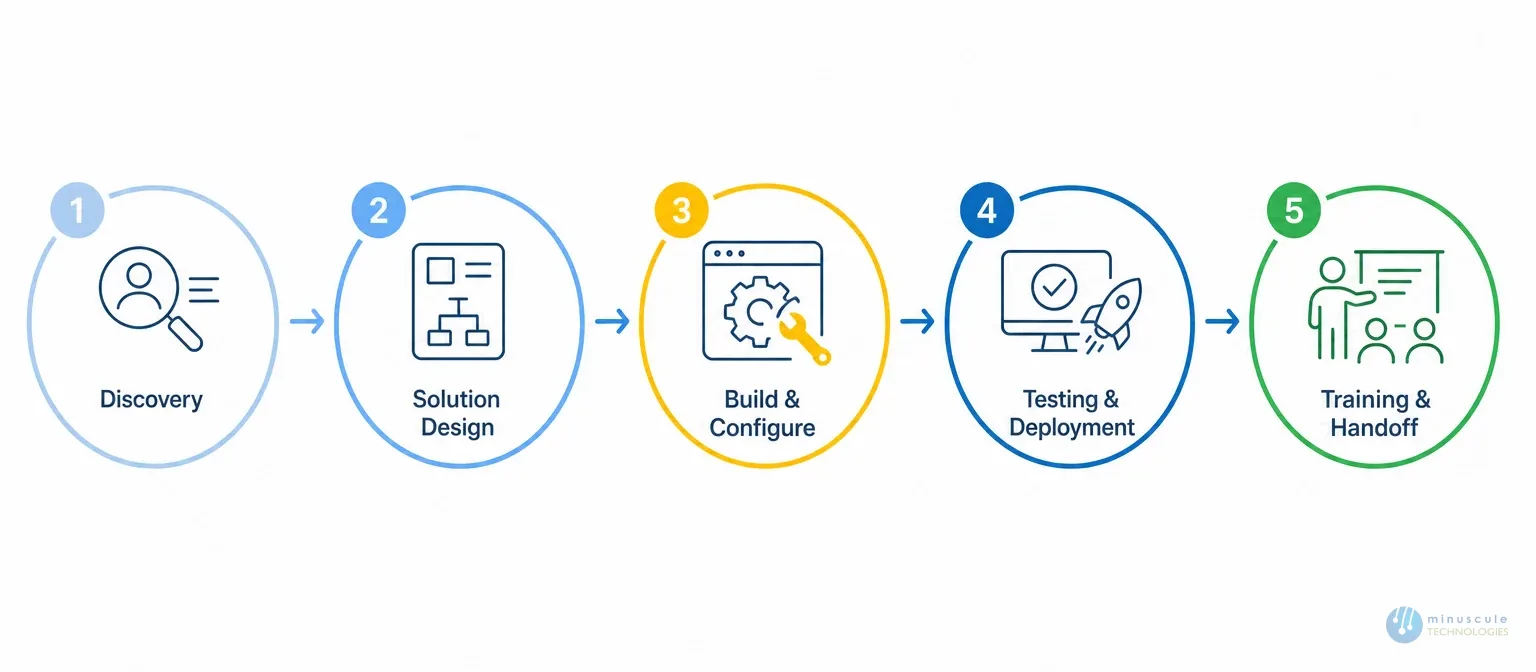
Whether it's a four-week assessment or a six-month implementation, most consulting engagements follow a similar arc. Here's what to expect.
The consultant's team meets with your stakeholders - department heads, end users, IT leads, and executive sponsors. They map out current processes, pain points, data flows, and existing technology. The output is a discovery document that serves as the foundation for everything that follows.
This phase typically takes 1-3 weeks and involves a mix of interviews, workshops, system audits, and data analysis. Don't rush it. The quality of your discovery directly determines the quality of your implementation.
Based on discovery findings, the consulting team creates a solution architecture. This includes data models, integration diagrams, automation logic, user role hierarchies, and a detailed project plan with milestones. You'll review and approve the design before any building begins.
The development team executes on the approved design. This is where the actual Salesforce configuration, customization, and integration work happens. Good consulting partners follow agile sprints with regular demos - so you see progress every two weeks and can provide feedback before it's too late to change course.
Before going live, the solution goes through unit testing, system integration testing (SIT), user acceptance testing (UAT), and performance testing. The deployment itself is carefully planned — with rollback procedures documented in case something goes wrong. For enterprise orgs, this often involves sandbox promotion strategies and CI/CD pipelines using tools like Salesforce DX, Copado, or Gearset.
Go-live isn't the finish line - it's the starting line. The consulting team trains your administrators, power users, and end users. They hand over documentation, runbooks, and admin guides. The best partners also provide a hypercare period (typically 2-4 weeks post-launch) where they're available to fix issues quickly as your team settles into the new system.
With thousands of consulting firms on the Salesforce AppExchange, picking the right one matters. Here's what to look for beyond the sales pitch.
Salesforce sorts its partners into four tiers: Base, Ridge, Crest, and Summit. Summit sounds impressive - and it often is. But a 50-person Crest-level firm that specializes in financial services might run circles around a 5,000-person Summit partner that's juggling retail, healthcare, and telecom projects simultaneously. Tier tells you about the company. It doesn't tell you about the team that'll actually work on your project.
One question that cuts through the noise fast: "How many Salesforce certifications do the people assigned to my project hold?" Not the company total. The actual humans who'll be in your Slack channel every day.
A consulting partner who's delivered Salesforce projects in your specific industry will understand your terminology, regulatory requirements, and common business processes. They won't waste your first two weeks learning what a dealer incentive program is or how loan origination workflows function.
For example, choosing a Salesforce partner with manufacturing and automotive experience means they've already solved problems like ERP-Salesforce integration, field service scheduling, and dealer network management - they aren't starting from scratch.
In 2026, any Salesforce consulting partner worth considering should have a clear point of view on AI. Ask them about their experience with Agentforce implementations, Einstein features, Data Cloud integration, and predictive analytics. AI isn't a future consideration anymore - it's a present-day requirement for competitive Salesforce orgs.
Many consulting relationships end at go-live, which is exactly when you need support the most. Find out whether the partner offers managed services, what their SLAs look like, and whether the same people who built your solution will be available for ongoing support. Continuity matters - you don't want to re-explain your entire org to a new team every time something breaks.
The Salesforce consulting landscape is shifting fast. Here are the trends shaping how consulting services are delivered this year.
Salesforce's Agentforce is changing the game for both consultants and the organizations they serve. Autonomous AI agents can now handle routine tasks - qualifying leads, resolving support tickets, updating records - that previously required manual configuration or custom code. Forward-thinking consulting partners are already building Agentforce-powered solutions that reduce operational costs while improving response times.
What this means for you: when evaluating consultants, ask whether they're building AI-first solutions or just bolting AI onto old approaches.
Salesforce Data Cloud has moved from a nice-to-have to a must-have for enterprises that want a unified customer view. Consulting partners are now spending as much time on data strategy - identity resolution, data harmonization, real-time segmentation - as they do on traditional CRM configuration. If your consulting partner isn't talking about Data Cloud, they're behind.
Here's a trend that doesn't get enough attention: the majority of Salesforce consulting work in 2026 isn't new implementations. It's optimization. Companies that implemented Salesforce three, five, or ten years ago are sitting on orgs with mounting tech debt, underused features, and rising license costs. The most valuable consulting partners today are the ones who can re-engineer an existing org - modernizing it without disrupting the business operations that depend on it.
This is exactly what Minuscule Technologies specializes in as a Trusted Salesforce Engineering Partner. With 160+ Salesforce experts, 75+ global projects, and deep experience across Sales Cloud, Service Cloud, Financial Services Cloud, and Revenue Cloud, Minuscule helps enterprises refactor legacy orgs, optimize license costs, and build AI-ready Salesforce environments. Whether you're dealing with a messy brownfield org or planning a greenfield build, schedule a free strategic call to see how the right engineering partner can make Salesforce actually work for your business.
Salesforce consulting services are professional services provided by certified Salesforce experts who help businesses plan, implement, customize, integrate, and manage the Salesforce platform. These services cover the entire CRM lifecycle - from initial strategy and architecture through go-live and ongoing optimization.
It depends on who you hire and what you need done. Independent consulting partners in the U.S. typically charge $150 to $350 per hour. Salesforce's own professional services team? North of $400 per hour in most cases. For a mid-size implementation - say, Sales Cloud plus Service Cloud with a handful of integrations - expect to spend somewhere between $50,000 and $250,000. If you're going the managed services route instead, most firms price that on a monthly retainer, usually $5,000 to $15,000 per month depending on the support level.
Short answer: yes, for most companies. The data backs it up - organizations working with certified partners consistently report faster go-lives, better user adoption numbers, and stronger ROI. Where the investment really pays for itself is in complex scenarios: multi-cloud rollouts, heavy integration work, orgs drowning in tech debt, or teams where Salesforce adoption has stalled below 50%. For a simple single-cloud setup with minimal customization, an experienced internal admin might handle it fine.
A Salesforce admin handles day-to-day platform management -user setup, reports, basic configuration, and troubleshooting. A Salesforce consultant is a strategic and technical advisor who designs solutions, architects complex systems, manages large-scale projects, and brings cross-industry expertise. Admins maintain the org; consultants transform it.
Timelines vary wildly. A focused strategy assessment? Two to four weeks. A standard Sales Cloud implementation with basic customization? Eight to sixteen weeks is typical. But if you're rolling out three clouds, integrating with SAP, and migrating ten years of data from a legacy CRM - that's a six- to twelve-month project, minimum. Managed services are different; those are ongoing relationships, usually structured as annual contracts with monthly deliverables.
You've seen what's possible. Now, let's make it happen for your business. Whether you need an end-to-end Salesforce solution, a complex integration, or ongoing managed services, our team is ready to deliver.

Schedule a Free Strategic Call


Plot No. 4, Sridevi Amman Street, Perumal Nagar Extension, Old Pallavaram, Chennai, Tamil Nadu 600117, India.
