

May 29, 2026
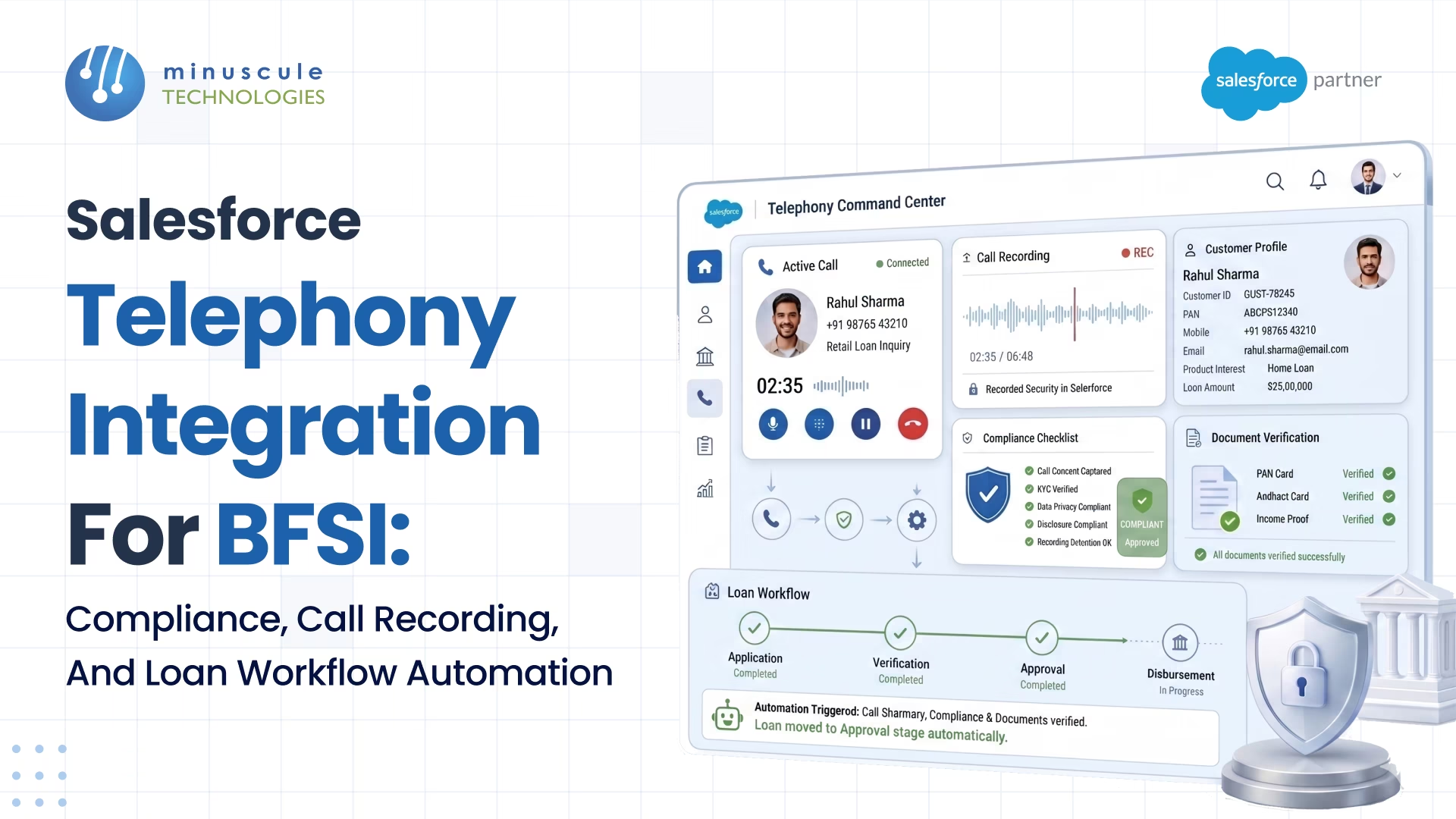
Salesforce telephony integration for BFSI connects your bank's or insurer's phone system directly to your CRM - so every inbound call triggers a screen pop with the customer's account history, every outbound collection call gets logged automatically, and every recorded conversation meets the compliance rules that regulators like the RBI, SEC, and FCA actually enforce. The technology behind it is CTI (Computer Telephony Integration), and in financial services, it's not optional anymore. It's infrastructure.
Here's the business case in one stat: financial institutions using CRM-integrated telephony report 35-40% shorter average handle times on service calls, according to contact center benchmarks from Deloitte. That translates directly to cost savings when your call center handles 10,000+ interactions per week. But speed alone isn't the point in BFSI. Compliance is. And that's where most generic CTI guides fall short - they cover the "how" but skip the "how without getting fined."
This guide covers the full picture: how Salesforce CTI works inside Financial Services Cloud, which compliance frameworks apply to call recording in banking and insurance, how to automate loan workflows with telephony triggers, and which tools fit BFSI requirements specifically.
CTI - Computer Telephony Integration - is the bridge between your phone system and Salesforce. When a customer calls your bank's service line, CTI matches the incoming number to a Salesforce record and pops up the customer's profile on the agent screen before they even say hello. Account balances, recent transactions, open cases, active loan applications, last interaction notes - all visible instantly.
In technical terms, Salesforce offers two CTI paths. Salesforce Open CTI is a JavaScript-based API that lets you embed a softphone widget directly inside the Salesforce interface. It's browser-based, requires no adapter installation, and works with Lightning Experience. Most modern CTI providers - Twilio, Amazon Connect, Genesys, RingCentral, Five9 - use Open CTI to build them Salesforce integrations. Our step-by-step Salesforce telephony integration guide walks through the full setup.
Service Cloud Voice is Salesforce's own telephony product, built on Amazon Connect under the hood. It bundles real-time transcription, AI-powered recommendations, and omnichannel routing into a native Salesforce experience. For BFSI orgs already running Service Cloud, it's the tightest integration available - no middleware, no syncing delays.
What makes BFSI different from a typical CTI setup? Three things. First, every call potentially involves regulated data - account numbers, PAN details, card information, and health records for insurance. The CTI layer must handle that data securely. Second, call recordings aren't just nice-to-have — they're legally mandated in most financial services contexts. Third, the workflows triggered by calls (loan follow-ups, KYC verification, collections outreach) are multi-step processes that cross departments, and they need to fire reliably every time.
A SaaS company integrating Salesforce with Twilio cares about call logging and maybe click-to-dial. A bank integrating the same tools also cares about those things - plus 15 other requirements that don't exist outside regulated industries.
This section matters more than any feature comparison. Get compliance wrong and the fines dwarf whatever you spent on the telephony platform.
Any financial institution handling card payments over the phone falls under PCI-DSS. The relevant requirements for telephony:
Practical implementation: configure your CTI to automatically pause recording when the agent opens the payment capture screen in Salesforce. Service Cloud Voice and most enterprise CTI tools (Genesys, Five9, Natterbox) support this natively. Test it thoroughly - we've seen implementations where the pause trigger fired 2-3 seconds late, capturing partial card data in the recording.
The Reserve Bank of India's telephony requirements for financial institutions include mandatory call recording for tele-verification in loan processing, KYC verification call retention for the lifetime of the customer relationship plus eight years after account closure, customer consent capture before recording (either IVR-based or explicit verbal consent logged in the CRM), and data localization - recordings must be stored on servers physically located in India. That last point matters for cloud CTI platforms. If your telephony provider stores recordings on US or EU servers by default, you'll need to configure India-specific storage or use a provider with Indian data centers.
US broker dealers and investment advisors face strict communication retention rules. Call recordings must be stored in WORM format (Write Once, Read Many) - meaning nobody can alter or delete them during the retention period. Three-year minimum retention, with the first two years immediately accessible. Supervisory review procedures must be documented - random sampling of recorded calls with written signoffs.
For institutions operating in or serving EU customers: explicit consent before recording (a pre-call IVR announcement isn't always sufficient under GDPR - some jurisdictions require affirmative opt-in), right to access (customers can request copies of their recorded calls), right to erasure (customers can request deletion - which conflicts with financial retention mandates, creating a legal tension your compliance team needs to resolve case-by-case), and data minimization - record only what's necessary, not every second of every call.
MiFID II requires recording all communications related to transactions or intended transactions in financial instruments. This includes phone calls, emails, and electronic communications. Retention period: five years minimum, extendable to seven years by regulatory request. Your Salesforce CTI must flag which calls relate to transactions and apply the appropriate retention policy automatically - you can't rely on agents to categorize calls manually.
This is where telephony integration stops being a contact center project and starts being a revenue operations tool. In our work with BFSI clients, the loan lifecycle is where CTI delivers the most measurable ROI.
A prospect calls for a home loan. The IVR captures basic intent ("press 2 for home loans") and routes to the right team. When the agent qualifies the lead during the call, a Salesforce Flow triggers automatically: it creates a Loan Application record in Financial Services Cloud, links it to the Contact and Account, populates fields from the call data (loan amount discussed, property type, employment status captured in screen notes), and assigns the application to the appropriate loan officer based on product type and region. What used to require 15 minutes of post-call data entry now happens in the background while the agent wraps up the conversation.
The loan officer calls the applicant for KYC verification. During the call, they walk through a verification checklist built as a Salesforce Flow screen. Each item checked off updates the Loan Application record in real time. When the call ends, if any KYC documents are missing, Salesforce automatically sends an email or WhatsApp message to the applicant for listing exactly which documents are needed - with upload links that feed directly back into the Salesforce record. No manual follow-up. No, "I'll send you a list after the call" that gets forgotten.
Collections are where telephony automation saves the most agent time. The agent calls a delinquent borrower. Based on the call disposition they select in the CTI softphone (promise-to-pay, dispute, no answer, wrong number, hardship request), different workflows fire:
We built a collections workflow like this for a banking client where agents were spending 8-12 minutes on post-call admin per interaction. After automation, that dropped to under 2 minutes. Across a 50-agent team making 80 calls per day each, that's roughly 400 recovered hours per week.
Not every CTI feature matters equally in financial services. Here's what to prioritize, ranked by compliance impact and operational value.
| Tool | BFSI Fit | Compliance Features | Transcription | Pricing Model / Best For |
|---|---|---|---|---|
| Service Cloud Voice | Strong | Pause/resume, consent IVR, audit trails | Yes, native | Per-user/month. Best for orgs already on Service Cloud. |
| Genesys Cloud CX | Strong | PCI-DSS pause/resume, WORM storage, GDPR tools | Yes | Per-user/month + usage. Best for large contact centers with 200+ agents. |
| Five9 | Strong | Recording compliance, workforce management | Yes | Per-seat/month. Best for mid-to-large BFSI call centers. |
| Natterbox | Strong | ISO 27001, PCI pause/resume, speech analytics for compliance | Yes | Per-user/month. Best for EU-based financial services. |
| Amazon Connect + CTI Adapter | Moderate | AWS storage controls, encryption, flexible controls | Via Transcribe | Pay-per-use by minutes. Best for cost-sensitive orgs with AWS expertise. |
| RingCentral | Moderate | Basic recording, compliance archiving add-on | Yes | Per-user/month, tiered. Best for SMB financial firms. |
| Twilio Flex | Moderate | Programmable compliance setup with custom controls | Via plugins | Pay-per-use. Best for dev-heavy teams wanting full control. |
Financial Services Cloud (FSC) isn't just a Salesforce edition with a different name. It ships with a data model built specifically for banking, insurance, and wealth management - and that data model changes how CTI should be configured. Here is how to tie FSC features to financial results.
The Financial Account object replaces generic Account hierarchies. When a banking customer calls, your CTI screen pop shouldn't just show "John Smith - Acme Bank Account." It should show all of John's Financial Accounts: checking (balance $4,200), savings (balance $18,500), home loan (outstanding $312,000, next EMI $2,400 due June 15), and credit card (limit $15,000, current balance $3,200). FSC's data model supports this natively - your CTI just needs to be configured to query Financial Account objects, not just standard Accounts.
Actionable Relationship Maps show how customers are connected — co-applicants on a loan, beneficiaries on a policy, authorized signatories on a business account. During a call, the agent sees not just the caller but their entire financial relationship network. This matters for cross-sell conversations and compliance — an agent speaking with a non-authorized party about an account is a regulatory risk.
The Interaction Summary object in FSC is purpose-built for call documentation. Instead of logging calls as generic Tasks (which is what standard Salesforce CTI does), FSC logs them as Interaction Summaries linked to the relevant Financial Account, with structured fields for discussion topics, action items, next steps, and compliance notes. This creates a much richer audit trail than a Task record with freeform notes.
For Salesforce development teams building CTI inside FSC, the key integration points are: CTI call events should create Interaction Summary records (not Tasks), screen pops should query Financial Account and Opportunity objects specific to FSC, and post-call automation should use FSC's built-in action plans for multi-step follow-ups rather than custom Flows where possible.
AI in BFSI telephony isn't about replacing agents. It's about giving them information they'd otherwise miss during a fast-moving conversation.
Service Cloud Voice with Einstein analyzes call sentiment as it happens. If a customer's tone shifts negative - frustration about a declined loan, anger about unexpected fees — the system can automatically alert a supervisor, suggest de-escalation scripts, or offer the agent authority to make a concession (fee waiver, rate adjustment) without putting the customer on hold.
For collections of calls specifically, sentiment tracking helps agents calibrate their approach. A borrower showing genuine distress triggers different scripting than one showing evasion patterns. This isn't guesswork - it's pattern recognition across thousands of previous calls.
During a service call, Einstein Next Best Action can surface real-time recommendations based on the customer's profile, recent activity, and current conversation context. A wealth management client calling about a maturing fixed deposit might trigger a recommendation to discuss reinvestment options. A business banking customer with growing transaction volumes might get flagged for a credit line to increase conversation.
These recommendations appear in the agent's Salesforce sidebar during the call - not after. The agent decides whether to act on them. In our experience, agents who use NBA recommendations during calls achieve 15-20% higher cross-sell conversion rates compared to agents relying on memory and instinct alone.
After the call ends, AI processes the transcript for compliance review. Did the agent read the required disclosures? Did they make any unauthorized guarantees about loan approval? Did they follow the prescribed greeting and closing scripts? Automated compliance scoring flags calls that need supervisor review instead of requiring managers to listen to random samples - which is how most BFSI contact centers still operate, and it catches maybe 2-3% of issues.
Rolling out telephony integration in a regulated environment takes longer than a standard CTI project. Here's a realistic timeline based on what we've seen across BFSI implementations
CTI (Computer Telephony Integration) connects your phone system to Salesforce, so calls are logged, routed, and enriched with CRM data automatically. When a customer calls, the agent screen displays their full profile - account history, open cases, recent transactions - before the conversation starts. Outbound calls launch with a single click from any Salesforce record. In BFSI, CTI also handles call recording, compliance logging, and workflow triggers tied to call outcomes.
Yes - Service Cloud Voice is Salesforce's native telephony product, built on Amazon Connect. It includes a softphone, real-time transcription, omnichannel routing, and AI-powered recommendations - all inside the Salesforce interface. For organizations that don't want Service Cloud Voice, Salesforce also offers Open CTI, a JavaScript API that lets third-party phone systems (Genesys, Five9, RingCentral, Twilio) embed directly into Salesforce.
It depends on your size and compliance requirements. Service Cloud Voice is the strongest native option - the tightest Salesforce integration, built-in transcription, and good compliance controls. Genesys Cloud CX and Five9 are the enterprise alternatives for large contact centers (200+ agents) needing advanced workforce management and specific regulatory certifications. Natter box is strong for EU-based financial services firms needing ISO 27001 compliance. For Indian banks subject to RBI data localization requirements, verify that any chosen platform offers India-based data centers.
Multiple frameworks overlap. PCI-DSS governs calls involving payment card data (requires pause/resume recording during card capture). SEC Rule 17a-4 requires US broker-dealers to retain call recordings in WORM format for three years minimum. RBI guidelines mandate recording and retaining KYC verification calls. MiFID II requires European financial firms to record all transaction-related communications for five years. GDPR requires explicit consent before recording EU citizens. Your implementation must address whichever combination applies to your geography and license type.
FSC's data model - Financial Accounts, Interaction Summaries, Actionable Relationship Maps - integrates directly with CTI. Screen pops query Financial Account objects to show balances, loans, and products. Calls get logged as Interaction Summaries (richer than standard Tasks) with structured fields for discussion topics and compliance notes. Post-call workflows use FSC's Action Plans for multi-step follow-ups. The key implementation difference: configure CTI to read from FSC-specific objects, not standard Salesforce Account/Contact alone.
Plan for 12-16 weeks from discovery to full rollout. Weeks 1-2 for compliance mapping, weeks 3-4 for architecture and tool selection, weeks 5-8 for build and configuration, weeks 9-10 for compliance-specific testing, weeks 11-12 for a pilot with one team, and weeks 13-16 for phased expansion. The compliance testing phase extends BFSI timelines beyond standard CTI projects - skip it and risk regulatory findings during your first audit.
CTI call dispositions trigger Salesforce Flows that automate loan workflows end-to-end. A qualified lead call auto-creates a Loan Application in Financial Services Cloud. KYC verification calls trigger document request emails when items are missing. Collections calls branch into different workflows based on disposition - promise-to-pay, hardship, dispute - each with its own follow-up sequence. The automation eliminates 8-12 minutes of post-call data entry per interaction, which compounds dramatically across a 50+ agent team.
Telephony integration in financial services isn't a plug-and-play project. The compliance requirements alone - PCI-DSS pause/resume, WORM-compliant storage, consent management, data residency controls - put it in a different category than a standard CTI rollout. Add loan workflow automation, collections of branching, and FSC-specific configuration, and you need a team that understands both the Salesforce platform and the regulatory landscape.
Minuscule Technologies has been building Salesforce solutions for BFSI since 2014. We've integrated telephony systems for banking clients handling loan origination, collections, and customer servicing - connecting voice, WhatsApp, and email into unified Salesforce workflows that meet RBI, PCI-DSS, and SEBI compliance requirements. Our 160+ Salesforce engineers work with Service Cloud Voice, Genesys, Five9, and custom CTI implementations, so recommendations fit your compliance profile - not a vendor partnership.
Talk to our BFSI integration team for a free telephony architecture assessment. We'll map your compliance requirements, identify workflow automation opportunities, and tell you exactly which CTI approach fits your org.
You've seen what's possible. Now, let's make it happen for your business. Whether you need an end-to-end Salesforce solution, a complex integration, or ongoing managed services, our team is ready to deliver.

Schedule a Free Strategic Call


Plot No. 4, Sridevi Amman Street, Perumal Nagar Extension, Old Pallavaram, Chennai, Tamil Nadu 600117, India.

