

June 30, 2026
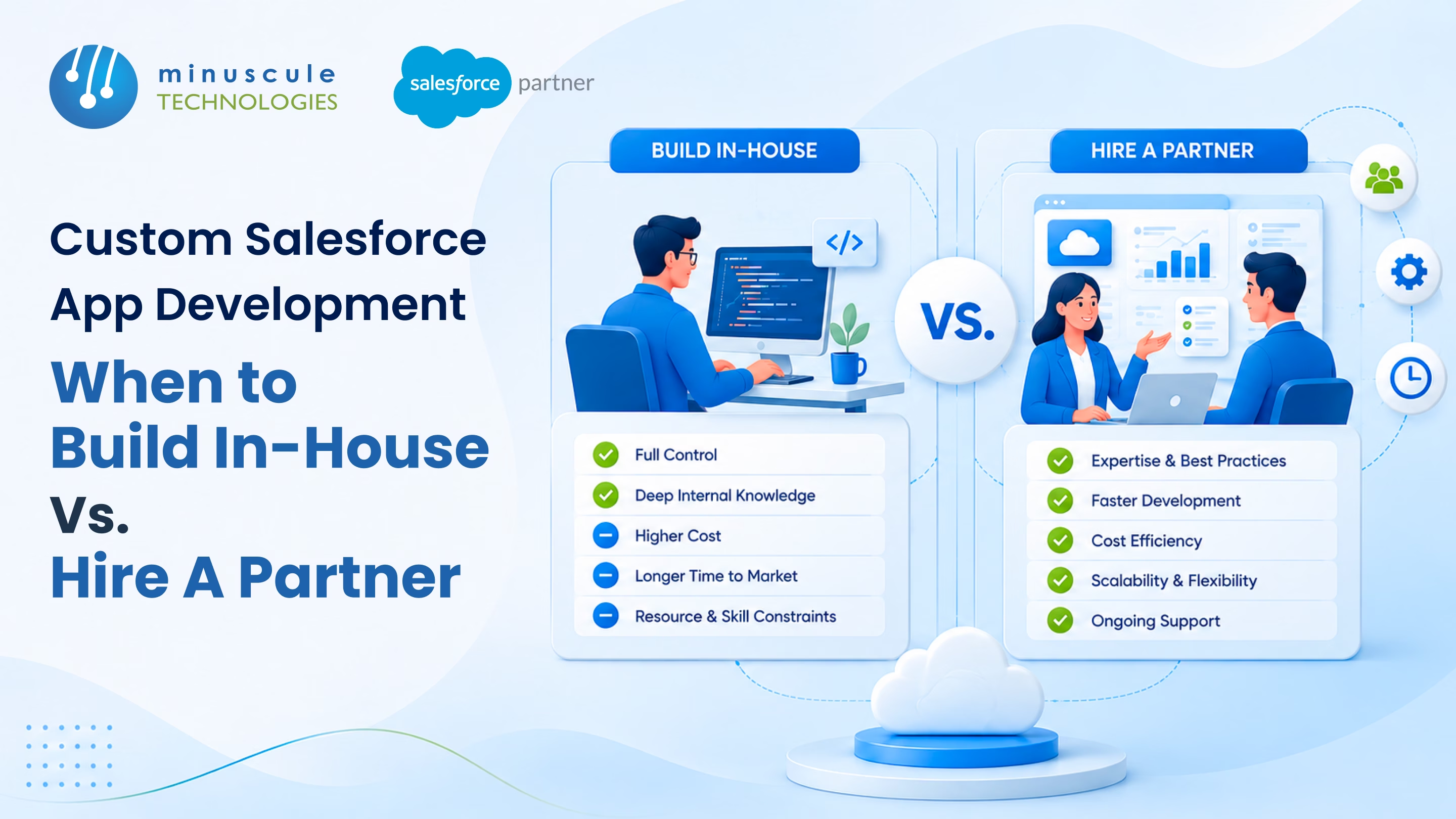
Custom Salesforce app development is the practice of building a bespoke application on the Salesforce platform - using Apex, Lightning Web Components, custom objects, and APIs - instead of configuring standard features or installing an AppExchange product. Whether to build it with your own Salesforce developers or hire a partner comes down to five things: your engineering skill depth, your timeline, your three-to-five-year budget, your tolerance for technical debt, and who owns long-term maintenance. Build in-house when you have certified developers, a steady pipeline of work, and want full control. Hire a partner when the app is complex, the timeline is tight, or your team lacks Apex and integration depth.
Quick decision signals:
Custom Salesforce application development means building an app from the ground up on the Salesforce platform to fit a workflow that standard features and AppExchange packages can't handle. It's a specialized branch of Salesforce platform development that mixes two layers: declarative work (custom objects, flows, and pages built in the Lightning App Builder) and programmatic work (Apex for server-side logic, Lightning Web Components for the interface, and REST or SOAP APIs to connect outside systems).
It sits alongside broader Salesforce CRM development, but goes further than configuration. It isn't implementation, which is standing up and configuring Salesforce for your business. And it isn't the build vs. buy choice between a custom app and an AppExchange product - that question is about whether to build at all. Once you've decided to build, the next question is who writes the code: your own team or a partner. Salesforce's own developer resources show how deep the Apex and LWC skill set runs, which is exactly why the staffing decision matters so much.
Here's how the two models compare across the factors that decide most custom development projects.
| Factor | In-House Team | Salesforce Partner |
|---|---|---|
| Upfront Cost | Lower per project, higher fixed overhead | Higher hourly, no standing payroll |
| Engineering Depth | Limited to who you hired | Access to Apex, LWC, and integration specialists |
| Speed to First Release | Slower; ramp-up and learning curve | Faster; reusable frameworks and accelerators |
| Control & Oversight | Full, day-to-day | Shared; needs clear governance |
| Business Context | Deep, built in | Learned during discovery |
| Flexibility to Scale | Slow; hiring takes months | Fast; add or drop capacity per sprint |
| Technical Debt Risk | Higher without senior review | Lower with code review and testing standards |
| Long-Term Maintenance | Owned internally | Optional managed-service coverage |
An in-house build puts your own Salesforce developers and admins in charge of the whole thing - data model, Apex, components, testing, and release. It works best when Salesforce is core to your product and you plan to keep shipping features for years.
Choose in-house when you have certified developers on staff, the app is a long-lived internal product, you need constant iteration, and you can protect your team's time from competing work. Small, well-scoped builds - like a custom Sales Cloud object with a few flows - are also fine to keep internal.
Salesforce app development services give you certified developers, architects, and QA engineers you contract for a project or an ongoing engagement. A good partner has shipped dozens of custom apps and reuses that experience, so you're not paying to solve problems someone already solved.
Bring in a Salesforce development company when the app is complex - multi-cloud, CPQ, or integration-heavy - when your timeline is tight, when you don't have certified developers, or when data accuracy is mission-critical. Salesforce's own guidance on scaling points the same way: the more central the app is to how you run, the stronger the case for proven expertise. Minuscule Technologies works as a Salesforce app development partner for exactly these builds.
Most articles say in-house is "cheaper upfront" and stop there. That misses the real math. The honest comparison is total cost of ownership over three to five years, and it has to include the costs people forget.
A single mid-level Salesforce developer in the US runs roughly $120,000–$150,000 in base salary, and the fully loaded cost — benefits, payroll taxes, tooling, and overhead — is usually 1.3 to 1.4 times that. Add certification exams (around $200–$400 each, plus study time), a sandbox and DevOps tooling budget, and the recruiting cost to fill the seat. A two-person in-house pod can easily cost $350,000+ a year before they ship a single feature.
Salesforce app development services bill an hourly or blended rate instead. Onshore senior Apex work often lands in the $120–$200 per hour range, while blended onshore-offshore models can bring the effective rate well below that. You pay only for the hours worked, with no bench cost between projects. For a defined build, that often totals less than a year of loaded in-house salary - and the app ships sooner, so the payback starts earlier.
Cost gets the attention, but code quality decides whether your app is an asset or a liability in year two. This is where the in-house-vs-partner choice really bites, and it's the part most comparisons skip.
Technical debt. Salesforce enforces hard limits - Apex governor limits on queries, CPU time, and DML operations. A team learning as they go tends to write code that works in a demo and breaks once real data volumes hit. Cleaning that up later costs more than building it right. A partner with senior review and a test-coverage standard prevents most of it. The Salesforce Admins resources and community sites like Apex Hours are good places to see how deep those best practices go.
Security review. Custom code touches sensitive data. Sharing rules, field-level security, and Apex that runs "without sharing" all need deliberate handling. Experienced developers build with the Salesforce Trust Layer in mind; less experienced ones create gaps that surface in an audit.
DevOps maturity. A serious custom app needs version control, CI/CD, and a repeatable release process - not changes clicked straight into production. Many in-house teams haven't built this muscle yet. In our experience, the projects that age well are the ones with automated testing and rollback from the start.
Ownership and IP. When a partner writes the code, agree upfront that you own it, with documentation and a knowledge transfer at handoff. A good partner makes you self-sufficient; a bad one keeps you dependent.
Score your project on these five questions. More "in-house" answers point one way; more "partner" answers point the other.
A useful rule of thumb: the more mission-critical and complex the app, the stronger the case for a partner - at least for the first build.
The best answer is often "both." In a hybrid model, your in-house team owns strategy, daily admin, and cultural fit, while a partner handles the complex custom code, integrations, and DevOps setup. Two common shapes:
This gets you speed and quality now while building internal capability for later. Many organizations start with a partner-led first release, then move ongoing work in-house with managed-service support as a safety net. If you want the broader implementation angle, our take on in-house vs. a Salesforce consulting partner covers the configuration side of this same decision.
In-house looks cheaper per project because you're not paying an hourly rate, but the fully loaded cost of salaries, certifications, tooling, and ramp-up often makes a partner cheaper for a defined build. Compare total cost of ownership over three to five years, not just the sticker price.
Most builds need Apex for server-side logic, Lightning Web Components for the interface, data modeling with custom objects, and API skills for integrations. Larger apps also need an architect and a DevOps setup with version control and CI/CD.
A small, well-scoped app can take a few weeks. Complex, integration-heavy, or multi-cloud apps run several months. A partner with reusable frameworks usually reaches a first release faster than an in-house team building it for the first time.
Yes, and many companies do. Agree upfront that you own the code and get full documentation plus a knowledge transfer at handoff. A partner that follows clean coding and DevOps standards makes that transition smooth.
5. What is the hybrid Salesforce development model?
Hybrid means your in-house team handles strategy and daily admin while a partner delivers complex custom code and integrations. Common forms are staff augmentation and a Center of Excellence, both of which build your internal skills over time.
Custom Salesforce app development is too important to decide on cost alone. Score your project on skills, complexity, timeline, longevity, and risk - then match the model to the answer. If you have the engineering depth and time, build in-house with your own developers. If the app is complex or the clock is running, a partner will get you there faster and cleaner. And if you want both speed and lasting internal capability, go hybrid. As a Salesforce engineering partner, Minuscule Technologies provides end-to-end Salesforce app development services, handles the integrations and DevOps, and hands you clean, documented code you own. If you're weighing the build, talk to our team about your custom app and we'll help you pick the right path.
You've seen what's possible. Now, let's make it happen for your business. Whether you need an end-to-end Salesforce solution, a complex integration, or ongoing managed services, our team is ready to deliver.

Schedule a Free Strategic Call


