We are at Dreamforce 2026, Industry Pavilion at San Francisco


June 15, 2026
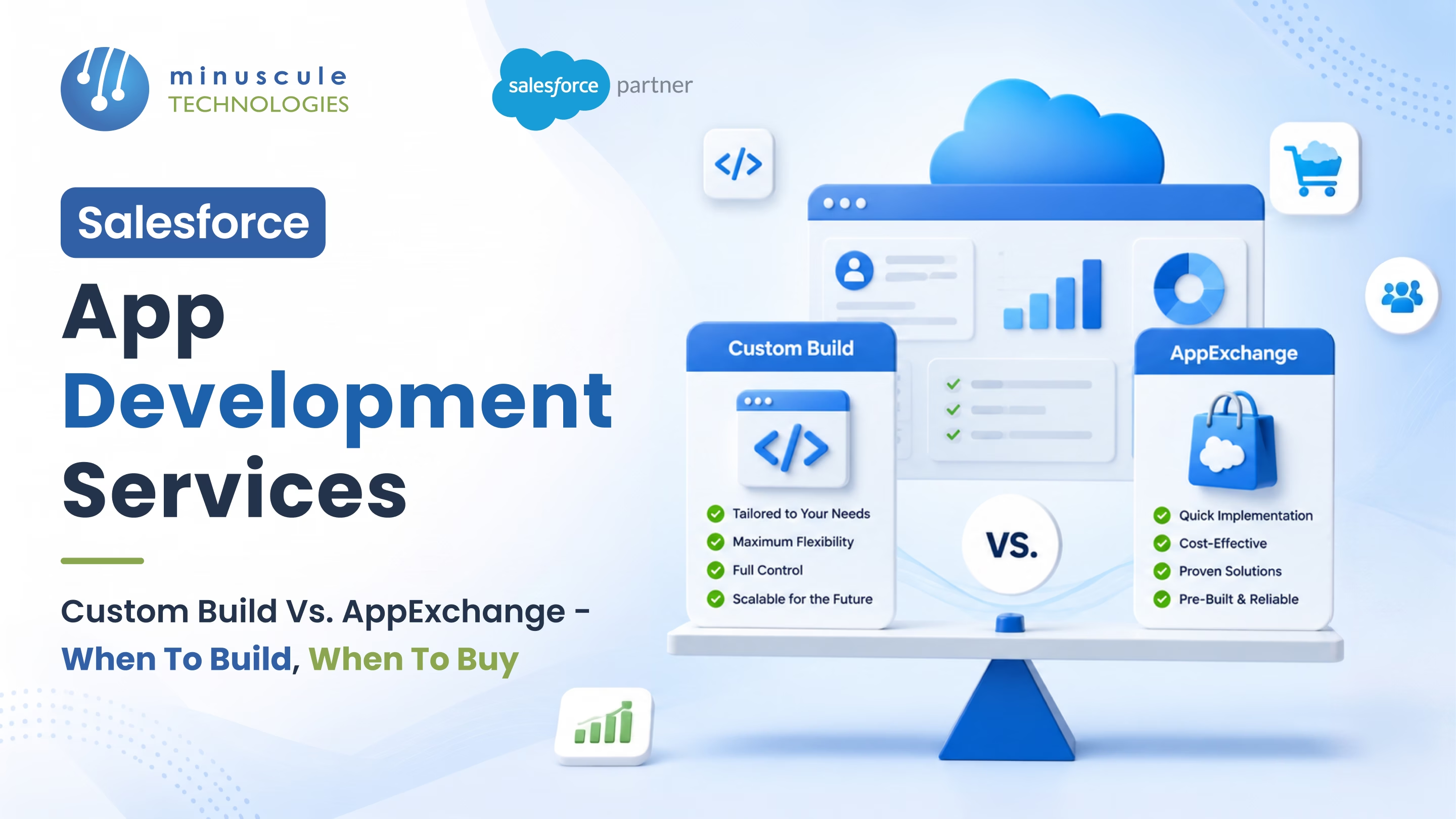
A dealer operations manager at an equipment manufacturing company found what looked like the perfect solution on AppExchange. The app handled dealer performance tracking, came with strong reviews, and was specifically marketed to companies like hers. Licenses were purchased, the app was installed, and her team spent weeks on configuration.
Three months later, the cracks were showing. The app tracked standard dealer KPIs but had no concept of her company's tiered rebate structure. The integration with their SAP instance required a custom middleware layer the vendor hadn't documented. And every Salesforce release brought a tense two-week window of testing whether the app still behaved as expected.
Her IT team delivered the uncomfortable verdict: they would need to build a custom solution anyway, using the AppExchange app as a reference for field requirements.
Two builds. One problem. A timeline nobody had planned for.
This outcome is more common than organizations expect. The decision between buying a Salesforce app from AppExchange and building a custom one is not simply a question of convenience versus control. It carries downstream consequences for integration complexity, maintenance overhead, long-term adaptability, and whether the solution actually fits how your business works. Getting it right requires a clear framework - not a coin flip.
AppExchange is Salesforce's marketplace of over 7,000 pre-built apps, components, and solutions. Every listed product has passed Salesforce's security review, which means it meets defined standards for data access and org safety. Many are built by established vendors with deep platform expertise and updated with each Salesforce release.
AppExchange works best when the requirement is generic across industries. E-signature workflows, document generation, SMS messaging, project management, time tracking - these are problems most businesses face in broadly similar ways. A well-reviewed AppExchange app built for these scenarios will often be better designed and more feature-complete than anything a custom build delivers in a comparable window.
It also makes sense when the functionality being added is not a source of competitive differentiation. If the capability you need — invoicing, survey collection, basic notification routing - is something every company in your industry handles the same way, building it from scratch is an inefficient use of development resources. Buy it, configure it, and direct your development investment toward what actually makes your business unique.
Custom Salesforce development uses Apex (Salesforce's Java-like backend language), Lightning Web Components for UI, and platform APIs to build solutions that are native to your org, built exactly to your specifications, and under your full control. As Salesforce's developer documentation notes, the platform's custom development capabilities are among the most comprehensive in enterprise software - but they require investment in design, build, testing, and ongoing maintenance.
Custom development is the right path when the requirement is genuinely unique to your business model. Dealer rebate structures that vary by product tier, region, and quarterly performance. Warranty claim routing that maps to specific ERP service order types. Distributor portals that surface real-time inventory data from SAP. No AppExchange app anticipates every variant of these use cases - because they are specific to how your industry and organization operate.
It is also the right path when integration complexity is high. For manufacturers, distributors, and industrial companies running SAP, PeopleSoft, or Oracle ERP systems, the integration between Salesforce and the ERP is often the heart of the solution. AppExchange apps rarely have pre-built connectors for specific ERP versions and configurations. Custom development — combined with a structured integration architecture - produces something built for your exact data model, not a general approximation of it.
And when long-term control is a priority, custom-built solutions win outright. There is no vendor roadmap to depend on, no acquisition risk, no pricing model change that forces a rebuild. The solution lives in your org and evolves on your terms.
Both options carry costs that rarely appear in the headline comparison.
AppExchange hidden costs compound in ways that are easy to underestimate. Per-user licensing scales with headcount, and many apps charge for every Salesforce user regardless of how much they interact with the app's features. Configuration effort is real - most apps require meaningful admin or developer time to connect to your existing data model and automations. And when Salesforce releases a major update, you are dependent on the vendor to patch their app, not on your own team to act. According to Salesforce's own AppExchange guidance, organizations should treat app evaluation as a procurement decision - not a download.
Custom development hidden costs are equally real. Well-built Apex code requires maintenance as the platform evolves. If the developers who built the solution move on, onboarding their replacements to an unfamiliar codebase takes time. Custom solutions require their own testing cycles for every Salesforce release. And a poorly scoped custom build — one that tries to handle every edge case in the first version - can become a maintenance burden that consumes development capacity long after go-live.
The decision is never free. The question is which costs you are better positioned to manage.
For many organizations, the best answer is neither a pure AppExchange purchase nor a ground-up custom build. It is a pre-built accelerator — a solution designed for a specific industry or use case, built on native Salesforce, and structured to be modified without running into vendor-imposed limitations.
Minuscule's Salesforce accelerators are built for this purpose. The B2B Marketplace accelerator consolidates fragmented dealer and distributor networks into a single Salesforce-managed sales ecosystem. The Dealer Audit accelerator gives manufacturer and automotive organizations full visibility into dealer compliance and performance metrics. The Dealer Incentive accelerator handles rebate and incentive payout logic - exactly the use case that caused the equipment manufacturer in this story to rebuild from scratch.
These accelerators deliver on Salesforce's native platform, so they inherit all platform upgrades automatically. They are designed to be extended, not just installed. And because they are built on top of real-world implementations, they account for industry edge cases that a ground-up custom build typically discovers only after go-live.
Before choosing, answer these:
An AppExchange app is a pre-built product created by a third-party vendor, installed into your Salesforce org, and configured within the limits the vendor defined. A custom Salesforce app is built from scratch by developers using Apex, Lightning Web Components, and Salesforce APIs — it does exactly what your business requires, with no vendor-imposed feature constraints. The right choice depends on how closely your requirement maps to what already exists on the marketplace.
AppExchange is the stronger choice when the requirement is generic across industries, when the capability is not part of your competitive differentiation, and when a well-reviewed vendor with strong platform compatibility history already solves the problem. The Salesforce blog recommends evaluating apps like a procurement decision — assessing vendor stability, support responsiveness, and review recency alongside feature fit.
Look at installation counts, review recency, how often the app is updated relative to Salesforce's release cycle, and whether the vendor has a visible support channel. Request a sandbox trial before purchasing. Have a Salesforce admin or developer assess how the app's data model interacts with your existing org configuration. Admin.salesforce.com has practical guidance on app evaluation that goes beyond AppExchange listing pages.
Yes, and this is common. Organizations frequently use AppExchange apps for generic needs (document generation, e-signatures, SMS) while custom solutions handle the industry-specific logic (ERP integration, distributor portals, complex approval workflows). The key is ensuring their data models don't conflict. A Salesforce developer should review the interaction before both are built or installed to avoid automation conflicts or object duplication.
A Salesforce accelerator is a pre-built solution delivered as native Salesforce metadata - Apex classes, custom objects, flows, and components installed directly into your org. Unlike AppExchange apps, accelerators carry no ongoing per-user licensing from an external vendor, no dependency on vendor updates, and full room for customization after delivery. Minuscule's accelerators - including the B2B Marketplace and Dealer Audit solutions are designed for organizations that need more than AppExchange offers but want to move faster than a full custom build allows.
The right decision is rarely "always build" or "always buy." It is a deliberate call made with full visibility into what each option actually requires — technically, financially, and operationally.
Minuscule Technologies' Salesforce app development services cover the full decision spectrum. We evaluate whether an AppExchange solution genuinely fits your requirements. When it doesn't, we build custom Apex and LWC solutions designed to last. When a middle path makes more sense, we deliver industry-specific accelerators that start at a more advanced baseline than anything built from scratch. Our Salesforce customization team has seen every version of the build-vs-buy mistake — and helped organizations avoid or recover from them.
With 160+ certified Salesforce engineers and 75+ implementations across manufacturing, automotive, BFSI, and distribution, we know how these decisions play out over time. Talk to our team to get an honest assessment of what your specific requirement actually needs.
You've seen what's possible. Now, let's make it happen for your business. Whether you need an end-to-end Salesforce solution, a complex integration, or ongoing managed services, our team is ready to deliver.

Schedule a Free Strategic Call


