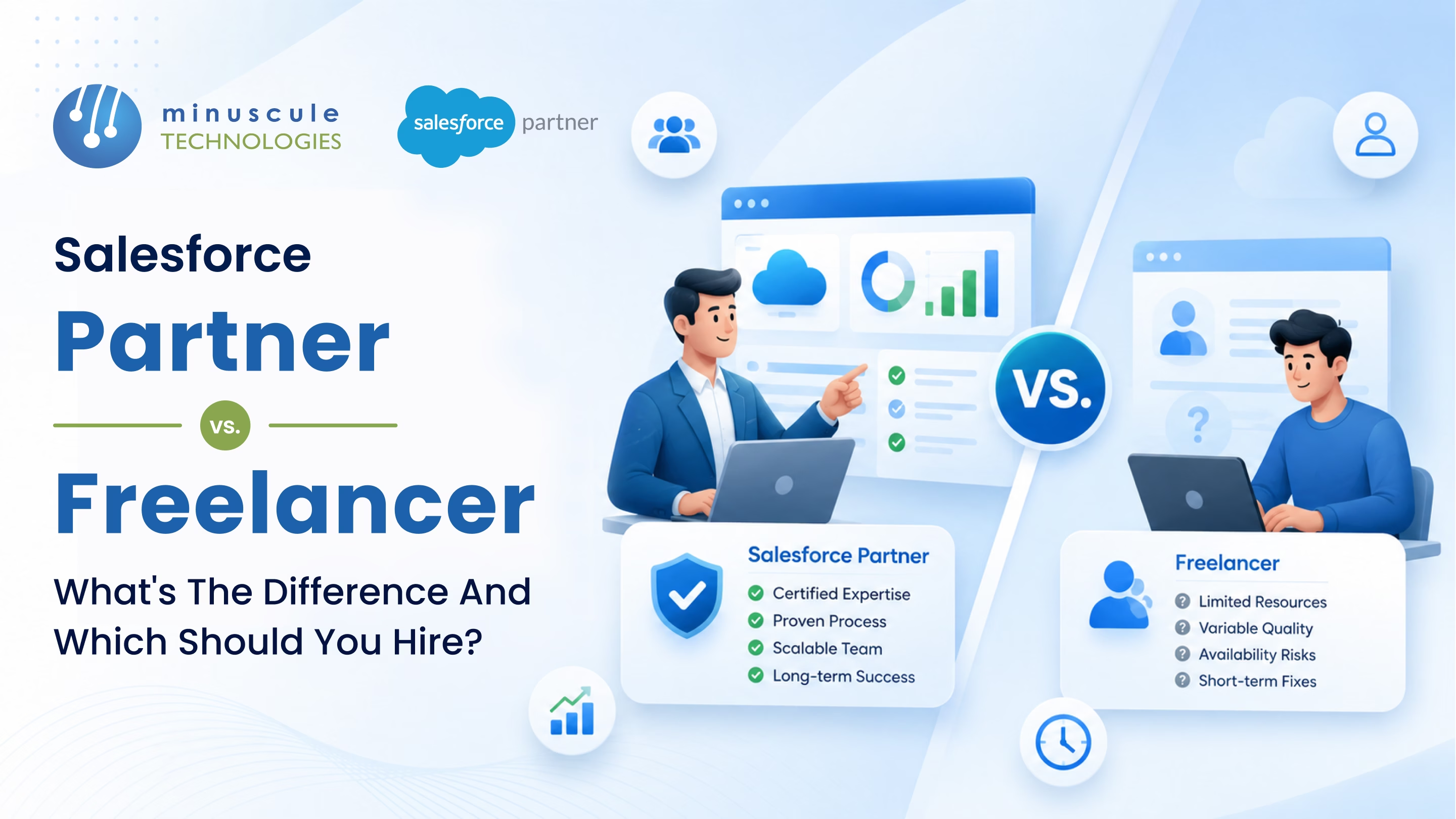
Salesforce Partner vs. Freelancer: What's the Difference and Which Should You Hire?

Article Written By:
Sajiv Narayanan
Created On:
Salesforce Partner vs. Freelancer: What's the Difference and Which Should You Hire

The industrial equipment company had done everything right in the hiring process. They found a Salesforce freelancer with strong reviews, a healthy portfolio of implementations, and the right certifications. The project started well. Discovery was thorough. Configuration was moving at pace.

Three months in, the freelancer went quiet for a week. Then two. Then an email arrived: he had accepted a full-time role at another company and could not continue the engagement.

The Salesforce org was half-built. There was no handover document. The data model existed only in the freelancer's head. The automations were partially configured — functional enough to confuse users, not complete enough to go live.

Starting over with a Salesforce partner added months to the project and cost more than the entire original freelancer budget. The company learned a lesson the hard way that many organizations have learned before them: the decision between a Salesforce partner and a freelancer is not a cost comparison. It is a risk decision.

What Is a Salesforce Partner?

A Salesforce partner is an organization that has been vetted, approved, and tiered by Salesforce within its formal Partner Program. Partners range from Registered level through Crest, Ridge, and Summit tiers - tiers that reflect demonstrated delivery capability, customer satisfaction scores, and the number of certified Salesforce professionals on staff.

Partners bring a team, not an individual. A typical engagement involves a project manager, a solution architect, one or more developers, an admin/configurator, and a QA resource. Each role is staffed based on project needs. If someone is unavailable, the partner provides cover. When the primary architect leaves, the firm retains institutional knowledge, documentation, and delivery methodology. The client's project does not leave with the person.

Partners also carry contractual accountability. Statements of work define deliverables, timelines, and change management procedures. There is a legal relationship, a support structure, and an escalation path when things go wrong.

What Is a Salesforce Freelancer?

A Salesforce freelancer is an independent professional who offers Salesforce services — typically configuration, development, or consulting — on a project or hourly basis. Many are highly skilled, often with years of experience working inside partner firms or at enterprises before going independent.

Freelancers offer real advantages in specific situations: they are typically faster to engage, more flexible in how they structure work, and can be a good fit for tightly scoped tasks. For a company that needs a single flow built, a report set configured, or a data import reviewed, a freelancer with the right specialization can be the most efficient path.

The risks, however, are structural. A freelancer is one person. If that person gets sick, takes another engagement, or accepts a full-time role, the project stops. There is no bench. There is no team. Documentation quality depends entirely on the individual's habits, not on a firm-wide standard. And if the engagement ends before knowledge transfer is complete, the client owns a system they cannot fully explain.

Head-to-Head: Where the Differences Matter Most

Accountability.

A partner firm carries contractual and reputational accountability for delivery. A freelancer carries personal accountability — meaningful when things go well, fragile when they don't. As SalesforceBen's analysis of Salesforce partner quality notes, project failures in the Salesforce ecosystem are rarely technical — they stem from communication gaps, poor documentation, and inadequate change management. A structured partner firm has processes to address all three. A freelancer's approach to these depends entirely on the individual.

Breadth of expertise.

A complex Salesforce implementation involving Sales Cloud, a Service Cloud case management layer, and an SAP integration requires an architect, a developer with ERP integration experience, and an admin-level configurator - three distinct skill profiles. No single freelancer covers all three at production quality. A partner firm staffs the right skills for each phase. For organizations in manufacturing, distribution, or automotive sectors where Salesforce must connect to SAP, PeopleSoft, or Denodo, a multi-discipline team isn't optional — it's the only way the integration gets built correctly.

Continuity.

Projects that span six months or more carry real continuity risk with a freelancer. Mid-project departures — for full-time roles, competing engagements, or personal reasons — are common in the freelance market. A partner firm absorbs that risk internally. The client's timeline is protected even when individual team members change.

Post-project support.

When a freelancer's engagement ends, ongoing support typically ends with it. Partners offer structured post-go-live options — managed services, retainer-based admin support, release management - that keep the Salesforce org maintained and aligned with business changes. Minuscule's managed services team provides exactly this continuity, covering everything from hypercare through ongoing development sprints.

Documentation and knowledge transfer.

Partner firms operate to a delivery standard. Solution design documents, configuration workbooks, data dictionaries, and test scripts are produced as a matter of process. Freelancers vary widely. Some are excellent documenters; many deprioritize it under delivery pressure. Without documentation, the client is left with a system they can't maintain or hand off internally.

When a Freelancer Is the Right Call

Freelancers genuinely are the better choice in specific, narrow circumstances. A company with a small, well-defined task — updating a set of reports, reconfiguring a permission set structure, or building a single automation - may have no need for a partner engagement. Startups with very early-stage Salesforce orgs and minimal complexity can move faster with a skilled individual than with a firm's structured delivery process.

The key test is scope and risk. If the work is bounded, reversible, and doesn't form the foundation of your CRM, a freelancer can be a practical choice. If it involves your core data model, your primary integrations, or any configuration that other systems depend on, the structural risks of a freelancer arrangement become difficult to justify.

When You Need a Partner

A Salesforce partner is the right choice when the project involves full implementation from scratch; multi-cloud deployment; ERP or third-party system integration; data migration from a legacy CRM; a requirement for ongoing development and support after go-live; or any scenario where the Salesforce environment is central to how the business operates.

Minuscule's Salesforce consulting and implementation practice is built for exactly these engagements. We bring a team with the architecture, development, integration, and industry expertise your project requires - and we stay engaged through hypercare, managed services, and long-term support so that the work we deliver continues to function as your business grows and evolves.

FAQs

1. What is the difference between a Salesforce partner and a Salesforce consultant?

A Salesforce partner is a company formally recognized and tiered by Salesforce within its Partner Program, carrying multiple certified staff, delivery methodology, and contractual accountability. A Salesforce consultant is a broader term — it can refer to someone at a partner firm, an independent freelancer, or an in-house expert. When evaluating external help, the relevant distinction is whether you are engaging a firm (with team coverage, documentation standards, and post-project support) or an individual (with personal accountability and no structural backup).

2. How do I verify that a Salesforce partner is legitimate?

Salesforce maintains a publicly searchable partner directory where you can verify a firm's tier (Registered, Crest, Ridge, or Summit), specializations, and customer satisfaction scores. Higher tiers require more certified professionals, more delivered projects, and sustained CSAT scores — they are an imperfect but meaningful proxy for delivery capability. As SalesforceBen's partner quality framework notes, asking partners to show real project artifacts and explain how they handle knowledge transfer reveals far more than their tier status alone.

3. Can a freelancer handle a full Salesforce implementation?

For small, tightly scoped implementations with minimal integration complexity, a highly experienced freelancer can deliver a complete project. For implementations involving multiple Salesforce clouds, ERP integration, data migration, and post-go-live support requirements, the breadth of skills and the continuity demands almost always exceed what a single individual can reliably deliver. The risk is not that freelancers lack skill - many are excellent - it is that the project's success depends entirely on one person remaining available and engaged for its full duration.

4. What happens if a freelancer leaves mid-project?

The outcome depends on documentation quality and how much work has been completed. In the best case, a well-documented project can be picked up by another resource with manageable onboarding time. In typical cases, incomplete documentation and undocumented configuration decisions create significant rework. Engaging a Salesforce partner to recover a mid-project freelancer exit is common - and the cost of recovery almost always exceeds what a partner engagement would have required from the start. Managed services and structured handover requirements can mitigate this risk when working with freelancers on defined tasks.

5. Is Minuscule Technologies a Salesforce partner?

Yes. Minuscule Technologies is a certified Salesforce partner with 160+ Salesforce engineers and 75+ completed implementations. Our practice covers end-to-end Salesforce delivery — from consulting and implementation through integration, data migration, managed services, and Agentforce. We work across manufacturing, automotive, BFSI, healthcare, real estate, and other sectors, with deep experience in complex ERP integration scenarios involving SAP and PeopleSoft

Conclusion: The Decision Is About Risk, Not Cost

The freelancer-vs-partner question is often framed as a budget question. Organizations looking to reduce spend see freelancer rates and make a cost comparison against partner billing. What that comparison misses is the full cost model: the risk of mid-project discontinuity, the cost of rebuilding after a handover failure, the ongoing support gap after go-live, and the architectural debt that accumulates when complex systems are built without a team.

Minuscule Technologies has 160+ certified Salesforce engineers across architecture, development, integration, and industry specializations. In 75+ implementations across manufacturing, automotive, BFSI, distribution, and other sectors, our teams have taken over projects started by freelancers, partners, and internal teams alike — and we understand exactly what gets left behind when the engagement model isn't matched to the project's actual requirements.

If you are evaluating how to resource your Salesforce project, talk to our team. We will give you an honest assessment of what your specific situation requires — and whether that's us or not.

Contact Us for Free Consultation
Thank you! We will get back in touch with you within 48 hours.
Oops! Something went wrong while submitting the form.

Recent Blogs

Ready to Architect Your Salesforce Success?

You've seen what's possible. Now, let's make it happen for your business. Whether you need an end-to-end Salesforce solution, a complex integration, or ongoing managed services, our team is ready to deliver.

Schedule a Free Strategic Call