We are at Dreamforce 2026, Industry Pavilion at San Francisco


June 17, 2026
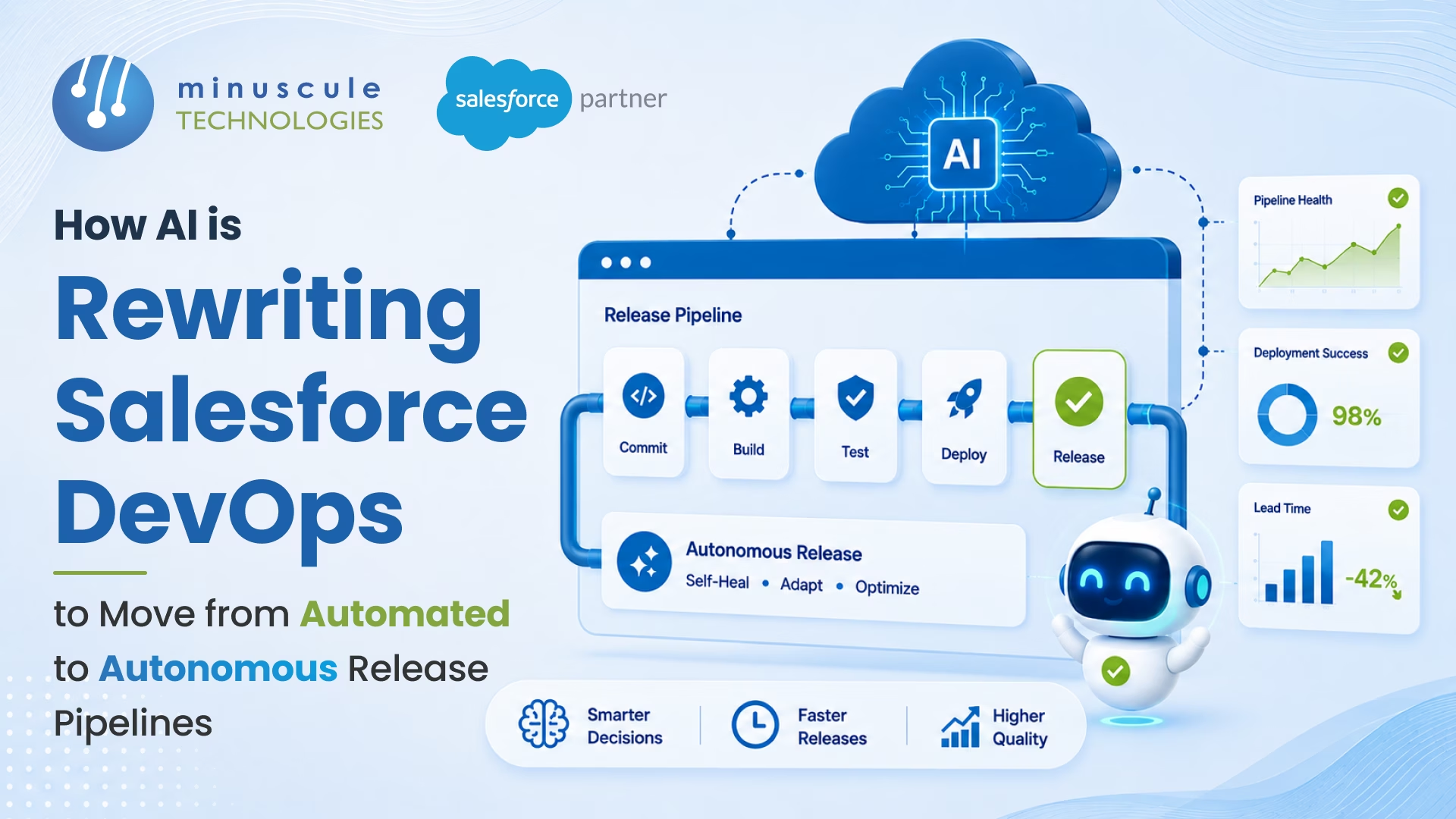
Salesforce DevOps has two distinct modes that teams often conflate: automated and autonomous. Automated pipelines execute predefined scripts - CI/CD tools to run your tests, package your metadata, and deploy command. Autonomous pipelines go further: AI agents analyze what changed, predict what could break, select which tests matter, self-heal when failures occur, and make deployment decisions without waiting for a human to act on each step.
Most Salesforce teams are somewhere in the automated stage. The top performers are already building toward autonomous. Here's what that shift looks like in practice - and what it means for your releases, your team, and your DORA metrics.
The difference in four lines:
Understanding where you are helps you plan where to go. Three stages describe the evolution of Salesforce release practices:
Stage 1 - Manual. Change sets, sandbox-to-sandbox copies, and release spreadsheets. Every deployment is a human-coordinated event. Rollback means "click undo and hope." Most teams left this stage years ago, but traces often survive in orgs with long histories or frequent admin-only changes.
Stage 2 - Automated. CI/CD pipelines built on tools like Copado, Gearset, Folsom, or GitHub Actions with SFDX. Deployments are triggered by code commits; tests run on a schedule, and metadata changes are tracked in version control. The pipeline executes faster and more consistently than any manual process could - but it still only does exactly what you script it to do. When something unexpected happens, a human diagnoses and decides.
Stage 3 - Autonomous. AI agents operate within the pipeline. They read metadata changes, identify downstream dependencies, select relevant tests, flag risk before deployment, and respond to post-deployment anomalies without waiting for human instruction. They still escalate to humans - but only for decisions that genuinely need human judgment. Everything else is handled.
Most enterprise Salesforce teams in 2026 sit at Stage 2 with patches of Stage 3 functionality. Gearset's State of Salesforce DevOps 2026 report found that 18% of teams still discover bugs primarily in production - a clear Stage 2 failure mode that Stage 3 is designed to eliminate.
"Autonomous" is easy to say and difficult to define. Here are four specific AI capabilities that mark the shift from scripted to self-directing in a Salesforce release pipeline:
Before a deployment runs, an AI layer scans every metadata component in the changeset - Apex classes, flows, validation rules, custom objects, integrations - and maps relationships to identify what the change could affect downstream. It flags high-risk components, highlights dependencies the developer may not have considered, and scores the overall deployment risk.
This is the first thing that breaks the "deploy" model and sees what happens. The analysis happens during pre-deployment, not post-failure. Salesforce's own DevSecOps documentation now explicitly supports AI-assisted risk analysis within the release process for both code and AI agent deployments.
Running a full regression suite on every deployment is slow and wasteful. Autonomous pipelines replace full-suite runs with impact-scoped test execution: the AI identifies which test classes cover the components that changed and runs only those. Unaffected test classes are skipped.
Salesforce's own engineering team reports saving 30,000 developer hours per month from AI-assisted coding and testing tools internally. Intelligent test selection is where that gain shows most directly in release pipelines.
When a deployment fails in an automated pipeline, a developer reads the error, diagnoses the cause, and fixes it manually. In an autonomous pipeline, the AI reads the error, traces it to a specific component or dependency gap, proposes or applies a fix, and retries. If it can't resolve the issue autonomously, it escalates with a structured diagnosis - not just a stack of trace.
Copado's Agentia and similar AI-native DevOps layers are building exactly this capability. The goal is not to eliminate human involvement but to ensure humans are involved at the right level - decisions, not diagnostics.
Autonomous pipelines don't stop deployment. They monitor production metrics, flow execution rates, error logs, and API response patterns in the hours after release. When behavior deviates from the established baseline, the pipeline can initiate a rollback without waiting for a support ticket to surface the problem.
This capability directly attacks the statistics from Gearset's report: 18% of teams find issues in production first. An autonomous observe-and-respond layer closes to that gap.
The biggest concern teams raise about autonomous DevOps is the right one: what if it decides wrong? This is a governance question, not a technology question - and nobody in the current conversation is answering it clearly.
The practical answer is a two-tier decision model:
The boundary between Tier 1 and Tier 2 is something your team defines - not the tool vendor. Salesforce's DevOps Center documentation provides a useful starting point for change gating policies that map to this model.
At Minuscule Technologies, our Agentic DevOps practice helps teams design exactly this governance layer - defining which decisions should be fully automated, which need AI-assisted recommendations, and which require human sign-off before execution.
For teams managing Agentforce agent deployments specifically, the DevOps Architect role picks up a new responsibility: defining how AI agents in production are monitored and updated without disrupting live customer interactions. This is territory that standard CI/CD pipelines weren't designed for.
For a practical look at how Salesforce CI/CD is structured at the pipeline level, Minuscule's CI/CD implementation guides cover the Stage 2 foundations that autonomous capabilities build on.
DORA metrics - deployment frequency, change lead time, change failure rate, time to recover - are the standard for measuring DevOps performance. Here's how the move to autonomous affects each:
Deployment frequency rises because autonomous pipelines remove the human bottlenecks that throttle release cadence. When impact analysis and test selection run automatically, teams stop batching changes to reduce release risk. Smaller, more frequent deployments become the default.
Change lead time drops because pipeline decisions - dependency checks, test runs, risk scoring - happen in parallel rather than sequentially waiting for human review at each gate. Gearset's 2026 data show teams with full lifecycle adoption already outperform partial adopters on lead time.
Change failure rate falls because predictive impact analysis catches high-risk changes before they reach production. The 18% of teams that currently find bugs in production first drop significantly once pre-deployment of AI risk scoring is standard.
Time to recover improves because autonomous post-deployment monitoring detects anomalies faster than any on-call human can, and initiates rollback with structured root cause analysis rather than ad hoc debugging.
The data from Gearset's report makes the directional case clear: teams with high lifecycle adoption are four times more likely to feel confident on release day. Autonomous pipelines are the mechanism that makes full lifecycle coverage possible without proportionally scaling headcounts.
Minuscules Salesforce DevOps team have helped enterprise Salesforce orgs instrument DORA metrics and connect them to specific pipeline automation decisions - so the performance case for autonomy is measurable, not just theoretical.
Automated pipelines execute predefined scripts and rules - they do exactly what you programmed them to do. Autonomous pipelines use AI to reason what's happening in the pipeline, make decisions that weren't explicitly scripted, adapt to new conditions, and handle failures without requiring human diagnosis at every step. The distinction matters because automation breaks when reality doesn't match the script; autonomy adapts.
Yes, with the right governance model. The answer isn't "trust the AI with everything"- it's a tiered decision model where low-risk, well-understood pipeline decisions are handled autonomously, and high-risk or high-complexity decisions are escalated to humans with an AI-generated recommendation. Enterprises running regulated systems (financial services, healthcare) should apply the strictest Tier 2 criteria to any deployments touching compliance-relevant objects or integrations.
No. Autonomous pipeline capabilities come from DevOps-specific AI tools - Copado's Agential, Gearset's AI features, Flosum's deployment intelligence - not from Agentforce directly. However, Agentforce changes the DevOps problem in a separate way: when you're deploying AI agents as the product, your release pipeline needs to account for agent behavior testing, prompt version control, and live agent monitoring. That's a new DevOps discipline layered on top of standard pipeline automation. Apex Hours covers Agentforce deployment architecture for teams navigating this intersection.
Change failure rate and time to recover see the largest improvements because they're the metrics most directly affected by pre-deployment risk detection and post-deployment monitoring - the two areas where autonomous AI operates most distinctly from scripted automation. Deployment frequency improves as a secondary effect once teams trust that smaller, more frequent releases won't carry elevated risk.
For teams already at Stage 2 (working CI/CD with version control), adopting autonomous capabilities in targeted pipeline stages - starting with intelligent test selection and predictive impact analysis - typically takes 8–16 weeks. Full autonomous pipeline coverage across the DevOps lifecycle is a 6–12-month program, depending on complexity, number of integrations, and the maturity of existing test coverage. Teams without working Stage 2 foundations should establish those first.
The move from automated to autonomous in Salesforce DevOps isn't about replacing your current tools. It's about adding a reasoning layer that makes those tools more reliable, your team more focused on the right decisions, and your production or more stable.
The practical path forward is incremental: add predictive impact analysis to your current pipeline, move to intelligent test selection, instrument post-deployment anomaly monitoring. Each step reduces the manual judgment load on your team and improves your DORA baselines. Full autonomy isn't a single project - it's a direction.
Minuscule Technologies works with Salesforce engineering teams to design and build Agentic DevOps pipelines - from governance model design to specific AI capability integration. If you want to map where your pipeline sits today and what the next stage looks like for your org, start a conversation with our DevOps team.
You've seen what's possible. Now, let's make it happen for your business. Whether you need an end-to-end Salesforce solution, a complex integration, or ongoing managed services, our team is ready to deliver.

Schedule a Free Strategic Call


