We are at Dreamforce 2026, Industry Pavilion at San Francisco


May 1, 2026
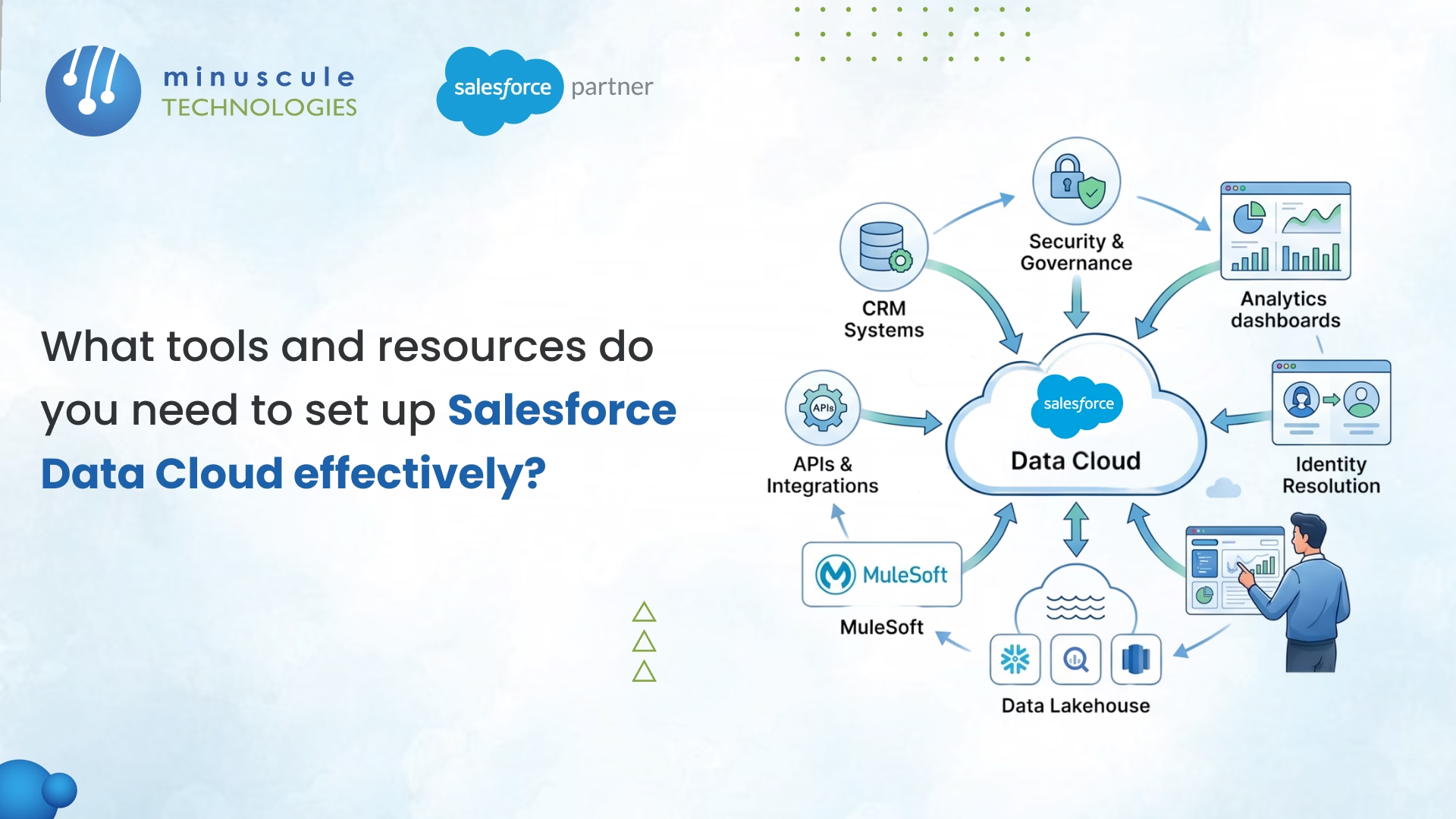
Data is everywhere, and it is growing faster than ever before. For many businesses, however, this data is scattered noise rather than actionable intelligence. Salesforce Data Cloud is intended to address this by connecting, harmonizing, and activating your data in real time.
Implementing this solid platform is not as simple as flipping a switch. Because it operates a modern Data Lakehouse architecture rather than a traditional relational database, it requires specific tools, configurations, and planning. This thorough guide breaks down exactly what tools and resources you need for a successful Salesforce Data Cloud implementation.
Salesforce Data Cloud relies on a powerful "Data Lakehouse" architecture to efficiently store data at scale. To get your data flowing, you will rely on these basic tools:
Once your data is connected, it must be mapped and processed so that it can be used across your enterprise. You will need to utilize several native objects and engines:
Once data is harmonized and profiles are built, you need tools to push that data into operational systems.
Handling massive amounts of customer data requires enterprise-grade security and budget tracking tools.
Software tools alone cannot fix broken data. A successful implementation relies heavily on upfront planning and human expertise.
Yes, for most enterprises, hiring a certified Salesforce consultant is highly practical. If you are dealing with multiple data sources, real-time pipelines, and intricate compliance requirements, a consultant can help you build the right architecture and accelerate implementation.
Zero Copy Integration permits businesses to securely access and query external data (such as data natively stored in Snowflake, Databricks, or Google BigQuery) directly from Data Cloud without copying or moving it. This eliminates traditional ETL processes, reduces data duplication, and ensures you query the most up-to-date data.
Calculated Insights (CI) processes full historical and multi-object data on a scheduled basis to compute durable metrics, such as Customer Lifetime Value and propensity scores. Streaming Insights (SI) evaluates incoming events in real time within defined time windows (e.g., detecting 3 product views in 15 minutes) to trigger instant actions.
It uses an Identity Resolution Engine that employs both deterministic (exact-match) and probabilistic (fuzzy-match) techniques. These tools map multiple identifiers—such as email addresses, phone numbers, and device IDs—to an Identity Graph to create a single, unified profile for each customer.
Salesforce Data Cloud uses a usage-based pricing model, powered by credits. Your costs scale based on data storage (measured in terabytes), data services (processing power), and add-on features. You can track and manage this credit usage directly through the Digital Wallet feature to ensure you get a clear return on investment.
Data Cloud uses an activation layer to push enriched profiles and audience segments directly to target platforms such as Marketing Cloud, Commerce Cloud, and external ad networks. When setting up an activation, you must adhere to system limits, such as a maximum of 20 related attributes per activation, all of which must sit on a singular data model object path.
While a traditional CDP often focuses solely on marketing use cases and relies on batch processing, Salesforce Data Cloud is a real-time intelligence platform serving the entire enterprise. It runs natively on Salesforce's Hyperforce infrastructure, smoothly integrating with Sales, Service, and Commerce Clouds without requiring custom middleware.
Yes, Data Cloud provides enterprise-grade security, guaranteeing all data is logically isolated and encrypted at rest and in transit using TLS 1.2+ and AES-256. It natively integrates with Salesforce Shield for event monitoring and field-level security, and it includes strong features to support GDPR and CCPA compliance (such as consent management and data deletion tools).
Ultimately, implementing Salesforce Data Cloud is much more than deploying a new database; it is a fundamental change in how your business handles information. As data grows at an unprecedented rate, isolated fragments of customer engagement are no longer sufficient to power modern, connected experiences. Salesforce Data Cloud acts as the vital connective tissue, turning scattered noise into actionable, real-time intelligence across your entire enterprise.
However, the true value of Data Cloud relies entirely on executing the setup correctly. Simply purchasing the platform will not solve underlying data hygiene issues or fragmentation. To succeed, you must pair the platform's powerful native tools—like Zero Copy Data Federation and the Identity Resolution Engine—with tight data governance and a clear architectural vision.
At Minuscule Technologies, we specialize in bridging the gap between raw data and operational excellence. We don't just connect sources; we architect intelligent data ecosystems that move your teams from reactive to predictive. Whether it's empowering sales with live signals or providing service agents with real-time context, we ensure your Data Cloud implementation is a secure, scalable foundation for the intelligent customer experiences of tomorrow.
Don't let architectural complexity stall your data strategy. Partner with Minuscule Technologies to design a high-performance Salesforce Data Cloud roadmap that delivers measurable business intelligence. Connect with our Data Cloud Strategists today to start your implementation.
You've seen what's possible. Now, let's make it happen for your business. Whether you need an end-to-end Salesforce solution, a complex integration, or ongoing managed services, our team is ready to deliver.

Schedule a Free Strategic Call


