
August 21, 2026
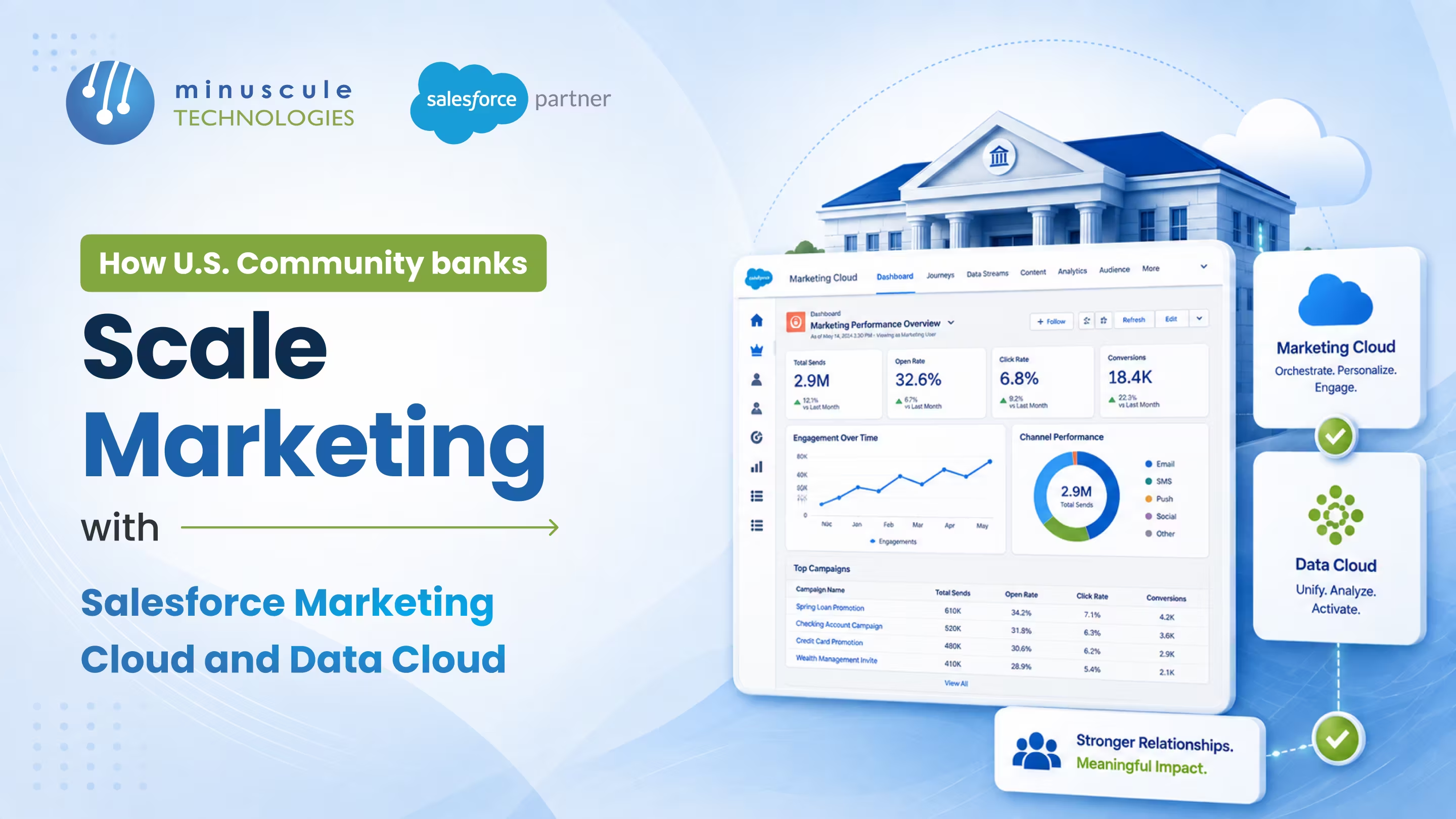
Salesforce Marketing Cloud - the platform Salesforce now markets as Agentforce Marketing - is a digital marketing system that automates email, SMS, mobile, web, and advertising campaigns from a single place. For a U.S. community bank, it works in three steps. It pulls account and transaction data from your core into Salesforce Data 360. It resolves that data into one profile per customer. Then it fires journeys off real banking events - a CD nearing maturity, a large outbound transfer, a mortgage payoff. That pairing is what lets a two-person marketing team run targeted deposit and lending campaigns that used to require an outside agency.
Here's what the stack actually does for a bank:
Picture a marketing director at a $1.4 billion bank with twelve branches. She has one analyst, a shared design contractor, and a spreadsheet of CDs maturing next quarter that she gets from treasury on the fifteenth of every month. She pulls a list. She writes copy. She routes it through compliance and loads it into the email tool. By then, a third of those certificates have walked out the door to a credit union offering nine more basis points. She isn't short on strategy. She's short on plumbing. This guide covers the plumbing. How the data moves. Which journeys pay for themselves first. What compliance needs nailed down before you turn anything on. And what a real rollout looks like when your whole marketing team fits in one office.
Salesforce Marketing Cloud is a digital marketing automation platform that builds, sends, and measures campaigns across email, SMS, push, web, and paid channels. SFMC is the common abbreviation, and you'll still hear it everywhere in job postings and vendor conversations.
The naming has shifted, which trips up a lot of buyers. Salesforce now brands the marketing product line Agentforce Marketing, while the underlying products remain Marketing Cloud Engagement, and the newer Marketing Cloud Next generation of Growth and Advanced Editions.. Salesforce Data Cloud also appears as Data 360 on some product pages. Same technology, different labels depending on which page you landed on - and if you're comparing quotes from two partners, make sure you're comparing the same SKU. Our breakdown of what changed in Marketing Cloud and who each edition suits goes deeper on the product line itself.
This is the distinction that decides whether your build works. Data Cloud unifies and resolves identity, then computes segments. Marketing Cloud activates those segments across channels. Banks that skip the Data Cloud layer end up rebuilding the same customer list in five different tools.
| Layer | Its job | What it looks like at a bank |
|---|---|---|
| Core banking system | Holds the record of truth on balances, rates, and transactions | Fiserv DNA or Premier, Jack Henry SilverLake or Symitar, FIS Horizon |
| Integration layer | Moves and reshapes data on a schedule or in near real time | MuleSoft, REST APIs, or a nightly batch file from the core vendor |
| Salesforce Data Cloud | Resolves identity, builds the household view, computes segments | One profile per household; a live "CD matures within 45 days" segment |
| Salesforce Marketing Cloud | Activates segments across email, SMS, push, and ads | A three-touch renewal journey with a branch-appointment offer |
| Financial Services Cloud | Gives bankers the relationship context behind the campaign | The relationship manager sees which offers a client already received |
Read that table bottom to top and you get the honest sequencing answer: most banks should stand up clean data before they buy more channels.
Edition choice usually comes down to send volume, how much of your team is technical, and whether you already own SFMC. The table below reflects what we typically see work at each asset tier.
| Edition | Typical fit | What you get | Watch out for |
|---|---|---|---|
| Marketing Cloud Growth Edition | Under roughly $1B in assets, one or two marketers | Built natively on the Salesforce platform, Flow-based automation, one admin skillset | Send and contact ceilings you can outgrow faster than you expect |
| Marketing Cloud Advanced | Roughly $1B to $5B in assets | More channels, deeper automation, room for multi-product journeys | Still only as good as the data feeding it |
| Marketing Cloud Engagement | Banks already running SFMC, or high monthly send volume | Journey Builder, SQL queries on Data Extensions, AMPscript control | Separate platform with a separate admin skillset to hire or rent |
| Marketing Cloud Next | New builds where agentic campaign creation is the draw | Agent-assisted campaign assembly on the core Salesforce platform | Migration paths from Engagement are still settling — confirm parity for the features you rely on |
So the sector is profitable and shrinking at once. The banks left standing chase the same deposits against fewer, bigger rivals. Their marketing budgets have not grown to match.
What we see over and over in BFSI engagements is that the constraint isn't creative. It's that customer data lives in four or five systems that don't agree with each other:
Because nothing joins those records, marketing defaults to what it can actually build: a monthly newsletter to everyone, and a rate sheet. Meanwhile one customer has a $180,000 CD maturing in three weeks and a mortgage payoff last month. She gets the same message as someone who opened a student checking account yesterday. That's not a targeting failure. It's an identity resolution failure, and it's exactly the problem a customer data platform for banks is designed to solve.
Community bank technology decisions tend to compound here. Every point solution added without a unifying data layer makes the next campaign harder, not easier. The Salesforce community has covered the data architecture well. Apex Hours has a solid walkthrough of Data Cloud's data model and ingestion patterns. Read it before you scope anything.
This is the step almost nobody publishes, and it's the one that decides whether the project works. Your core vendor is not going to hand you a streaming API on day one.
In practice, a workable data path for a community bank looks like this:
Step three is where projects stall. Identity resolution at a bank is hard. The same human shows up as a personal checking owner, a business account signer, and a co-borrower on a HELOC. Decide the household definition with your compliance and analytics people in the room before you write a single match rule.
A real customer 360 in banking means one profile that carries deposit balances, loan status, channel preferences, consent flags, and service history together. Once that exists, new things become possible. You can hide a checking-account offer from someone who already has three. You can route a high-balance customer's question to a relationship manager instead of the general queue. And you can see that the person who just moved $40,000 out is the same person who asked about CD rates last week. Here is how banks can build a 360° customer view in Salesforce.
Marketing gets the visible benefit, but the same profile feeds service and lending. That's why we usually scope Data Cloud work alongside Financial Services Cloud implementation rather than as an isolated marketing project — the data layer earns its cost across three departments, not one.
Generic marketing advice tells you to build a welcome series. Fine, do that. But these four journeys are where community banks see money move, and none of them are documented anywhere useful. Each one assumes Data Cloud is feeding the segment.
The single highest-value journey most community banks aren't running.
The reason this works is that it fires on a date the core already knows. You are not predicting anything. You're just showing up before the competitor does.
Attrition rarely announces itself. It shows up as a pattern of outbound transfers.
When you open a branch in a new market, you have a geography, not a list. Combine address data with third-party new-mover files, suppress anyone already in the core, and run a short local-proof sequence — the branch manager's name and face, hours, and one concrete reason to switch. Keep it to three touches and stop. New-mover windows close fast.
Most community banks under-monetize the business side because the data sits in a different place. Look for households where a business checking account exists but treasury services, merchant services, or a line of credit does not. Sequence by what the transaction pattern suggests: heavy incoming ACH volume points to treasury management, high card volume points to merchant services. Route the qualified ones to a commercial banker rather than trying to close in email.
Already running Account Engagement on the commercial side? The handoff between the two platforms needs real design work. We covered how Marketing Cloud and Account Engagement actually integrate, traps included, in a separate piece.
Marketing Cloud Personalization handles the real-time layer — what a returning visitor sees on your rate page, which product a logged-in customer gets nudged toward in digital banking. For a bank, the useful cases are narrow but they pay off. Show CD terms to someone who checked CD rates twice this week. Hide the mortgage banner from someone who just closed one. Move the branch appointment link to the top for a household with a large balance about to mature.
The agentic layer is newer and worth approaching carefully. Agent-assisted campaign building can draft copy, assemble audiences, and propose journey logic in minutes rather than days — a genuine relief for a marketing team of two. But bank marketing copy carries regulatory weight, and an agent that drafts a rate claim without the accompanying disclosure creates a UDAAP problem, not a productivity win.
The rule we apply on BFSI builds is simple: agents draft, humans approve, and nothing activates without a recorded approval. Build the approval step into the journey itself so it can't be skipped under deadline pressure. Salesforce Admins publishes practical guidance on automation governance and approval design that translates well to regulated environments.
Financial services marketing automation fails audits for boring, preventable reasons. Sort these out during the build, not after examiners ask.
| Rule | What it touches in your campaigns | Guardrail to build |
|---|---|---|
| Reg DD / Truth in Savings | Any APY or rate claim in email, SMS, or a landing page | Lock disclosure language into a reusable content block that authors cannot edit |
| Reg B / ECOA and FCRA | Prescreened or model-scored credit offers built from segments | Keep credit-bureau-derived attributes out of marketing segments; route firm offers through the compliant prescreen process |
| TCPA | SMS and mobile push journeys | Capture express written consent, honor stop keywords instantly, sync suppression back to Data Cloud |
| CAN-SPAM | Every promotional email | Physical mailing address, working unsubscribe, opt-outs honored within ten business days |
| UDAAP | All promotional copy, including anything an AI agent drafts | Human approval recorded before activation; no agent-authored claim ships unreviewed |
| E-SIGN and consent records | Preference centers and electronic disclosure delivery | Store consent as data in Data Cloud, not as a flag inside one channel tool |
| Third-party risk (FFIEC guidance) | Vendor onboarding for the martech stack itself | Document data flows and retention before procurement review, not during it |
One practical note: put consent in the data layer. Banks that keep opt-out status inside the email platform discover during their first SMS campaign that the two systems disagree, and reconciling them after the fact is painful.
A Salesforce Marketing Cloud implementation at a community bank is not a scaled-down enterprise project. The sequencing is different because your constraint is people, not budget.
Flip that order and you pay for it. Teams who buy channels first and fix data later spend year one building lists by hand, wondering why the platform feels so heavy. Our Marketing Cloud implementation practice sequences it the other way around for exactly this reason.
Most community banks already own something that sends email. The question is whether Marketing Cloud replaces it or sits above it. A few honest guidelines:
Community banking software choices are sticky, and the realistic answer for most institutions is a layered stack rather than a rip-and-replace. What matters is that exactly one system owns identity and consent. Salesforce Codex covers integration architecture patterns that are useful when you're deciding where those boundaries sit.
Nobody publishes real numbers here, so let's be direct about the shape of the spend. Budget for four things, not one. Platform licensing. Data Cloud consumption. Integration work to get core data flowing. And either an internal admin or a partner on retainer. The integration line is the one people lowball. It is often the biggest first-year cost at a bank, because core extracts are rarely as clean as the vendor said.
Salesforce Data 360 pricing runs on consumption, which cuts both ways for a community bank. You aren't paying enterprise seat counts, but an unbounded ingestion design can surprise you. Scope which objects you actually need for marketing before you turn on the tap.
For the board conversation, engagement metrics are the wrong currency. Open rates don't defend a budget line. What works:
Set up that attribution join in phase one even though you won't need it until phase two. Retrofitting it later means arguing about numbers instead of results. For a practical view of reporting design on the platform, Salesforce Geek publishes hands-on tutorials on dashboards and analytics that fill in the mechanics.
Salesforce Marketing Cloud is a digital marketing automation platform that lets you build, send, and measure campaigns across email, SMS, mobile push, web, and paid advertising from one system. Salesforce now markets it as Agentforce Marketing, with Marketing Cloud Engagement, Growth, Advanced, and Next as the editions underneath. For banks, its value comes from connecting to unified customer data so campaigns trigger on real account behavior instead of a calendar.
SFMC is the standard abbreviation for Salesforce Marketing Cloud. You'll see it constantly in job listings, certification names, and partner conversations. It refers to the same product family, most often to Marketing Cloud Engagement specifically.
Salesforce currently markets the product line as Agentforce Marketing, and you'll see "formerly Marketing Cloud" alongside it on Salesforce's own pages. The individual products kept their names — Marketing Cloud Engagement, Marketing Cloud Growth, Marketing Cloud Advanced, and Marketing Cloud Next. Salesforce Data 360 also appears as Data 360 in places, so confirm SKU names on any quote you receive.
Salesforce is the broader platform, with CRM products like Sales Cloud, Service Cloud, and Financial Services Cloud that manage relationships and internal work. Salesforce Marketing Cloud is the outbound marketing layer that runs campaigns to customers and prospects. At a bank, Financial Services Cloud is where the banker works, Data Cloud is where customer identity is resolved, and Marketing Cloud is what reaches the customer.
It depends far more on your data situation than your asset size. A bank under $1 billion with clean core extracts and one capable marketer can run Marketing Cloud Growth productively. A larger bank with five disconnected systems and no data owner will struggle regardless of edition. If you can't answer "which system owns customer identity," fix that before buying anything.
Almost always through a staged path rather than a direct connector. The core delivers a scheduled extract. An integration layer such as MuleSoft lands and reshapes it. Data Cloud takes it in and resolves identity. Marketing Cloud then subscribes to the segments that come out. Direct core-to-marketing connections are rare and generally not worth engineering.
Not necessarily for Marketing Cloud Growth, which a strong marketing operations person can administer with Flow. Marketing Cloud Engagement is a different story. SQL on Data Extensions and AMPscript are real skills. Most community banks either train one person deeply or keep a partner on retainer instead of hiring a full-time specialist.
Expect the data foundation phase to take longer than the campaign work. Getting core extracts reliable, identity resolution agreed, and consent modeled correctly is typically a multi-month effort. The first working journey after that comes together comparatively fast, because the hard part is already done.
Community bank marketing doesn't lose to bigger budgets nearly as often as it loses to disconnected data. The banks pulling ahead aren't sending more email. They're sending email that fires on a maturity date the core already knew about. The disclosure block is one compliance already approved. And it goes to a household the system reads as one relationship, not four account numbers. That's an engineering outcome before it's a marketing one.
Start with the CD maturity journey. It's the shortest path from "we bought a platform" to "here's the retained balance," and it forces you to solve identity resolution, consent, and attribution on a single, defensible use case. Everything else gets easier once that pipeline exists.
If you want a clear-eyed read on whether your core data can support this before you commit to licensing, book a strategic Salesforce call with our team. We'll walk your core extracts, identity model, and consent setup. Then we'll tell you plainly what phase one has to look like - including where our BFSI engineering work hit the same walls.
You've seen what's possible. Now, let's make it happen for your business. Whether you need an end-to-end Salesforce solution, a complex integration, or ongoing managed services, our team is ready to deliver.

Schedule a Free Strategic Call


Plot No. 4, Sridevi Amman Street, Perumal Nagar Extension, Old Pallavaram, Chennai, Tamil Nadu 600117, India.
