Why Salesforce Consulting Services Are Essential for Business Growth and Success

Article Written By:
Sajiv Narayanan
Created On:
 Why Salesforce Consulting Services Are Essential for Business Growth and Success

The mid-market CFO opens the quarterly review. Pipeline is up. Win rate is flat. Customer churn is creeping. The Salesforce admin who joined eighteen months ago has built reports, configured page layouts, added users, fixed validation rules. Everything she was asked to do, she's done.

The thing nobody asked her - connect Sales Cloud forecasting to quote-to-cash data, build customer 360 across sales and service, design renewals automation, plan the multi-cloud rollout - sits untouched. Not her fault. It's not an admin job.

This is the moment most mid-market and enterprise Salesforce customers face. The platform delivers the basics. The growth opportunities — better forecasting, customer-360 visibility, renewal automation, multi-cloud orchestration, AI insights — sit just beyond the internal team's bandwidth and skill mix.

The fix is Salesforce consulting services - partners who bring multi-cloud architects, industry expertise, integration depth, and change management to convert platform potential into measurable business growth.

Here's why Salesforce consulting services are essential for business growth and success.

1. Where in-house Salesforce hits its ceiling

Six things internal admins consistently can't deliver alone.

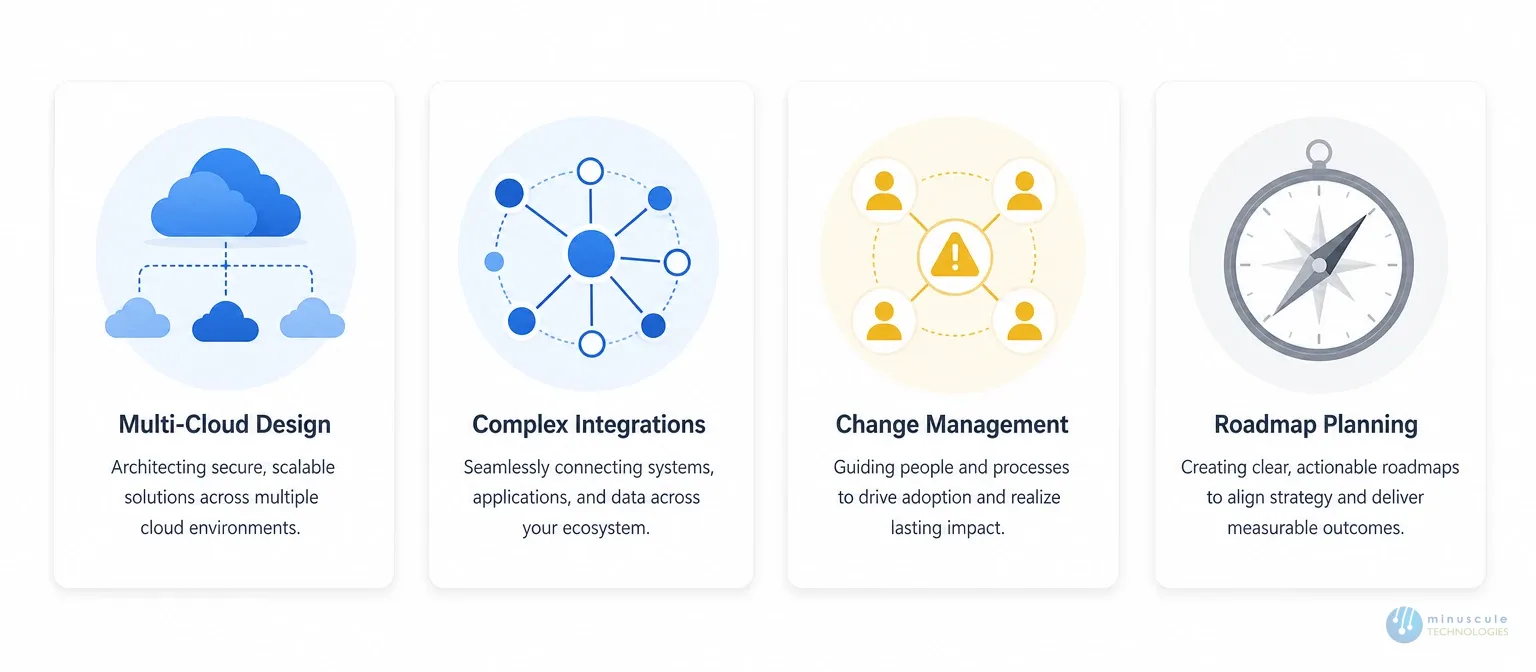
  • Multi-cloud architecture decisions: Sales Cloud + Service Cloud + Marketing Cloud + Experience Cloud + Data Cloud integration patterns require architect-level expertise.
  • Complex integration design: ERP, accounting, marketing automation, e-commerce, payment, telephony — connector choice, retry logic, error handling, latency targets.
  • Industry-specific configurations: Manufacturing CPQ, BFSI compliance, healthcare FHIR, higher-ed FERPA — vertical knowledge admins don't accumulate from one role.
  • Change management across departments: Sales adoption, service adoption, marketing adoption, executive adoption — different audiences, different playbooks.
  • Salesforce release coverage: Three platform releases per year. Each can break customisations. Internal teams rarely have bandwidth for systematic pre-release testing.
  • Strategic roadmap planning: Phasing multi-cloud rollouts, prioritising integrations, sequencing AI use cases. Requires experience with what's worked across many customers.

Each of these is a senior-architect skillset. Hiring all of them is hard; consulting brings them on demand.

2. What consulting partners bring beyond admin work

Six capabilities consulting engagements deliver.

  • Multi-cloud certified architects: Architects who have shipped multiple rollouts across sales, service, marketing, advancement, and AI.
  • Industry vertical expertise: Pre-built patterns and accelerators for BFSI, manufacturing, healthcare, higher education, retail.
  • Integration platform depth: MuleSoft, Boomi, Workato, Celigo, plus deep ERP integration experience (SAP, Oracle, NetSuite, Dynamics).
  • Change management methodology: User training, role-based playbooks, executive communication, adoption metrics, hypercare.
  • Project velocity: Eight-month projects delivered in eight months because the partner has done it before.
  • Long-term advisory relationship: Strategic roadmap reviews, architecture audits, technical debt management — the steady-state engineering an admin doesn't have time for.

Consulting is the difference between "Salesforce installed" and "Salesforce driving growth."
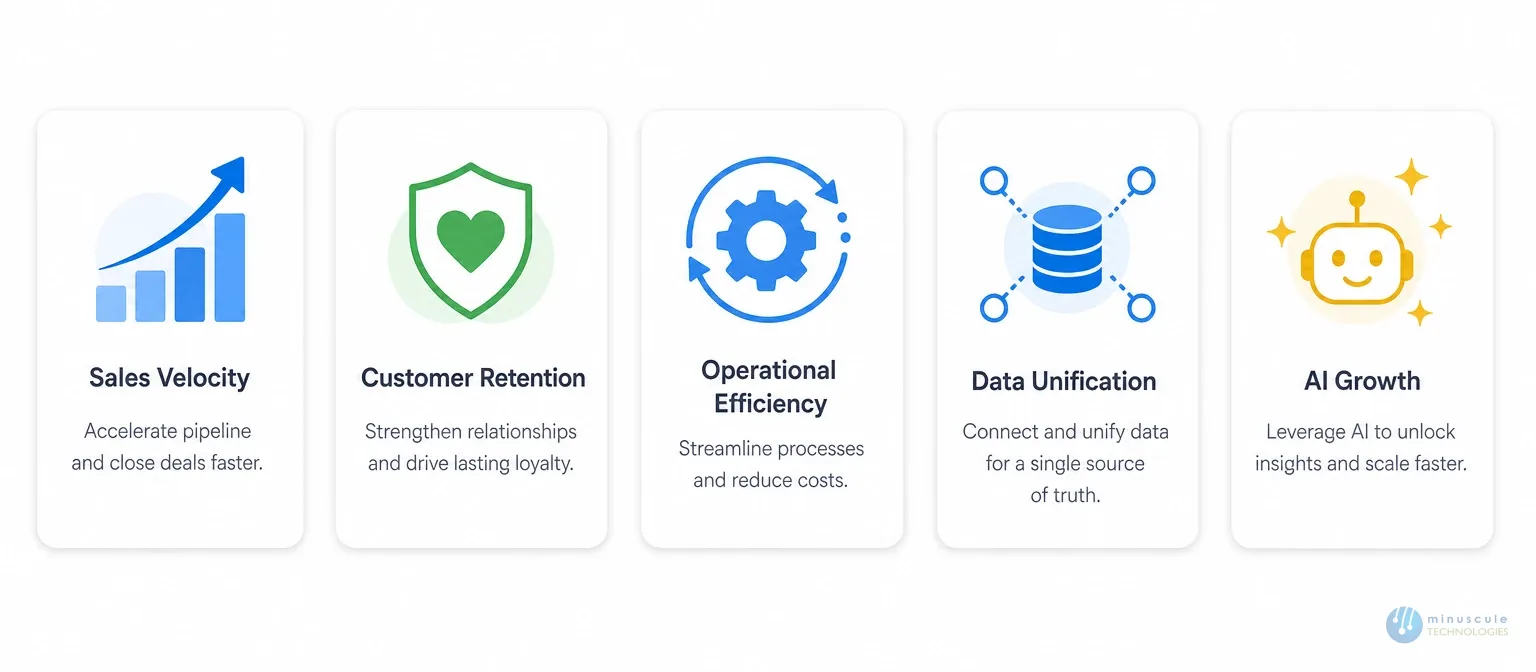
3. The five growth levers consulting unlocks

Lever 1 - Sales velocity and forecast accuracy

Sales Cloud, CPQ, and Revenue Cloud configured to compress quote-to-cash, lift win rate, and surface predictive forecasting signals. Salesforce features only deliver value when configured against the real sales motion.

Lever 2 - Customer experience and retention

Service Cloud, Experience Cloud, and Marketing Cloud orchestrated to reduce churn, lift NPS, and convert support interactions into renewal conversations.

Lever 3 - Operational efficiency

Process automation through Flows and Apex, integration with ERP and accounting, manual workflow elimination. Less work to maintain the same revenue.

Lever 4 - Data unification and decision-making

Data Cloud, Tableau, CRM Analytics give executives reliable dashboards. Decisions made on data, not gut.

Lever 5 - AI and Agentforce-driven growth

Agentforce agents handling tier-zero service, Einstein scoring for lead prioritisation, predictive forecasting. Growth without proportional headcount lift.

4. The consulting engagement models

Four models institutions and enterprises choose between.

Model 1 - Implementation project

Defined scope, fixed timeline, deliverables-based pricing. Best for major rollouts - new cloud, migration, multi-cloud orchestration.

Model 2 - Staff augmentation

Consulting resources embedded with the internal team for a defined period. Best for institutions with strong internal leadership but skill gaps in specific areas.

Model 3 - Managed services

Ongoing operational support - admin, development, release management, integration monitoring. Best for steady-state coverage when the institution doesn't want full-time admin headcount.

Model 4 - Strategic advisory

Senior architect and partner principals on retainer for roadmap, architecture review, and strategic decisions. Best for enterprises with mature internal teams needing executive-level guidance.

Most mature engagements combine two or three models - project for new builds, managed services for ongoing operations, advisory for strategic direction.

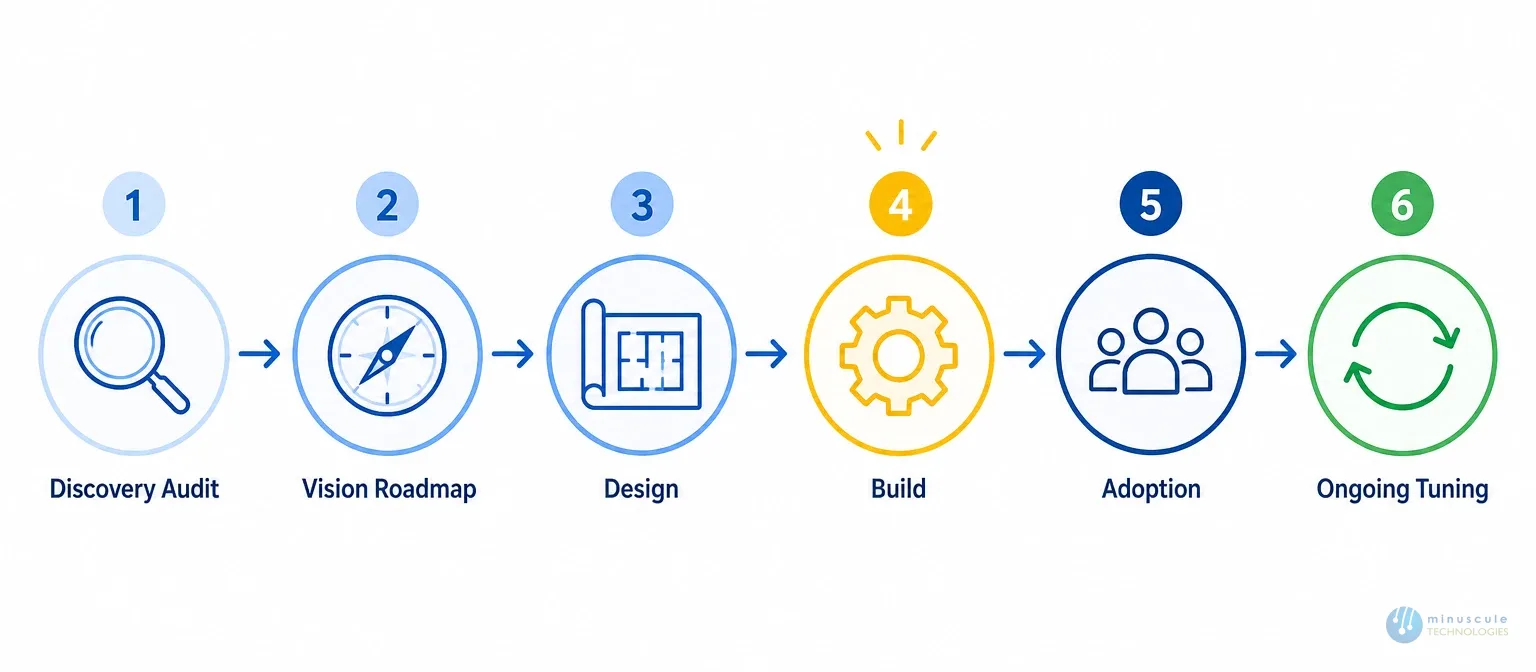
5. The framework consulting partners follow

Six phases of a structured growth-focused engagement.

Phase 1 - Discovery and current-state audit

Salesforce footprint assessment, integration landscape, technical debt inventory, user adoption analysis. Findings sized by business impact.

Phase 2 - Future-state vision and roadmap

Aligned with business priorities - sales growth, customer experience, operational efficiency, AI readiness. Roadmap with milestones, KPIs, decision gates.

Phase 3 - Architecture and design

Multi-cloud architecture, integration patterns, data model, security and compliance design. Documented before code.

Phase 4 - Build and configuration

Iterative delivery in sandbox, sprint reviews, continuous validation. CI/CD pipelines enforced.

Phase 5 - Adoption and change management

User training tailored by role, communication plans, executive enablement, hypercare for go-live.

Phase 6 - Continuous optimisation

Post-launch operational support, release management, technical debt remediation, expansion planning.

6. Validation rules for engaging a partner

Six rules every Salesforce consulting engagement should observe.

Salesforce partner tier verified

Summit, Premier, or Specialised partner status. AppExchange listing, customer reviews, certified architect count.

Industry-specific case studies on record

Partner has shipped at least three engagements in the customer's industry. References are checked.

Outcome-based SLAs where possible

Define success metrics - adoption rates, deflection rates, revenue lift, integration uptime — with the partner accountable to them.

Knowledge transfer as a contractual deliverable

Architecture documentation, runbooks, configuration explanations all delivered. No black-box engagements.

Sandbox-first deployment for every change

Production changes go through sandbox testing and validation gates. CI/CD pipeline enforces.

Exit and transition plan documented

End-of-engagement knowledge transfer, runbook handoff, and sixty-day transition period defined in the contract.

7. Frequently Asked Questions

1. How do we know if we need consulting vs hiring more admins?

If the work is daily user support, page-layout tweaks, and reports - hire an admin. If the work is multi-cloud architecture, integration design, change management, or strategic roadmap — engage consulting. Many enterprises do both.

2. How long does a typical consulting engagement last?

Implementation projects: three to twelve months. Staff augmentation: six to eighteen months. Managed services: ongoing, with quarterly reviews. Strategic advisory: annual retainer with monthly cadence.

3. What's the ROI we should expect from consulting?

Depends on scope. Sales-focused engagements typically target win rate lift, deal velocity, and forecast accuracy. Service-focused engagements target deflection, CSAT, and agent productivity. Integration engagements target manual work elimination. Set metrics upfront; track monthly.

4. Can a consulting partner handle our entire Salesforce operation?

Yes, under a managed services model. Most enterprises retain a small internal team - admin lead, business analyst - and outsource development, integration, release management, and strategic advisory to the partner. The hybrid model is the most common in mid-market and enterprise.

Salesforce works. Consulting makes it work harder.

Salesforce delivers features. Consulting delivers outcomes. The platform supports growth across sales, service, marketing, operations, and AI - but only when configured by people who've done it before. Five growth levers, four engagement models, six framework phases, six validation rules. Built right, the CFO opens the quarterly review with win rate up, churn down, and a roadmap the board can fund for the next year.

Minuscule Technologies is a Trusted Salesforce Engineering Partner with 160+ Salesforce experts and 75+ projects delivered globally - including Nasdaq-listed enterprises across BFSI, manufacturing, IT services, and higher education. We deliver Salesforce consulting across Sales Cloud, Service Cloud, Marketing Cloud, Experience Cloud, Data Cloud, Agentforce, MuleSoft, and managed services - for enterprises that need their Salesforce investment to drive real business growth.

Plan your Salesforce growth roadmap with us and we'll review your platform footprint, growth priorities, integration architecture, and the consulting engagement that fits your business.

Contact Us for Free Consultation
Thank you! We will get back in touch with you within 48 hours.
Oops! Something went wrong while submitting the form.

Recent Blogs

Ready to Architect Your Salesforce Success?

You've seen what's possible. Now, let's make it happen for your business. Whether you need an end-to-end Salesforce solution, a complex integration, or ongoing managed services, our team is ready to deliver.

Schedule a Free Strategic Call