We are at Dreamforce 2026, Industry Pavilion at San Francisco


June 15, 2026
A financial services firm had one person who knew Salesforce Marketing Cloud inside and out. She had built every customer journey, written every SQL query, set up every data extension, and configured the CRM sync. Then she resigned.
For three weeks, the marketing team watched open rates fall, bounce rates climb, and automated journeys stall mid-sequence. A campaign went out to a suppression list that had not been refreshed in months. The damage to email deliverability took longer to fix than the original hire. And the new hire — even a certified Marketing Cloud specialist — spent their first two months reverse-engineering what had been built, not improving it.
This is not an unusual story. Salesforce Marketing Cloud is one of the most operationally demanding platforms in the Salesforce ecosystem. It is not a configure-once-and-maintain tool. Campaigns run daily. Audiences refresh constantly. Journeys break when data changes upstream. Deliverability requires active, ongoing management. Most businesses, regardless of their industry, reach a point where a single in-house specialist - or a stretched marketing team - cannot keep up. That is where Salesforce Marketing Cloud Managed Services fill the gap.
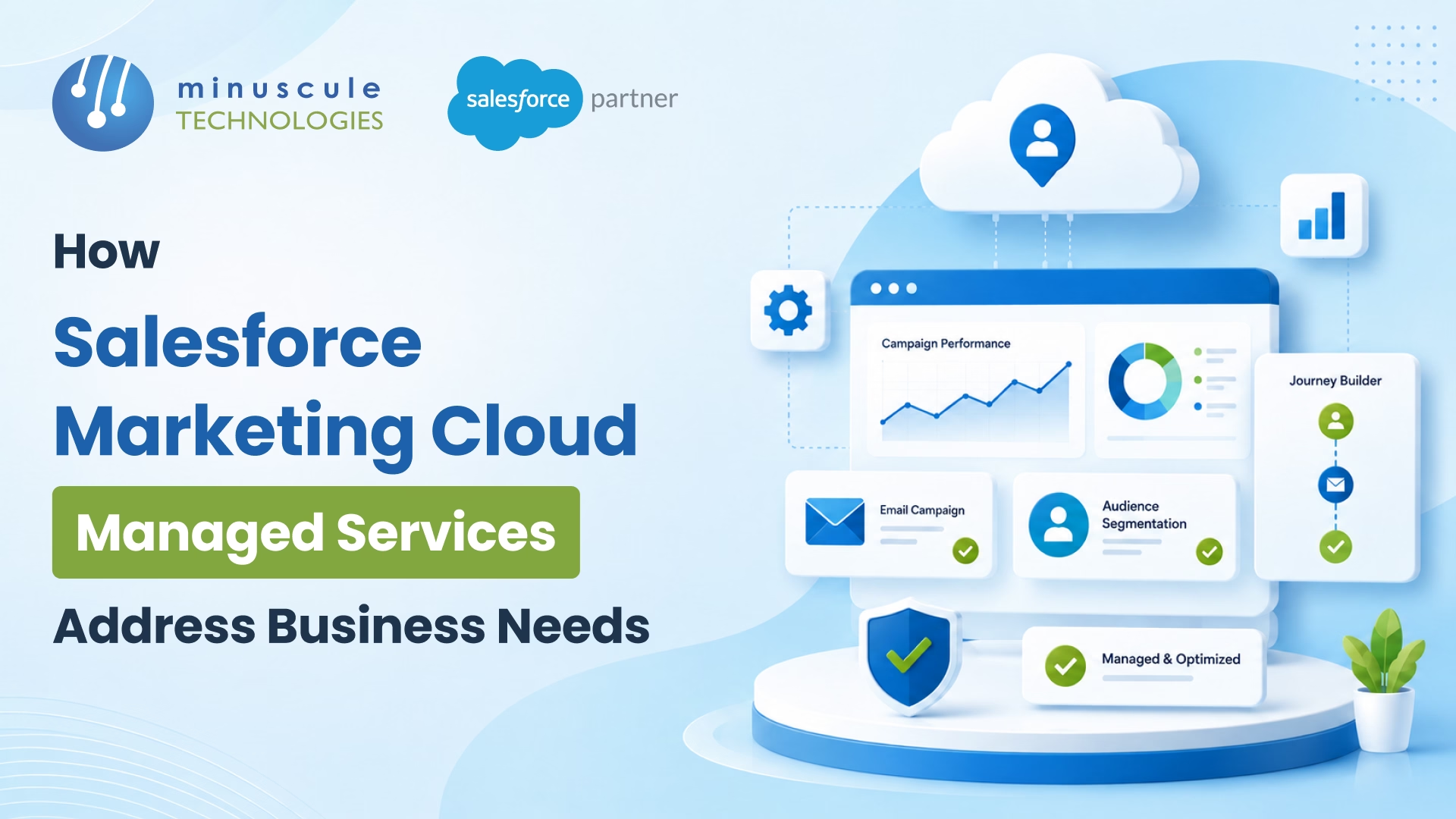
Salesforce Marketing Cloud Managed Services is an ongoing engagement where a certified partner team handles the day-to-day operations, optimization, and health of your Marketing Cloud environment - as an extension of your marketing team, not a replacement for your strategy.
This is distinct from a one-time Salesforce Marketing Cloud implementation. Implementation gets the platform live. Managed services keep it performing - through every campaign cycle, every Salesforce release, and every change in your underlying CRM data.
The scope typically covers campaign operations, Journey Builder management, audience and data hygiene, email deliverability, Einstein AI configuration, platform monitoring, and reporting. What specific services your business needs depends on the complexity of your SFMC environment and the capability gaps on your internal team.
Building, testing, scheduling, and deploying email campaigns in Marketing Cloud requires hands-on expertise in Email Studio, Content Builder, and Ampscript for dynamic content. For organizations that run high-frequency campaigns - weekly newsletters, promotional sends, transactional notifications - this is a significant operational load. A managed services team absorbs this work, maintains brand and compliance standards across every send, and handles QA before deployment. For industries like financial services and manufacturing, where a misconfigured send can have regulatory or reputational consequences, having certified specialists on every send matters.
Journey Builder is Marketing Cloud's most valuable capability and its most fragile. Multi-step journeys with decision splits, wait steps, Einstein engagement scoring, and Sales Cloud entry criteria will break when upstream data changes - a field rename, a CRM schema update, a data extension refresh that runs late. Most businesses do not discover a broken journey until they notice a drop in conversions or a customer complains they received the wrong communication at the wrong time. A managed services team monitors active journeys, catches errors before they affect customers, and keeps journeys aligned with your CRM as it evolves. Minuscule's Salesforce Integration capability means the Marketing Cloud–Sales Cloud connection is managed as part of the same team, not handed between vendors.
Salesforce Marketing Cloud stores contact data in data extensions, and without regular maintenance, they accumulate duplicates, stale records, invalid addresses, and outdated segments. Over time, this degrades send performance, inflates contact counts, and increases the risk of deliverability issues. Managed services includes ongoing data extension housekeeping, suppression list management, SQL query maintenance for dynamic audience segmentation, and regular audits to keep your data clean and your contact volumes accurate.
Deliverability is the silent metric most businesses ignore until it becomes a crisis. Sending to stale lists, ignoring bounce patterns, or failing to warm a new dedicated IP correctly can result in spam folder placement across entire domain segments — damage that takes months to repair. A managed services partner monitors your sender score, bounce rates, and complaint rates on an ongoing basis, responds to deliverability signals proactively, and manages IP warming when you add sending capacity. Salesforce's own Marketing Cloud best practices guidance underscores that deliverability management is an ongoing operational responsibility, not a one-time setup task.
Most organizations that have Salesforce Marketing Cloud also have access to Einstein features — Einstein Send Time Optimization, Einstein Engagement Scoring, Einstein Content Tagging - and most of them are not using these features at all, or have them enabled but untuned. Einstein Send Time Optimization, for example, requires sufficient send history and correctly structured audience data to produce meaningful send-time predictions. Getting it right requires hands-on configuration and ongoing adjustment. A managed services team activates these features correctly, monitors their performance, and adjusts configuration as your audience behavior evolves.
Salesforce releases three major updates per year, and Marketing Cloud often introduces breaking changes, deprecated features, or new capabilities that require immediate attention. Managing these updates - testing against your active journeys, updating automations that reference deprecated features, adopting capabilities that improve your campaigns - is a full-time task during release windows. Without it, businesses discover broken features in production. A managed services partner handles release readiness, regression testing, and adoption of new capabilities as part of the ongoing engagement. Minuscule's Salesforce Consulting team tracks every release and prepares impact assessments before updates hit your production environment.
In financial services, Marketing Cloud managed services covers consent management, opt-out compliance, communication archiving, and regulatory-compliant journey design. Transactional and marketing communications must be cleanly separated, suppression lists must be flawlessly maintained, and every send must be logged. This cannot be left to a stretched internal team.
For manufacturing and automotive businesses running dealer communication programs, product launch campaigns, and service follow-up sequences, managed services keeps the operational layer running - dealer list management, territory-based segmentation, localized campaign deployment - while the internal team focuses on strategy and commercial priorities. Minuscule's experience with Salesforce Managed Services in manufacturing-context environments means these programs are supported by teams who understand the ERP and dealer network data that feeds Marketing Cloud, not just the marketing platform itself.
Patient journey automation requires careful management of communication frequency, consent status, and data privacy. Managed services ensures that journeys stay compliant as contact data changes and that no patient receives a communication outside their consent scope.
Not every organization needs managed services from day one. The signal to consider it is usually one of the following: your in-house SFMC specialist is a single point of failure; your campaigns have grown in complexity faster than your team's capacity; you are consistently behind on Salesforce releases; or you are not using the Einstein features your license includes.
For businesses that implemented Marketing Cloud in the last twelve to eighteen months, managed services is also the natural next step — when the implementation partner has handed over a live environment, a managed services engagement keeps optimization momentum going rather than letting the platform plateau. Minuscule's team handles this transition without a knowledge gap, because Minuscule's implementation and managed services practices are run by the same certified team.
The scope typically includes day-to-day campaign operations (Email Studio, Journey Builder), data extension management and audience hygiene, email deliverability monitoring, Einstein AI feature configuration, Marketing Cloud Connect maintenance, Salesforce release management, and performance reporting. The exact scope is defined based on the complexity of your environment and your internal team's capability gaps.
A support contract typically covers break-fix issues - something stopped working, and a ticket is raised to fix it. Managed services is proactive: the partner team monitors your environment on an ongoing basis, prevents issues before they affect campaigns, optimizes performance continuously, and handles operational tasks your team doesn't have capacity for. It operates as an extension of your marketing team, not a helpdesk.
It depends on the volume and complexity of your Marketing Cloud operations. If your in-house specialist is managing campaigns, data hygiene, deliverability, journey maintenance, and release updates for a complex environment, they are likely spread too thin to do all of it well. Managed services can handle the operational layer so your specialist focuses on strategy, new feature adoption, and stakeholder priorities rather than maintenance.
Marketing Cloud Managed Services should be closely integrated with whoever manages your Sales Cloud and Service Cloud environments, because Marketing Cloud Connect — the integration that syncs contact and lead data between systems - requires coordination across both platforms. The best managed services engagements are delivered by a team that handles the full Salesforce stack, not a Marketing Cloud-only specialist who has no visibility into what's happening in your CRM.
In most cases, businesses see measurable improvement in deliverability, campaign throughput, and data quality within the first quarter of a managed services engagement. Journey reliability and Einstein feature performance typically improve over the first two to three months as the team stabilizes existing configurations, addresses accumulated technical debt, and tunes Einstein models against current audience data.
Salesforce Marketing Cloud is powerful precisely because it runs complex, high-frequency, data-driven communications at scale. That same complexity is what makes ongoing managed support not a luxury, but a practical necessity for most businesses that depend on it.
The organizations that get the most from Marketing Cloud are not the ones with the biggest internal teams. They are the ones with the right external partner - one that monitors their environment daily, keeps their data clean, their journeys running, their deliverability healthy, and their Einstein features actually working.
With 160+ certified Salesforce experts and 75+ enterprise projects delivered, Minuscule Technologies provides Marketing Cloud Managed Services that go beyond platform monitoring. We connect Marketing Cloud to the SAP, PeopleSoft, and Denodo environments our clients run, manage the full Sales Cloud and Service Cloud integration layer, and bring end-to-end engineering depth to every engagement. Whether you are recovering from a specialist departure, scaling a campaign operation, or simply not getting enough from a platform you've already paid for, we're here to close the gap. Talk to us.
You've seen what's possible. Now, let's make it happen for your business. Whether you need an end-to-end Salesforce solution, a complex integration, or ongoing managed services, our team is ready to deliver.

Schedule a Free Strategic Call


