

May 22, 2026
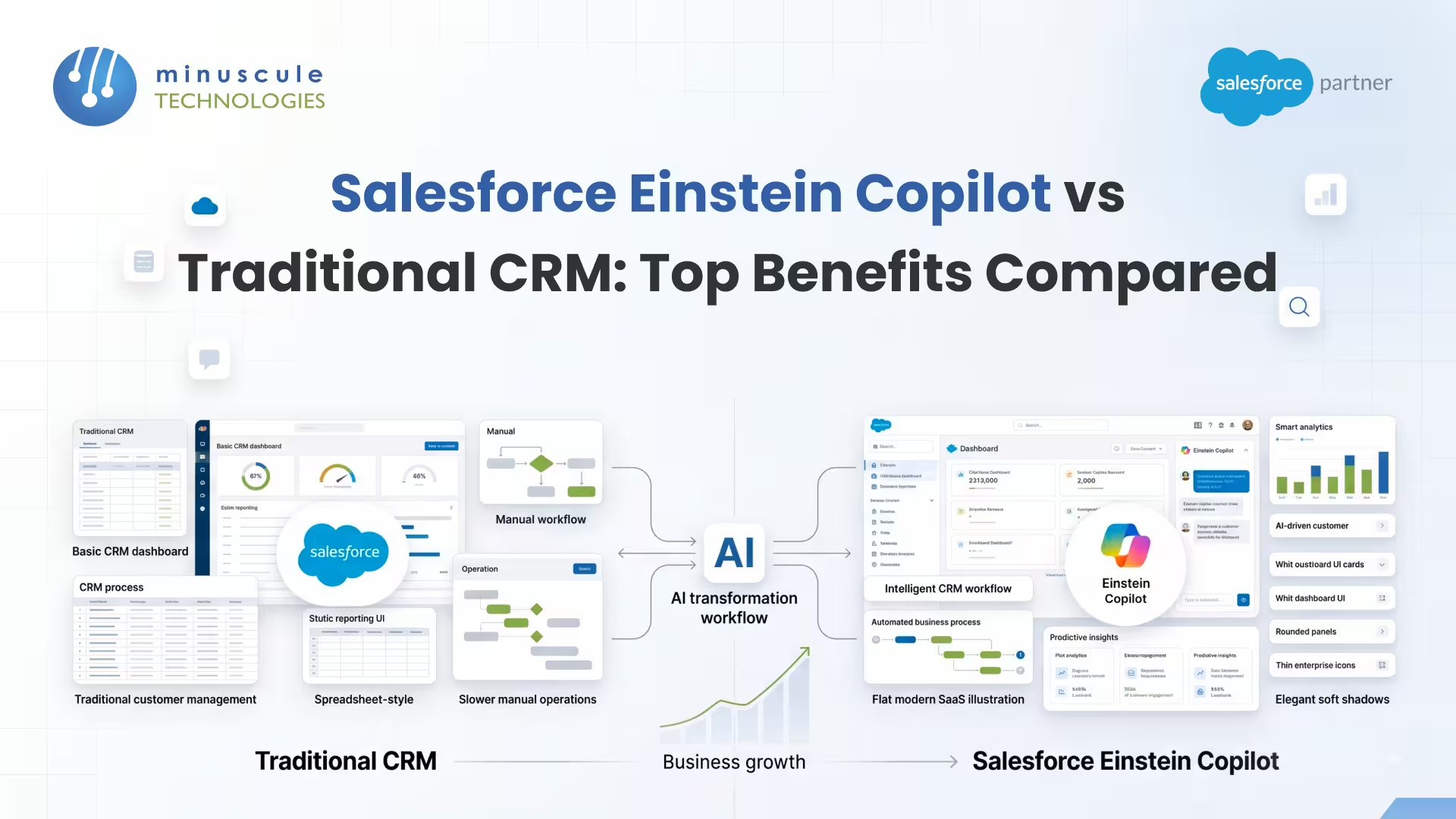
Salesforce Einstein Copilot - now evolved into Agentforce - is an AI assistant built directly into your CRM that generates emails, summarizes records, predicts deal outcomes, and automates multi-step workflows using natural language prompts. Traditional CRM, by contrast, is a database. A powerful one, sure, but still fundamentally a system that stores what your team types into it and reports back what you ask it to report.
That distinction matters more than most comparison articles admit. A traditional CRM tells you that a deal has been stuck in Stage 3 for 22 days. Einstein Copilot tells you why (the primary contact hasn't opened the last three emails), what to do about it (re-engage through their preferred channel - LinkedIn, based on past response patterns), and drafts the outreach message for you. One system records history. The other acts on it.
Salesforce's own data puts the productivity gain at 37% for sales teams using Einstein AI features. But the real question isn't whether AI-powered CRM is better - it obviously is, in theory. The question is whether your org is ready for it, whether the ROI justifies the license cost, and where Einstein Copilot actually outperforms traditional CRM in day-to-day work versus where the marketing gets ahead of the reality. This guide covers all of that.
Einstein Copilot launched in February 2024 as Salesforce's conversational AI assistant - a chat-based interface embedded across Sales Cloud, Service Cloud, Marketing Cloud, Commerce Cloud, and custom Lightning apps. You type a question or instruction in natural language ("summarize this account's activity for the last 90 days" or "draft a follow-up email for this opportunity"), and Einstein processes the request using your org's CRM data, generates a response, and can execute actions directly in Salesforce.
The technology stack under the hood has three layers. The large language model (powered by a combination of proprietary and third-party models, including partnerships with OpenAI and Anthropic) handles natural language understanding and generation. The Data Cloud unifies structured and unstructured customer data from across your Salesforce org and connected external systems - giving Einstein context beyond what lives in standard CRM fields. And Copilot Actions are the pre-built and custom functions that Einstein can execute: creating records, sending emails, updating fields, running reports, querying knowledge bases, and triggering Flows.
In September 2024, Salesforce rebranded Einstein Copilot as part of the broader Agentforce platform. The naming shift reflects a strategic pivot: from a "copilot" that assists humans to "agents" that can operate autonomously on defined tasks. The technology didn't change overnight - most of what Einstein Copilot could do carried directly into Agentforce. But the licensing model, the capabilities roadmap, and the marketing positioning shifted significantly. More on that distinction later.
For this article, we'll use "Einstein Copilot" when discussing the AI assistant functionality and "Agentforce" when discussing the broader autonomous agent platform, since both terms show up in current Salesforce documentation and the distinction matters for purchasing decisions.
Traditional CRM - whether that's Salesforce without Einstein, HubSpot Free, Zoho CRM, Pipedrive, or Microsoft Dynamics 365 without Copilot — is fundamentally a structured database with a user interface on top. Your team logs activities, updates opportunity stages, attaches files, and records notes. The CRM stores that data, lets you search and filter it, generates reports, and sends automated notifications based on rules you define.
That model has worked well for two decades. It still works. Plenty of businesses run successfully on traditional CRM. But the model has three structural limitations that AI-powered CRM addresses:
Limitation 1: It only knows what you tell it. A traditional CRM's data quality depends entirely on how diligently your team logs information. Reps skip call notes because they're rushing between meetings. Managers forget to update deal stages. Customer emails sit in inboxes instead of getting linked to records. The result: your CRM shows a partial, often outdated picture of reality. Salesforce estimates that CRM data decays at 30% per year without active maintenance.
Limitation 2: It reports the past but can't predict the future. Traditional dashboards show you what happened - deals closed last month, pipeline coverage ratios, average sales cycle length. Useful, but backward-looking. You don't get answers to the questions that actually drive revenue: "Which deals in my pipeline are most likely to close this quarter?" or "Which accounts are showing early churn signals?" Those require predictive analytics that traditional CRM doesn't include.
Limitation 3: Automation is rule-based, not intelligent. Traditional CRM automation works on if-then logic: if a lead fills out a form, then assign it to a rep. If a case isn't resolved in 48 hours, then escalate it. These rules are rigid. They don't adapt to context, can't handle ambiguity, and break when your process changes. Einstein Copilot handles the same scenarios with contextual intelligence - routing a lead not just by geography but by the rep's current workload, win rate on similar deals, and available calendar slots.
This is the comparison that actually matters for purchase decisions. Not marketing bullet points - functional differences you'll feel in daily use.
The biggest immediate impact isn't a flashy AI feature - it's time recovery. Activity logging, email drafting, CRM updates, and research that used to eat 1-2 hours daily now happen in the background or with a single prompt. Salesforce reports that Einstein users save an average of 11 hours per week per rep on administrative tasks. Even discounting that number by half for real-world conditions, 5-6 recovered hours per week per rep is substantial. For a 20-person sales team, that's 100+ hours weekly redirected from data entry to selling.
Traditional lead scoring is a fiction most sales teams maintain but don't trust. The scores drift as market conditions change and nobody recalibrates the rules. Einstein Lead Scoring rebuilds its model continuously based on your actual conversion data. It learns which attributes, behaviors, and timing patterns predict real deals — not the patterns your marketing team assumed two years ago when they set up the original scoring rules.
Manual forecasts are aspirational. Reps inflate deals they want to close and sandbag deals they're not sure about. Einstein Forecasting overlays AI predictions on top of rep-submitted estimates, flagging where the two diverge. It also catches pipeline patterns humans miss - like the fact that deals with three or more stakeholders involved close at 2x the rate of single-contact deals in your org, even when the rep is less optimistic about those deals.
Service Cloud with Einstein cuts average handle time by routing cases to the right agent, auto-suggesting Knowledge articles, and drafting initial responses. One metric that consistently shows up in Salesforce consulting implementations: 20-30% reduction in average case resolution time within the first 90 days of Einstein deployment. That means handling the same case volume with fewer escalations, or handling more cases without hiring.
Einstein-generated emails aren't magic. They're personalized drafts that the rep reviews and adjusts. But the personalization - referencing the prospect's recent activity, matching the tone of previous successful emails, suggesting optimal send times - consistently outperforms generic templates. Early benchmarks from Salesforce show 25-30% higher open rates and 15-20% higher reply rates for Einstein-drafted emails versus standard templates.
Traditional CRM data quality initiatives rely on begging reps to fill in fields. It doesn't work. Einstein approaches the problem differently: it auto-captures activity data from email and calendar integrations, suggests corrections to existing records, flags duplicates proactively, and fills in missing fields from external data enrichment sources. Data quality becomes a system capability rather than a cultural battle.
Einstein analyzes customer behavior, purchase history, and account signals to surface cross-sell and upsell recommendations when they're contextually appropriate — not just on a quarterly business review slide. A customer support interaction about one product becomes a natural touchpoint for introducing a complementary product, because Einstein flags the opportunity in real time during the service conversation.
This is the section most Einstein Copilot articles gloss over, and it's the one your CIO will ask about first.
The Einstein Trust Layer is Salesforce's framework for ensuring that AI interactions don't leak sensitive customer data. Here's how it actually works:
Zero Data Retention by LLM Partners. When Einstein sends a prompt to an external large language model (like GPT-4 or Claude), the data is processed and returned - but never stored, logged, or used for model training by the LLM provider. Salesforce contractually enforces zero data retention with all LLM partners. This is the single biggest concern enterprise security teams raise, and Salesforce addressed it structurally, not just contractually.
Dynamic Grounding with Data Cloud. Einstein doesn't just forward your question to an LLM. It first grounds the prompt with your Salesforce data - the specific Account, Opportunity, Case, or Contact context — so the LLM generates relevant responses based on your real data. But the grounding happens inside Salesforce's secure boundary. The LLM receives enough context to answer well without receiving your entire database.
PII Masking. Before any data reaches an external LLM, the Trust Layer automatically detects and masks personally identifiable information - names, email addresses, phone numbers, account numbers. The LLM works with masked data and returns a response. Salesforce then unmasks the response for the end user. This is particularly critical for financial services and healthcare organizations subject to PCI-DSS, HIPAA, and GDPR.
Audit Trails. Every Einstein interaction - every prompt, every response, every action taken - is logged and auditable. Administrators can review what users asked Einstein, what data was accessed, and what actions were executed. For regulated industries, this audit trail is as important as the AI features themselves.
Toxicity Detection. Einstein filters responses for harmful, biased, or inappropriate content before they reach the user. This includes brand-safety checks - making sure AI-generated customer-facing emails don't contain language that contradicts your company's tone or policies.
The naming shift from Einstein Copilot to Agentforce happened in September 2024, and it confused a lot of Salesforce customers. Here's what actually changed:
Einstein Copilot was a conversational assistant. You typed a request, it responded. It was reactive - it waited for you to ask. Think of it as a very smart search bar that could also take actions.
Agentforce is an autonomous agent platform. Instead of waiting for prompts, Agentforce agents can monitor conditions, detect triggers, and execute multi-step workflows independently — within boundaries you define. A sales agent might monitor your pipeline, detect that three high-value deals haven't been touched in a week, draft re-engagement emails for each, and queue them for rep review. Nobody asked it to. It just runs.
The practical differences:
For most organizations evaluating "Einstein Copilot vs Traditional CRM," the comparison they actually need is Agentforce vs Traditional CRM - since Einstein Copilot's conversational features are now part of the broader Agentforce platform. We'll keep using both terms in this article because the distinction is still important for Salesforce development teams configuring the platform.
Einstein isn't the only AI assistant in CRM. Here's how it stacks up against the major competitors:
Pricing is approximate and varies by edition, contract, and region. Agentforce consumption-based pricing adds per-conversation costs on top of base licenses.
The key differentiator for Salesforce: Data Cloud + Industry Clouds + Einstein Trust Layer is a combination nobody else matches. If you're in financial services, healthcare, or manufacturing - industries where data privacy rules are strict and workflow complexity is high — Einstein's ecosystem advantage is substantial. If you're a smaller org already running Microsoft 365 with Dynamics, Microsoft Copilot's native Office integration might matter more than Einstein's deeper AI capabilities.
A relationship manager preparing for a client review meeting asks Einstein: "Summarize this household's portfolio activity and any service issues from the last quarter." Einstein pulls data from Financial Services Cloud - investment accounts, recent transactions, open cases, advisor notes - and generates a briefing document in seconds. What used to take 30-45 minutes of clicking through records now takes one prompt.
For collections teams, Einstein identifies accounts showing early delinquency patterns and drafts outreach messages calibrated to each borrower's communication history. In loan processing, it auto-generates status update emails to applicants based on real-time application stage changes - keeping borrowers informed without loan officers spending time on routine communications. These workflows tie directly into what we build for BFSI clients at Minuscule Technologies.
Field service is the killer use case here. A technician troubleshooting equipment in the field asks Einstein: "What are the common failure modes for this asset model, and which parts were replaced in the last service visit?" Einstein queries Service Cloud, Field Service, and Knowledge - returning a ranked list of likely issues with resolution steps. No scrolling through manuals.
For sales teams at manufacturers, Einstein analyzes dealer order patterns and flags unusual drops - a dealer who normally orders 500 units per month suddenly ordering 200 triggers an automated alert to the regional sales manager, along with a suggested conversation template. Catching churn signals before the dealer formally complains is the difference between saving the account and reading about it in a lost-business report.
Appointment scheduling, referral management, and patient outreach are the primary use cases. Einstein assists care coordinators by summarizing patient interaction history, flagging overdue follow-ups, and drafting outreach messages for appointment reminders or care plan updates - all while respecting HIPAA boundaries through the Trust Layer's PII masking. Health Cloud's data model gives Einstein clinical context that generic CRM AI can't access.
No comparison article is worth reading if it doesn't cover what doesn't work. Here's what we've seen in real deployments:
Einstein Copilot is Salesforce's conversational AI assistant, embedded directly into Sales Cloud, Service Cloud, Marketing Cloud, and custom Lightning apps. You interact with it using natural language - ask questions, request summaries, draft emails, generate reports, or trigger automated workflows. It uses your org's CRM data (grounded through Data Cloud) to generate contextually relevant responses. As of September 2024, Einstein Copilot's capabilities have been folded into the broader Agentforce platform, which adds autonomous agent functionality on top of the conversational assistant.
Not exactly. Einstein Copilot is the conversational AI assistant (prompt → response). Agentforce is the broader platform that includes Einstein Copilot's capabilities plus autonomous AI agents that can execute multi-step workflows independently. Think of Einstein Copilot as one component within the Agentforce platform. Salesforce retired the "Einstein Copilot" standalone branding in late 2024, but the underlying technology carries forward in Agentforce.
Einstein AI features are included in Einstein 1 editions, starting at approximately $500/user/month for Einstein 1 Sales (billed annually). Agentforce adds consumption-based pricing at $2 per conversation for autonomous agent interactions. Data Cloud credits (required for AI grounding) are priced separately based on usage. For comparison, standard Salesforce Enterprise Edition without Einstein costs about $165/user/month - so the AI premium is significant.
No — it sits on top of one. Einstein Copilot requires Salesforce CRM as its foundation. The CRM stores the data, manages records, and provides the workflow infrastructure. Einstein adds AI capabilities - predictions, natural language interaction, content generation, autonomous agents - on top of that foundation. You can't run Einstein without Salesforce CRM underneath it.
The top benefits are: time recovery (5-8 hours per rep per week on administrative tasks), predictive lead and opportunity scoring (dynamic, data-driven prioritization vs. static rules), AI-drafted emails and content (personalized at the individual level), natural language reporting (ask for insights instead of building reports), automated activity capture (reduces manual data entry), and intelligent case routing and resolution suggestions for service teams.
It depends on your user count and process complexity. Einstein's ROI inflection point is roughly 30-50 users. Below that, the licensing premium ($300+/user/month above standard editions) may not justify the productivity gains. Smaller teams typically get more value from optimizing their standard Salesforce setup - better automation rules, cleaner data, stronger processes - before adding AI. Start with a standard edition, optimize your foundation, then evaluate Einstein once your team outgrows rule-based automation.
Through the Einstein Trust Layer - a multi-component security framework. Key features: zero data retention by external LLM partners (your data is processed but never stored or used for training), automatic PII masking before data reaches external models, dynamic grounding with your org's data (so responses are relevant without exposing your full database), complete audit trails of all AI interactions, and toxicity/content filtering. For regulated industries, the Trust Layer supports compliance with GDPR, HIPAA, PCI-DSS, and SOC 2 requirements. Always verify specific compliance certifications with Salesforce for your use case.
The gap between traditional CRM and AI-powered CRM widens every quarter. Teams still running static, rule-based Salesforce orgs are losing ground - not because the traditional approach is bad, but because competitors using Einstein and Agentforce are moving faster, forecasting better, and closing more efficiently.
Minuscule Technologies has been engineering Salesforce solutions since 2014 - from traditional CRM implementations to Einstein-powered transformations. We help organizations assess AI readiness, clean up the data foundation that Einstein needs to perform, configure Copilot actions and Agentforce agents, and train teams to actually use what they're paying for. Our 160+ Salesforce engineers work across Sales Cloud, Service Cloud, Financial Services Cloud, and Data Cloud, so the approach fits your specific Salesforce edition and industry requirements.
Book a free AI readiness assessment with our team. We'll evaluate your current Salesforce setup, identify where Einstein delivers real ROI for your org, and give you a phased roadmap that doesn't require ripping everything up on day one.
You've seen what's possible. Now, let's make it happen for your business. Whether you need an end-to-end Salesforce solution, a complex integration, or ongoing managed services, our team is ready to deliver.

Schedule a Free Strategic Call


