
June 8, 2026
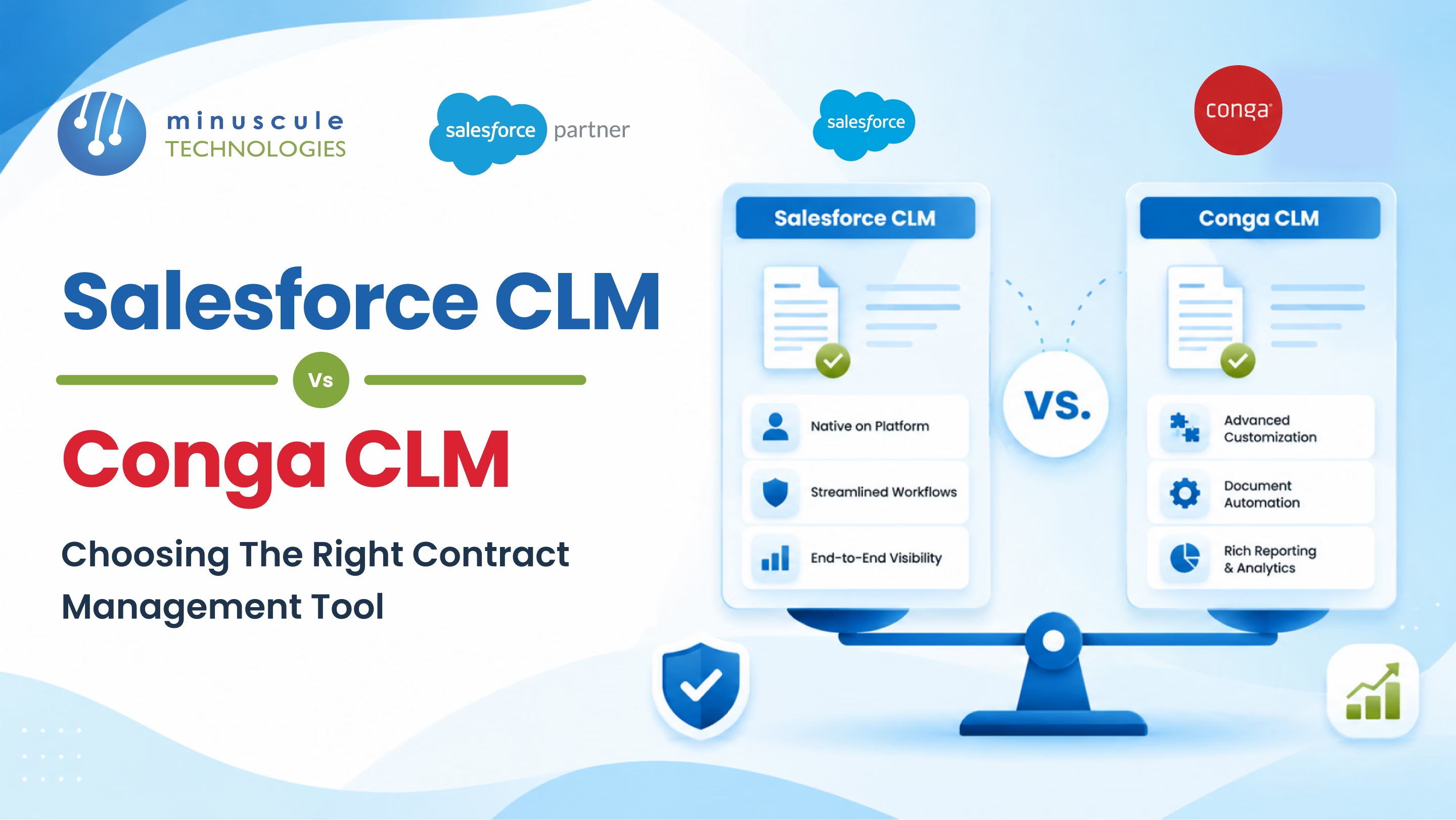
The Salesforce admin recommends Salesforce CLM because "it's native." The General Counsel recommends Conga because "that's what legal uses everywhere." The CFO picks the cheaper one. Six months later, the project stalls - clauses don't render; redlines don't reconcile; signed contracts don't link back to the Opportunity.
This isn't a vendor problem. It's a workflow problem. Salesforce CLM and Conga CLM both run-on Salesforce. They both store contracts. They both integrate with e-signature. The difference is what they're optimized for - Salesforce CLM ships fast and ties to Revenue Cloud Quote-to-Cash; Conga CLM handles complex redlining, deep clause libraries, and the legal-grade workflows enterprise MSAs require.
The fix isn't picking the louder vendor. It's mapping your contract mix - volume, complexity, redlining frequency, regulated content - to the CLM that fits, with a clear decision framework instead of a hallway argument.
Here's how Salesforce CLM and Conga CLM stack up.
Six things every Contract Lifecycle Management tool delivers on Salesforce:
Salesforce CLM and Conga CLM both cover these surfaces. The difference is depth at each layer.
Salesforce CLM is the native contract management surface that lives inside Salesforce — formerly tied to Revenue Cloud and Industries CPQ, now part of the Revenue Lifecycle Management bundle.
Contract objects live in the same data model as Opportunity, Quote, and Order. No external app, no data sync — the Quote-to-Contract handoff is one transaction.
Contracts inherit pricing, products, and terms from the Salesforce Quote. When the Quote updates, the Contract reflects the change without manual reconciliation.
Contract templates generated from Salesforce data with merge fields. Authoring is straightforward for standard contracts; complex redlining requires partner add-ons.
Connects to Adobe Sign, Docusign, or Salesforce Sign for execution. Signed PDF stores against the Contract record.
Conga CLM is the long-standing enterprise CLM platform — formerly Apttus, now part of Conga — built natively on Salesforce since inception. Teams moving older contracts onto it can follow our approach to migrating legacy contract data into Conga CLM.
Conga's X-Author tool lets legal teams' author and edit contracts directly in Microsoft Word with full Salesforce data merge. Heavyweight authoring where Salesforce CLM is lightweight.
Conga's clause library handles thousands of approved clauses with version control, jurisdiction-specific variations, and AI-assisted clause selection.
Conga captures customer-side redlines in Word, reconcile versions, and shows clause-level history. Critical for enterprise MSAs that go through multiple negotiation rounds.
Connects to Conga CPQ, Conga Sign, Conga Composer (document generation), and Conga Contracts in one product family. The full quote-to-renew cycle on one stack.
"Salesforce CLM is fast to ship. Conga CLM is fast to negotiate. Which one wins depends on what your contracts actually do."
| Capability | Salesforce CLM | Conga CLM |
|---|---|---|
| Platform | Native Salesforce (Revenue Lifecycle Management) | Native Salesforce app (acquired Apttus) |
| Contract authoring | Template-driven, Salesforce-native | X-Author for Word — deeper for complex contracts |
| Clause library | Basic clause management | Mature library with jurisdiction-specific variants |
| Redlining | Light; relies on partners for deep redline | Native redline reconciliation with version history |
| AI assistance | Einstein for Sales Cloud + emerging contract AI | AI-assisted clause selection and risk scoring |
| Quote-to-Cash integration | Tight — same data model as Revenue Cloud | Strong if also using Conga CPQ |
| E-signature | Adobe Sign, DocuSign, Salesforce Sign | Conga Sign (native), plus external options |
| Implementation speed | Faster when already on Salesforce Revenue Cloud | Heavier setup; more configuration |
| Best fit | Standard B2B contracts, high volume, lighter legal | Enterprise MSAs, regulated industries, heavy redlining |
Five questions that point to one platform or the other.
High volume of standard contracts → Salesforce CLM. Low volume, high-complexity contracts (enterprise MSAs, manufacturing supply agreements) → Conga CLM.
Contracts going through three or more rounds of customer redline → Conga CLM. Contracts that close on the first version sent → Salesforce CLM.
Large in-house legal team with established Word-based authoring → Conga CLM's X-Author fits the workflow. Lean ops team that wants legal-as-a-service → Salesforce CLM's simpler authoring suffices.
Already running Revenue Cloud or Salesforce CPQ → Salesforce CLM extends the same stack. Already running Conga CPQ → Conga CLM is the natural extension.
Heavily regulated (BFSI, pharma, defence, life sciences) with audit-grade redline history and jurisdiction-specific clauses → Conga CLM. Standard B2B / SaaS / manufacturing → either works.
Five rules protect CLM choice in production.
Both platforms collapse without a curated clause library. Legal team owns the curation; admin team owns the technical merge logic.
Approval Processes must route based on contract value and discount tier, not just deal stage. Both platforms support this; both implementations skip it.
Every executed contract needs a renewal trigger - typically ninety days before expiration. Without it, renewals slip into churn.
The Contract record's status flips to Signed only when the e-signature confirmation lands. No half-executed contracts in production.
When a contract is signed, key fields (term, value, renewal date, special clauses) write back to the Opportunity or Account. Without this, the contract becomes an island.
"The CLM choice is one decision. The clause library, approval routing, and renewal triggers are five hundred decisions. Get those right and either platform works."
Yes. Salesforce uses several names for the same offering — Salesforce CLM, Salesforce Contract Management, and now Revenue Lifecycle Management (the umbrella that includes CLM, CPQ, and Billing). All refer to the native contract lifecycle management capabilities inside Salesforce.
Yes, but it's not ridiculous. Both platforms store contracts in Salesforce, which makes data migration straightforward. Template logic, clause libraries, and approval of workflows need rebuilding — typically a four-to-six-month engagement. The reverse migration (Salesforce CLM → Conga) is equally heavy on the workflow side.
Yes. Conga CLM operates independently of Conga CPQ. Many enterprises run Salesforce CPQ for quoting and Conga CLM for contracts — the integration between them is well-established. The full Conga Suite is optional, not required.
Conga CLM, in most cases. Master Service Agreements with multi-round redlining, complex clause libraries, and jurisdiction-specific variations are where Conga's X-Author and clause infrastructure pay off. Salesforce CLM can handle standard MSAs but starts to strain under heavy negotiation cycles.
CLM platform selection is one of the most expensive Salesforce decisions a revenue org makes. The right answer comes from mapping your contract mix against five decision factors: volume, complexity, redlining frequency, legal team workflow, and regulatory load. Salesforce CLM fits high-volume standard contracts and lean ops teams. Conga CLM fits complex enterprise MSAs and mature legal organizations.
Minuscule Technologies is a Trusted Salesforce Engineering Partner with 125+ Salesforce experts and 75+ projects delivered globally - including Nasdaq-listed enterprises across BFSI, manufacturing, and IT services. We engineer CLM evaluations and rollouts for both Salesforce CLM and Conga CLM, with clause libraries, approval routing, and renewal automation that hold up under audit.
Book a CLM platform fit session, and we'll review your contract mix, decision factors, and the CLM implementation that fits.
You've seen what's possible. Now, let's make it happen for your business. Whether you need an end-to-end Salesforce solution, a complex integration, or ongoing managed services, our team is ready to deliver.

Schedule a Free Strategic Call


Plot No. 4, Sridevi Amman Street, Perumal Nagar Extension, Old Pallavaram, Chennai, Tamil Nadu 600117, India.
