We are at Dreamforce 2026, Industry Pavilion at San Francisco


June 12, 2026
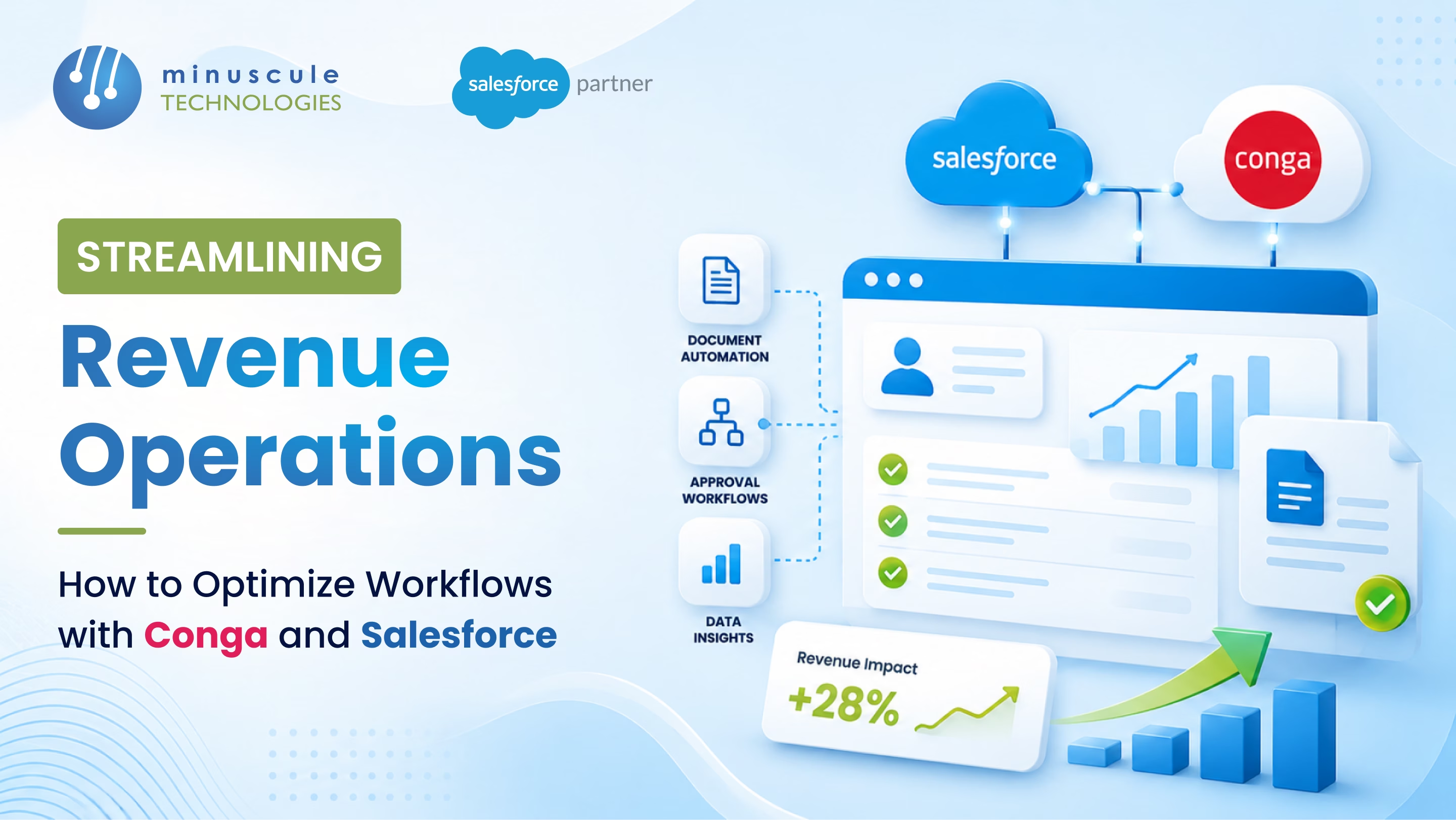
Revenue operations (RevOps) is the practice of aligning sales, marketing, finance, and customer success around shared processes, data, and tools — so every stage of the revenue lifecycle moves without friction. When you combine Conga's automation suite with Salesforce, you get a connected workflow stack that covers the entire revenue cycle from inside your CRM: quoting, contracting, document generation, approvals, and renewals.
Here's what a Conga and Salesforce RevOps stack handles:
The result: a revenue workflow where no deal stalls because of a process gap between teams.
Revenue operations is a strategic framework that connects all revenue-generating activities - product-to-cash - under a single operating model. It's not just a sales ops function. RevOps aligns marketing, sales, legal, finance, and customer success around consistent data, shared processes, and integrated tools.
In a Salesforce context, this means building your entire revenue workflow inside the CRM so every team sees the same customer record, deal status, and contract terms. Salesforce provides the CRM backbone. Conga's app suite fills the gaps that Salesforce's native tools leave open: advanced CPQ configuration, contract lifecycle management, automated document generation, and e-signature.
Together, they give you a complete quote-to-cash workflow without routing deals through external tools, email chains, or disconnected systems.
Most revenue leakage doesn't come from bad deals. It comes from process gaps between teams. A sales rep builds a quote in a spreadsheet, sends it as a PDF, negotiates contract terms over email, waits three days for legal to redline the document, and then manually uploads a signed PDF to Salesforce. Finance sees none of this until the deal is already closed.
These are the specific gaps that add cost and time to every deal:
Automating these revenue processes is where Conga and Salesforce, configured together, deliver the most immediate impact.
Conga is a suite of revenue automation apps built natively on Salesforce. It doesn't replace your CRM — it adds the automation layer that turns Salesforce into a true end-to-end revenue platform.
The Conga suite covers four core areas:
Every app reads from the same Salesforce CRM record. When a quote closes in Conga CPQ, the data flows into Conga Contracts without manual entry. When a contract is signed via Conga Sign, the opportunity stage updates in Salesforce automatically. This connected data model is what makes RevOps automation work across the entire org.
The quote-to-contract workflow is where most RevOps teams see the fastest time savings. Here's how the automated flow works:
From quote creation to contract execution, every step runs inside Salesforce. The deal never leaves the CRM. What used to take 5–7 days of back-and-forth can compress to 24–48 hours with the right workflow configuration.
Manually building proposals, statements of work, and order forms is one of the most consistent time drains in revenue operations. Conga Composer removes it entirely.
Conga Composer generates any document by merging live Salesforce data into prebuilt templates. A rep clicks a button on the opportunity to record. Composer pulls the account name, deal terms, product details, and pricing from Salesforce, populates the template, and delivers a finalized document in seconds - branded, accurate, and ready to send.
Key Conga Composer use cases for RevOps:
Document errors from manual copy-paste drop to near zero. And because Composer reads live Salesforce data, every document reflects the current state of the deal now of generation.
Once a contract is created, Conga Contracts manages the negotiation and approval cycle without leaving Salesforce. Legal teams work in Microsoft Word via X-Author - editing, redlining, and negotiating in the tool they already use - with every tracked change syncing back to the contract record automatically.
Approval workflows run on rules you define. A standard contract under a set value threshold route to the sales director. Any contract with non-standard clauses or above the value threshold routes to legal first, then finance, then the executive approver. Each approver acts from within Salesforce. If an approval stage sits idle past the SLA, it escalates automatically to a backup approver.
No email chains. No version of confusion. A full audit trail at every step.
For RevOps leaders, this produces something just as valuable as faster approvals: data. You get visibility into where contracts are at any given time, how long each approval stage takes on average, and which deal types generate the most legal back-and-forth. That data feeds directly into process improvement decisions in the following quarter.
Most RevOps teams focus on deals in flight. Post-close management - renewals, amendments, obligation tracking - gets less attention, and that's revenue leaks quietly.
Conga Contracts tracks post-signature obligations: delivery milestones, SLA commitments, compliance checkpoints, and renewal dates. Automated alerts fire at 90, 60, and 30 days before contract expiry. The assigned account manager gets a Salesforce task automatically - no calendar management or spreadsheet tracking required.
Agentforce Revenue Management adds real-time MRR and ARR dashboards on top of this, giving finance and sales leadership a live view of recurring revenue health across the full account portfolio.
When a renewal triggers, the account manager generates the renewal proposal directly from the original contract record using Conga Composer - pre-populated with updated product details and refreshed pricing. The renewal cycle becomes a workflow, not a manual task someone has to remember.
A connected Conga and Salesforce stack makes the following metrics trackable without manual reporting effort:
These metrics are unavailable when your revenue workflow runs across email, spreadsheets, and disconnected systems. They become measurable when Conga and Salesforce operate as a connected platform.
Conga CPQ is an alternative to Salesforce's native CPQ functionality and runs on the Salesforce platform. Some organizations use Conga CPQ as their primary quoting engine. Others use Conga Contracts alongside Salesforce's native CPQ because Conga's CLM depth exceeds what Salesforce offers natively. The right configuration depends on your deal complexity and existing Salesforce setup.
Yes. Conga Composer supports trigger-based document generation — for example, automatically generating a renewal letter when a contract record crosses the 90-day-to-expiry threshold, or generating an invoice when an opportunity moves to Closed Won. These automations run without any manual action from the rep.
Conga apps are Salesforce-native and read directly from your CRM objects — accounts, opportunities, products, contracts, and custom objects. There's no separate data sync for standard operations. Every document and contract automatically reflects live Salesforce field values at the time of generation.
Sales operations teams benefit from faster quoting and fewer manual approval steps. Legal and contract ops teams gain version-controlled negotiation with automated routing. Finance teams get accurate billing data without re-keying from CRM records. Account management teams get automated renewal alerts and one-click proposal generation.
A Conga Contracts and Composer implementation typically runs 8–14 weeks for standard deployments. Configurations that include CPQ, custom approval logic, and complex multi-template document libraries may run 4–6 months. Many teams start with a single workflow - Composer for proposals, for example - and expand to CLM and CPQ in subsequent phases.
Configuring Conga and Salesforce to work as a connected RevOps platform requires more than app installation - it takes workflow design, approval chain architecture, template library setup, and CRM field mapping that fits how your specific teams operate.
Minuscule Technologies Salesforce integration team has deployed Conga workflows across manufacturing, BFSI, and real estate organizations, connecting CPQ, CLM, and Composer into a unified revenue automation layer. We also handle Revenue Cloud implementation for teams building out the full quote-to-cash stack. Talk to our Salesforce consulting team or contact us directly to see what an optimized RevOps workflow looks like for your org.
You've seen what's possible. Now, let's make it happen for your business. Whether you need an end-to-end Salesforce solution, a complex integration, or ongoing managed services, our team is ready to deliver.

Schedule a Free Strategic Call


