Why Enterprises Are Turning to Salesforce Consulting Services for AI-Powered CRM Transformation

Article Written By:
Anantharaman Veeraraghavan
Created On:
Why Enterprises Are Turning to Salesforce Consulting Services for AI-Powered CRM Transformation

The CIO presents at the board meeting. "AI-powered CRM by year-end." The board approves. The CIO hires two Salesforce developers. Six months in, the team has built a chatbot. The CEO asks for the ROI number. The team realises they've built a feature, not a transformation.

They didn't configure Einstein Trust Layer. They didn't unify customer data in Data Cloud. They didn't integrate the rest of the stack. They didn't design change management for sales, service, marketing. The chatbot works. Nothing else does.

This is the most common AI-CRM transformation failure of 2026. Enterprises buy the technology, hire developers, and discover AI in CRM is a transformation problem, not an engineering one. Generative AI shifts every two quarters. Salesforce ships three releases a year. Compliance frameworks evolve. Internal teams that succeed at admin work struggle to absorb AI rollout, change management, and governance simultaneously.

The fix is Salesforce consulting services - partners who've done dozens of AI-CRM transformations, bring certified architects and AI specialists, and absorb the platform complexity so the internal team can focus on adoption.

Here's why enterprises are turning to Salesforce consulting services for AI-powered CRM transformation.

1. Why AI-CRM transformation is genuinely hard

Six factors that make AI-CRM transformation harder than standard CRM implementation.

  • Generative AI evolves quarterly: LLM capabilities, pricing, and best practices shift faster than annual project plans.
  • Trust and compliance are non-negotiable: PII masking, audit logging, dynamic grounding, customer-managed encryption keys — all must be configured before AI touches enterprise data.
  • Data unification precedes AI value: Agentforce and Einstein need clean, unified data. Most enterprises haven't completed that unification.
  • Integration sprawl across systems: AI agents need access to CRM, ERP, accounting, marketing, service — each with its own integration pattern.
  • Change management across the org: Sales reps, service agents, and marketing teams need training, adoption support, and trust-building. Technical rollout is the easy part.
  • Salesforce platform releases: Three releases a year, each shifting Lightning components, APIs, and AI capabilities. Internal teams struggle to keep current.

Each is solvable. Together, they create a complexity load most internal teams can't carry alone.
2. What consulting services actually deliver

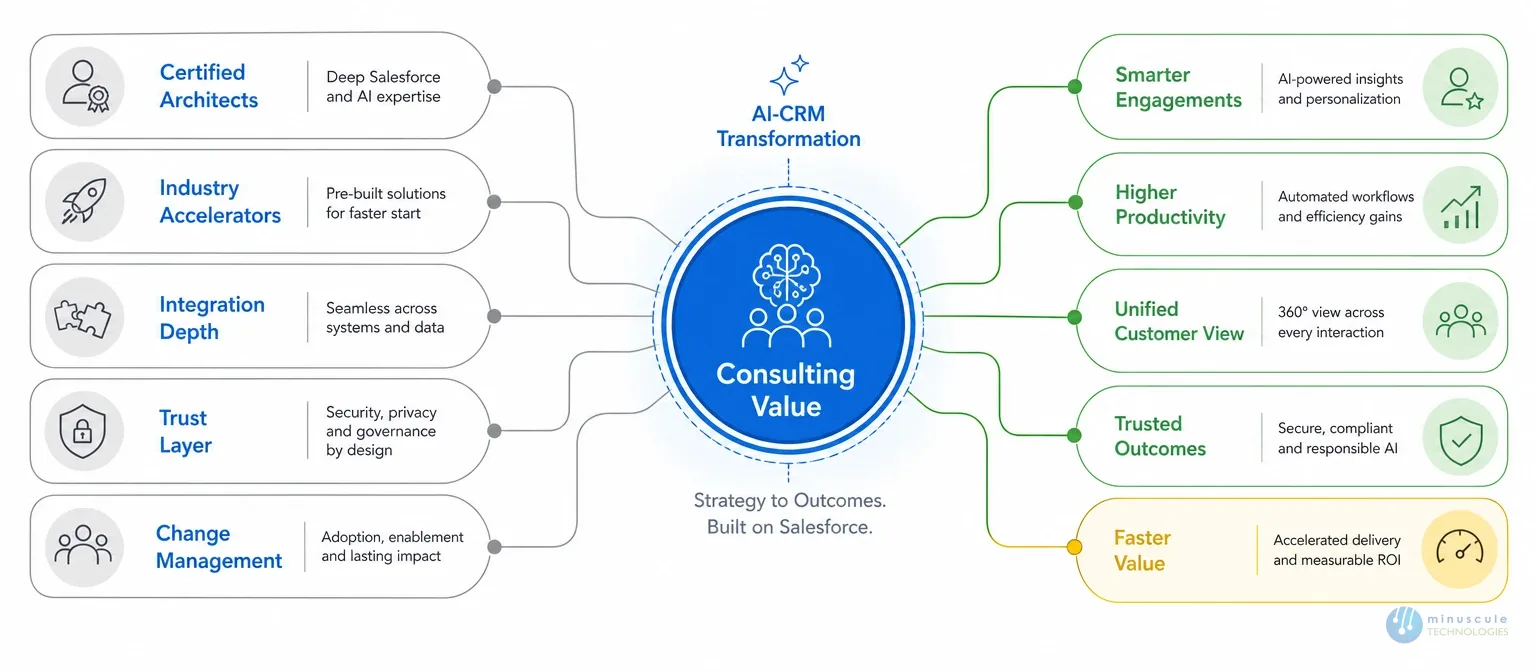
Six capabilities a strong Salesforce consulting engagement brings.

  • Certified Salesforce architects and AI specialists: Multi-cloud architects who've delivered Agentforce, Data Cloud, and Einstein rollouts across industries.
  • Industry-specific accelerators: Pre-built patterns for BFSI, manufacturing, healthcare, higher education, retail — not generic templates.
  • Integration depth across platforms: MuleSoft, Boomi, Workato expertise plus connectors for SAP, Oracle, Microsoft, AWS, GCP.
  • Trust Layer and governance configuration: Einstein Trust Layer setup, FERPA/HIPAA/GDPR/SOC 2 compliance patterns, audit trail design.
  • Change management as part of the deliverable: User training, communication plans, adoption metrics — not just code.
  • Time-to-value compression: Six-month transformations delivered in six months because the partner has done it before.

Consulting is the difference between an AI feature and an AI-CRM transformation.

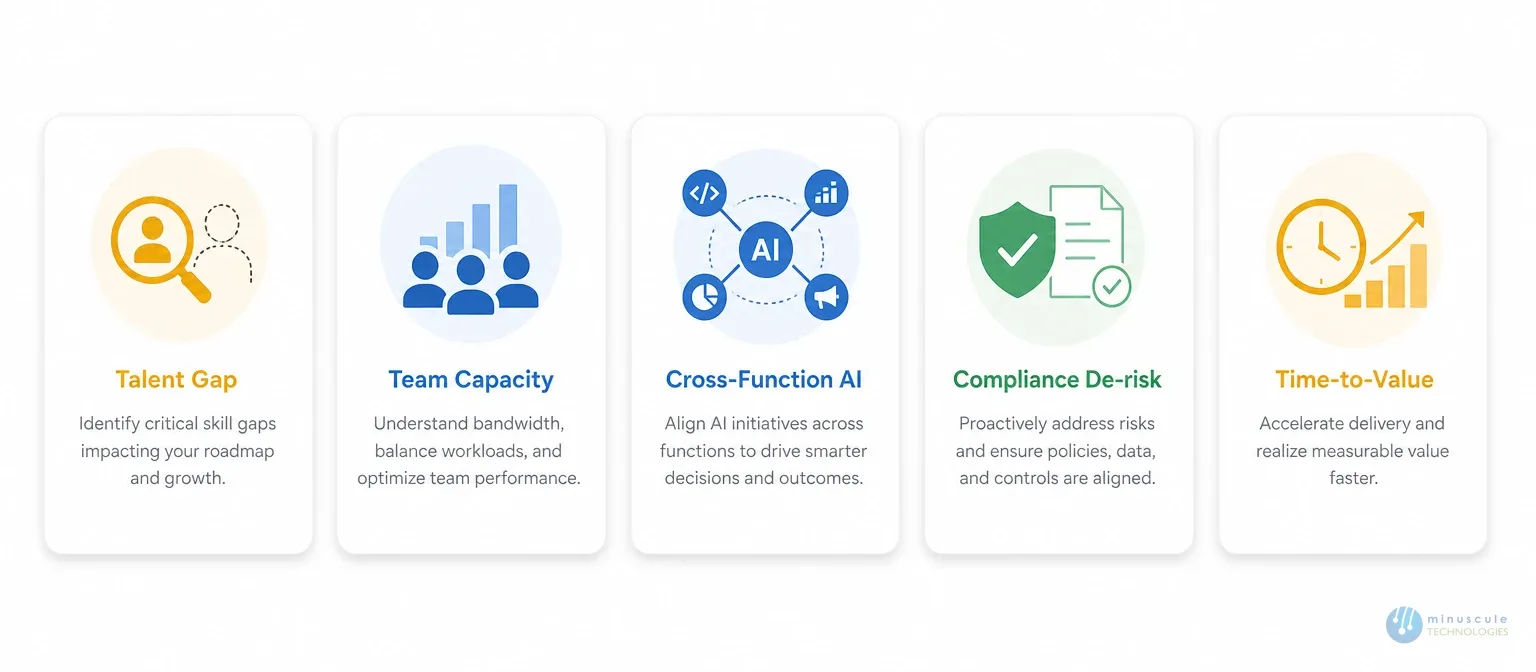
3. The five enterprise drivers behind the consulting shift

Driver 1 - Hiring AI Salesforce talent is genuinely hard

Salesforce architects with AI experience are rare. Hiring takes six months; consulting starts week one. For enterprises with year-end transformation deadlines, the math is decisive.

Driver 2 - Internal teams have day-to-day work

Admin support, integration monitoring, release management - the internal Salesforce team is fully utilised on steady-state. Adding transformation on top of operations burns out the team that knows the business best.

Driver 3 - AI transformation crosses every business function

Sales, service, marketing, finance, operations - each needs AI integration tailored to their workflows. No internal team has equal expertise across all five.

Driver 4 - Risk mitigation

The Einstein Trust Layer, Data Cloud governance, and compliance frameworks (HIPAA, GDPR, FERPA, SOC 2) have right answers. Wrong configuration is a regulatory finding. Consulting partners bring the templates.

Driver 5 - Time-to-value pressure from the boardroom

Boards ask for AI ROI every quarter. Internal teams need to learn while delivering. Consulting partners deliver while training the internal team — knowledge transfer built into the engagement.

4. The framework consulting partners follow

Six phases of a structured AI-CRM transformation.

Phase 1 - Discovery and strategy

Current-state assessment of Salesforce footprint, data sources, integration architecture, compliance posture. Future-state vision aligned with business priorities. Roadmap with milestones, KPIs, and decision gates.

Phase 2 - Data Cloud foundation

Identity resolution, source ingestion, data unification, profile activation. Without Data Cloud, AI runs on fragmented data and produces unreliable answers.

Phase 3 - Agentforce design and topic library

Use case prioritisation, agent topics, action libraries, escalation patterns, prompt engineering. Trust Layer configuration baked in from day one.

Phase 4 - Integration and middleware

MuleSoft, Boomi, or native connectors to ERP, accounting, marketing automation, service platforms. Real-time vs batch decisions documented per integration.

Phase 5 - Change management and adoption

User training, role-based playbooks, communication plans, adoption metrics, hypercare staffing. Built into the project, not bolted on.

Phase 6 - Continuous optimisation

Post-launch model tuning, agent conversation review, accuracy tracking, expansion to new use cases. AI-CRM isn't a project; it's a programme.

"Buying Agentforce is a procurement decision. Implementing AI-CRM transformation is a consulting decision. The first costs licences; the second delivers value."

5. The validation rules that protect the transformation

Six rules every consulting engagement should write into the contract.

Knowledge transfer as a deliverable

Every architectural decision, every Trust Layer configuration, every agent topic documented in the customer's possession. No black-box deliverables.

Multi-cloud Salesforce architect on the engagement

Engagement includes at least one certified Salesforce architect with Agentforce and Data Cloud experience. Resume reviewed and approved by the customer.

Compliance officer review at each phase gate

Compliance team reviews and signs off at the end of each phase. Trust Layer, FERPA, HIPAA, GDPR scoping reviewed before user activation.

Adoption metrics defined and tracked

KPIs - agent deflection rate, user engagement, ROI proxy metrics - defined upfront and tracked monthly. Not "we'll figure that out later."

Sandbox-first deployment for every change

Every transformation change tested in sandbox before production. No same-day production changes. CI/CD pipeline enforces.

Exit and handover plan documented

At the end of the engagement, the partner delivers full documentation, runbooks, and a sixty-day knowledge transfer to the internal team. No lock-in.

"The consulting engagement that protects the customer is the one with documentation, knowledge transfer, and exit terms written into the contract from day one."

6. Frequently Asked Questions

1. Is consulting more expensive than building in-house?

Depends on the AI scope. For a single chatbot, in-house is cheaper. For multi-cloud AI-CRM transformation spanning sales, service, marketing, and operations, consulting is faster, lower-risk, and usually less expensive on a total-cost basis once hiring time, training, and rework are counted.

2. What about Salesforce's own professional services?

Salesforce's professional services exist; they're often expensive and oriented toward the platform's standard playbook. Independent partners with domain expertise (BFSI, manufacturing, higher ed) typically deliver better fit for industry-specific transformations.

3. How do we choose the right consulting partner?

Look for: Salesforce partner tier (Summit/Premier/Specialised), industry-specific case studies, certified architect count, Agentforce and Data Cloud project references, and willingness to commit to outcome-based SLAs.

4. Does the partner stay engaged after launch?

Most engagements include a transition to managed services or hypercare period. Continuous AI-CRM optimisation — agent tuning, new use cases, integration expansion — usually runs as a managed-services engagement after the initial transformation.

Enterprises don't fail at AI. They fail at AI execution.

AI-CRM transformation isn't a chatbot project. It's a multi-cloud, multi-team, multi-quarter programme that touches data, integration, compliance, change management, and platform releases simultaneously. Salesforce consulting services bring certified architects, industry accelerators, Trust Layer expertise, integration depth, and change management built into the deliverable. Six drivers push enterprises toward consulting. Six phases structure the engagement. Six validation rules protect the customer's investment.

Minuscule Technologies is a Trusted Salesforce Engineering Partner with 160+ Salesforce experts and 75+ projects delivered globally — including Nasdaq-listed enterprises across BFSI, manufacturing, IT services, and higher education. We deliver AI-CRM transformation consulting — Agentforce design, Data Cloud rollout, MuleSoft integration, Einstein Trust Layer configuration, multi-cloud architecture - for enterprises that need their AI rollout to actually transform the business.

Map your AI-CRM transformation roadmap with us and we'll review your Salesforce footprint, AI readiness, compliance posture, and the consulting engagement that fits your transformation.

Contact Us for Free Consultation
Thank you! We will get back in touch with you within 48 hours.
Oops! Something went wrong while submitting the form.

Recent Blogs

Ready to Architect Your Salesforce Success?

You've seen what's possible. Now, let's make it happen for your business. Whether you need an end-to-end Salesforce solution, a complex integration, or ongoing managed services, our team is ready to deliver.

Schedule a Free Strategic Call