We are at Dreamforce 2026, Industry Pavilion at San Francisco


July 15, 2026
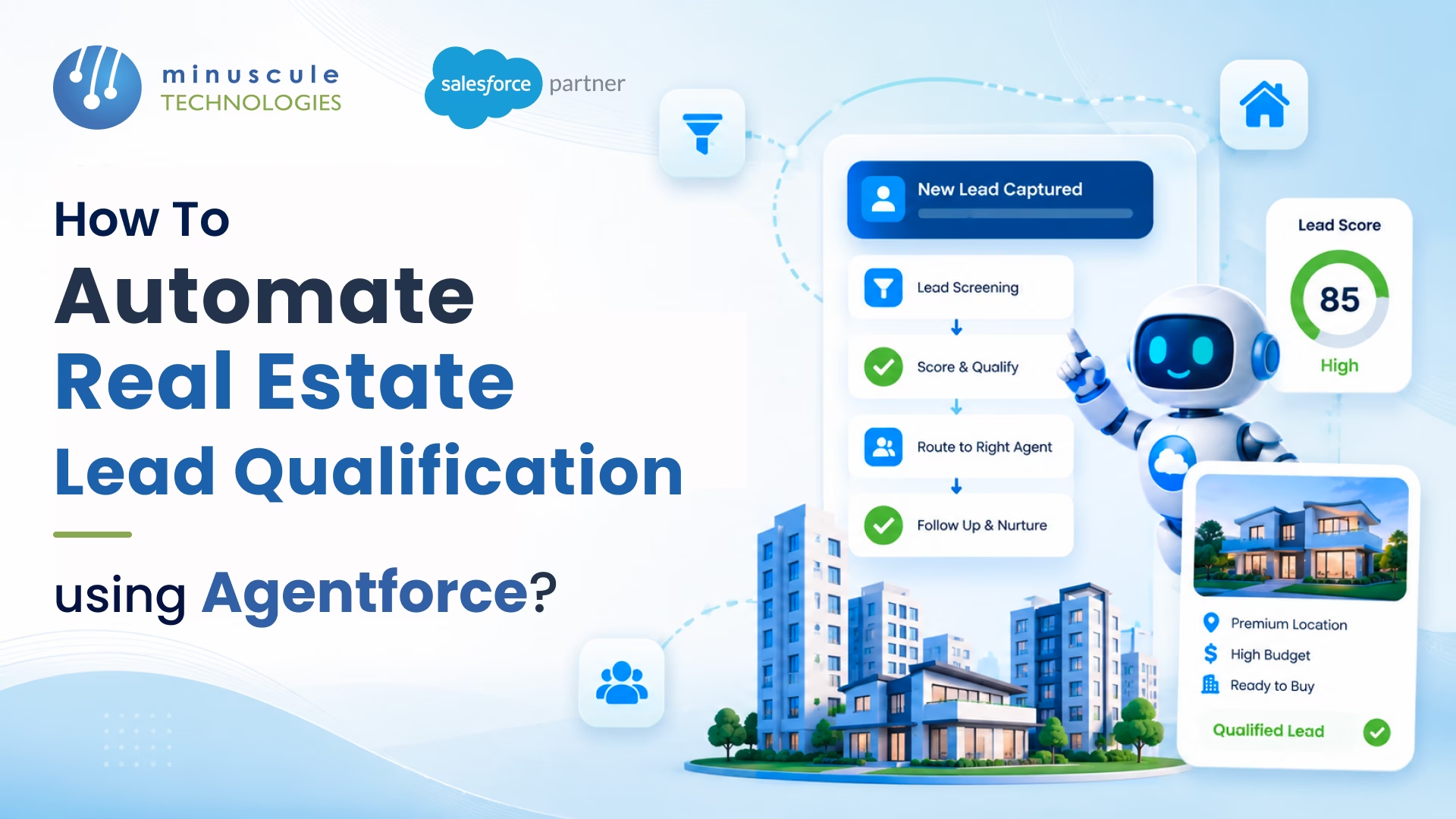
Automating real estate lead qualification with Agentforce means deploying an AI agent inside Salesforce that evaluates every inbound lead the moment it arrives - checking intent signals, budget indicators, timeline, and property preferences - and deciding whether it's worth pursuing, before a salesperson ever looks at it. Unlike Einstein Lead Scoring, which assigns a predictive score based on historical conversion patterns, Agentforce acts on each lead in real time: it classifies the lead, updates the record, and invokes the next configured Action automatically
For real estate teams managing hundreds of daily inquiries from property portals, WhatsApp, website forms, and paid campaigns, this is the difference between responding in minutes and losing a prospect to a competitor who did.
What you'll find in this post:
Lead qualification answers one question: is this inquiry worth a salesperson's time right now?
In real estate, a "lead" could be a first-time buyer for research projects six months away, an NRI investor ready to wire funds this week, or a portal click from someone who submitted their contact without reading the listing. All three arrive in Salesforce looking identical — a name, a phone number, a source tag.
Qualification is the process of sorting them. It typically evaluates intent (how serious?), timeline (how soon?), budget fit (does the range match?), and property relevance (does the inquiry match available inventory?). Done manually, a salesperson calls the lead, asks a few questions, and makes a judgment call. Done by Agentforce, the same evaluation happens at the moment the lead record is created - no call needed for the first pass.
This is distinct from lead routing, which decides who handles a qualified lead. Qualification comes first. Once Salesforce Agentforce marks a lead as qualified, the routing logic kicks in. We covered the Agentforce lead routing process for real estate in a separate post - this one focuses on what happens before routing begins.
A sales team of 10 handling 300 leads per day cannot call every inquiry within a reasonable window. What happens is a triage based on gut feel - the salesperson scans the lead source, glances at the project name, and decides whether to call. High-value leads from slower-moving sources get missed. Bulk inquiry leads from portals like 99acres or MagicBricks get dismissed as low quality — even when 15% of them are serious buyers.
Three specific failure modes show up consistently in real estate CRM data:
Speed-to-contact drops. The widely cited stat that response within 5 minutes is 8x more effective originates from an MIT/InsideSales.com study, not from Salesforce Ben's real estate CRM analysis. Attributing third-party research findings to 'Salesforce Ben' - a Salesforce blog/community site - without a direct citation is factually incorrect and a credibility risk on a consulting firm's blog. Manual qualification adds a 4–24-hour lag between inquiry and first contact.
Qualification bias. Salespeople tend to over-qualify leads from premium sources and under-qualify leads from high-volume campaigns, regardless of actual signals. The result is a pipeline full of "interested" leads that never convert, and a bin of "junk" leads that contained real buyers.
No consistent criteria. Without a standardized qualification framework, every salesperson applies different logic. Pipeline data becomes unreliable. Forecasts miss. Management can't distinguish bad leads from bad follow-ups.
Agentforce solves this by applying the same qualification criteria, consistently, to every lead, the moment it arrives.
Agentforce's Atlas Reasoning Engine evaluates leads against a set of criteria you define during agent configuration. For real estate, those criteria typically include:
When a new lead record enters Salesforce, the Agentforce agent fires. It runs the criteria evaluation using Salesforce record fields and, where configured, Data Cloud-connected behavioral signals, then writes the qualification output back to the lead record
The entire process typically completes within seconds for standard record-based evaluations. Processing time may vary depending on the number of Actions invoked; external API calls within those Actions, and Data Cloud query latency if behavioral signals are included. The Salesforce developer's documentation on Agentforce Topics and Actions covers how the reasoning engine processes multi-criteria evaluations and returns structured outputs.
Setting up a lead qualification agent in Agentforce requires three components: a Topic, a set of Actions, and a data connection.
The Topic defines the agent's job. For lead qualification, the topic is something like: "Evaluate incoming real estate leads and classify them by purchase of readiness." The Topic defines the agent's scope and instructions - it tells the Atlas Reasoning Engine what the agent is responsible for and how to behave. Actions are separately configured and must be explicitly associated with a Topic; the Topic itself does not automatically determine which Actions are eligible to fire.
The Actions are the actual operations the agent performs. A qualification agent for real estate typically includes:
The data connection is what separates a useful qualification agent from a toy one. If Agentforce only has access to the fields in a prospect filled out on a form, it can only do basic scoring. Connect it to Data Cloud - which can ingest portal interactions, website behavior, email engagement, and WhatsApp conversation history - and the agent qualifies leads based on what prospects do, not just what they say.
Our Salesforce Agentforce services team configures these agents as part of broader Sales Cloud implementations for real estate clients. The agent builder is a low-code interface, but the quality of the output depends heavily on how the scoring logic is defined and how cleanly the data sources are connected.
Most real estate lead volume in India and the Middle East comes from property portals (99acres, MagicBricks, Housing.com, Property Finder, Bayut) and WhatsApp. Neither feed into Salesforce by default.
Portal leads typically arrive via email or API. A well-configured Salesforce integration maps portal lead emails to Lead records automatically - parsing the source, the project name, the budget range, and the contact details into the right fields. Once the lead is in Salesforce as a structured record, Agentforce can evaluate it.
WhatsApp is more nuanced.
The Minuscule WhatsApp Salesforce Accelerator creates a bidirectional sync between WhatsApp Business and Salesforce — conversation transcripts are linked to Salesforce records. For Agentforce to read intent signals from those conversation transcripts as part of its qualification evaluation, the transcripts must be stored as structured fields or indexed in Data Cloud Vector Database for retrieval-augmented grounding. Unstructured conversation text is not automatically readable by an Agentforce agent without this additional configuration.
Once the agent classifies a lead, Salesforce takes over with automation:
Hot leads get immediate assignment to a senior salesperson, a WhatsApp or SMS notification to the lead confirming receipt, and a CRM task with a 2-hour follow-up deadline.
Warm leads enter a nurture sequence - automated email with project details, a follow-up call task within 24 hours, and scheduled check-ins based on their stated timeline.
Cold leads go into a long-term drip campaign with no immediate sales resource assigned. If behavior changes — they re-engage with content, revisit the portal listing, or respond to an email - a configured trigger (such as a Record-Triggered Flow or a Data Cloud segment activation) can invoke the Agentforce agent to re-evaluate and update the classification.
The routing step that follows qualification - deciding which agent or salesperson handles each Hot lead based on geography, project specialization, and current workload - is covered in our post on Agentforce lead routing for real estate.
Yes, provided each portal feed is mapped to Salesforce through an integration layer. Once portal leads arrive as structured Salesforce Lead records, the Agentforce qualification agent processes them the same way regardless of source. You can also include source weighting in the scoring logic — so a direct website inquiry scores differently than a bulk portal submission.
Einstein Lead Scoring assigns a predictive score based on historical conversion patterns — it tells you which leads look like past winners. Agentforce acts on leads in real time: it evaluates the current record, applies to your defined criteria, updates the record, and triggers the next workflow. Einstein scores sit on a lead record passively. Agentforce qualification drives immediate action. The Salesforce Admin Blog covers when to use each.
At minimum: lead source, budget range, project or property preference, and contact completeness. For higher accuracy: portal interaction data, website visit history, WhatsApp conversation context, and prior inquiry records on the same contact. The more signal the agent can evaluate, the fewer misclassifications.
A basic qualification agent connected to Salesforce Lead records typically takes 3–4 weeks to configure, test, and go live. Adding portal integrations and WhatsApp data extends to 6–8 weeks. Full Data Cloud integration for behavioral signal processing - including data ingestion setup, Identity Resolution configuration, and Vector Database indexing for unstructured grounding - adds another 6–10 weeks depending on data source complexity and the number of external systems being connected.
Every hour a real estate lead waits in a manual review queue is an hour your competitor must respond. Agentforce closes that gap by evaluating every lead the moment it arrives - not just the ones a salesperson gets around to.
At Minuscule Technologies, we've built Agentforce qualification and routing systems for real estate teams managing multi-project pipelines across India and the Middle East. Our implementations go beyond configuration - we design the scoring logic, connect the data sources, and validate classification accuracy against real pipeline outcomes before go-live.
If your team is still manually sorting through portal leads to find the buyers worth calling, talk to our team about what an Agentforce qualification agent would look like for your pipeline.
You've seen what's possible. Now, let's make it happen for your business. Whether you need an end-to-end Salesforce solution, a complex integration, or ongoing managed services, our team is ready to deliver.

Schedule a Free Strategic Call


