
June 2, 2026
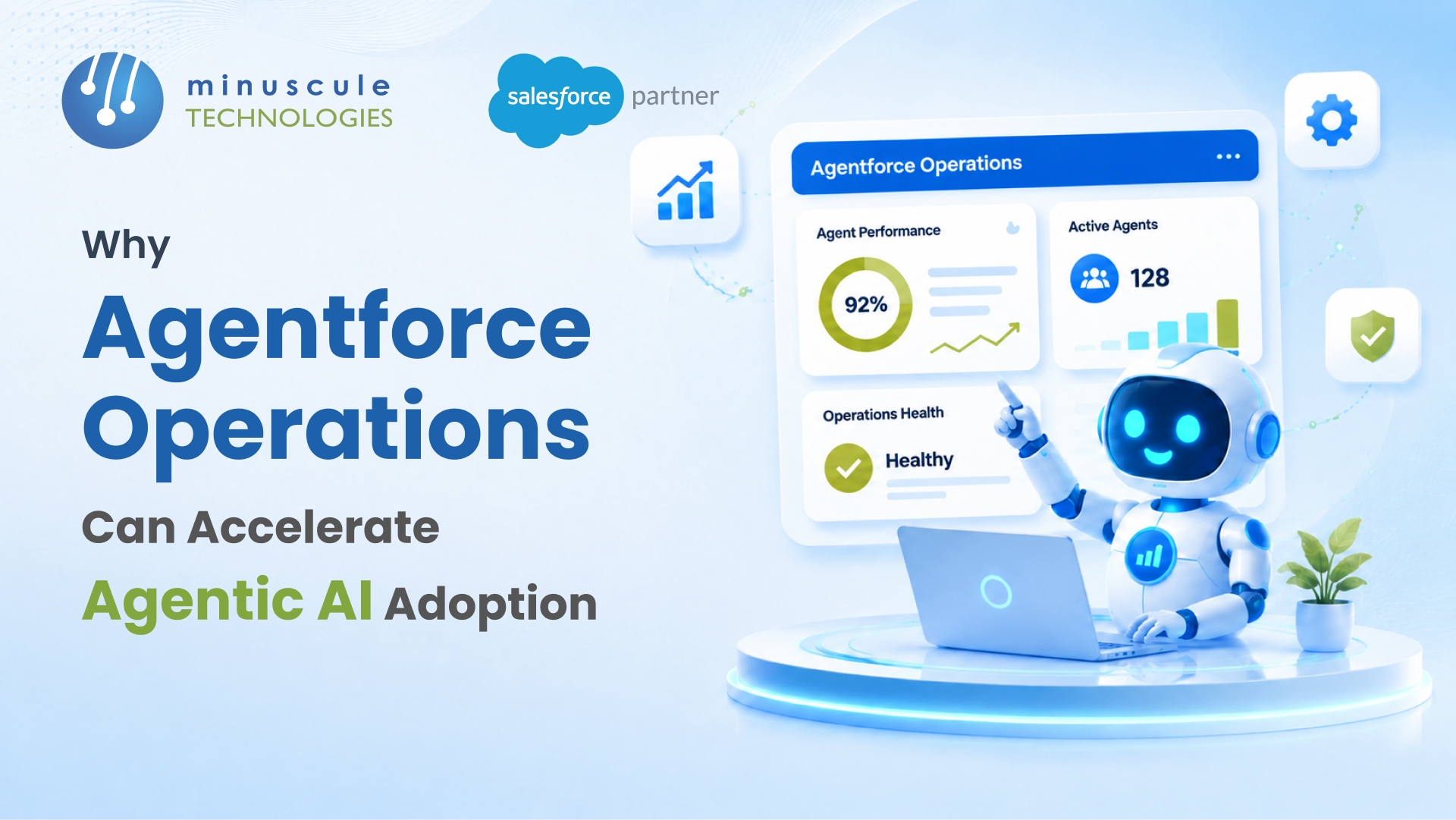
Agentforce Operations is Salesforce's answer to the biggest blocker in enterprise AI adoption: fragmented, manual back-office workflows that AI agents can't touch. Launched in April 2026, it digitizes the operational tasks that sit between your front-end AI experiences and your legacy back-office systems - data verification, approvals, compliance checks, cross-system coordination. Without it, your AI agents handle the customer conversation but can't complete the work behind it.
We've been working with Salesforce implementations across industries where the front-office AI was ready months before the back-office could keep up. That gap is where Agentforce Operations fits - and it's why adoption has been stuck at pilot stage for so many teams. This guide breaks down what the product actually does, why it matters for adoption, and how to evaluate whether your org is ready for it.
Agentforce Operations is a Salesforce product that extends the Agentforce platform from customer-facing conversations into back-office execution. While the original Agentforce Service Agents handle the front end - answering questions, routing cases, surfacing Knowledge articles — Operations handles what happens after the conversation: processing refunds, verifying data across systems, running compliance checks, coordinating approvals.
Think of it this way. A customer asks your AI agent to cancel a subscription. The agent confirms the request in the chat. But the actual cancellation requires checking the billing system, verifying contract terms in the ERP, applying prorated credits, updating the CRM record, and sending a confirmation email. That chain of tasks used to require human agents toggling between three or four systems. Agentforce Operations automates that chain with specialized agents that handle each step autonomously - with human oversight at the points you define.
The Salesforce Blog covered the April 2026 launch announcement. The product is consumption-based, priced per operation, and available to orgs already running Agentforce.
Here's the pattern we see with almost every Agentforce deployment: the front-end AI works. Customers get fast responses. Case deflection improves. The executive dashboard looks good for the first month. Then the complaints start — not about the AI's answers, but about what happens after the AI answers.
"The agent said my refund was processing, but it's been two weeks." "The chatbot confirmed my address change, but my next invoice went to the old address." "The AI told me my order shipped, but the tracking number doesn't work."
Every one of those failures happens in the back office. The AI handled the conversation correctly but couldn't execute the operational steps behind it. A human was supposed to pick up the work, and it fell through the cracks — or got delayed because it required manual handoffs across disconnected systems. According to Salesforce's developer documentation, this front-end-to-back-office gap is the primary reason agentic AI adoption stalls after initial pilots.
The numbers tell the story. Organizations we've worked with typically automate 30-40% of customer interactions with Agentforce within the first quarter. But the operational completion rate - where the AI-initiated task actually gets done end-to-end — hovers around 60-70% without back-office automation. That 30-40% gap is where customer trust breaks down.
Agentforce Operations closes the gap with five specific capabilities. Each one targets a different blocker that keeps agentic AI stuck in pilot mode.
Instead of building operational workflows from scratch, teams start with industry-specific templates. Order-to-cash processing, claims verification, subscription management, invoice reconciliation - these ship as pre-built agent configurations that you customize to your business rules. Salesforce reports a 50% reduction in time-to-value compared to building equivalent automation manually. In practice, this means teams that took 12 weeks to automate an operational workflow now do it in 6.
Operations agents connect to multiple systems through Salesforce's integration layer - ERP, billing platforms, document management, compliance databases. The agent doesn't just query one system; it orchestrates data across several, validating consistency before executing. This is the piece that manual processes always get wrong: a human checks system A but forgets to verify system B, and the operation fails downstream.
These are specialized agents that handle specific operational tasks: verifying customer identity, checking credit limits, confirming compliance requirements, validating document completeness. They run independently once triggered, escalating to humans only when they hit exceptions. The difference from traditional automation (like Flow or Process Builder) is that these agents reason about edge cases rather than following a fixed decision tree.
Not every back-office task should be fully autonomous. Agentforce Operations lets you define exactly where humans stay in the loop - high-value approvals, regulatory sign-offs, exception handling. The system routes these touchpoints to the right person with full context, then picks up autonomously after the human approves. This controlled handoff model is what makes compliance teams comfortable with expanding AI into operations.
Every operation the agent executes gets logged with the reasoning chain, data accessed, decisions made, and approvals obtained. For industries like financial services and healthcare - where we do a significant portion of our Salesforce consulting work - this audit trail is non-negotiable. Without it, legal and compliance teams block AI expansion regardless of how well it performs.
For operations managers, the daily work shifts from processing tasks to managing exceptions. The agent handles the routine 70-80% automatically; humans focus on the complex cases that require judgment.
For Salesforce administrators, there's a new configuration surface - defining operational workflows, setting approval thresholds, mapping system integrations, and tuning the agent's decision boundaries. It's not a fundamentally different skill set from building Flows, but it requires thinking about multi-system orchestration rather than single-object automation.
For leadership, the ROI conversation changes. Instead of measuring AI success by conversation deflection alone, you're measuring end-to-end process completion - from customer request to operational fulfillment. That's a much stronger business case because it connects directly to revenue impact and cost savings.
Agentforce Operations makes sense when your front-end AI is working but the back-office can't keep up. Specific signals: your case deflection rate is strong but customer satisfaction scores are flat or declining, operational tasks initiated by AI agents are getting stuck in manual queues, or your compliance team is blocking AI expansion because there's no audit trail for autonomous operations.
It also fits organizations running Agentforce that want to expand from service into operations - order management, billing, procurement, HR processes. The Apex Hours community has been discussing real-world implementation patterns for operational agents since the April launch.
If you're still in the early stages of Agentforce - just setting up your first Service Agent - focus on that first. Operations is the expansion layer, not the starting point. Get the front-end agent right, prove the value, then extend into operations.
Automating everything at once. Start with one operational workflow - the one with the highest volume and clearest rules. Prove it works end-to-end before expanding. Teams that try to automate five workflows simultaneously end up with five half-working automations and zero confidence from stakeholders.
Skipping the compliance review. Operations agents touch financial data, personal information, and contractual obligations. Get your legal and compliance teams involved before deployment, not after. The audit trail capabilities exist specifically for this - use them from day one.
Ignoring the integration layer. Agentforce Operations is only as good as its connections to your other systems. If your ERP data is messy or your billing system's API is unreliable, the operational agent will inherit those problems. Clean up the integration layer first.
Agentforce handles customer-facing conversations - answering questions, routing cases, providing information through AI agents on your website or portal. Agentforce Operations handles the back-office work that follows those conversations - processing transactions, verifying data, coordinating approvals across systems. One talks to the customer; the other completes the work.
Yes. Agentforce Operations extends the Agentforce platform. You need active Agentforce licenses and at least one deployed agent. Operations adds the back-office execution layer on top of your existing agent infrastructure.
It's consumption-based, priced per operation executed. An "operation" is a completed workflow - like processing a refund or verifying an identity. This is separate from your Agentforce conversation pricing. Check the SalesforceBen community for the latest pricing breakdowns and comparison calculators.
Yes. It connects to external systems through MuleSoft integrations, REST APIs, and platform events. The operational agents can orchestrate tasks across ERP, billing, document management, and other systems - as long as the integration layer is configured. The quality of those integrations directly affects how well the operational agents perform.
Agentforce Operations addresses the gap that's been holding back enterprise AI adoption - the disconnect between what the AI says and what actually gets done. For organizations that have already proven Agentforce works for customer conversations, Operations is the logical next step: extend the agent's reach from the front office into the operational backbone.
At Minuscule Technologies, we've been building Salesforce solutions since 2014 with 125+ specialists. Our Agentforce work has always included the integration and operational plumbing that makes AI agents actually deliver on their promises - not just in the chat window, but all the way through to fulfillment.
Reach out to our team for a free consultation on whether Agentforce Operations fits your roadmap.
You've seen what's possible. Now, let's make it happen for your business. Whether you need an end-to-end Salesforce solution, a complex integration, or ongoing managed services, our team is ready to deliver.

Schedule a Free Strategic Call


Plot No. 4, Sridevi Amman Street, Perumal Nagar Extension, Old Pallavaram, Chennai, Tamil Nadu 600117, India.
