
July 6, 2026
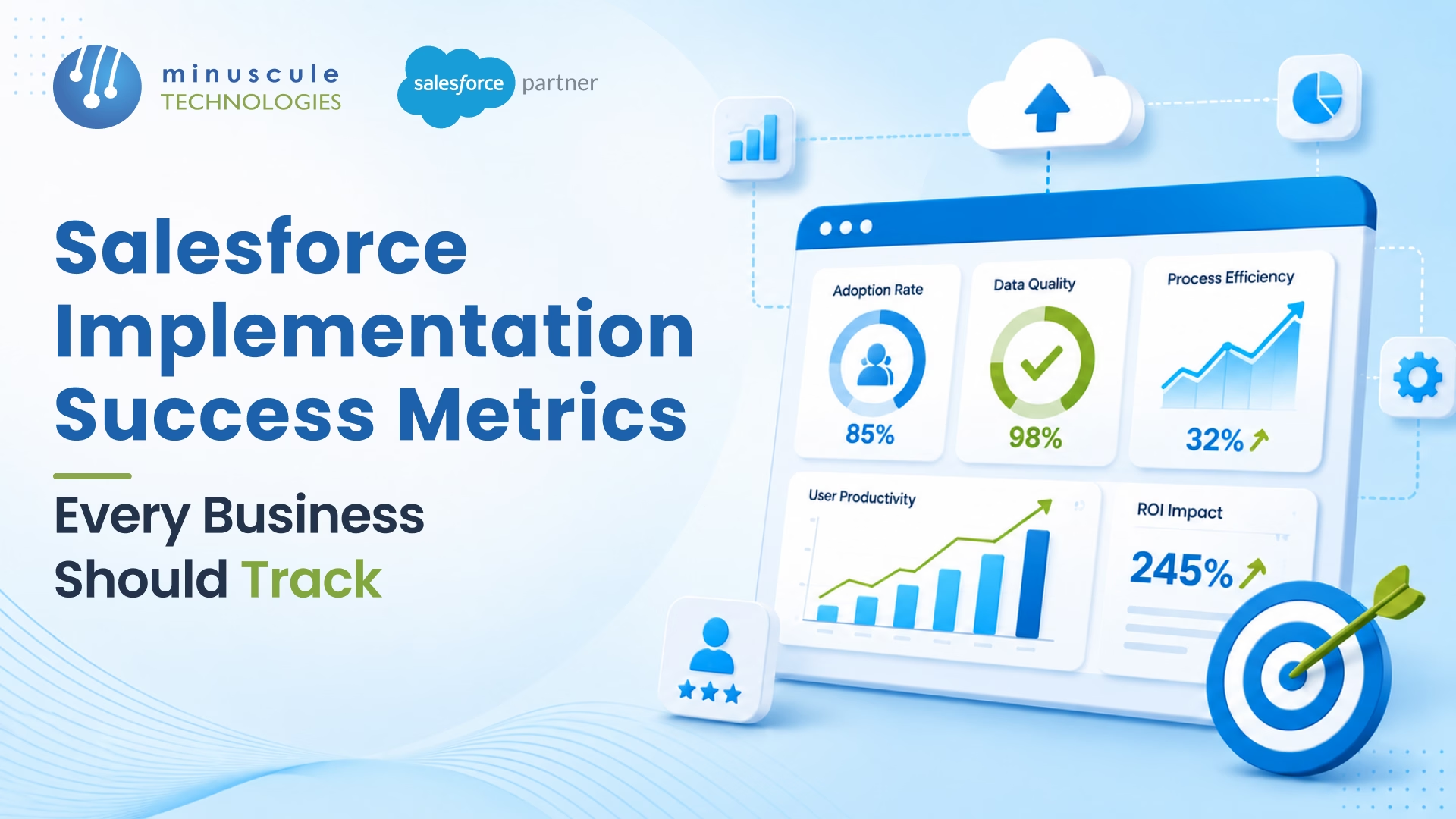
The Salesforce implementation success metrics every business should track fall into five groups: adoption, data quality, business outcomes, system performance, and project delivery. Together they answer the only question that matters after go-live - did this actually work? Tracking them turns a Salesforce implementation from an act of faith into a measurable investment you can prove and improve.
Picture the meeting no one wants to be in. Six months and a six-figure budget after go-live, the CFO leans forward and asks, "So what did we get for it?" The room goes quiet.
There's no baseline, no before-and-after, just a vague sense that things are "better." Without metrics, you can't prove ROI, you can't spot the team that never adopted, and you can't fix what you can't see. Numbers are how a rollout defends itself.
The five metric groups at a glance:
Defining these up front is part of any serious rollout, which is why a strong Salesforce implementation sets success metrics before the first sprint, not after go-live.
Salesforce implementation success metrics are the measurable signals that show whether your rollout delivered the outcomes you paid for. They span how much people use the system, how clean the data is, and what business results followed.
Good metrics are tied to goals you set before the project. If the aim was faster sales cycles, you measure cycle time - not just how many features you shipped.
The point isn't to drown in dashboards. It's to track the handful of numbers that tell you whether the Salesforce CRM implementation is earning its keep.
A strong Salesforce implementation partner measures across five groups, because any one alone can mislead. High usage on dirty data, for example, isn't success - which is why consulting and change management tie every metric back to a goal.
Adoption is the first proof that the system is alive. Track active users, login frequency, records created and updated, and feature usage by team.
Low adoption is an early warning that no amount of clever configuration fixes on its own. Salesforce implementation experts watch these numbers closely in the first 90 days.
Every downstream number depends on clean data. Track duplicate rates, field completeness, and how current your records are.
If data quality slips, reports and forecasts quietly become fiction. A good Salesforce implementation company builds these checks into ongoing administration and governance.
This is the group your CFO cares about. Track sales cycle length, win rate, lead conversion, case resolution time, and overall ROI against the goals you set.
These connect the system to money and time saved. Salesforce implementation consultants map each build decision back to one of these outcomes, and mature Salesforce implementation services report on them from day one. For context, Salesforce Ben tracks what strong CRM outcomes look like.
A slow or unstable org kills adoption fast. Track page load times, error rates, integration reliability, and uptime.
Performance problems often hide until users quietly give up. Salesforce's admin best practices put monitoring at the center of a healthy org.
How the project ran predicts how the system performs. Track on-time delivery, budget variance, scope changes, and defects found after go-live.
These reveal whether your delivery process was disciplined or chaotic. The best Salesforce implementation companies report them openly, not just when asked.
Here's a starting set of metrics, what each one tells you, and where the number comes from:
You can only prove improvement if you measured the "before." Capture baseline numbers - current cycle time, conversion, data quality - before the new system goes live.
Set targets for each metric during planning, then review them at 30, 90, and 180 days after launch. Structured managed services keep this reporting rhythm going instead of letting it fade.
Without a baseline, every "we improved" claim is just a feeling. With one, you can show exactly what the investment returned.
A few habits quietly undermine good measurement. Watch for these:
Free resources like Salesforce Trailhead can help your team build reporting skills to avoid these traps.
Adoption, data quality, and business outcomes are the core three. Adoption shows the system is used, data quality shows it can be trusted, and business outcomes like sales cycle length and ROI show it's delivering value. Performance and delivery metrics round out the picture.
Compare the value gained - added revenue, time saved, cost reduced — against the total cost of the project, including licenses, services, and support. A Salesforce implementation partner helps tie specific gains back to the build so the ROI number holds up.
Before go-live. Capture baseline numbers during planning, set targets, and then review at 30, 90, and 180 days. Measuring only after launch leaves you with no "before" to compare against.
Ownership is shared between your internal admin or RevOps team and your Salesforce implementation consultant. The business defines the goals, and the implementation team builds the dashboards and reporting to track them.
Monthly in the first six months, then quarterly once the system stabilizes. Regular reviews catch adoption dips and data issues early, while there's still time to act.
Remember that silent room when the CFO asked what the project delivered? With the right metrics, that answer is a confident one. Success stops being a feeling and becomes a number you can defend.
That's what Minuscule Technologies helps you build. As an engineering-led Salesforce implementation partner, we set the baselines, build the dashboards, and run the reporting so you always know exactly what your CRM is returning.
Don't wait for the ROI question to catch you off guard. Tell Minuscule Technologies what success should look like and book a free consultation - we'll map the metrics that prove it, whether or not we're the right fit.
You've seen what's possible. Now, let's make it happen for your business. Whether you need an end-to-end Salesforce solution, a complex integration, or ongoing managed services, our team is ready to deliver.

Schedule a Free Strategic Call


Plot No. 4, Sridevi Amman Street, Perumal Nagar Extension, Old Pallavaram, Chennai, Tamil Nadu 600117, India.
