
July 4, 2026
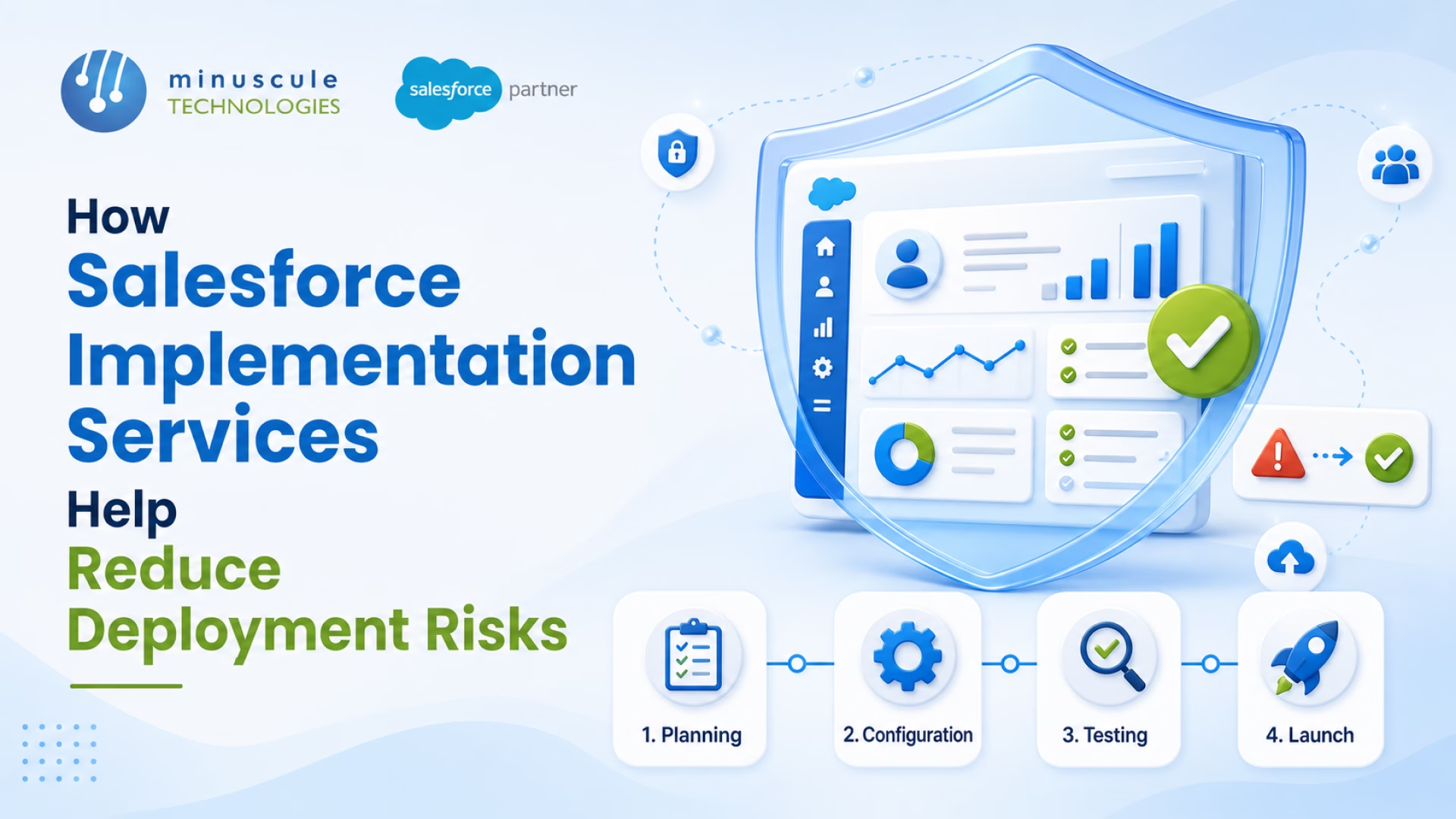
Salesforce implementation services reduce deployment risks by replacing guesswork with a proven process - clear discovery, clean data migration, a disciplined sandbox and release strategy, thorough testing, and structured change management. Instead of pushing changes straight to production and hoping they hold, experienced teams stage every move, validate it, and plan the rollback before go-live. The payoff is fewer failed deployments, less downtime, and a Salesforce CRM implementation your users trust from day one.
The deployment risks a good implementation team removes:
Most CRM projects that underdeliver fail on process and adoption, not the technology. That's where professional Salesforce implementation services earn their keep. For Salesforce's own view on release quality, see its guidance on faster, safer deployments.
Salesforce deployment risks are the things that can go wrong when you move a Salesforce build into production. They range from data loss and broken automations to blown budgets and users who quietly refuse to switch.
Some risks are technical, like a bad release or a failed integration. Others are organizational, like unclear goals or poor training. Left unmanaged, they turn a promising project into an expensive stall.
Here are the risks that derail most Salesforce projects:
The cost of ignoring these adds up fast. A failed deployment means rework, lost productivity, and stalled adoption that's hard to win back.
In 2026 the stakes are higher still. AI features like Agentforce and Data Cloud only deliver value on clean, well-governed data, so a risky deployment today caps what you can do tomorrow.
Professional Salesforce implementation services attack risk at every phase. Here's how a strong Salesforce implementation partner turns each failure point into a controlled step.
Most risk is created before a single field is built. Salesforce implementation experts start with discovery, mapping your processes, goals, and success metrics into a written scope.
That document becomes the guardrail against scope creep. New requests get triaged against the plan instead of quietly bloating the build.
Data is the hardest part of any Salesforce CRM implementation, and the easiest place to lose trust. A good team audits your source data, removes duplicates, maps fields carefully, and runs test migrations into a sandbox before touching production.
Validation checks confirm record counts and relationships so nothing silently disappears on go-live day. See how structured data migration services keep that process safe.
This is where deployment risk lives or dies. Rather than editing production directly, mature Salesforce implementation companies build in sandboxes and promote changes through a controlled pipeline.
Each environment validates a different part of the release, and validate-only deploys catch errors before anything goes live. Automated DevOps and CI/CD practices add version control, peer review, and one-click rollback - so a bad change is reversed in minutes, not days. Keep every release on track with this Salesforce deployment checklist.
Salesforce's own developer guidance on DevOps Center follows the same source-driven release model.
Testing is the safety net between "it works on my screen" and "it works for 500 users." Implementation teams run unit tests, integration tests, and user acceptance testing against real scenarios.
Automated regression testing means fixing one thing doesn't quietly break another - the most common cause of a surprise production incident. Salesforce's admin best practices also stress testing every change in a sandbox first.
Salesforce rarely stands alone. It has to talk to ERP, finance, marketing, and support tools without dropping data.
Salesforce implementation consultants map every integration up front, respect API limits, and use middleware where it makes sense, then test each connection under load before launch. Careful integration work stops the data-sync failures that quietly erode reporting.
The best-built org fails if nobody uses it. Strong implementation services fold in change management from the start: early stakeholder involvement, role-based training, clear documentation, and a communication plan.
Adoption is treated as a deliverable, not an afterthought. A system people avoid is its own kind of failed deployment.
Big-bang launches concentrate risk into a single day. A phased rollout spreads it out, letting you validate each release with a smaller group first.
After go-live, structured managed services monitor org health, catch issues early, and keep tech debt from building up as your team requests changes.
Each major deployment risk maps to a specific safeguard a Salesforce implementation partner puts in place:
| Deployment Risk | How Implementation Services Reduce It |
|---|---|
| Scope creep & budget overrun | Written discovery scope and change-triage process |
| Data loss or corruption | Data audit, sandbox test migrations, validation checks |
| Broken production releases | Sandbox pipeline, validate-only deploys, rollback scripts |
| Undetected regressions | Automated regression and UAT testing |
| Integration failures | Upfront integration mapping and load testing |
| Low user adoption | Change management, role-based training, phased rollout |
| Post-launch drift & tech debt | Managed services and org health monitoring |
An internal admin can handle small changes, but a full deployment stretches most in-house teams thin. They rarely have dedicated architects, QA, and DevOps engineers on hand, and they're learning your edge cases on your budget.
A specialist Salesforce implementation company brings a repeatable process, a bench of certified people, and lessons from dozens of past projects - which is exactly what lowers risk. Minuscule's work across banking and financial services shows how much industry-specific risk sits below the surface.
The strongest setups combine both: your team owns business context and adoption, while implementation experts own the engineering and release discipline.
Ask any prospective partner these before you commit. Clear answers signal a low-risk engagement:
Salesforce implementation services are the end-to-end work of planning, configuring, customizing, migrating data, integrating, testing, and deploying Salesforce so it fits how your business runs. Delivered by a certified Salesforce implementation partner, they also cover training and post-go-live support. In short, they turn licenses into a working, adopted system while keeping deployment risk under control.
They replace ad-hoc changes with a controlled process: a locked scope, clean data migration, sandbox-based releases, automated testing, and change management. Each step catches a category of risk before it reaches production, and a rollback plan limits the damage if something slips through.
Cost depends on scope, the number of clouds, data volume, and integrations. Most Salesforce implementation companies price by fixed project fee, time-and-materials, or a monthly retainer. Ask for total cost of ownership - including data migration, integration, and support - rather than a headline day rate.
It depends on scope. A focused single-cloud rollout can take a few weeks, while a multi-cloud build with heavy integration and data migration can run several months. A phased approach lowers risk by delivering value in stages rather than one high-stakes launch.
Small configuration changes are fine in-house. For a full deployment with data migration, integrations, and change management, Salesforce implementation consultants add the architects, QA, and DevOps discipline that most internal teams lack - which is what keeps a large project from stalling.
The usual culprits are unclear objectives, poor data quality, releases pushed without testing, weak user adoption, and over-customization. Nearly all of them are process problems, which is why a structured Salesforce implementation matters more than raw technical skill.
A safe deployment isn't luck. It's the product of discovery, disciplined releases, testing, and adoption planning done well.
Minuscule Technologies delivers Salesforce implementation services as an engineering-led partner, with certified experts across configuration, data migration, integration, DevOps automation, and managed support. If a past project stalled or you want to get the next one right the first time, tell us your goals and book a free consultation - we'll map the risks and the path to a clean go-live, whether or not we're the right fit.
You've seen what's possible. Now, let's make it happen for your business. Whether you need an end-to-end Salesforce solution, a complex integration, or ongoing managed services, our team is ready to deliver.

Schedule a Free Strategic Call


Plot No. 4, Sridevi Amman Street, Perumal Nagar Extension, Old Pallavaram, Chennai, Tamil Nadu 600117, India.
