

May 27, 2026
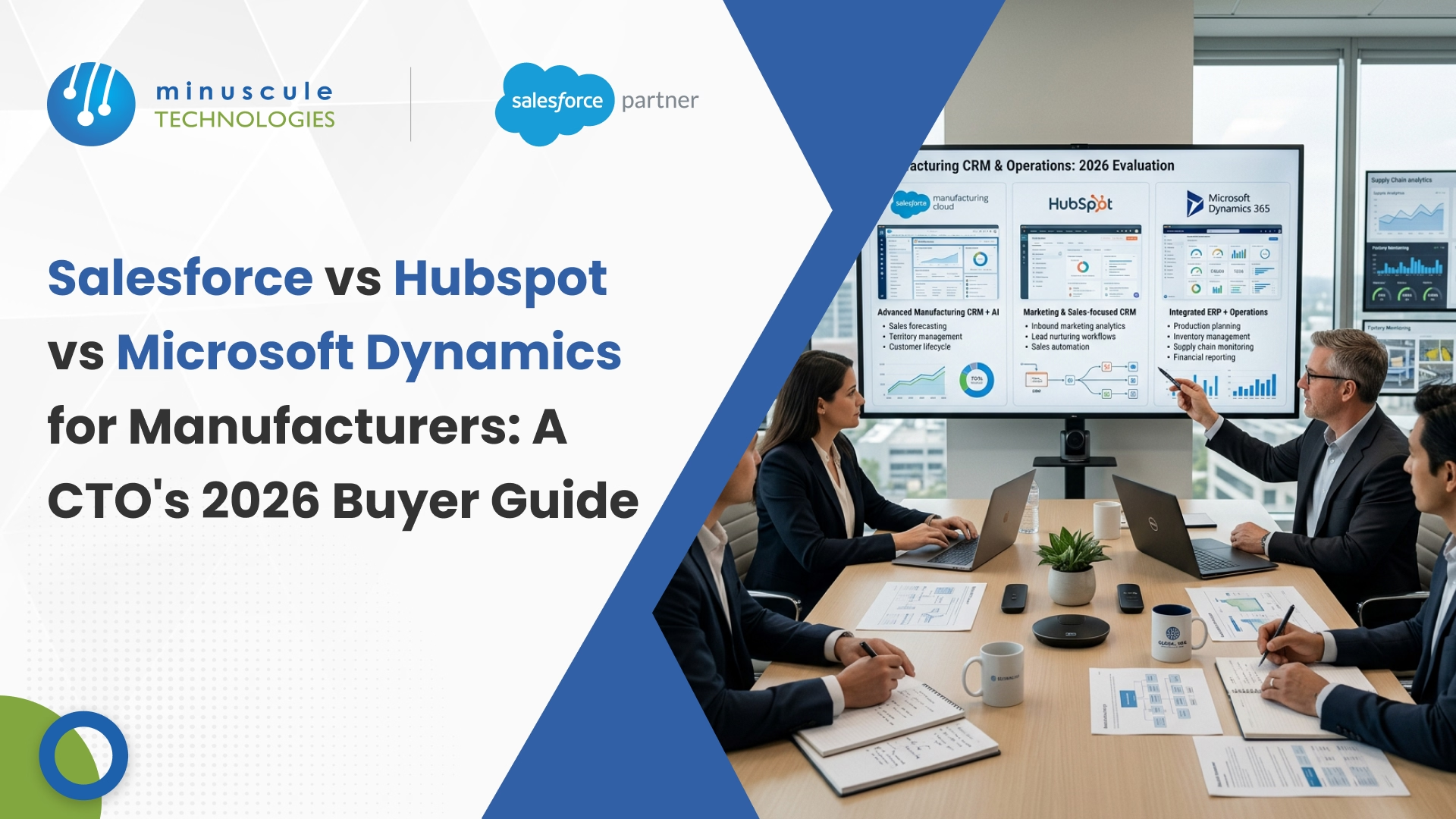
Salesforce, HubSpot, and Microsoft Dynamics 365 are the three CRM platforms manufacturers evaluate most often - but they're built for very different things. Salesforce owns roughly 23% of the global CRM market and offers the deepest manufacturing-specific product (Agentforce Manufacturing). Microsoft Dynamics 365 is the only one of the three with native ERP and supply chain modules, making it a CRM-plus-operations platform. HubSpot is the easiest to adopt and the most affordable, but it has no manufacturing-specific features at all.
For a CTO at a manufacturing company, the question isn't which CRM has the best features in general. It's which platform fits your specific operation - based on how complex your dealer network is, whether you need CRM-to-ERP integration or CRM-plus-ERP unification, how much you'll spend per user, and whether your AI investment should go toward sales agents, supply chain copilots, or marketing automation.
This guide compares all three through a manufacturing lens, with real pricing scenarios, AI capability breakdowns, and a decision framework built for CTOs making architecture decisions in 2026.
Generic CRM comparisons focus on contact management, email tracking, and pipeline visibility. Those features matter, but they're table stakes. Every modern CRM does them well enough. What separates the right platform from the wrong one for a manufacturer comes down to six criteria that generic comparisons skip entirely.
Manufacturing-specific modules - Does the platform have industry-specific objects and workflows for sales agreements, demand forecasting, dealer management, or production visibility? Or do you have to build everything custom?
Keep these six criteria in mind as we walk through each platform. They're the lens that makes this comparison useful for a CTO, not just a marketing manager.
Salesforce is the market leader with roughly 23% global CRM share and over 150,000 customers. It started as a sales automation tool and has grown into a platform with industry-specific clouds for manufacturing, healthcare, financial services, and more.
For manufacturers, the key product is Agentforce Manufacturing (launched August 2025, formerly Manufacturing Cloud). This adds sales agreement management, account-based demand forecasting, inventory visibility, partner channel management, and AI-powered agents on top of the standard Sales Cloud and Service Cloud.
Salesforce is a pure CRM and front-office platform. It does not include ERP, financial accounting, production planning, or supply chain management natively. For those functions, manufacturers either integrate Salesforce with a separate ERP (SAP, Oracle) or use Salesforce-native ERP partners like Rootstock or Certinia.
Dynamics 365 holds about 5% of the global CRM market, but its positioning is fundamentally different. It's a modular platform that covers both CRM (Sales, Marketing, Customer Service, Field Service) and ERP (Finance, Supply Chain Management, Business Central) in a single ecosystem.
For manufacturers, Dynamics 365 is the only platform among these three that offers CRM and manufacturing ERP on the same technology stack. The Supply Chain Management module handles production control, warehouse management, master planning, demand forecasting, quality management, and logistics - all natively integrated with the CRM modules.
This CRM+ERP convergence is Dynamics 365's biggest differentiator and the reason it keeps coming up in manufacturing CTO conversations.
HubSpot holds about 5-6% CRM market share by revenue and has been the fastest-growing major CRM by customer count. It's built around inbound marketing and sales enablement, with an emphasis on ease of use and rapid adoption.
HubSpot has no manufacturing-specific module, no ERP capabilities, and no supply chain features. It does have a manufacturing landing page on its website, but it offers standard CRM and marketing tools repackaged for a manufacturing audience - not purpose-built manufacturing functionality.
HubSpot is strongest for manufacturers who need a CRM primarily for marketing and sales activities — lead generation, email marketing, pipeline management, and basic sales automation. It's weakest for manufacturers with complex operations, dealer networks, or ERP integration requirements.
This is where the three platforms diverge sharply. Here's a feature-by-feature comparison through a manufacturing lens:
| Manufacturing Feature | Salesforce | Microsoft Dynamics 365 | HubSpot |
|---|---|---|---|
| Sales Agreement Management | Native via Agentforce Manufacturing — planned vs actual volume tracking, product schedules, contract lifecycle | Available via Sales module — contract management with integration to supply chain | Basic deal tracking — no agreement-vs-actual tracking |
| Demand Forecasting | Account-based, bottom-up forecasting with AI suggestions. Standard and Advanced forecasting options | Statistical demand forecasting in Supply Chain Management module, ML-enhanced via Demand Sensing | Basic pipeline forecasting only — no demand planning |
| Inventory Visibility | New in Spring '26 — multi-location allocation, soft reservations, stock status | Native and deep — warehouse management, inventory costing, batch/serial tracking, multi-site | Not available |
| Production Planning / MRP | Not available natively. Requires Rootstock or partner ERP | Native — production control, BOM management, routing, capacity planning, shop floor execution | Not available |
| Quality Management | Case-based quality tracking | Native QM module — inspection plans, nonconformance, corrective actions, certificates of analysis | Not available |
| Field Service Management | Salesforce Field Service (add-on) — scheduling, dispatch, mobile workforce, asset management | Dynamics 365 Field Service — scheduling, IoT integration, mixed reality, resource optimization | Not available |
| CPQ (Configure-Price-Quote) | Salesforce CPQ (add-on) — product configuration, pricing rules, guided selling, quote generation | Dynamics 365 Sales CPQ capabilities — product bundles, pricing tiers, quote-to-order | Basic quotes — no product configuration or complex pricing rules |
| Dealer / Partner Management | Sales Cloud PRM — lead distribution, deal registration, channel forecasting, partner scorecard. Experience Cloud for dealer portals | Partner Center — deal registration, partner scoring, referral management | Basic referral tracking — no PRM framework |
| B2B Commerce / Ordering | B2B Commerce (Agentforce Commerce) — account-specific pricing, catalog, cart, checkout, reorder | Dynamics 365 Commerce — B2B/B2C, account hierarchies, trade agreements | Not available |
| Rebate / Incentive Management | Native via Agentforce Manufacturing — rebate programs, tier management, stock rotation, budget management | Trade allowance management in Supply Chain Management — customer rebates, vendor rebates, broker/royalty | Not available |
| Financial Accounting | Not available natively | Native — general ledger, AP, AR, fixed assets, cash management, budgeting | Not available |
| Procurement | Not available natively | Native — purchase orders, vendor management, procurement workflows, goods receipt | Not available |
Salesforce wins on CRM depth for manufacturing. Its Agentforce Manufacturing product is purpose-built for manufacturer-specific workflows: sales agreements, demand forecasting, channel management, and AI agents for customer-facing operations. No other CRM matches this for the front-office manufacturing experience.
Dynamics 365 wins on breadth. It's the only platform that covers CRM, ERP, supply chain, production, and finance in a single ecosystem. For a CTO who wants one vendor for both front-office and back-office, Dynamics 365 is the only real option among these three.
HubSpot wins on simplicity. If your manufacturing company's primary CRM need is marketing and sales enablement - generating leads, nurturing prospects, and managing a pipeline - HubSpot delivers that faster, cheaper, and with less complexity than either alternative. But it hits a hard ceiling when you need manufacturing-specific features.
AI is the new battleground for CRM platforms, and each of these three takes a different approach. For a CTO evaluating the AI investment, here's how they stack up for manufacturing use cases:
Salesforce's AI strategy is built around autonomous agents - AI workflows that take action on behalf of users. For manufacturing, Agentforce Manufacturing includes prebuilt agents for sales planning, inventory management, demand forecast adjustments, and service case resolution.
Strengths: The most customizable AI platform. You can build custom agents for your specific manufacturing workflows using Agent Builder, Atlas Reasoning Engine, and Data Cloud. Agents can process orders, adjust forecasts, and handle warranty claims without human intervention.
Limitations: Requires Enterprise or Unlimited edition. Significant setup and configuration investment. Usage-based pricing can be unpredictable. Needs clean, well-structured data in Salesforce to deliver strong results.
Best for: Manufacturers who want AI-driven automation of customer-facing operations — order processing, demand planning, service resolution — and are willing to invest in configuration.
Microsoft's AI strategy embeds Copilot directly into everyday seller workflows — Outlook, Teams, and the Dynamics 365 interface. For manufacturing, Copilot extends into Supply Chain Management for demand forecasting and supply risk identification.
Strengths: Lowest friction to adoption. Sales reps get meeting summaries from Teams calls, auto-drafted follow-up emails, and natural language queries for deal data without leaving their familiar Microsoft tools. The Supply Chain Copilot identifies external risks (weather, geopolitical events, supplier financial health) that could impact orders — something neither Salesforce nor HubSpot offers.
Limitations: Less customizable than Agentforce for building bespoke AI agents. AI capabilities are strongest in the Microsoft ecosystem — if you don't use Teams and Outlook, you lose much of the value.
Best for: Manufacturers already embedded in the Microsoft ecosystem who want practical, everyday AI assistance without major configuration projects. Especially strong for manufacturers who need AI applied to both CRM and supply chain.
HubSpot's AI is the most accessible. Breeze Copilot provides in-context AI assistance across the platform, and Breeze Agents handle prospecting, content creation, and customer service automation.
Strengths: Included in core subscriptions - no additional AI licensing. No developer configuration required. Expanded from 4 to 20+ agents in 12 months. Excellent for AI-powered content creation, lead scoring, and marketing automation.
Limitations: Does not reach the sophistication of Agentforce or Copilot for enterprise manufacturing scenarios. No supply chain AI. No manufacturing-specific agent templates. Best suited for marketing and sales AI, not operations AI.
Best for: Manufacturers who want quick wins with AI for lead generation, content creation, and basic sales automation without a major AI infrastructure investment.
This is the single biggest technical decision in a manufacturing CRM evaluation. How your CRM connects to your ERP determines data flow, operational visibility, and long-term architecture complexity.
Salesforce connects to ERP systems through middleware - most commonly MuleSoft (which Salesforce owns), Dell Boomi, or SAP Business Technology Platform. Prebuilt connectors exist for SAP S/4HANA, Oracle Cloud ERP, Oracle E-Business Suite, and Microsoft Dynamics.
What this means in practice: You'll have two systems with a data bridge between them. Customer master data, orders, inventory status, and invoicing information sync bidirectionally through the middleware layer. Integration projects for core CRM-to-ERP workflows typically take 4 to 8 weeks. Complex scenarios (real-time inventory, multi-entity sync, EDI) can take 3 to 6 months.
The advantage: You can pair Salesforce with any ERP - SAP, Oracle, Dynamics, Infor, Epicor. You're not locked into a single vendor's back-office.
The trade-off: You're maintaining two platforms, a middleware layer, and ongoing integration monitoring. In our experience, integration maintenance is a hidden cost that manufacturers underestimate - plan for 10 to 15% of initial integration cost annually for maintenance and updates.
Dynamics 365's modules - Sales, Finance, Supply Chain Management, and Business Central - share a single data model on the Dataverse platform. There's no integration layer between CRM and ERP because they're the same system.
What this means in practice: When a sales rep closes a deal in Dynamics 365 Sales, the order flows directly into Finance for invoicing and Supply Chain Management for fulfillment — no middleware, no sync delays, no data mapping. Financial data, inventory levels, and production schedules are visible in real time from the CRM interface.
The advantage: Dramatically simpler architecture for manufacturers who want CRM and ERP from one vendor. Faster implementation for the combined stack. Lower integration maintenance costs.
The trade-off: If you're already running SAP or Oracle as your ERP, switching to Dynamics 365 for back-office is a massive project. And Dynamics 365 Supply Chain Management, while strong for mid-market manufacturers, doesn't match SAP S/4HANA's depth for highly complex discrete or process manufacturing.
HubSpot connects to ERPs through third-party connectors (Commercient, Bedrock, custom API development). There are no native ERP capabilities and no Salesforce-level middleware platform.
What this means in practice: You can get basic data sync between HubSpot and your ERP — customer records, deal status, basic order information. But deep integration (real-time inventory, production status, financial data in CRM) requires significant custom development.
The trade-off: For manufacturers whose CRM needs are limited to marketing and sales and who don't need operational data in their CRM, this is fine. For manufacturers who need a connected front-office-to-back-office view, HubSpot creates more integration complexity than it saves in CRM simplicity.
CTOs care about how far a platform can stretch before you hit its ceiling.
| Capability | Salesforce | Dynamics 365 | HubSpot |
|---|---|---|---|
| Custom Objects | Unlimited custom objects with relationships, validation rules, triggers | Custom entities in Dataverse with relationships and business rules | Custom objects available but more limited in complexity |
| Low-Code Development | Lightning App Builder, Flow Builder, OmniStudio | Power Apps, Power Automate, Power Pages | Workflow automation, custom properties, calculated fields |
| Pro-Code Development | Apex (Java-like), LWC (JavaScript), Visualforce | C#/.NET, JavaScript, Power Fx | Limited server-side customization via API |
| API Depth | REST, SOAP, Streaming, Bulk, Metadata — extremely deep | REST, OData, Power Platform — deep | REST API — well-documented but less granular |
| Mobile App Customization | Salesforce Mobile app (configurable), custom mobile apps via platform | Power Apps mobile, Dynamics 365 mobile | HubSpot mobile app (limited customization) |
| Customization Ceiling | Very high — can build nearly anything on-platform | High — especially with Power Platform | Moderate — hits limits on complex manufacturing workflows |
The practical takeaway: Salesforce and Dynamics 365 are both enterprise platforms that can handle complex manufacturing customizations. The difference is the development ecosystem - Salesforce uses Apex/LWC (proprietary), while Dynamics 365 uses .NET/Power Platform (Microsoft standard). If your IT team already has .NET developers, Dynamics 365 has a lower learning curve. If you're building a dedicated Salesforce practice, the Salesforce developer ecosystem is larger with more available talent.
HubSpot's customization ceiling is real. For straightforward marketing and sales workflows, it's sufficient. For complex manufacturing workflows — multi-step approval processes, configurable product rules, cross-object automations - you'll hit limitations that require workarounds or external tools.
| Platform | App Marketplace | Number of Apps | Manufacturing-Relevant Apps |
|---|---|---|---|
| Salesforce | AppExchange | 7,000+ | Rootstock (ERP), Certinia (ERP/PSA), DealerMatix (DMS), Propel (PLM), ComplianceQuest (QMS), numerous CPQ and field service apps |
| Dynamics 365 | AppSource | 1,000+ | ISV solutions for manufacturing, Power Platform templates, industry-specific add-ons |
| HubSpot | App Marketplace | 1,500-2,000+ | Primarily marketing, sales, and integration apps. Limited manufacturing-specific solutions |
Salesforce's AppExchange is a significant competitive advantage for manufacturers. You can add a manufacturing ERP (Rootstock), product lifecycle management (Propel), quality management (ComplianceQuest), and dealer management (DealerMatix) — all running natively on the Salesforce platform without integration. This lets you build a manufacturing technology stack on a single platform even though Salesforce itself isn't an ERP.
Dynamics 365's advantage is different: instead of needing marketplace apps for ERP functions, those functions are native modules from Microsoft. You go to AppSource for specialized add-ons, not for core capabilities.
HubSpot's marketplace is strong for marketing tools and integrations but offers very little for manufacturing-specific needs.
This is the strategic decision that shapes everything else. Manufacturing CTOs face a fundamental architecture choice:
Your manufacturing operations are complex enough to need SAP S/4HANA or Oracle Cloud ERP for production, finance, and supply chain. You want the deepest CRM and manufacturing front-office capabilities available. You're willing to invest in middleware and ongoing integration maintenance. Your CRM and ERP teams can operate somewhat independently.
You want CRM and ERP from one vendor to minimize integration complexity. You're a mid-market manufacturer where Dynamics 365 Supply Chain Management or Business Central provides sufficient manufacturing depth. Your IT team is already Microsoft-centric (Azure, M365, Teams). You want the simplest possible architecture with the lowest total integration cost.
Your immediate need is marketing and sales - lead generation, pipeline management, and customer communication. Manufacturing operations are handled separately and don't need CRM integration yet. You want fast time-to-value and plan to add manufacturing capabilities incrementally.
Minuscule Technologies helps manufacturing CTOs navigate this architecture decision. As a Trusted Salesforce Engineering Partner, they've designed hybrid architectures connecting Salesforce with SAP, Oracle, and Dynamics 365 ERP systems — and they've also helped manufacturers evaluate whether a unified Dynamics 365 approach might be the better fit for their specific situation.
| Your Situation | Recommended Platform | Why |
|---|---|---|
| Complex discrete or process manufacturer with 200+ users, SAP/Oracle ERP, and deep dealer network | Salesforce with Agentforce Manufacturing | Deepest manufacturing CRM, strongest PRM, best AI agents for front-office operations. Integrate with existing ERP via MuleSoft. |
| Mid-market manufacturer (50-200 users) wanting CRM+ERP from one vendor | Microsoft Dynamics 365 | Only option that covers CRM, ERP, supply chain, and finance natively. Lower per-user cost. Simpler architecture. |
| Growing manufacturer (under 50 users) focused on marketing and lead generation | HubSpot | Fastest adoption, lowest cost, strongest inbound marketing. Add ERP integration later if needed. |
| Manufacturer with complex CPQ (configured products, pricing rules, guided selling) | Salesforce | Salesforce CPQ is the market leader for complex product configuration. |
| Microsoft-centric IT organization (Azure, M365, Teams) | Microsoft Dynamics 365 | Native integration with existing Microsoft stack. Copilot works inside Outlook and Teams. Lower learning curve for IT team. |
| Manufacturer prioritizing AI-driven autonomous operations | Salesforce with Agentforce | Most advanced AI agent framework for custom manufacturing workflows. |
| Manufacturer needing supply chain AI (demand sensing, risk identification) | Microsoft Dynamics 365 | Copilot for Supply Chain Management identifies external risks and optimizes demand — not available in Salesforce or HubSpot. |
| Budget-constrained manufacturer needing quick CRM wins | HubSpot (Free or Starter) then evaluate | Start with free CRM, prove value, then invest in a full platform based on actual needs. |
Before comparing features and pricing, ask: "Where does our biggest operational gap live - in how we sell and serve customers, or in how we produce and deliver products?"
If the gap is in customer-facing operations - demand visibility, dealer management, sales-service alignment - Salesforce closes that gap faster than anyone else.
If the gap is in production-to-delivery operations - and you want CRM visibility into those operations without a separate integration project - Dynamics 365 is the only platform that delivers both in one stack.
If the gap is in lead generation and marketing efficiency - and your operations are handled - HubSpot gets you to value fastest.
Minuscule Technologies helps manufacturers evaluate these platforms honestly. Their team has implemented Salesforce for enterprises with complex manufacturing requirements and can advise on whether Salesforce, Dynamics 365, or a hybrid approach fits your operation.
Explore their Salesforce consulting services at minusculetechnologies.com/services/salesforce-consulting-services.
Yes - and in some ways it's the strongest of the three for manufacturers. Dynamics 365 is the only platform that combines CRM and ERP natively, with modules for Supply Chain Management, production control, warehouse management, quality management, and financial accounting alongside its CRM capabilities. For mid-market manufacturers who want one vendor for front-office and back-office, it's a strong choice. Its limitation: for very complex manufacturing (multi-level BOMs, advanced production scheduling), SAP S/4HANA still offers more depth.
Salesforce is a pure CRM platform with manufacturing-specific add-ons (Agentforce Manufacturing). It excels at customer-facing operations: sales agreements, demand forecasting, dealer management, and AI agents. Dynamics 365 is a CRM+ERP platform with native manufacturing modules. It covers both front-office (sales, service) and back-office (production, finance, supply chain) in a single ecosystem. Salesforce is deeper on CRM; Dynamics 365 is broader across the entire operation.
HubSpot works well for manufacturers who need a CRM primarily for marketing and sales - lead generation, email marketing, pipeline management, and content marketing. It's the easiest to adopt and the most affordable. However, HubSpot has no manufacturing-specific features, no ERP capabilities, no field service management, and limited partner management tools. Manufacturers with complex operations, dealer networks, or ERP integration needs will outgrow HubSpot quickly.
For a 50-user manufacturer needing CRM plus manufacturing features, expect approximately $192,000 to $240,000 per year for Salesforce (Enterprise + Agentforce Manufacturing + Field Service + PRM), $114,000 to $144,000 per year for Dynamics 365 (Sales Enterprise + Supply Chain Management + Field Service), or $60,000 per year for HubSpot (Professional tier, but missing manufacturing-specific capabilities). Add 30 to 50% for first-year implementation, consulting, and training costs.
It depends on the use case. Salesforce Agentforce offers the most customizable AI agents for customer-facing manufacturing workflows — autonomous order processing, demand forecast adjustments, and warranty resolution. Microsoft Dynamics 365 Copilot is the most deeply embedded in everyday workflows and uniquely offers supply chain AI for demand sensing and risk identification. HubSpot Breeze is the most accessible and requires no configuration, but it's limited to marketing and sales AI without manufacturing-specific capabilities.
There's no universal answer. A unified platform (Dynamics 365) simplifies architecture, reduces integration costs, and provides a single data model. A best-of-breed approach (Salesforce CRM + SAP/Oracle ERP) gives you deeper capabilities in each layer. Mid-market manufacturers often benefit from unification. Enterprise manufacturers with complex production environments often need the depth of SAP or Oracle for ERP while getting the best CRM experience from Salesforce.
Choosing a CRM for your manufacturing operation is a five-to-ten-year commitment. The licensing costs are significant, the switching costs are higher, and the productivity impact - positive or negative - compounds over time.
Don't make this decision based on a feature checklist. Make it based on where your biggest operational gaps are, what your integration architecture looks like today, and where you want your manufacturing technology stack to be in three years.
Minuscule Technologies helps manufacturing CTOs navigate this decision. As a Trusted Salesforce Engineering Partner, they bring the Salesforce expertise to implement Agentforce Manufacturing - and the honesty to tell you when a different platform might be the better fit.
You've seen what's possible. Now, let's make it happen for your business. Whether you need an end-to-end Salesforce solution, a complex integration, or ongoing managed services, our team is ready to deliver.

Schedule a Free Strategic Call


