

May 26, 2026
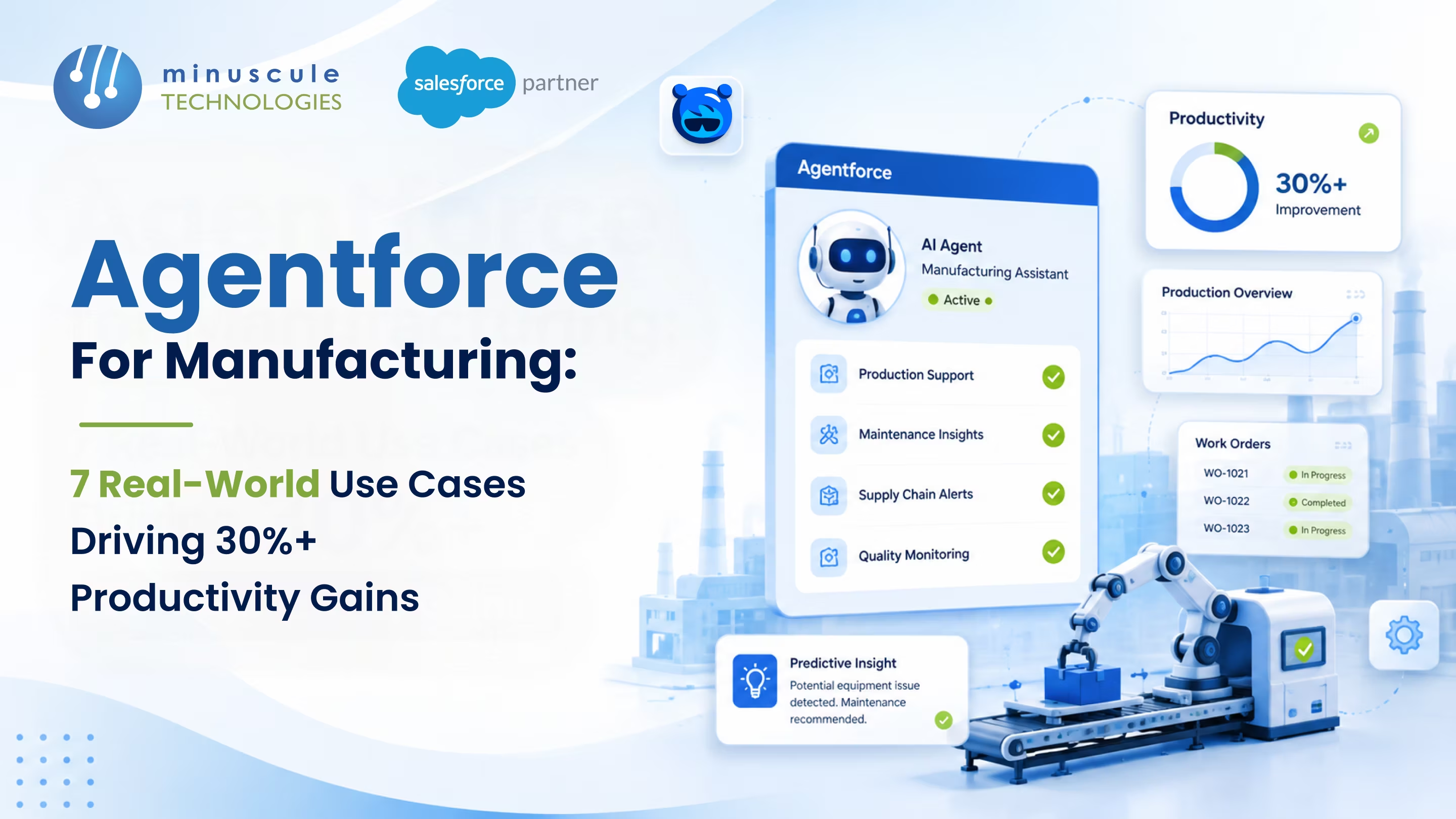
Agentforce for Manufacturing - Salesforce's rebranded and AI-enhanced version of Manufacturing Cloud - gives manufacturers prebuilt AI agents that handle sales operations, service workflows, and demand planning autonomously. A Forrester Total Economic Impact study commissioned by Salesforce found that manufacturing organizations using the platform achieved 354% ROI, saved 490 hours per year through generative AI automations, and saw 5% topline revenue growth.
Those are aggregate numbers. What matters to a VP of Operations or a plant manager is: what does this look like in practice? This guide breaks down seven specific use cases where Agentforce Manufacturing is driving measurable productivity gains - with verified data, not hypothetical scenarios.
Let's clear something up first. Agentforce Manufacturing is not a traditional manufacturing execution system. It doesn't run your shop floor, manage your BOMs, or schedule production lines. If you need those capabilities, you're looking at SAP S/4HANA, Oracle Cloud Manufacturing, or a Salesforce-native ERP like Rootstock.
What Agentforce Manufacturing does is put AI agents on the customer-facing side of your manufacturing operations. These agents work across three domains:
Salesforce Agentforce Manufacturing for Sales handles book of business analysis, opportunity management, run-rate agreement tracking, demand forecast adjustments, and product sample management. The agent surfaces patterns in customer ordering behavior and suggests forecast changes - work that used to take a sales ops analyst hours each week.
Agentforce Manufacturing for Service manages entitlement verification, warranty processing, complaint handling, pricing calculations, and proactive maintenance recommendations. It can process a service request, check warranty status, and draft a resolution plan without a human in the loop.
Manufacturing Intelligence provides embedded analytics with predictive recommendations - dashboards for sales performance, revenue cycle health, and demand-supply alignment.
The AI agents here aren't chatbots. They're autonomous workflows that take action based on rules, data signals, and machine learning models trained on your Salesforce data. They read, decide, and act - then flag exceptions for humans to review.
In August 2025, Salesforce formally retired the "Manufacturing Cloud" name and rebranded everything under Agentforce Manufacturing. All existing Manufacturing Cloud features carried over, with the new AI agent layer added on top. If you're already running Manufacturing Cloud, you're on the same platform - the agents are the new addition.
The problem: Most manufacturers still process orders through a mix of email, phone calls, and manual data entry. According to a 2024 Deloitte and Manufacturing Institute report, 70% of manufacturers rely on manual data entry for core processes. That's slow, error-prone, and expensive.
How Agentforce handles it: The AI agent monitors incoming order requests - whether they arrive via email, a customer portal, or an EDI feed into Salesforce. It validates the order against the customer's sales agreement, checks pricing and terms, confirms inventory availability (using the new Spring '26 inventory allocation feature), and either processes the order automatically or flags exceptions for human review.
Real-world result: A TELUS Digital case study documented a manufacturing customer that reduced order processing time from 16 to 24 hours down to less than 1 hour after deploying Agentforce. That's a 24x improvement in cycle time.
What this means for your team: If your order desk processes 50 orders a day and each takes 20 minutes of manual work, that's roughly 16 hours of daily labor. Even cutting that in half frees up a full-time equivalent to focus on exception handling and customer relationships instead of data entry.
The problem: Unplanned downtime costs manufacturers an estimated $50 billion annually, according to Deloitte research. Most manufacturers still react to equipment failures rather than predicting them. Even those with IoT sensors often lack the AI layer to turn sensor data into actionable maintenance schedules.
How Agentforce handles it: The Connected Assets feature in Agentforce Manufacturing monitors real-time equipment data - vibration patterns, temperature readings, cycle counts, and error codes. When the AI detects patterns that historically preceded failures, it automatically creates a maintenance work order, checks parts availability, and suggests an optimal service window that minimizes production disruption.
What this looks like in practice: Say your CNC machines typically throw a specific vibration pattern 72 hours before a spindle bearing fails. Instead of waiting for the failure (and the 4 to 8 hours of unplanned downtime that follows), the agent creates a maintenance case three days early, checks whether the replacement bearing is in stock, and schedules the work during a planned changeover window.
The Forrester TEI study found that organizations using Salesforce for manufacturing saved 490 hours per year through AI-driven automations. Predictive maintenance scheduling is one of the highest-impact contributors to that number.
For manufacturers running continuous or semi-continuous production, even a 10% reduction in unplanned downtime translates directly to revenue recovery. The math is straightforward: if your line generates $10,000 per hour of production and you recover 200 hours of downtime per year, that's $2 million in recovered output.
The problem: Traditional demand planning relies on either historical shipment data (backward-looking) or manual input from sales reps (inconsistent and often late). Neither approach handles sudden demand shifts, seasonal variations, or account-specific patterns well.
How Agentforce handles it: Agentforce Manufacturing for Sales builds bottom-up demand forecasts by combining CRM data (pipeline, win rates, customer engagement signals) with historical order patterns and sales agreement terms. The AI agent analyzes trends across accounts and product lines, identifies anomalies, and suggests forecast adjustments before the planning cycle.
What makes this different from ERP-based forecasting: In SAP's Integrated Business Planning or Oracle's Demand Management, forecasts start with algorithms analyzing historical data. They're statistically sound but disconnected from what the sales team actually knows. Agentforce flips this - the forecast starts with customer-level insights from the people closest to the buyer, then the AI validates and enhances those inputs with data patterns.
Practical example: Your top 10 accounts represent 60% of revenue. The Agentforce agent notices that three of these accounts have reduced their ordering frequency over the past two quarters, even though their sales agreements project stable volumes. It flags this discrepancy to the account managers, who discover that those customers are dual-sourcing from a competitor. That early signal gives your sales leadership 90 days to respond - instead of discovering the issue when quarterly numbers miss.
The Forrester study reported 5% topline revenue growth attributed to improved demand visibility and faster sales response. For a $500 million manufacturer, that's $25 million in additional revenue.
The problem: Warranty claims in manufacturing are manual, document-heavy processes. A customer reports a defect, then a service agent has to verify the warranty terms, check the product's service history, determine if the claim is covered, and create a resolution. Each step involves switching between systems - ERP for warranty terms, CRM for customer history, a separate system for parts availability.
How Agentforce handles it: Agentforce Manufacturing for Service unifies all of this. When a warranty claim comes in, the AI agent automatically pulls the customer's purchase history, checks warranty coverage and entitlements, reviews the product's prior service cases, and drafts a resolution recommendation - all before a human agent touches the case.
The agent can handle straightforward claims end-to-end: verify coverage, authorize a replacement part shipment, and send the customer a confirmation. It routes complex or high-value claims to senior service engineers with a pre-built case summary, so they can make a decision in minutes rather than spending 30 minutes gathering context.
Why this matters at scale: Manufacturers with thousands of warranty claims per month - common in automotive components, industrial equipment, and consumer electronics — can redirect significant labor away from administrative processing toward actual problem-solving. The Kawasaki Engines case study shows this in action: Kawasaki implemented Agentforce Manufacturing to manage the full cycle from production to post-sale services, substantially boosting their CSAT scores and improving response times across their dealer network.
The problem: Manufacturers with multiple warehouses, distribution centers, or regional stocking locations constantly juggle inventory allocation. Sales reps promise delivery dates without knowing what's actually available where. Operations teams manually track stock across locations using spreadsheets or fragmented ERP modules. The result: overselling in one region while excess inventory sits in another.
How Agentforce handles it: The Spring '26 release introduced inventory allocation across locations - one of the most significant feature additions to Agentforce Manufacturing. This gives manufacturers real-time visibility into on-hand stock, allocated quantities, and available-to-promise inventory across every location.
The system supports soft reservations, so a sales rep can tentatively hold inventory for a large deal without hard-committing it. It handles concurrent transactions - multiple reps selling from the same pool won't accidentally double-allocate. And it shows stock status at a granular level: on-hand, allocated, in-transit, and available.
Practical impact: A distributor-manufacturer with 12 regional warehouses previously relied on daily spreadsheet updates from each location to allocate stock. Orders placed after 2 PM often had inaccurate availability data because the spreadsheet was already stale. With real-time allocation in Agentforce, reps see live inventory across all 12 locations. The immediate impact: fewer backorders, faster delivery commitments, and reduced safety stock buffers (because you're no longer hoarding extra inventory to compensate for poor visibility).
This feature is brand new in 2026. Most competitors haven't covered it yet because it shipped in the Spring '26 release just weeks ago. It's a direct move into territory that SAP's Extended Warehouse Management and Oracle's Inventory Management have dominated - though Salesforce's version is lighter and focused on commercial inventory decisions rather than deep warehouse operations.
The problem: Manufacturers that sell through dealer networks, distributors, or channel partners struggle with incentive management, rebate tracking, and channel revenue optimization. Typical pain points include partners not understanding their rebate tiers, disputes over earned vs. paid incentives, and a lack of visibility into which partners are actually driving profitable growth.
How Agentforce handles it: The Winter '26 and Spring '26 releases added several channel management features. Rebates Explainability gives partners (and your channel team) clear visibility into how rebates are calculated - which programs applied, what thresholds were met, and what's still outstanding. Stock rotation incentives let partners return or scrap aging inventory for rotation credits, with full budget allocation and tracking built in. And incentive budget management allows channel managers to define, allocate, and monitor incentive budgets across partners and programs from a single dashboard.
Why this is a productivity driver: Channel disputes consume a disproportionate amount of time for manufacturing sales ops teams. In our experience, companies with 50+ channel partners often dedicate two to three full-time employees just to manage rebate calculations and dispute resolution. Automating the calculation, making it transparent to partners, and providing self-service visibility through Agentforce can reduce dispute volume by 40% or more - because partners can see exactly where they stand without calling your team.
Minuscule Technologies has worked with manufacturers running complex partner programs across multiple industries. Their Salesforce consulting team can configure Agentforce's channel management features to match your specific incentive structures, including tiered rebates, volume bonuses, and market development funds.
The problem: Product recalls are high-stakes, time-sensitive operations. When a defect surfaces — whether from internal quality testing, customer complaints, or a regulatory agency — manufacturers need to identify every affected unit, trace the supply chain, notify customers and distributors, coordinate returns or repairs, and document everything for compliance. Most manufacturers cobble this together across email, spreadsheets, ERP quality modules, and sometimes paper records.
How Agentforce handles it: The Spring '26 release introduced recall handling templates that accelerate the entire recall process. These templates provide a pre-built workflow: identify the affected product lot or serial number range, automatically pull every customer and distributor who received those units from Salesforce records, generate notification communications, create individual service cases for each affected unit, and track resolution status across the entire recall population.
The AI agent can draft customer notification messages, prioritize outreach based on risk level (e.g., safety-critical recalls get immediate outbound calls, minor quality issues get email notifications), and generate compliance reports showing recall completion percentages by region, by customer, and by product line.
Why this is critical: Regulatory penalties for mismanaged recalls can be severe. In automotive, medical devices, and food manufacturing, recall response speed directly affects liability exposure. A manufacturer that can go from defect identification to full customer notification in 48 hours instead of two weeks dramatically reduces both risk and cost.
For manufacturers in regulated industries, having recall traceability built into your CRM - where customer, product, and service data already lives — is a significant advantage over running recall processes in a separate quality management system.
Let's put the 30%+ productivity claim in context with verified data:
The Forrester study analyzed organizations with approximately $500 million in annual revenue. At that scale, 490 hours saved translates to roughly $50,000 to $75,000 in direct labor savings per year - modest on its own. But the real productivity gain is compounding: faster orders free up sales ops to focus on upselling, predictive maintenance prevents revenue-killing downtime, better demand forecasts reduce both stockouts and excess inventory, and automated warranty processing improves customer retention.
When you stack these use cases together, the 30%+ productivity improvement isn't unrealistic for teams that were previously running on manual processes and disconnected systems. The key word is "previously manual." If your operations are already highly automated through SAP or Oracle, the incremental gain from Agentforce will be smaller - it adds the most value in the customer-facing layer, not the production layer.
We'd be doing you a disservice if we didn't acknowledge the elephant in the room. Browse Reddit's r/salesforce community for five minutes and you'll find threads asking whether Agentforce is overhyped. A thread from just last month titled "Agentforce - How is there still any hype?" pulled over 100 comments.
The skepticism is fair. Agentforce launched with big promises, and early implementations were limited. Many of the initial deployments were more demo than production. The Kawasaki Engines story, for example, mentions that they're still "piloting" Agentforce for case classification and suggested replies - even as a named customer reference.
Here's our honest take:
Where the hype is justified: Salesforce Agentforce's AI agent framework is genuinely ahead of what SAP (Joule) and Oracle offer for CRM-adjacent manufacturing workflows. The ability to create autonomous agents that process orders, handle warranty claims, and manage inventory allocation without human intervention is real and shipping in production today. The Forrester data backs up measurable ROI.
Where it's still early: Complex use cases like predictive maintenance require significant Data Cloud setup and clean IoT data feeds. Out-of-the-box, Agentforce doesn't magically connect to your PLCs or SCADA systems. You need integration work. And the AI agents need training data specific to your operation — generic models won't cut it for industry-specific workflows.
What this means for you: Start with the use cases that match your existing Salesforce data. If you're already on Sales Cloud with customer and order data, use cases 1 (order processing), 3 (demand forecasting), and 4 (warranty resolution) will deliver the fastest ROI. Use cases like predictive maintenance (use case 2) require more infrastructure investment and are better suited as phase-two deployments.
Based on the use cases above, here's a practical phased approach:
Focus on use cases that work with your existing Salesforce data - order processing automation, demand forecasting, and warranty case management. This phase requires minimal integration work if you're already on Sales Cloud and Service Cloud. Add Manufacturing Cloud (Agentforce Manufacturing) licensing, configure sales agreements and account-based forecasting, and deploy the first AI agents.
Add inventory allocation across locations (requires inventory data feeds from your ERP or warehouse management system), partner channel management, and recall handling templates. This phase involves ERP integration - connecting SAP, Oracle, or your warehouse system to Salesforce via MuleSoft or another middleware platform.
Deploy predictive maintenance (requires IoT/Connected Assets setup), Manufacturing Intelligence dashboards, and advanced AI agent customizations. This is the most complex phase and benefits from a Salesforce consulting partner with manufacturing domain expertise.
Minuscule Technologies has implemented Agentforce Manufacturing for organizations across industries - from heavy equipment to consumer goods. Their team handles the full arc: Salesforce licensing strategy, ERP integration architecture, agent configuration, and user training.
Salesforce Agentforce for Manufacturing is the rebranded and enhanced version of Salesforce Manufacturing Cloud. Salesforce retired the Manufacturing Cloud name in August 2025. All existing features - sales agreements, demand forecasting, account-based planning - carried over. The key addition is prebuilt AI agents that autonomously handle sales operations, service workflows, and inventory management tasks.
Agentforce Manufacturing is an add-on to Salesforce Sales Cloud or Service Cloud. Pricing follows Salesforce's per-user, per-month model and varies by contract size and edition. Salesforce offers a 30-day free trial. For specific pricing, contact Salesforce directly or work with a consulting partner like Minuscule Technologies who can advise on the most cost-effective licensing structure for your organization.
No. Agentforce Manufacturing handles customer-facing manufacturing operations - demand planning, sales agreements, service, warranty, and partner management. It does not cover core ERP functions like production scheduling, BOM management, procurement, or financial accounting. Most manufacturers run Agentforce alongside SAP, Oracle, or a Salesforce-native ERP like Rootstock.
It's production-ready. The Forrester TEI study validated ROI across production deployments. Named customers like Kawasaki Engines are running Agentforce Manufacturing in production, with some newer AI agent features (like case classification) still in pilot. The core platform - sales agreements, demand forecasting, inventory allocation - is GA (generally available) and fully supported.
For manufacturers already on Salesforce, adding Agentforce Manufacturing typically takes 3 to 6 months for core use cases (order processing, demand forecasting, service management). More complex deployments involving ERP integration, predictive maintenance, and IoT connectivity can extend to 6 to 9 months. A phased approach is recommended.
At minimum, you need clean customer data, order history, and product catalog information in Salesforce. For advanced use cases, you'll need inventory data (from ERP or WMS), equipment sensor data (for predictive maintenance), and channel partner data (for rebate and incentive management). Data Cloud serves as the integration layer that unifies these sources.
The seven use cases in this guide aren't theoretical. They're shipping features backed by Forrester-validated ROI data and production deployments at manufacturers like Kawasaki. The question isn't whether Agentforce Manufacturing can drive productivity gains - it's which use cases fit your operation today and which ones you phase in over the next 12 months.
Minuscule Technologies helps manufacturers answer that question. As a Trusted Salesforce Engineering Partner, they've built Agentforce Manufacturing deployments across industries -configuring AI agents, integrating ERP systems, and training teams to get value from day one.
You've seen what's possible. Now, let's make it happen for your business. Whether you need an end-to-end Salesforce solution, a complex integration, or ongoing managed services, our team is ready to deliver.

Schedule a Free Strategic Call


