

May 25, 2026
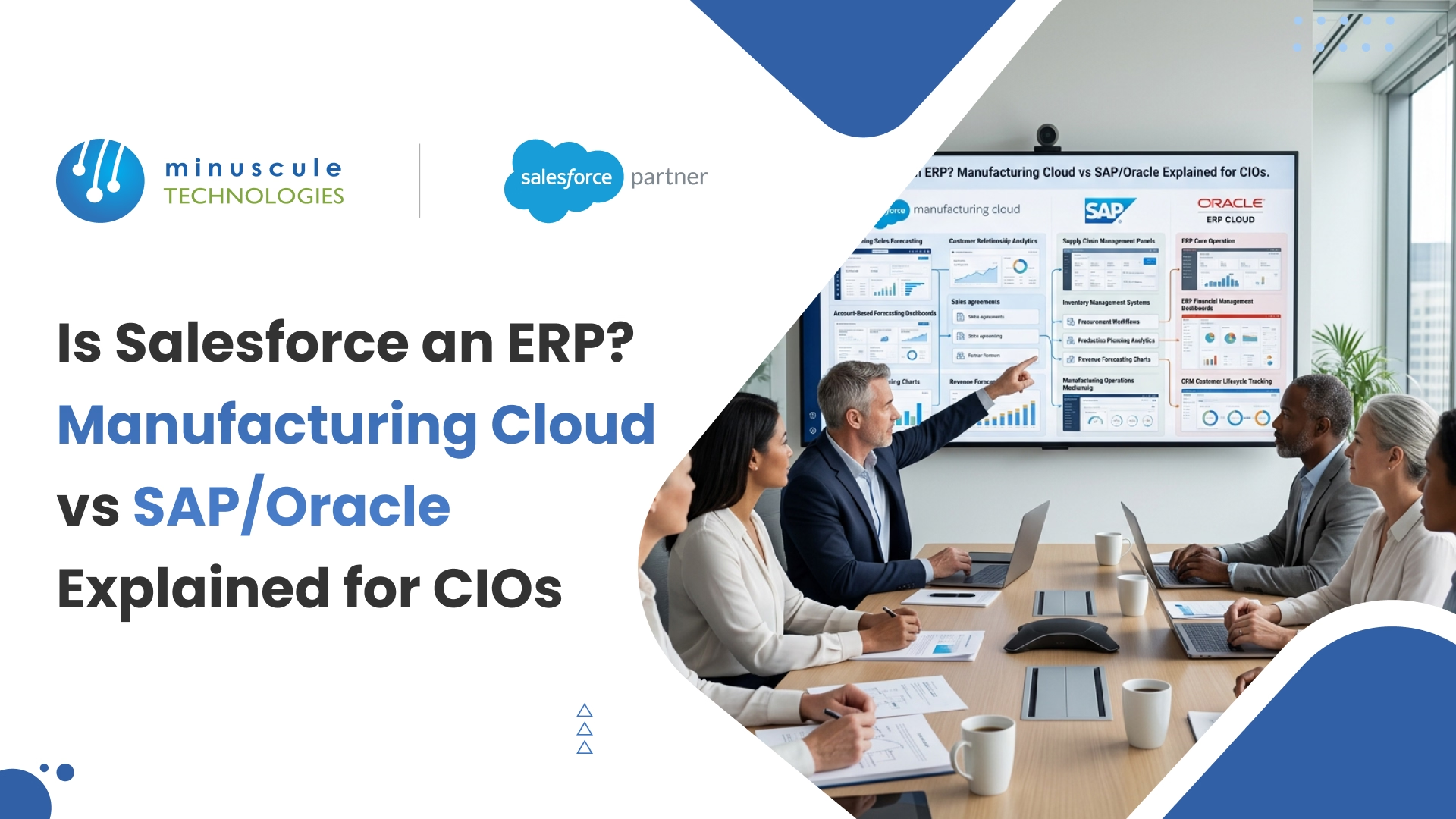
No, Salesforce is not an ERP system. It's a CRM platform - but that answer alone doesn't help a CIO who's watching Salesforce push deeper into manufacturing operations every quarter. With the 2025 launch of Agentforce Manufacturing (the rebranded Manufacturing Cloud), Salesforce now handles demand forecasting, sales agreements, inventory allocation, warranty management, and AI-driven operational insights - functions that used to live exclusively inside SAP or Oracle.
So the real question isn't "Is Salesforce an ERP?" It's "Can Salesforce replace my ERP for specific manufacturing workflows, and where do SAP S/4HANA or Oracle Cloud still win?" This guide breaks that down with a feature-by-feature comparison, a decision framework, and the latest 2026 capabilities - all written for CIOs making architecture decisions.
ERP - Enterprise Resource Planning - is a category of software that manages core business operations in one unified database. A true ERP system typically covers finance and accounting, procurement, supply chain and inventory, manufacturing execution (shop floor scheduling, work orders, BOM management), human resources and payroll, and order management.
SAP S/4HANA and Oracle Cloud ERP are full-stack ERPs. They handle all of the above in a single platform. That's their strength: one system of record for finance, production, and procurement. It's also their complexity - ERP implementations for mid-to-large manufacturers often run 12 to 24 months, sometimes longer.
Salesforce doesn't fit this definition. It doesn't have a native general ledger. It doesn't do shop floor scheduling. It doesn't manage bills of material natively. What Salesforce does - and does very well - is manage everything from the customer backward: sales pipelines, account management, demand signals, service cases, and now, with Agentforce Manufacturing, a growing set of manufacturing-adjacent operations.
Understanding this distinction matters because the decision for CIOs isn't "Salesforce or ERP." It's "Which processes belong in Salesforce, which belong in ERP, and how do I connect them?"
Salesforce started as a sales and marketing tool. Over the past five years, it's expanded aggressively into industry-specific solutions. For manufacturing, the key product is what was previously called Manufacturing Cloud - now rebranded as Agentforce Manufacturing.
Here's what Salesforce can handle natively for manufacturers:
Manufacturers with long-term contracts, blanket purchase orders, and recurring run-rate business can manage all of it inside Salesforce. Sales agreements track planned vs actual volumes, revenue forecasts, and contract terms. This is something SAP handles through SD (Sales and Distribution) modules, but in Salesforce, the data lives right alongside your CRM — so sales reps see account history, open cases, and contract status in one view.
Salesforce lets manufacturers build bottom-up demand forecasts based on real customer data. Account managers input expected order volumes by product line and time period. These roll up into aggregate forecasts that operations teams can use for production planning. The difference from traditional ERP forecasting? In Salesforce, the forecast is built by the people closest to the customer - your sales team - not by a planning algorithm looking at historical shipments.
The Spring '26 release introduced inventory allocation across locations. This gives manufacturers real-time visibility into on-hand stock, allocated inventory, and available-to-promise quantities across multiple warehouses. It supports soft reservations and concurrent transactions. This is a direct step into territory that SAP's Extended Warehouse Management and Oracle's Inventory Management have owned for years.
Agentforce Manufacturing includes case management, warranty tracking, complaint handling, and recall management templates. For manufacturers who spend significant time on post-sale service, this is a strong alternative to running a separate service module in SAP or Oracle.
There are clear boundaries. Salesforce doesn't handle general ledger accounting, accounts payable and receivable at the transaction level, production scheduling or shop floor execution, bill of materials management or engineering change orders, procurement workflows (RFQs, POs, goods receipt), or quality management with inspection lots and test plans.
For these functions, you still need SAP, Oracle, or a Salesforce-native ERP partner like Rootstock or Certinia (formerly FinancialForce).
In August 2025, Salesforce rebranded Manufacturing Cloud to Agentforce Manufacturing and embedded AI agent capabilities throughout the product. This wasn't just a name change - it marked a shift from "cloud features for manufacturers" to "AI-powered autonomous agents that handle manufacturing workflows."
The product now includes prebuilt, role-based AI agent templates. These agents can handle tasks that previously required manual work from sales ops or service teams. Here's what's available as of Spring '26:
Agentforce Manufacturing for Sales gives sales teams an AI agent that manages book of business analysis, opportunity insights, run-rate agreement tracking, and demand forecast adjustments. Instead of reps manually updating forecasts, the agent surfaces patterns and suggests changes. Read more about the benefits of Agentforce for sales and service teams.
Agentforce Manufacturing for Service provides AI-powered service agents that handle entitlement verification, pricing calculations, and proactive maintenance recommendations. The agent can process a service request, check warranty status, and create a resolution plan - reducing the back-and-forth between reps and systems. You can explore more Agentforce use cases for manufacturers across sales, service, and operations.
Manufacturing Intelligence delivers embedded analytics with predictive recommendations. This includes visibility dashboards for sales performance, revenue cycle analysis, and demand-supply alignment.
The latest release added inventory allocation across locations (mentioned above), criteria-based search and filter for products, sample management capabilities, timesheet management for manufacturing teams, and recall handling templates that accelerate product recall processes. Also new are stock rotation incentives - partners can return or scrap aging inventory for rotation credits with full budget allocation and tracking.
This pace of development matters for CIOs evaluating long-term platform strategy. Salesforce is adding one to two manufacturing-specific features per quarterly release, steadily narrowing the gap with traditional ERPs in customer-facing manufacturing operations.
Here's where a direct comparison gets useful. This table maps core manufacturing functions across both platforms:
| Manufacturing Function | Salesforce (Agentforce Manufacturing) | SAP S/4HANA |
|---|---|---|
| Sales Agreement / Contract Management | Native. Tracks planned vs actual volumes, revenue forecasts, contract terms alongside CRM data | Native via SD module. Deep contract management but disconnected from CRM insights |
| Demand Forecasting | Account-based, bottom-up from sales reps. AI-powered suggestions via Agentforce | Statistical forecasting in PP/APO. Demand Sensing with ML in IBP. More algorithmic, less sales-team driven |
| Inventory Management | Multi-location visibility, soft reservations, stock status tracking | Mature and deep. EWM, batch management, serial tracking, bin-level control |
| Production Planning / MRP | Not available natively. Requires Rootstock or partner ERP on Salesforce platform | Core strength. MRP, capacity planning, detailed scheduling, shop floor control |
| Bill of Materials | Not available natively | Full BOM management with engineering change management |
| Quality Management | Basic case-based quality tracking | Full QM module — inspection lots, test plans, certificates of analysis |
| Finance / GL / AP / AR | Not available natively. Requires Certinia or integration to external ERP | Full financial accounting suite |
| Procurement | Not available natively | Full Brits-to-pay: RFQs, POs, goods receipt, invoice verification |
| Service and Warranty | Strong. AI agents for entitlement, case management, recall handling | SAP S/4HANA Service handles similar functions but less CRM-integrated |
| AI / Automation | Agentforce AI agents embedded across sales and service workflows | SAP Business AI, Joule copilot, predictive analytics in IBP |
| Partner / Channel Management | Strong via PRM (Partner Relationship Management) | Limited natively; partner management often handled outside SAP |
| CRM / Customer 360 | Core strength. Full customer lifecycle view | Basic CRM in SAP Sales Cloud (separate product) |
SAP S/4HANA wins decisively in production execution, materials management, financial accounting, and procurement. If you're running complex make-to-order manufacturing with multi-level BOMs, routing optimization, and shop floor scheduling - SAP is the stronger platform and will be for the foreseeable future.
Salesforce wins in customer-facing manufacturing operations: sales agreement management, account-based demand planning, partner/channel management, service and warranty workflows, and AI-powered sales productivity. If your manufacturing operation's biggest challenge is demand visibility, customer relationship complexity, or sales-service alignment — Salesforce adds value that SAP doesn't replicate easily.
Oracle Cloud Manufacturing (part of Oracle Fusion Cloud ERP) is SAP's primary competitor in the full-stack ERP space. Here's how it stacks up against Salesforce for manufacturers:
| Manufacturing Function | Salesforce (Agentforce Manufacturing) | Oracle Cloud Manufacturing |
|---|---|---|
| Sales Agreement Management | Native with CRM integration | Available in Oracle Order Management but less CRM-focused |
| Demand Forecasting | Account-based, sales-team-driven, AI-augmented | Oracle Demand Management with ML-based statistical forecasting |
| Inventory Management | New multi-location visibility (2026) | Mature — inventory organizations, subinventories, lot/serial control |
| Production Planning | Not available natively | Oracle Cloud Manufacturing — work orders, routings, shop floor execution |
| Product Lifecycle Management | Not available | Oracle PLM Cloud — full item management, BOM, change orders |
| Quality Management | Case-based tracking | Oracle Quality Management — inspection plans, nonconformance, CAPA |
| Finance | Not available natively | Oracle Cloud Financials — GL, AP, AR, fixed assets, cash management |
| Procurement | Not available natively | Oracle Cloud Procurement — full procure-to-pay |
| Service Management | Strong with AI agents | Oracle Field Service Cloud (separate product) |
| AI Capabilities | Agentforce agents for sales and service | Oracle AI embedded in SCM, financial planning, demand sensing |
| CRM | Core strength | Oracle CX Cloud (separate product, less market share than Salesforce CRM) |
| Implementation Speed | Faster for CRM + manufacturing ops (3-6 months typical) | Longer for full ERP deployment (12-24 months typical) |
Oracle's advantage over SAP in this comparison is its unified cloud architecture. Oracle Cloud ERP runs on a single data model - finance, manufacturing, supply chain, and HCM all share the same database. This means less integration overhead compared to SAP's historically modular approach (though SAP S/4HANA has improved here significantly).
For CIOs already running Oracle ERP, integrating Salesforce as the CRM layer is a common pattern. Salesforce's MuleSoft integration platform and prebuilt Oracle connectors make this feasible, though it adds architectural complexity and licensing costs.
Here's what experienced manufacturing CIOs already know: the question isn't Salesforce OR ERP. It's Salesforce AND ERP, with clear boundaries.
A Reddit thread in r/salesforce from early 2026 asked, "Is keeping ERP separate from Salesforce still the smarter architecture choice?" The top-voted answer with 37 upvotes was straightforward: "Yes. Modular architecture that is well integrated is the better choice."
That aligns with what we see across manufacturing organizations. The most effective architecture looks like this:
Salesforce handles the front office - sales, customer management, demand forecasting, service, partner relationships, and now with Agentforce, AI-driven insights across all of these.
SAP or Oracle handles the back office - finance, production execution, materials management, procurement, quality management, and compliance.
An integration layer (MuleSoft, Dell Boomi, or SAP BTP) connects them - syncing customer master data, order data, inventory status, and invoice information bidirectionally.
Specialized tools outperform generalist ones. Your sales team gets a CRM built for selling. Your plant managers get an ERP built for production. Neither team is forced to work in a system designed for someone else.
Updates and upgrades happen independently. You can adopt Agentforce AI features without touching your SAP upgrade cycle, and vice versa.
Vendor lock-in decreases. With clean integration boundaries, you can swap components - move from SAP to Oracle ERP, or from Salesforce to Microsoft Dynamics CRM - without rebuilding everything.
There's one scenario where consolidating makes sense: if you're a mid-market manufacturer (under $500M revenue) without deeply complex production processes, you might consider Salesforce plus a Salesforce-native ERP like Rootstock. Rootstock runs natively on the Salesforce platform and covers manufacturing execution, inventory, and financials — giving you one platform for everything. The trade-off is that Rootstock doesn't match SAP or Oracle's depth in complex manufacturing scenarios.
For CIOs evaluating their manufacturing technology stack, here's a practical decision framework:
| Your Situation | Recommended Approach |
|---|---|
| Complex discrete or process manufacturing with multi-level BOMs and shop floor complexity | SAP S/4HANA or Oracle Cloud ERP as primary, Salesforce as CRM and demand planning layer |
| Mid-market manufacturer with straightforward production and strong customer/channel complexity | Salesforce with Rootstock or Certinia for ERP functions — single platform approach |
| Already running SAP or Oracle ERP and struggling with demand visibility or sales-service alignment | Add Salesforce Manufacturing Cloud (Agentforce Manufacturing) for front-office operations, integrate with existing ERP |
| Greenfield / new manufacturing operation | Evaluate Salesforce-native ERP (Rootstock) for speed to market, or full SAP/Oracle if production complexity warrants it |
| Primary challenge is AI-driven sales and service productivity | Salesforce Agentforce Manufacturing — strongest AI agent capabilities for customer-facing manufacturing workflows |
Before choosing a direction, work through these:
If you're unsure where the boundaries should fall, a Salesforce consulting partner like Minuscule Technologies can map your manufacturing processes against platform capabilities and recommend an architecture that fits. Their team has done this across industries from heavy equipment to consumer goods.
You can learn more about their manufacturing expertise at minusculetechnologies.com/industry/manufacturing.
Once you've decided on a hybrid approach, integration design becomes the next critical decision. Here are the three patterns we see most often in manufacturing environments:
Best for: Order-to-cash workflows where Salesforce orders need to flow into SAP/Oracle immediately, and fulfillment status needs to update in Salesforce in near real-time.
How it works: MuleSoft or SAP BTP processes events as they happen. When a sales rep confirms an order in Salesforce, it triggers order creation in SAP. When SAP ships the order, the delivery status updates in Salesforce automatically.
Best for: Customer master data, product catalogs, and pricing. These don't change every minute, so nightly or hourly batch syncs work well and reduce integration load.
How it works: A scheduled job pulls updated customer records, product data, and price lists from SAP/Oracle and pushes them to Salesforce. Changes flow the other direction for new accounts or updated contacts created by sales reps.
Best for: CIOs who want a unified view across front-office and back-office data without tightly coupling the operational systems.
How it works: Both Salesforce and SAP/Oracle feed data into a shared analytics layer - Tableau CRM (now CRM Analytics), Power BI, or Snowflake. Manufacturing Intelligence dashboards in Agentforce Manufacturing can pull from these shared datasets.
Minuscule Technologies specializes in Salesforce integration architecture and has built these patterns for manufacturers across multiple industries. Their MuleSoft and Salesforce integration practice can help design the right approach for your specific ERP and manufacturing setup.
Salesforce is a CRM (Customer Relationship Management) platform, not an ERP. It manages sales, marketing, customer service, and partner relationships. However, with Agentforce Manufacturing (formerly Manufacturing Cloud), Salesforce now covers several manufacturing operations like demand forecasting, sales agreements, and inventory visibility that overlap with traditional ERP functions.
Not entirely. Salesforce can replace SAP for customer-facing manufacturing operations - demand planning, sales agreements, service management, and partner channel management. But for core ERP functions like production scheduling, materials management, financial accounting, and procurement, SAP S/4HANA remains the stronger platform. Most manufacturers run both in a hybrid architecture.
They're the same product. In August 2025, Salesforce rebranded Manufacturing Cloud to Agentforce Manufacturing and embedded AI agent capabilities throughout. The rebrand reflects Salesforce's broader strategy of building autonomous AI agents for specific industry workflows. All existing Manufacturing Cloud features carried over, with new AI-powered sales and service agent templates added.
For mid-market manufacturers already using Salesforce Sales Cloud or Service Cloud, adding Manufacturing Cloud (Agentforce Manufacturing) is a natural extension that typically pays for itself within 12 months through better demand visibility and sales-service alignment. If you're not on Salesforce at all, the decision depends on whether your biggest operational gaps are customer-facing (favor Salesforce) or production-focused (favor traditional ERP).
The most common approach uses MuleSoft (owned by Salesforce) or SAP Business Technology Platform as middleware. Prebuilt connectors exist for SAP S/4HANA, Oracle Cloud ERP, and Oracle E-Business Suite. Data typically synced includes customer master records, orders, product catalogs, pricing, inventory status, and invoicing data. Integration projects usually take 4 to 8 weeks for core workflows.
Rootstock Cloud ERP and Certinia (formerly FinancialForce) are the two major ERPs built natively on the Salesforce platform. Rootstock covers manufacturing execution, inventory management, and supply chain. Certinia covers financial management, professional services automation, and billing. Both share Salesforce's data model, so there's no integration layer needed between CRM and ERP.
Choosing between Salesforce, SAP, or Oracle isn't really about picking one winner. It's about drawing the right boundary lines - deciding which processes belong in your CRM, which belong in your ERP, and how data flows between them.
Minuscule Technologies helps manufacturers make these decisions every day. As a Trusted Salesforce Engineering Partner, they bring deep expertise in Salesforce implementation, Manufacturing Cloud configuration, and ERP integration design. Whether you're adding Agentforce Manufacturing to an existing SAP landscape or evaluating a full Salesforce-native stack with Rootstock, their team can build the architecture that fits.
You've seen what's possible. Now, let's make it happen for your business. Whether you need an end-to-end Salesforce solution, a complex integration, or ongoing managed services, our team is ready to deliver.

Schedule a Free Strategic Call


