
August 10, 2026
Scene playing out at a bank somewhere right now. A senior customer logs in to dispute a charge she didn't make. The fraud team is buried. The dispute sits for nine days. By the time someone calls back, the fraudster has emptied her son's college savings.
She doesn't sue or post on Reddit. She quietly moves her retirement nest egg to the neobank her daughter recommended, files a regulator complaint, and mentions it at Bridge Club. Six months later, the bank notices odd attrition. Twelve months later, the auditor asks why fraud disputes average 6.7 days against a 24-hour policy. Nobody has a good answer.
This isn't hypothetical. It happens every week to banks running operations on disconnected systems, manual workflows, and service teams buried under tickets an AI agent could triage in 47 seconds. The regulators are watching. The cost of quiet churn shows up in the loan book two quarters too late.
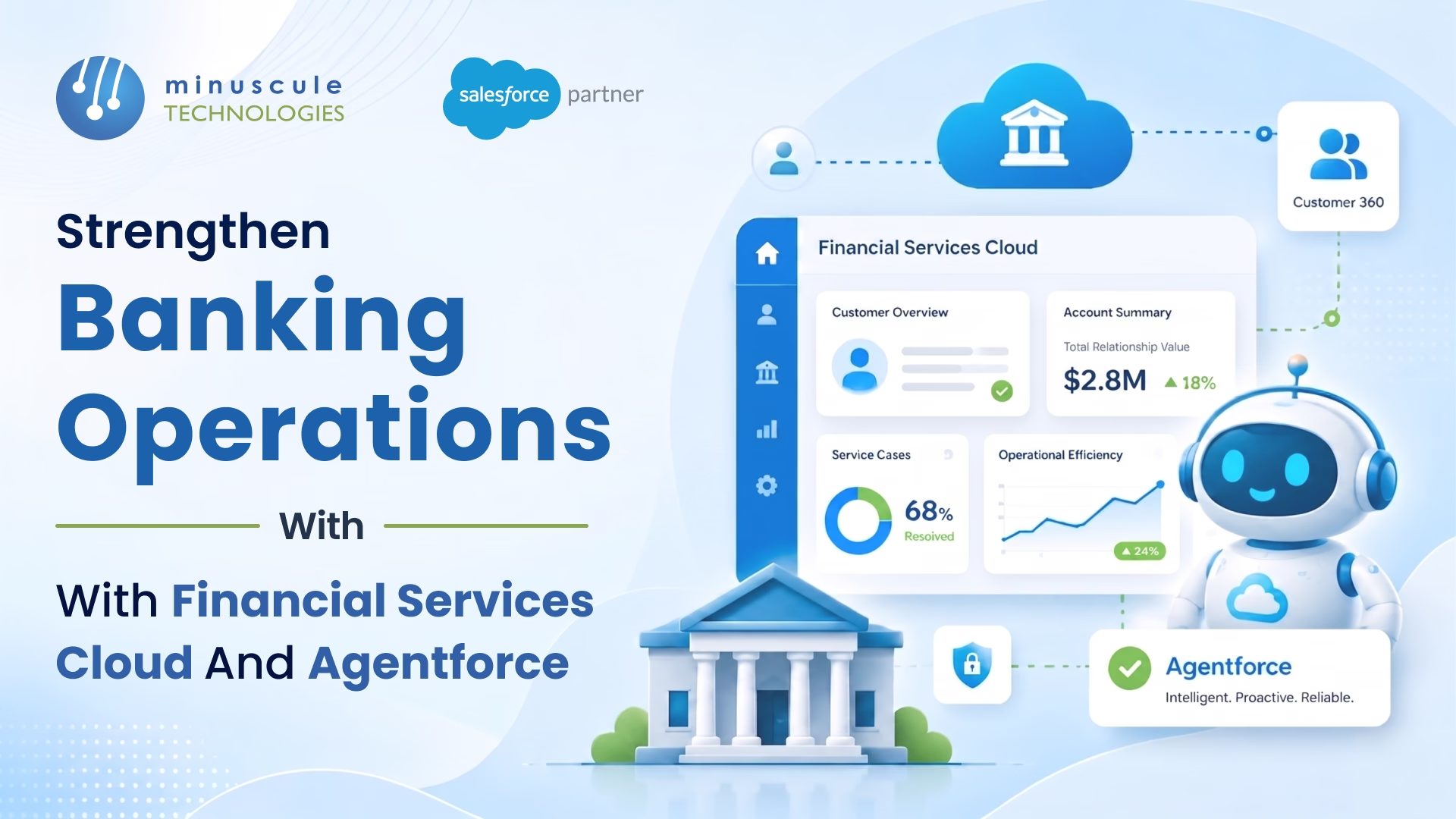
Salesforce Financial Services Cloud now includes pre-built Agentforce agents - Banking Service Agent, Digital Loan Officer, and Wealth Service Agent - on top of the existing FSC data model. For retail banks, NBFCs, and credit unions running Service Cloud and a core banking platform like Finacle, T24, FIS, or Jack Henry, it's the 2026 stack that ties operational efficiency to measurable customer trust. For the wider picture, see how AI and Salesforce are reshaping financial services.
What strong banking ops on FSC and Agentforce delivers:
Let's dig into how it works - the six banking ops move that pay back fastest, the data foundation that makes them possible, and the rollout order that keeps the compliance team on your side.
Banking operations cover everything that happens between a customer signing up and a transaction settling - onboarding, KYC, account servicing, lending, payments, disputes, fraud handling, and branch operations. Five core characteristics make banking ops harder than generic CRM workflows:
Salesforce's response is to the Agentforce Financial Services stack. The platform ships pre-built AI models for banking, lending, collections, and insurance service, plus a Banking Service Agent and Digital Loan Officer that drops into FSC with role-based defaults. The Salesforce financial services page has the full feature breakdown.
Six concrete moves we see deliver measurable operational lift in the first quarter:
The pattern repeats: pre-built FSC objects plus an Agentforce agent plus a tight integration to core banking. The Apex Hours community has working reference flows for several of these use cases.
The most common mistake in 2026 banking ops rollouts: turning on Agentforce before the FSC data model is clean. AI on dirty data is just confident in garbage with regulatory consequences.
Six data foundations to settle before Agentforce goes live:
This data work is unglamorous. It compounds across every Agentforce use case you turn on later. The Salesforce admin documentation has reference patterns for the FSC household model that hold up across multi-product banks.
Banking AI carries regulatory weight that retail or SaaS AI doesn't. Six guardrails to build before Agentforce hits a single real customer:
A good Salesforce Agentforce Implementation partner builds these guardrails before the first AI action ships, not after the first regulator question.
A clean banking ops rollout on FSC, and Agentforce follows a predictable order. Skipping any phase costs more later than it saves now.
Teams that compress this into 12 weeks usually regret it within the year. Teams that stretch it past 12 months lose momentum. A 9-month program with the right Salesforce managed services handoff is the sweet spot for most retail banks.
Salesforce Financial Services Cloud now includes pre-built Agentforce agents - Agentforce Banking Service Agent, Digital Loan Officer, and Wealth Service Agent - on top of the existing FSC data model, objects, and APIs are the same - Salesforce added pre-built AI agents (Agentforce Banking Service Agent, Digital Loan Officer) and tightened the marketing around the AI capabilities. Existing FSC orgs upgrade in place. The Salesforce Ben blog has good coverage of what changed and what didn't happen.
Yes, through a properly built integration layer. Agentforce calls Apex actions, Flow, or external REST endpoints. With MuleSoft or custom REST built in front of Finacle, T24, FIS, or Jack Henry, Agentforce can read and write to core systems in real time - within the permission boundaries you set.
A single high-impact use case (e.g., digital account opening or dispute triage) takes around three to four months of end-to-end. A multi-use-case program covering four to six banking workflows runs seven to nine months. Multi-region or multi-product rollouts can stretch to twelve to fifteen months.
The same underlying platform with different default configurations, role-based agents, and pre-built dashboards. FSC for banking ships with Agentforce Banking Service Agent, Digital Loan Officer, deposit and lending objects, and AML/fraud workflows. FSC for wealth ships with Wealth Service Agent, Goal-Based Planning, and AUM-focused household views. Most universal banks run both configurations side-by-side. Our wealth management FSC blog covers the wealth side in detail.
FSC and Agentforce is one of the highest-impact Salesforce programs a retail bank, NBFC, or credit union can run in 2026 - when the data foundation, audit guardrails, and rollout sequence are right. Done badly, it becomes an expensive compliance risk. At Minuscule Technologies, we've delivered FSC and Agentforce rollouts across retail banking, lending, and credit union segments - including KYC autofill, digital account opening, Agentforce Banking Service Agent on Experience Cloud, and dispute triage built on the 3 FSC Flow automations framework.
Our team brings 125+ Salesforce engineers, FSC and Agentforce certifications, and an integration-first approach that wires the platform cleanly into Finacle, T24, FIS, Jack Henry, and the KYC and AML providers banks use. Book a free strategic call and we'll audit your banking ops journey, pick the two or three highest-impact use cases, and ship a realistic 9-month plan. For deeper context, our Top 5 Service Cloud AI Tasks for BFSI and Salesforce Consultants Help BFSI guides cover the tactical and strategic layers that sit alongside the FSC + Agentforce build.
You've seen what's possible. Now, let's make it happen for your business. Whether you need an end-to-end Salesforce solution, a complex integration, or ongoing managed services, our team is ready to deliver.

Schedule a Free Strategic Call


Plot No. 4, Sridevi Amman Street, Perumal Nagar Extension, Old Pallavaram, Chennai, Tamil Nadu 600117, India.
