
August 11, 2026
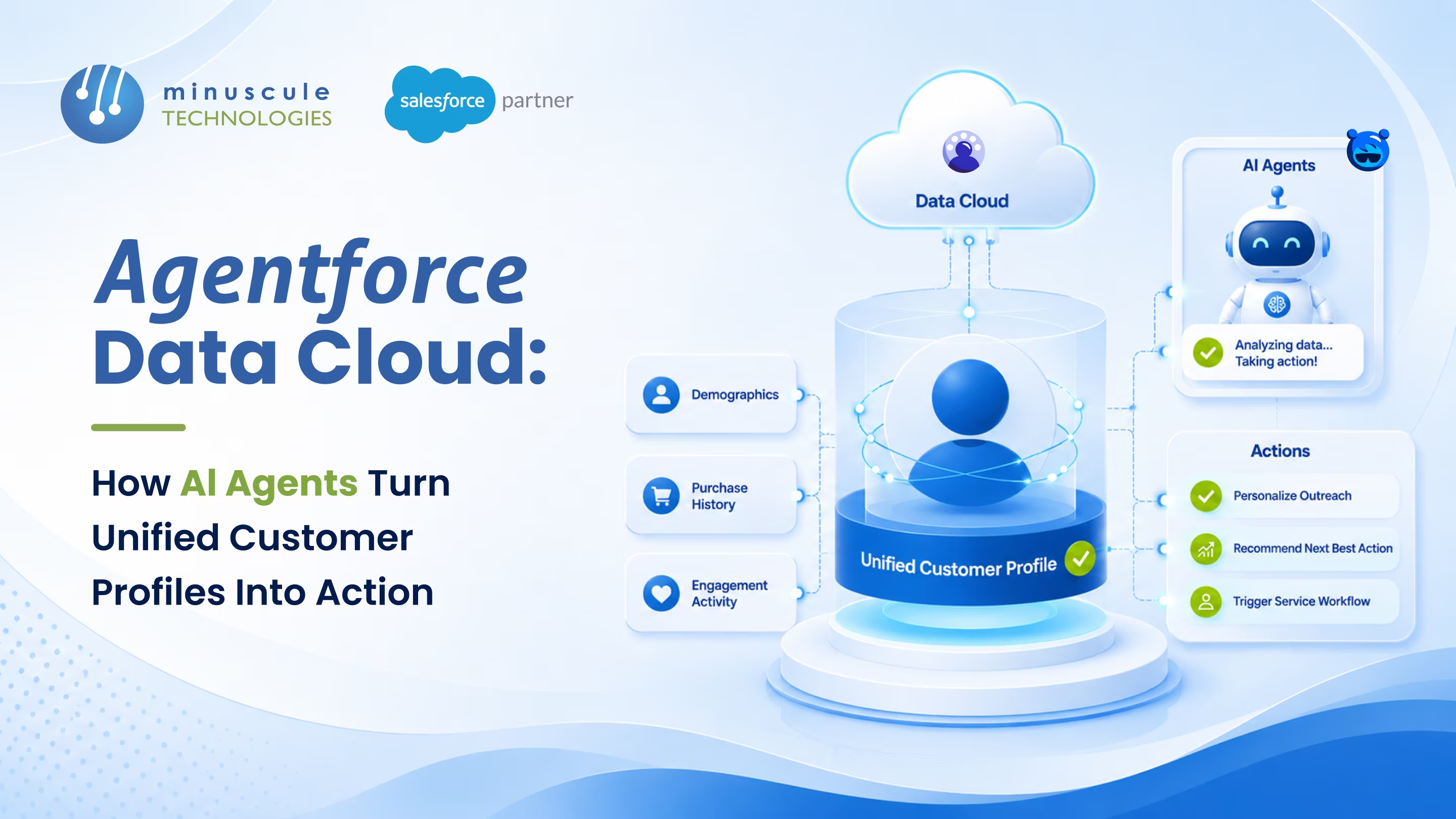
Agentforce Data Cloud is the pairing of Salesforce's autonomous AI agents (Agentforce) with Salesforce Data Cloud, the platform that unifies scattered customer data into a single, real-time profile. Together, they let an AI agent read a complete customer record and then act on it - answer a billing question, reschedule a service visit, or push a next-best offer - grounded in trusted, current data. Put simply: Data Cloud builds the unified customer profile, and Agentforce turns that profile into action.
Here's what that pairing gives you:
Picture a support agent - the human kind - juggling six browser tabs while a customer waits on the line. Order history in one system, support tickets in another, marketing consent somewhere else. By the time they piece the story together, the customer is already frustrated. Now hand that same job to an AI agent that reads one unified profile in a fraction of a second and takes the next step on its own. That's the shift Agentforce Data Cloud makes possible, and this guide walks through exactly how it works - from raw data to a decision an agent can act on.
Think of it as two halves of one system. Salesforce Data Cloud is the data engine. It connects to every source you have - Sales Cloud, Service Cloud, Marketing Cloud, your ERP, a data warehouse, website clicks, even PDFs and call transcripts - each through its own connector or ingestion setup - and stitches the result into a single, resolved record. Agentforce is the action engine. It's Salesforce's platform for building AI agents that reason over data and complete tasks with limited human help.
Neither half is worth much alone. An AI agent with no reliable data hallucinates or stalls. A perfectly unified profile that nobody reads just sits in a table. Agentforce Data Cloud connects them: the agent grounds every response in the unified profile, then decides what to do next. Salesforce now markets the data layer under the "Data 360" name, but the mechanics are the same - one customer, one profile, ready for AI.
If you're already investing in Salesforce Agentforce services, the data layer is the part that decides whether your agents are helpful or hollow. That's why teams treat Data Cloud as a prerequisite, not an add-on.
Agentforce is a set of AI agents that work inside Salesforce. Unlike a chatbot that follows a script, an agent can interpret a request, look up the right data, reason through options, and take an action - like logging a case, issuing a refund within policy, or booking an appointment. You define the topics it handles and the actions it's allowed to take, and the Einstein Trust Layer keeps sensitive data protected along the way.
A unified customer profile is a single, de-duplicated view of one customer built from every system that holds their data. It answers a deceptively hard question: which of these 40 records are actually the same person? Most companies store the same customer four to six times across different tools, each copy slightly different. An AI agent working from four conflicting copies makes four different decisions.
This is where the idea of Customer 360 stops being a slogan and starts mattering. When the profile is unified, the agent sees the whole picture: the open support ticket, the recent purchase, the email that bounced, the loyalty tier. It can then reason like a well-briefed employee instead of a stranger reading half a file.
The payoff shows up in three places:
Data Cloud follows a clear pipeline to turn messy inputs into one clean profile. Understanding these steps helps you see where quality is won or lost.
Data Cloud connects to your sources through native connectors, APIs, and streaming feeds. Structured data (CRM fields, transactions) and unstructured data (emails, chat logs, knowledge articles) both land in the platform. Streaming feeds bring events in as they happen; batch jobs handle the rest.
Raw data arrives in a hundred different shapes. Data Cloud maps each source into a common data model so that "cust_email," "EmailAddr," and "email_1" all become the same field. This mapping is the unglamorous work that makes everything downstream possible, and it's usually where a strong Salesforce integration partner earns their keep.
Now the platform decides which records belong to the same person. Identity resolution rules match on signals like normalized email, phone, and name, then merge the matches into one unified individual. Get the rules too loose and you merge two different people; too strict and one customer stays split in two. Salesforce's own Data Cloud workshop on creating a unified profile walks through building these rulesets step by step.
Finally, Data Cloud layers on calculated insights (lifetime value, engagement scores) and indexes unstructured content so an agent can search it by meaning, not just keywords. Data graphs pre-assemble related data - a customer plus their orders plus their cases - so the agent retrieves everything in one fast lookup instead of ten slow ones.
The table below shows what changes when raw, siloed data becomes a unified profile an AI agent can use.
This is the part most articles skip. Building a unified profile is only useful if something acts on it. Here's the loop that runs every time a customer or employee talks to an Agentforce agent.
First, the agent retrieves. It pulls the relevant slice of the unified profile from Data Cloud - the order in question, the customer's tier, the last three interactions. This step is called grounding, and it's what keeps the agent honest.
Next, the agent reasons. Using the retrieved data and the topics you've configured, it works out what the customer actually needs and which of its allowed actions fit. If a customer asks "where's my order," the agent knows to check fulfillment status, not restart the whole conversation.
Then the agent acts. Actions are the muscles. An action can run a Salesforce Flow, call an Apex method, update a record, or trigger an external API. This is how an agent moves from talking to doing - issuing the credit, booking the technician, updating the shipping address. Salesforce Admins has good, practical material on wiring agent actions to Flows on the Salesforce Admins site.
Finally, the agent writes back. Whatever happened gets recorded, and Data Cloud reflects the change, so the next interaction - human or AI - starts from an updated profile. The loop closes, and the data stays current.
The short version: retrieve, reason, act, write back. Remove the unified profile and the first step collapses, which is why Data Cloud sits underneath every reliable Agentforce deployment.
An AI agent is only as good as its most recent data point. If a customer canceled an order 10 minutes ago and the profile still shows it active, the agent gives a wrong, confident answer - the worst kind. Real-time ingestion is what prevents that.
Data Cloud supports streaming data so profiles update as events arrive, not overnight. For a service agent handling a live conversation, that difference is everything. A batch-only setup means the agent is always reasoning about yesterday. Streaming means it reasons about now.
In our experience, the teams that get the most from Agentforce treat freshness as a design decision, not a default. They map which data must be real time (order status, payments, consent) and which can lag a few hours (lifetime value scores). That prioritization keeps costs sensible while the agent stays accurate where it counts. Trailhead's Data Cloud learning modules are a good place for your admins to build this instinct.
The pattern is the same everywhere - unify the profile, then let the agent act - but the payoff looks different in each industry. Here's how it plays out in a few we work in closely.
A quick, real-world shape of this: a heavy equipment manufacturer we worked with wanted dealers to stop calling support for the same three questions. Once dealer, order, and warranty data lived in one profile, an agent could answer those questions and open a case when needed - freeing the human team for the hard problems. If your customers reach you over chat apps, an approach like our WhatsApp Salesforce Accelerator puts the same agent-driven action right inside the channel they already use.
Agentforce Data Cloud delivers when the groundwork is solid. Most stumbles trace back to the same handful of issues, and each has a clear fix.
None of these are exotic. They're the same data-quality and governance disciplines good teams already practice - applied to a new, higher-stakes use. A clean migration into Data Cloud, handled by an experienced Salesforce data migration team, removes most of the risk before an agent ever goes live.
You don't need to unify every data source on day one. The teams that succeed start narrow and prove value fast. A workable sequence looks like this:
This crawl-walk-run path keeps the project honest. You get a working agent in weeks, not a year-long data project with nothing to show. For a deeper technical grounding, Salesforce Ben publishes clear explainers on Data Cloud and Agentforce architecture at Salesforce Ben.
Agentforce Data Cloud is the combination of Salesforce's AI agent platform (Agentforce) and Salesforce Data Cloud, the platform that unifies customer data into one real-time profile. Data Cloud builds the unified customer profile; Agentforce reads it and takes action, like updating a record or resolving a request. The two are designed to work together, with Data Cloud acting as the trusted data foundation for every agent decision.
Agentforce uses Data Cloud as its source of truth. Before an agent responds, it retrieves the relevant part of the unified profile from Data Cloud — a step called grounding — so its answer reflects real, current data. After it acts, the result is written back so the profile stays up to date for the next interaction.
A unified customer profile is a single, de-duplicated record that combines all of a customer's data from every connected system into one view. Data Cloud creates it through identity resolution, which matches and merges duplicate records into one resolved individual. This gives AI agents and employees the same complete, consistent picture of the customer.
You can run basic Agentforce agents on standard CRM data, but Data Cloud is what makes them reliable at real customer complexity. Without unified, real-time profiles, an agent works from partial or conflicting data and its answers suffer. For most enterprise use cases, Data Cloud is treated as a practical requirement.
Employees get one screen instead of six. Because the profile already resolves duplicates and pulls in history, service reps, sales teams, and agents all work from the same trusted record - less time hunting for data, fewer mistakes, and faster resolutions for the customer.
The lesson underneath all of this is simple: an AI agent is only as smart as the data it stands on. Data Cloud builds the unified customer profile, Agentforce turns it into action, and the quality of your data model decides whether that action helps or hurts. Get the foundation right and the agents take care of the rest.
Minuscule Technologies helps enterprises build exactly that foundation - clean data, sound identity resolution, and agent actions with real guardrails. Our pre-built WhatsApp Salesforce Accelerator and our industry starter packs for BFSI, manufacturing, and real estate get an agent-ready Data Cloud setup live faster, so you're not starting from a blank org.
If you're weighing an Agentforce and Data Cloud rollout, the smartest first move is a short readiness conversation about your data. Schedule a free strategic Salesforce call with our team, and we'll map your fastest path from siloed records to agents that actually act.
You've seen what's possible. Now, let's make it happen for your business. Whether you need an end-to-end Salesforce solution, a complex integration, or ongoing managed services, our team is ready to deliver.

Schedule a Free Strategic Call


