
May 16, 2026
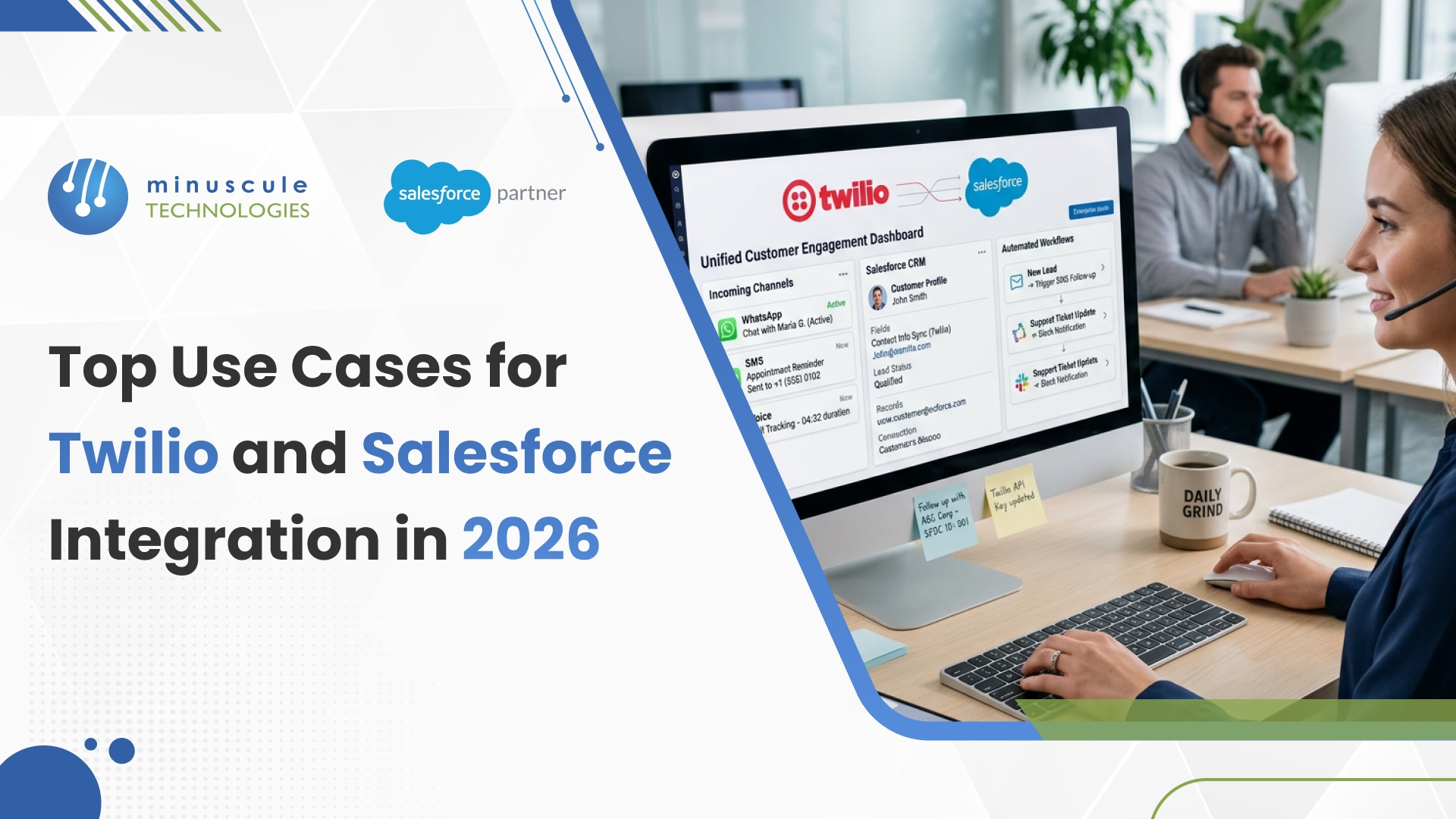
Twilio and Salesforce integration is the process of connecting Twilio's cloud communication platform with Salesforce CRM so that teams can manage SMS, voice calls, WhatsApp messages, and video interactions directly from Salesforce records. Instead of switching between tools, your sales reps, service agents, and marketing teams work from a single interface.
The integration works through several channels. The Twilio for Salesforce managed package (currently in public beta) handles the basics - sending automated SMS from Process Builder, running SMS campaigns tied to Salesforce Campaigns, and enabling one-on-one messaging from Lead and Contact records. For contact centers, Twilio Flex plugs into Salesforce via Open CTI, powering omnichannel routing across voice, chat, SMS, and WhatsApp.
But the 2026 picture looks different from even two years ago. Twilio's Flex SDK now allows teams to embed a full contact center directly inside Salesforce Lightning. Service Cloud Voice natively connects Salesforce telephony with Twilio's voice infrastructure. And with Salesforce's Agentforce, AI agents can use Twilio channels to handle routine customer queries autonomously - escalating to humans only when needed.
The result? A single platform where every customer interaction - whether it's a fraud alert, an appointment reminder, or a sales follow-up - is logged, tracked, and actionable inside Salesforce.
Three shifts have made Twilio-Salesforce integration more relevant than it was even 18 months ago.
Customer expectations have jumped. According to Twilio's State of Customer Engagement 2025 report, 88% of consumers are more likely to buy when engagement is personalized in real time. Customers no longer accept delayed responses or generic messages. They expect you to know their history and respond on the channel they prefer - whether that's SMS, WhatsApp, or a phone call.
AI has changed the contact center. Salesforce's Agentforce and Twilio's AI-powered features (Agent Copilot, CustomerAI) have turned communication from a manual process into an assisted one. AI agents can now draft responses, summarize calls, and route inquiries - all within the Salesforce interface. This isn't future-state thinking; a Guggenheim partner survey found Twilio is the most implemented adjacent platform for Salesforce, cited by more than a third of partners.
Compliance pressure keeps rising. Financial services, healthcare, and other regulated industries need every customer interaction logged, auditable, and compliant. Running communication through Salesforce - where it's attached to the customer record - solves this problem at the architecture level rather than through manual workarounds.
For Salesforce teams, the question isn't whether to integrate Twilio. It's which use cases to prioritize first.
When a new lead enters Salesforce - through a web form, an import, or a marketing campaign - Twilio can automatically send a personalized welcome text within seconds. You can trigger this through Salesforce Flow or Process Builder using the Twilio for Salesforce package.
Why it works: Speed-to-lead matters. Research consistently shows that responding to a lead within five minutes increases conversion rates significantly compared to waiting even 30 minutes. An automated SMS gets your message in front of the prospect while they're still engaged.
Twilio's webhook architecture allows incoming customer replies to flow back into Salesforce automatically. Agents see the full conversation thread on the Contact or Case record - no external app needed.
This is especially useful for support teams handling high-volume inquiries. A customer texts back "What's my order status?" and the agent sees the message alongside the customer's order history, past cases, and account details. The response time drops because the agent doesn't have to search for context.
Healthcare providers, financial advisors, and field service teams all deal with no-shows. By connecting Twilio SMS or voice calls to Salesforce scheduling objects, you can build automated reminder sequences - say, a text three days before an appointment and a voice call the morning of.
The numbers back this up. Healthcare organizations that implemented SMS-based reminders through their CRM have reported no-show reductions of 25–40%. That's revenue recovered and schedules optimized, without adding headcount.
Salesforce's push toward unified service experiences aligns perfectly with Twilio Flex. Using the Flex SDK, teams can embed a programmable contact center inside Salesforce Lightning. Agents handle voice, SMS, WhatsApp, and chat from a single workspace.
What makes Flex different from other telephony integrations is programmability. You can customize routing logic, build custom agent UIs, and integrate with your existing Salesforce data model - all without ripping out your current setup.
Twilio's SMS Campaign component in the Salesforce managed package lets marketing teams send bulk, personalized texts to Campaign members. Merge fields pull in first names, account details, product names, or any custom field from Salesforce.
This isn't about blasting generic promotions. It's about sending the right message to the right segment. A retailer might text customers who abandoned their cart with a specific product mention and a time-limited offer. An insurance company might send renewal reminders with the policy number included.
For banking, fintech, and e-commerce teams, speed matters when it comes to fraud. Twilio's programmable messaging API, triggered by Salesforce event monitoring or custom Apex logic, can send instant alerts when suspicious activity is detected.
The integration ensures the alert - and the customer's response - is logged on the Salesforce record. If the customer confirms the transaction is fraudulent, the case escalation starts automatically within Salesforce.
Twilio's voice API, combined with Salesforce's Open CTI framework, lets agents make outbound calls with a single click from any record - Lead, Contact, Opportunity, or Case. The call is automatically logged with duration, notes, and outcome.
This removes the friction of manual dialing and separate call-logging tools. For sales teams making 50+ calls a day, the time savings add up fast.
With over 2 billion active users globally, WhatsApp is the preferred communication channel in many markets. Twilio's WhatsApp Business API integrates with Salesforce, allowing teams to send template messages, receive customer replies, and manage conversations - all from the Salesforce interface.
This is particularly powerful for companies operating in regions like India, Latin America, and Southeast Asia, where WhatsApp adoption outpaces SMS. Salesforce developers can build custom Lightning Web Components to create tailored WhatsApp experiences that match their business workflow.
After a case is closed or a deal is won, Twilio can send an SMS survey directly from Salesforce. The customer's response flows back into a custom object or field on the Case/Opportunity record, giving your team real-time satisfaction data without relying on external survey tools.
The advantage over email surveys? SMS surveys consistently achieve response rates of 30–45%, compared to 10–15% for email surveys. When the data lands directly in Salesforce, it's immediately available for reporting, dashboards, and follow-up workflows.
This is the 2026 frontier. Salesforce's Agentforce, combined with Twilio's voice infrastructure, enables AI agents that can handle routine calls - checking order status, scheduling appointments, or processing simple requests - and then hand off to a human agent with full context when the situation requires it.
The AI agent has access to the customer's Salesforce record during the call. It knows their purchase history, open cases, and preferences. When it escalates, the human agent picks up exactly where the AI left off, with a call summary and recommended next steps already populated.
Not every Salesforce org needs the same integration approach. Here's a comparison of the four main methods:
The managed package works well for teams that want quick wins - automated lead texts, SMS campaigns, basic two-way messaging. If your needs go beyond that, Apex callouts to the Twilio REST API give you full control over the logic. And for enterprise contact centers, Flex or Service Cloud Voice are the production-grade options.
One thing to keep in mind: these aren't mutually exclusive. Many organizations start with the managed package for marketing and sales SMS, then layer on Flex for their support team later.
Appointment reminders are just the starting point. Healthcare organizations use Twilio-Salesforce integration for patient intake form links via SMS, prescription refill notifications, telehealth session links sent automatically from Health Cloud, and post-visit follow-up surveys. Compliance matters here - every message must be logged and tied to the patient record for HIPAA-related documentation.
Eight of the top ten U.S. banks already rely on Twilio for customer engagement. Within Salesforce Financial Services Cloud, the integration powers real-time fraud alerts, advisor-client texting with compliance archiving, loan application status updates, and automated KYC verification workflows. The key differentiator is auditability - every interaction is part of the customer's financial record.
Cart abandonment recovery through automated SMS, order status updates triggered by Salesforce Commerce Cloud events, personalized product recommendations via WhatsApp, and loyalty program notifications. A well-configured setup can recover 20–30% of abandoned carts through timely, personalized text messages.
Work order notifications to field technicians via SMS, customer appointment confirmations for equipment installations, parts availability alerts from Salesforce Field Service, and automated service completion surveys. For manufacturers with dealer networks, Twilio enables direct SMS communication between dealers and the central CRM.
Twilio Flex and Salesforce Service Cloud Voice represent two paths to the same goal: a modern, AI-assisted contact center running inside Salesforce. But they work differently, and choosing between them depends on your team's priorities.
Service Cloud Voice is Salesforce-native. It bakes telephony directly into the Service Cloud console with Amazon Connect or Twilio as the underlying carrier. Call transcription, AI-generated summaries, and Einstein recommendations appear automatically. The trade-off is less customization - you're working within Salesforce's framework.
Twilio Flex is developer-first. It gives you a fully programmable contact center that integrates with Salesforce via Open CTI or the new Flex SDK. You control the UI, the routing logic, the channel mix, and the data flow. The trade-off is more development effort upfront.
In practice, we see large enterprises choosing Flex when they need heavy customization - custom agent desktops, complex routing rules, or integrations with non-Salesforce systems. Mid-market teams often lean toward Service Cloud Voice for faster deployment and tighter Salesforce-native experience.
The April 2026 release of Twilio's embeddable Flex SDK has blurred this line further, letting Flex users embed their contact center directly inside Salesforce Lightning with less custom code than before.
Salesforce's Agentforce has changed how teams think about Twilio integration. Instead of just automating message delivery, organizations are now building AI agents that handle entire conversation flows across Twilio channels.
Here's how it works in practice. An AI agent, built in Agentforce, connects to Twilio's voice or messaging APIs. When a customer calls or texts, the agent accesses their Salesforce record, understands the context, and handles the request - checking an order status, rescheduling an appointment, or answering a product question. If the query is too complex, the agent transfers the conversation to a human with a complete summary.
The business impact is significant. Early adopters report handling 30–50% of routine inquiries without human involvement, while maintaining satisfaction scores comparable to human-handled interactions. The key is getting the handoff right - the AI needs to know when to escalate, and the human agent needs full context when they take over.
For Salesforce consulting teams building these workflows, the integration layer between Agentforce and Twilio requires careful planning. You need to map out which queries the AI handles, which it escalates, and how the Salesforce data model supports both paths.
Getting started doesn't have to be complicated. Here's a practical checklist for your first integration:
Prerequisites you'll need
Step-by-step setup:
Pro tip: Start with a single use case - like automated lead response texts - and measure the impact before expanding. Teams that try to implement five use cases simultaneously often end up with none working well.
After working with dozens of Salesforce orgs on communication integrations, a few mistakes come up repeatedly.
You need to track specific numbers to know if your Twilio-Salesforce integration is delivering value. Here are the metrics that matter most:
Build a Salesforce dashboard that brings these metrics together so you can review performance weekly and adjust your workflows based on real data.
Twilio and Salesforce integration connects Twilio's communication APIs (SMS, voice, WhatsApp, video) with Salesforce CRM. It lets teams send automated messages, make calls, and manage conversations directly from Salesforce records. Common uses include lead follow-up texts, appointment reminders, contact center operations, and personalized marketing campaigns.
Twilio uses usage-based pricing - you pay per message or per minute of voice. SMS in the U.S. typically costs around $0.0079 per message. The Twilio for Salesforce managed package itself is free to install, but you need a Twilio account with credits. For Flex contact center, pricing starts at $1 per active user hour or $150 per named user per month.
Yes. The Twilio for Salesforce managed package supports both Lightning Experience and Salesforce Classic. Twilio Flex also supports both through the Open CTI framework. However, newer features - like the Flex SDK embedding -are designed primarily for Lightning.
Twilio offers HIPAA-eligible services for voice, messaging, and video when configured correctly with a Business Associate Agreement (BAA). On the Salesforce side, Health Cloud and Shield provide the compliance infrastructure. The integration itself needs proper configuration - encrypted messaging, access controls, and audit logging -to meet HIPAA requirements.
Twilio Flex is a programmable contact center you customize and embed into Salesforce. Service Cloud Voice is Salesforce's native telephony solution that uses Twilio (or Amazon Connect) as the carrier. Flex offers more customization; Service Cloud Voice offers faster deployment and deeper Salesforce-native integration. Many enterprise teams evaluate both before choosing.
You need a Twilio account with the WhatsApp Business API enabled, plus an approved WhatsApp Business Profile. Once configured, you can send template-based messages from Salesforce using Apex callouts to the Twilio API or through Flow Builder with custom invocable actions. Incoming WhatsApp messages route back to Salesforce via Twilio webhooks.
Twilio and Salesforce integration has moved well past simple SMS alerts. In 2026, it's the foundation for AI-assisted contact centers, compliant multi-channel messaging, and automated customer journeys that run inside your CRM.
The organizations getting the most value aren't trying to implement everything at once. They're picking one or two high-impact use cases - like automated lead response or appointment reminders - proving the ROI, and then expanding.
If you're looking to integrate Twilio with your Salesforce org, or you want to modernize an existing setup with Flex, Service Cloud Voice, or Agentforce, Minuscule Technologies can help. As a Trusted Salesforce Engineering Partner with 160+ Salesforce experts and 75+ projects delivered globally, we've built communication integrations across healthcare, financial services, retail, and manufacturing. Book a free consultation to map out the right integration approach for your team.
You've seen what's possible. Now, let's make it happen for your business. Whether you need an end-to-end Salesforce solution, a complex integration, or ongoing managed services, our team is ready to deliver.

Schedule a Free Strategic Call


