
December 21, 2022
A Salesforce implementation goes wrong for a handful of clear reasons. The most common are duplicate data, weak customization, poor integration, low user adoption, unclear requirements, and shaky cost planning. The good news: every one of these has a known fix. Plan for them early and your rollout stays on track.
Salesforce is trusted by more than 150,000 companies worldwide. It's a powerful tool for your sales pipeline and customer relationships. But the platform only pays off when you set it up the right way. That's where many firms get stuck, and it's why they miss the full value of Salesforce.
This guide breaks down the most common challenges. It splits them into technical and non-technical groups, and gives you a practical fix for each one.
Salesforce is flexible by design. That's its strength and its trap. You can shape it to fit almost any business, but that same freedom makes it easy to over-build, under-plan, or skip the basics. Most problems aren't about the software. They're about how the rollout is planned and run.
Let's start with the technical side.
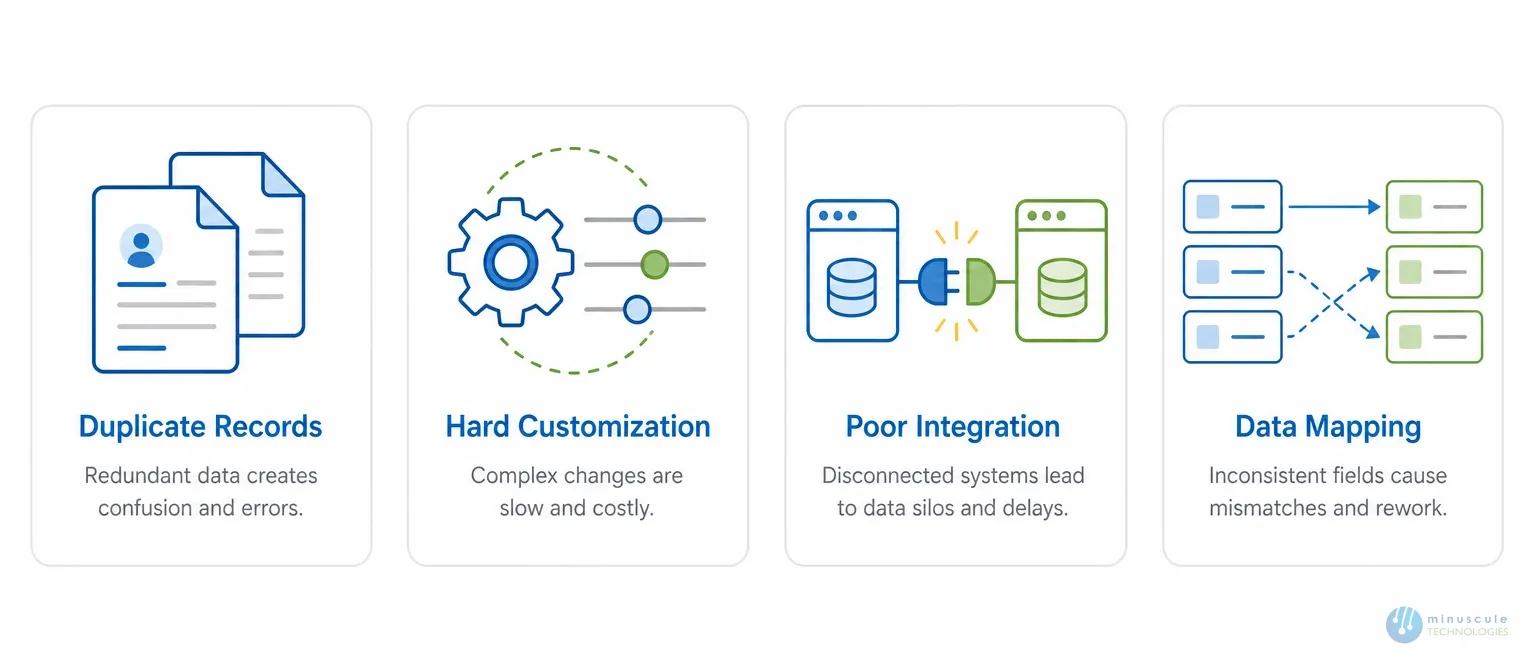
Duplicate records are one of the most common issues during a rollout. They lead to messy reports and bad decisions. To avoid them, use a system that spots and removes duplicate entries.
When you import data, use unique external IDs to block duplicates. An external ID is a custom field that holds a unique record ID from a system outside Salesforce. The import wizard checks your existing records against these IDs and matches them to the import file. That way, only new, unique records come in.
Salesforce serves companies of all sizes, so you have to shape it to fit your goals. There are many tools to help, but learning every option takes time. Heavy customization often needs help from a partner who knows the platform well and can tailor it to your needs.
Integrating Salesforce with your other software keeps your workflow connected. It can be tricky, but it's worth it. It lets data flow between systems and adds visibility and speed. Set a clear integration plan before you finalize the setup. That helps you decide which existing tools to keep.
Data mapping is another common trouble spot. Field types can differ across apps, which causes mapping errors. During a Salesforce CRM implementation, map your data with care. Use the correct field type so the data fits the target app. When needed, convert data to the field type the target app supports. That avoids mismatched data.
It's tempting to switch on every feature, but you don't need them all. Extra features you never use add cost and complexity. Sometimes less is more. Start lean and add features based on real use.
This is where most rollouts actually stall.
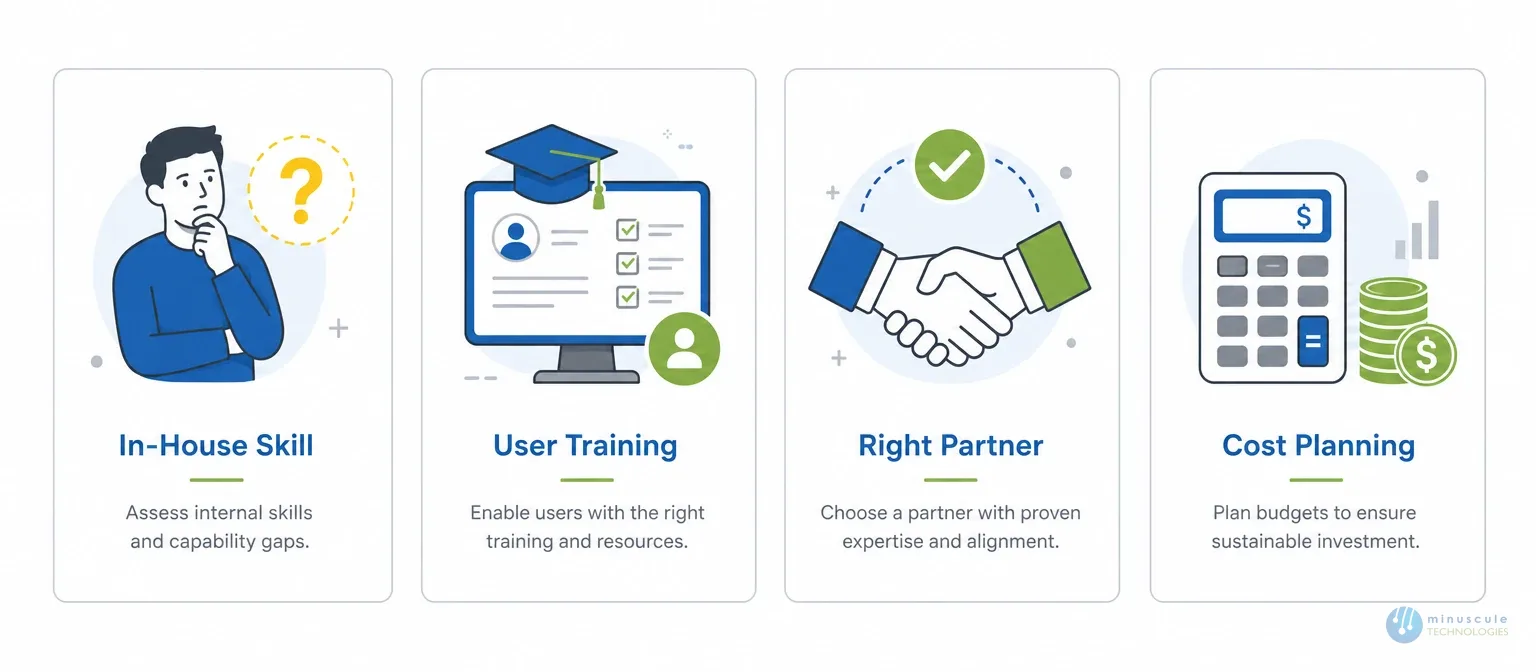
Many firms lack in-house Salesforce skill. So they hire an expert to run the rollout and teach staff how to use the CRM. Without that help, staff find the system confusing and make mistakes. Train your people before and during the rollout. That gets everyone ready and keeps adoption high.
User onboarding is a key part of any rollout. A system that people can't use will fail. Salesforce has a large community and plenty of online training. Still, you have to train users for your own setup. Basic training alone won't cut it, since Salesforce can be configured in many ways.
Salesforce has many out-of-the-box options, but custom ones are often a better fit. Hire a partner who can explain the pros and cons of each choice for your business.
Cost is always a top concern. Owners want to know if the investment will pay off and if the tool is worth the price. A short consultancy gives you answers on licensing, customization, and cost. A certified consulting partner helps you pick the right fit, so you make an informed choice and get a good return.
Salesforce offers a free support plan, but response times can lag. It often points you to possible fixes rather than solving the issue outright. Free videos, guides, and the Salesforce Trailblazer Community help, but they may not cover complex problems unique to your business. This is why many firms bring in a partner to handle tricky CRM issues.
Weak requirements are a leading cause of IT project failure. Requirements define what the software must do to meet your needs. The process starts with discovery, where analysts document findings. Manage requirements across the whole project so the final product meets your goals. Common pitfalls include missing details, no clear scope, poor communication, and changes that get out of control.
| Challenge | Type | Recommended Fix |
|---|---|---|
| Duplicate Records | Technical | Use unique external IDs during data import. |
| Hard Customization | Technical | Bring in platform expertise and build only what is necessary. |
| Poor Integration | Technical | Create an integration strategy before implementation begins. |
| Data Mapping Errors | Technical | Carefully map and convert field types before migration. |
| Feature Overload | Technical | Start with essential features and expand based on actual business needs. |
| No In-House Skill | Non-technical | Provide training before, during, and after implementation. |
| Weak Onboarding | Non-technical | Deliver role-based onboarding tailored to each user group. |
| Wrong Partner | Non-technical | Choose a Salesforce partner with proven expertise and industry experience. |
| Cost Uncertainty | Non-technical | Define licensing, scope, and budget with a trusted consultancy. |
| Slow Support | Non-technical | Use an experienced implementation partner for ongoing support. |
| Unmet Requirements | Non-technical | Continuously validate and manage business requirements throughout the project. |
A strong Salesforce implementation partner removes most of these risks before they hit your rollout. They bring proven methods, platform depth, and a track record of clean deliveries. Independent sources like Salesforce Ben make the same point: the right partner is the difference between a smooth go-live and a stalled project.
A good partner helps you:
Among Salesforce implementation companies, the ones worth shortlisting treat your org like a software product - documented, tested, and governed. That's the standard Minuscule delivers as a Salesforce Engineering Partner.
Strong Salesforce implementation services cover the full lifecycle, not just the build. When you compare providers, look for:
You can see how these fit together across our Salesforce implementation and managed services offerings.
Salesforce implementation is the process of setting up and shaping Salesforce to fit your workflows, data, and goals. It covers configuration, data migration, integration, and user training, so the platform supports real daily work.
The most common are duplicate data, hard customization, poor integration, weak user adoption, unclear requirements, and cost planning. Each one has a known fix, and a good partner can handle most of them for you.
Salesforce implementation companies range from large global firms to focused specialists. Shortlist ones that show real project experience, strong data migration skill, and good post-launch support. Fit and track record matter more than size.
A Salesforce managed services partner supports your org after launch. They handle monitoring, admin work, upgrades, and ongoing tuning. This keeps your Salesforce CRM implementation healthy as your needs change.
Yes, for most teams. If you lack in-house skill, a partner cuts the risk and speeds up go-live. They bring proven methods for data migration, integration, and training that trial and error can't match fast.
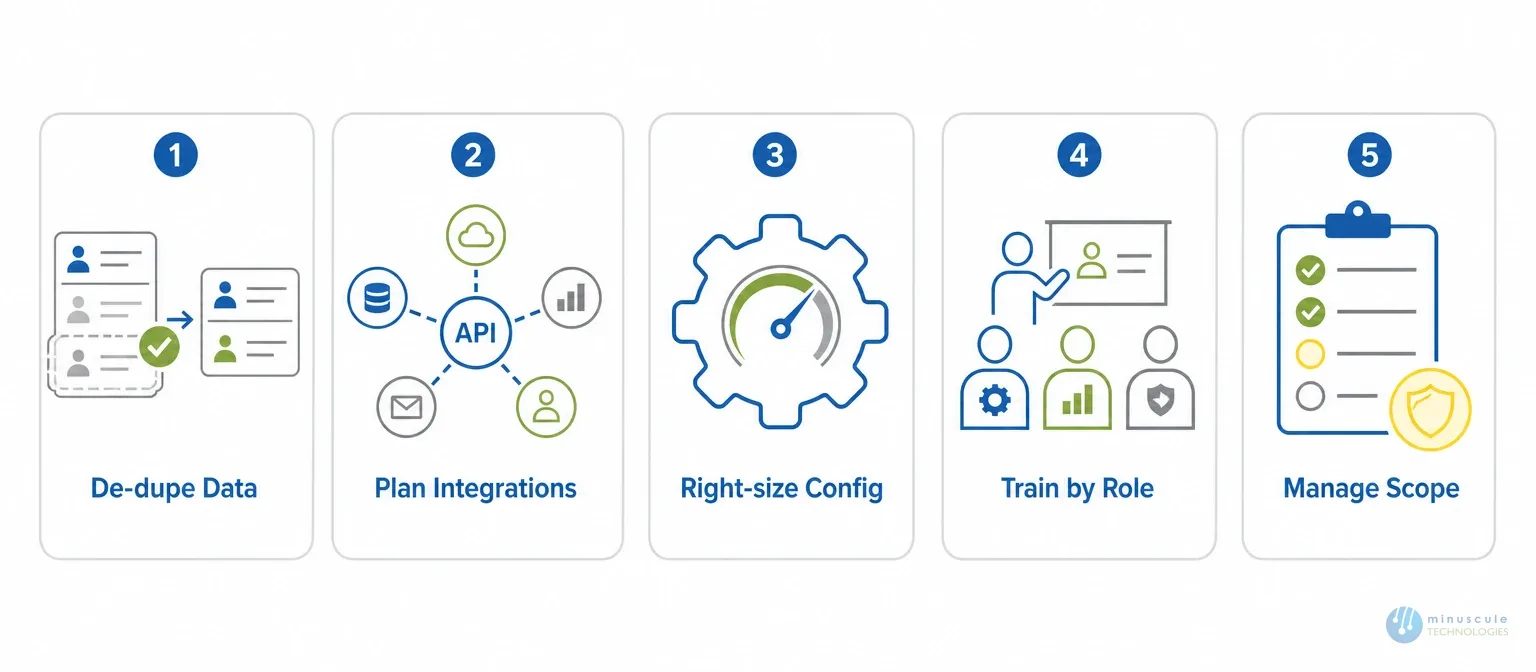
Every challenge on this list has the same root cause - a rollout run without engineering discipline. That's exactly the gap Minuscule Technologies closes. As a Salesforce Engineering Partner, we don't just configure the platform and walk away. We de-dupe and validate your data, architect integrations that hold up, right-size customization, and train your teams so adoption sticks. Our 160+ Salesforce engineers bring the same precision to your rollout that we bring to enterprise clients across banking, manufacturing, logistics, and real estate.
The result is a Salesforce implementation that avoids the pitfalls instead of paying for them later - cleaner data, faster go-live, lower total cost of ownership, and a system your people actually use.
You don't have to learn these lessons the hard way. Whether you're planning a fresh rollout, rescuing a stalled one, or scaling an org that's outgrown its setup, our team is ready to help.
Schedule a free strategic Salesforce call and let's map a rollout that works the first time - no guesswork, no disruption, no six-month cleanup.
You've seen what's possible. Now, let's make it happen for your business. Whether you need an end-to-end Salesforce solution, a complex integration, or ongoing managed services, our team is ready to deliver.

Schedule a Free Strategic Call


