

August 12, 2026
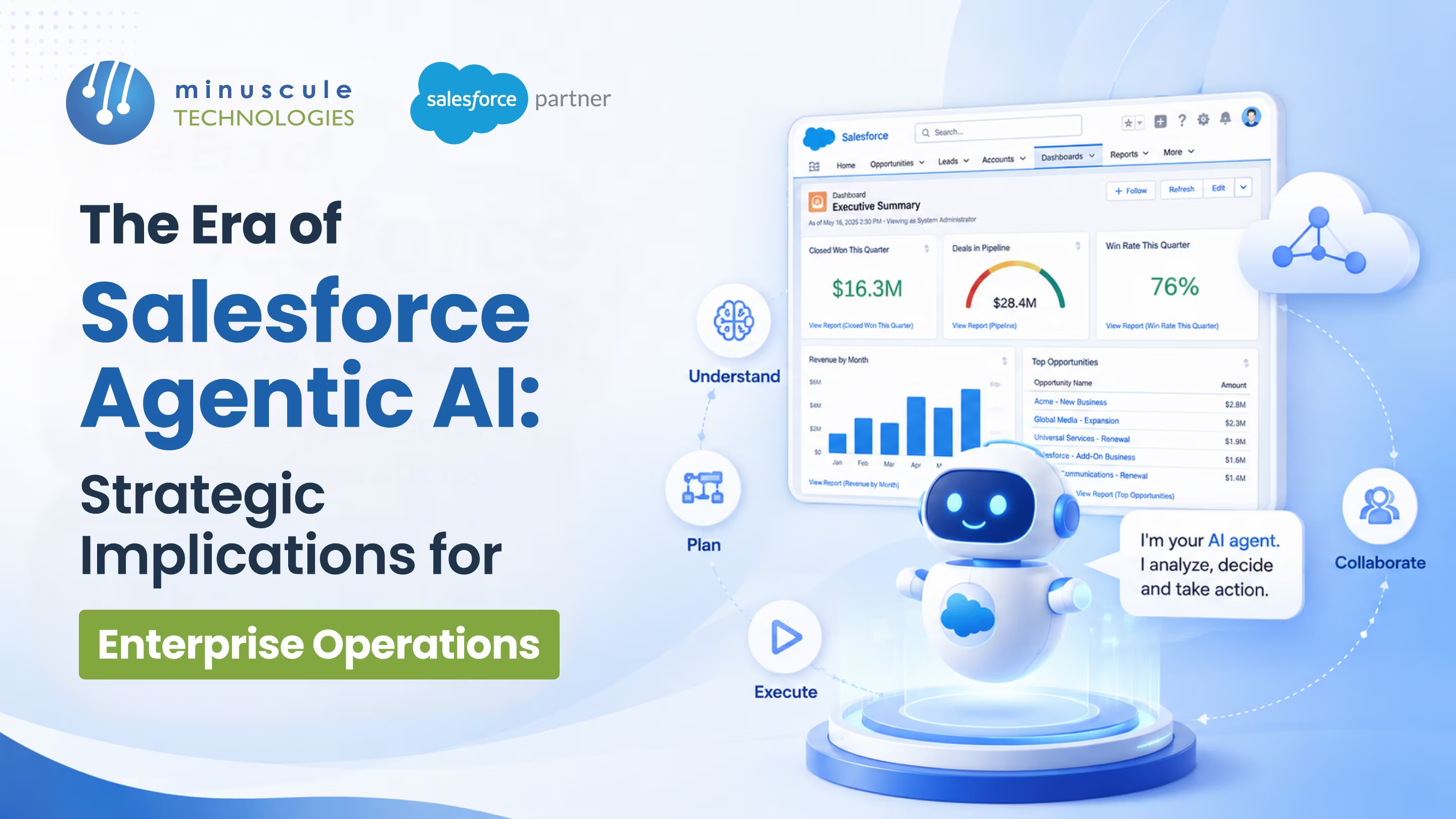
Salesforce Agentic AI is the technology that Salesforce Agentic AI is the technology that lets AI agents pursue a defined goal inside your business - reasoning through it, deciding the next step, and completing multi-step tasks against your live CRM data, with a human in the loop for oversight. It's delivered through Agentforce (part of the Agentforce 360 portfolio) and the Atlas reasoning engine, and it's shifting enterprise operations from software people run to software that runs the work with people. For operations leaders, the change shows up in four ways:
Think about a mid-size operations team drowning in repetitive back-office work: order checks, refund approvals, data lookups across four systems. Every task is small, but together they eat the week and slow every customer promise. That's the exact pressure agentic AI is built to relieve - and it's why the conversation has moved from 'should we pilot this' to 'how do we run our operations around it.'
This guide breaks down what Salesforce Agentic AI actually is, how it works, how it differs from the generative AI you already know, where it fits across operations, and the strategic calls leaders need to make before agents touch real work. Read it through and you'll be ready to plan, not just react.
Salesforce Agentic AI is a class of AI that operates autonomously toward a goal - perceiving context, reasoning through options, taking action across systems, and learning from the result. Where a chatbot waits for each instruction, an agent takes a goal like 'resolve this billing dispute' and works out the steps on its own.
Inside Salesforce, this is delivered through Salesforce Agentforce, the platform for building and running autonomous AI agents. Agentforce requires Data 360 (formerly Data Cloud) to be provisioned in your org before you turn on generative AI - it underpins the Einstein Trust Layer, the audit trail, and agent observability. Grounding on CRM records themselves uses standard Salesforce record access and prompt grounding, so agents see the actual customer, order, or account in front of them, within that user's permissions. Unstructured and external data grounding is where Data 360 does the heavy lifting. The reasoning itself runs on the Atlas Reasoning Engine, which plans the work and picks the right action at each step.
The short version: agentic AI is the 'brain and hands' layer. It thinks about what needs to happen and then does it, calling your systems through secure connections while staying inside the guardrails you set. Salesforce Ben's rundown of what shipped with Agentforce 2.0 is a good snapshot of how fast the platform is maturing.
Under the hood, a Salesforce agent runs a continuous loop. Understanding it helps you see where the value - and the risk - sits.
Two things make this practical for operations. First, tool use: agents act through your existing integrations, so they work with the ERP, billing, and service systems you already run. Getting those connections clean and reliable is foundational - it's why solid Salesforce integration work matters more, not less, in an agentic world. Second, memory and reflection let an agent handle a multi-step task without losing the thread halfway through.
People mix these up constantly, and the difference is the whole point. Generative AI creates content when you ask — a draft email, a summary, a suggested reply. Agentic AI pursues a goal and acts on its own, using generative AI as one of its tools. One writes the reply; the other sends it, updates the record, and books the follow-up.
Here's the practical breakdown:
| Dimension | Generative AI | Salesforce Agentic AI |
|---|---|---|
| Core job | Creates content in response to a prompt | Pursues a goal and completes the work |
| Trigger | A person asks each time | A goal or event kicks it off, then it runs |
| Autonomy | None — waits for the next instruction | High — plans and acts across steps |
| System access | Usually none; produces text | Calls CRM, ERP, and other tools to act |
| Operations fit | Assists a human doing the task | Executes the task, with human oversight |
For operations, that last row is the money line. Generative AI makes your people faster. Agentic AI changes who does the work in the first place.
The clearest way to see the impact is by function. These Salesforce Agentic AI use cases are already common ground, and each one maps to a real operational bottleneck.
Service agents resolve routine inquiries around the clock - checking order status, processing returns, updating account details - and escalate the tricky cases to a human with full context attached. The win isn't just deflection; it's that the work behind the answer actually gets done.
Sales-focused agents qualify inbound leads, answer product questions, and book meetings without a rep lifting a finger. They keep the pipeline moving overnight and hand warm, pre-qualified conversations to sellers in the morning.
This is where autonomous AI agents earn their keep for operations teams: order-to-cash processing, invoice reconciliation, data verification across systems, and approval routing. Salesforce has extended agents into these back-office tasks specifically because that's where the front-end promise usually breaks down. Salesforce Admins' Agentforce resources for admins show how these operational agents get configured in practice. You can also see why Agentforce Operations can speed agentic AI adoption.
Internal agents act as digital assistants for IT, HR, and operations staff - answering policy questions, provisioning access, and automating the small requests that clog a shared inbox. Your specialists get their time back for work that actually needs a human.
The technology is the easy part. The hard part - and the part that decides whether agentic AI pays off — is how you rethink operations around it. Four shifts deserve a leadership decision, not a delegated one.
Pointing an agent at a broken process gives you a faster broken process. The teams that win map the end-to-end workflow first, cut the steps that only existed to work around old software, then hand the clean version to an agent. Treat this as process redesign, and bring in Salesforce consulting support if you don't have the bandwidth to do it right.
An agent grounded in messy data makes confident, wrong decisions. Salesforce Data Cloud gives agents a unified, current view of each customer, but it's only as good as what you feed it. Duplicate records, stale fields, and disconnected sources become the agent's problem the moment it starts acting on them. Clean, well-modeled data is now an operational prerequisite, not a nice-to-have.
Autonomy without oversight is how you end up in a compliance review. Decide upfront where humans stay in the loop - high-value approvals, regulatory sign-offs, anything touching sensitive data - and log every action an agent takes with its reasoning and the data it used. For regulated sectors like banking and financial services, that audit trail is what makes expansion possible at all. Your Salesforce administration practice owns the guardrails that keep agents inside the lines.
When agents handle the routine work, your people shift to managing exceptions, tuning agent behavior, and handling the judgment calls. That's a real change to job design and team structure, and it works best when you plan the transition instead of letting it happen by accident. Reskilling and clear ownership beat surprise every time.
Salesforce frames the destination as the agentic enterprise - a business where people and agents work side by side across every function. You don't get there in one leap. The organizations making real progress follow a pattern: start with one high-volume, clearly-ruled workflow, prove it works end to end, then expand. Banks and insurers follow the same path, as our look at BFSI automation moving to AI agents shows.
Begin where the rules are clear and the volume is high - that's where an agent shows value fastest and fails safest. Get the data, integrations, and guardrails right for that first use case, measure the end-to-end completion, then carry the same foundation into the next. Automation Champion's ongoing Agentforce coverage is a useful pulse on how adoption is playing out release over release, and Trailhead's Get Ready for Agentforce trail is a practical starting point for your team.
The through-line is that agentic AI rewards operational maturity. Companies with clean data, solid integrations, and clear governance move fast. Companies without them stall at the pilot - not because the AI failed, but because the operational groundwork wasn't there.
The same mistakes trip up most early adopters. Watch for these:
Salesforce Agentic AI is technology that powers autonomous AI agents able to reason through a goal, make decisions, and complete multi-step tasks using live CRM data. It's delivered through Salesforce Agentforce and runs on the Atlas Reasoning Engine. Unlike a scripted chatbot, an agent plans and acts on its own within the guardrails you set.
Generative AI creates content in response to a prompt, like drafting an email or summarizing a case. Agentic AI pursues a goal and takes action across systems, using generative AI as one of its tools. In short, generative AI assists a person doing the task, while agentic AI completes the task with human oversight.
Salesforce Agentic AI is powered by Agentforce, the platform for building and running autonomous agents. Reasoning runs on the Atlas Reasoning Engine, and agents are grounded in unified business data through Salesforce Data Cloud. Together they let agents make decisions based on your real customer and operational data.
Common use cases include customer service resolution, sales lead qualification, back-office operations like order processing and approvals, and internal employee support for IT and HR. Each targets high-volume, repetitive work that used to require people toggling across systems. Operations and back-office workflows tend to deliver the strongest returns.
Start with one high-volume workflow that has clear rules, and make sure your data and integrations are clean before deploying an agent. Define where humans stay in the loop, prove the workflow end to end, then expand. Many teams bring in a Salesforce partner to get the data foundation and governance right from the start.
Salesforce Agentic AI isn't another tool your team logs into - it's a shift in who does the work, and it rewards the organizations that treat it as operational change rather than a tech demo. Clean data, reliable integrations, and clear governance are what separate the teams scaling agents from the ones stuck at pilot.
Minuscule Technologies helps enterprises build that foundation - from integration and data readiness to the governance and administration that keep autonomous agents safe in production. Our pre-built Salesforce accelerators and industry starter packs get regulated and operations-heavy verticals moving faster, so you're not engineering the groundwork from scratch.
Want to know if your operations are agent-ready? Book a Salesforce Agentic AI readiness review and we'll map the fastest, safest path from pilot to production.
You've seen what's possible. Now, let's make it happen for your business. Whether you need an end-to-end Salesforce solution, a complex integration, or ongoing managed services, our team is ready to deliver.

Schedule a Free Strategic Call


Plot No. 4, Sridevi Amman Street, Perumal Nagar Extension, Old Pallavaram, Chennai, Tamil Nadu 600117, India.

