We are at Dreamforce 2026, Industry Pavilion at San Francisco


March 18, 2026
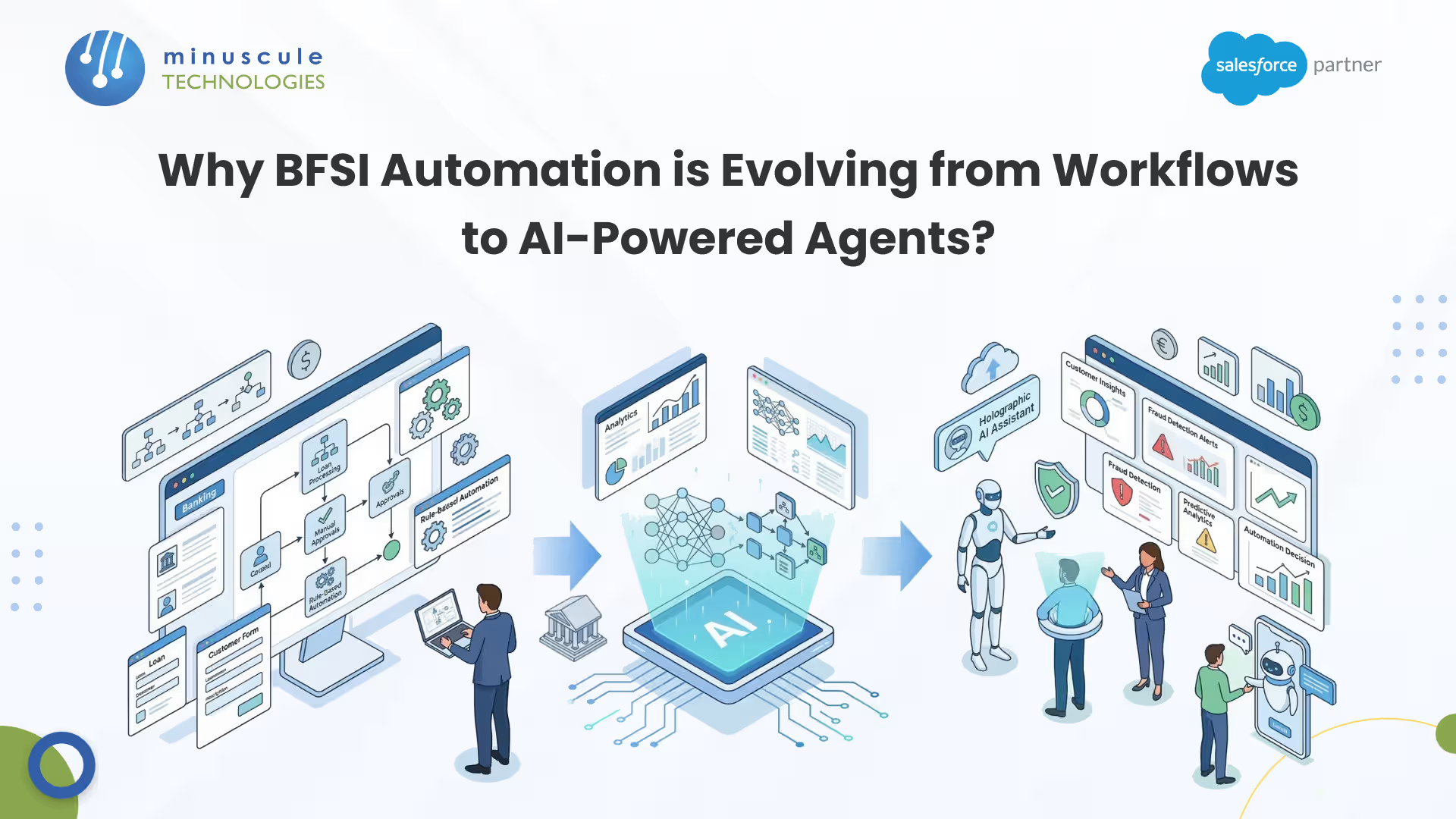
Imagine it’s a high-volume Monday morning at a major bank. Your "automation" is running, but your compliance team is still buried. Why? Because a traditional bot just hit an "exception" - a middle name was spelled differently on a passport than on a utility bill - and now everything has ground to a halt. The bot did exactly what it was told to do: it stopped.
For years, the BFSI sector has lived in this world of "if-this-then-that" logic. We called it automation, but in reality, it was just a digital paperweight whenever things got complicated. You’ve likely felt the frustration of a system that can’t "think," forcing your most expensive human experts to spend most of their day doing manual data entry and "software archaeology" instead of managing risk.
But the tide is shifting. We are moving away from rigid, rule-based scripts toward Agentic AI - autonomous reasoning engines that don’t just follow instructions; they understand goals. Think of it as moving from a basic calculator to a digital employee who can read an invoice, spot an inconsistency, and resolve it.
At Minuscule Technologies, we specialize in architecting this evolution. We help financial institutions transition from brittle workflows to resilient, AI-powered agents that scale.
For years, the BFSI industry has relied heavily on Robotic Process Automation (RPA) to handle data-heavy processes. While RPA promised efficiency, it has a fundamental ceiling:
Unlike standard automation or basic Generative AI, Agentic AI acts as a goal-oriented "digital employee." These agents are built on four key pillars:
Several core pressures are accelerating the shift toward an agentic model in banking and fintech:
Agentic AI is moving beyond simple chatbots to handle complex, multi-step financial workflows:
With increased autonomy comes the need for rigorous, audit-grade governance. To safely deploy these systems, BFSI firms must implement:
Agentic AI refers to autonomous software systems that go beyond generating text or following rigid rules. In finance, these agents can understand complex circumstances, interface with tools, make adaptive decisions, and take autonomous actions to achieve specific goals. They act as digital employees capable of completing multi-step financial workflows from end to end.
Traditional RPA operates on fixed checklists and is strictly rule-based, meaning it fails when encountering unexpected exceptions. AI agents, however, are reasoning engines that can process unstructured data, handle exceptions autonomously, and continuously learn from feedback, making them highly effective in dynamic financial environments.
Instead of a single AI trying to do everything, complex workflows are broken down and handled by a "squad" of specialized agents. For example, in a KYC workflow, one agent gathers data, another checks government registries, a third analyzes ownership structures, and a final quality-assurance agent validates the work before presenting it to a human. They use orchestration patterns (like supervisor-based or peer-to-peer collaboration) to coordinate seamlessly.
Yes, provided they are built with financial-grade architecture. This requires operating within strict enterprise governance, utilizing policy guardrails, role-based access controls, continuous monitoring, and reasoning traceability. Agents must generate comprehensive, immutable audit trails for every action to satisfy regulatory risk reviews.
No, AI agents are designed to redefine rather than replace human roles. By taking over high-volume data gathering, routine remediation, and initial analysis, they act as a digital workforce. Human analysts shift into supervisory roles - managing agents, handling complex exceptions, and focusing on high-value, strategic decision-making.
Agentic AI delivers massive value in complex, data-heavy operations. Top use cases include KYC and AML case remediation, real-time transaction monitoring and fraud investigation, credit and P&C insurance underwriting, accounts payable automation, and financial close acceleration
The evolution from rigid RPA to autonomous agents is rewriting the rules of banking and fintech. Organizations that adopt Agentic AI will drastically outpace competitors in speed, compliance, accuracy, and operational efficiency. In the BFSI sector, the question is no longer if you should adopt AI agents, but how quickly can you deploy them.
Take Control of Your Automation Roadmap Are manual exceptions and mounting compliance backlogs stalling your growth? Don't let legacy RPA limit your potential. At Minuscule Technologies, Trusted Salesforce Engineering Partner, we help you architect for a secure, agentic future where your team focuses on strategy while your AI handles the execution.
Schedule a Free Strategic Call Today. Let’s build a lean, high-performing financial ecosystem that thinks, acts, and scales as fast as your ambition.
You've seen what's possible. Now, let's make it happen for your business. Whether you need an end-to-end Salesforce solution, a complex integration, or ongoing managed services, our team is ready to deliver.

Schedule a Free Strategic Call


