
November 21, 2025
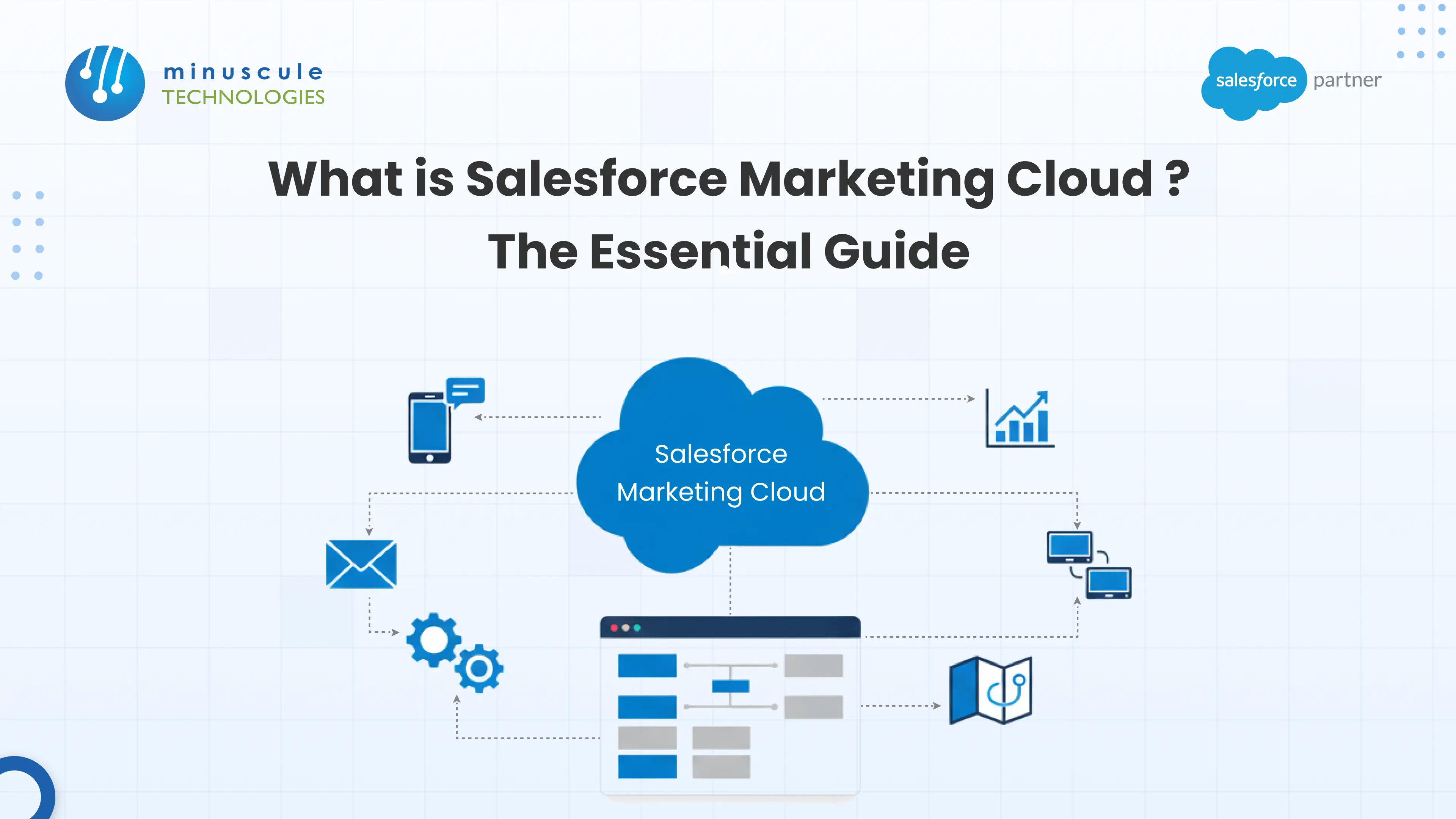
Marketing used to be simple. You bought a list. You wrote one email. You hit send. Today that approach lands in the spam folder, not the inbox. Modern customers expect more. If they abandon a cart on mobile, they want a quick text, not a generic email ten minutes later.
Salesforce Marketing Cloud was built to close that gap. It has changed shape again with Agentforce. The platform is moving from marketing automation to AI agents. These agents plan and run campaigns on their own. At Minuscule Technologies, we've guided companies through Salesforce Marketing Cloud services, from first-time setup to years of support. One pattern holds true: the platform is only as strong as the strategy and partner behind it.
This guide breaks down what Salesforce Marketing Cloud is. It covers how the platform is built, what a real rollout looks like, and how to pick a partner and support model that gets it right the first time.
Salesforce Marketing Cloud is a cloud-based engagement platform. It uses AI to unify marketing, customer data, and insight. The goal: deliver custom experiences on every channel. It connects with Sales Cloud, Service Cloud, Commerce Cloud, and the rest of Salesforce. Marketing doesn't work in isolation from sales and support.
This is the shift from broadcasting one message to everyone. Now it's conversational marketing: real one-to-one dialogue, at scale, across email, SMS, social, web, and ads.
The platform runs on two core ideas. Knowing the difference is the fastest way to understand the whole product.
In short: Studios hold the channels. Builders add the intelligence and automation that keep every message timely and coordinated.
Salesforce Marketing Cloud grew from ExactTarget, an early email tool. Over time it became a full omnichannel platform, covering social, ads, and customer data. Salesforce recently renamed the next generation Agentforce Marketing. This isn't just a new name. It's a new architecture.
Agentforce-powered AI agents don't just help with tasks. They act on them. Give an agent a goal, such as building a campaign for a new product line among top customers. The agent reads that goal. It builds the audience, drafts the journey, and personalizes the outreach, with little hand-holding needed. Teams once spent weeks mapping journeys and writing copy. Now teams work with Agentforce and launch a campaign in far less time.
Salesforce offers three product tiers. Picking the right one matters as much as using it well.
Marketing Cloud Next means deeper data access. It brings more advanced AI than Engagement or Account Engagement offer alone.
In Marketing Cloud Next, Einstein grows into Agentforce. This layer runs campaigns, workflows, and customer replies around the clock, on its own
Most guides stop at listing features. In real life, a Salesforce Marketing Cloud implementation succeeds or fails on the work done before one email goes out.
This is where most in-house teams get stuck. The platform isn't the hard part. Implementation strategy and platform mechanics are two different skills.
The platform scales from mid-market to global enterprise. Whether you run B2B nurture cycles, B2C high-volume campaigns, or both, there's a tier built for it.
The platform gives you access to the tools. It doesn't give you a data strategy. It won't build a journey structure that fits how your business sells. It won't tell you which Einstein features earn their cost, and which don't.
Judge a Salesforce Marketing Cloud partner the way you'd judge any long-term tech vendor:
At Minuscule Technologies, this is where our Salesforce Marketing Cloud services start: data strategy and architecture first, platform setup second.
Go-live starts the relationship with the platform. It doesn't end the project. Teams that get the most from Marketing Cloud treat support as an ongoing job.
Skip a support plan, and journeys go stale. Automations break without warning. The platform takes the blame for what is really a maintenance gap.
Teams use it to run personalized campaigns across email, SMS, social, web, and ads. It pulls customer data into one profile. It then times and targets each message for that person.
Engagement is built for B2C. It handles high-volume campaigns like newsletters and promotions. Account Engagement, formerly Pardot, is built for B2B. It fits longer sales cycles, lead scoring, and sales-team handoffs.
It depends on your data. Clean, unified customer data speeds things up. Messy data spread across systems slows it down. A single-journey rollout also moves faster than a full multi-channel launch.
Technical teams can configure the platform alone. A partner adds the most value in data strategy and journey design, the choices made before setup starts. Those choices are hard to fix after launch.
Good support covers deliverability checks, quarterly journey audits, clean data extensions, and staying current on new Agentforce features. Skip this, and journeys quietly go stale.
Yes. Marketing Cloud Next runs natively on the Salesforce Platform, with Data Cloud built in. This is where Agentforce lives. Engagement runs as a separate, older architecture built for high-volume B2C sending.
Salesforce Marketing Cloud is complex and powerful. It keeps growing more capable as Agentforce reshapes what the platform can do on its own. Picking the right tier is one choice. Building it on clean data, then supporting it well after launch, is what actually decides whether it delivers.
Minuscule Technologies delivers Salesforce Marketing Cloud services, implementation, and ongoing support to help teams move off legacy systems or scale a first rollout. We use pre-built Accelerators and Starter Packs to shorten the path to a working, well-built platform. We're not just a Marketing Cloud partner for the first build—we stay on as your support team as your journeys and data grow
Ready to talk through a Salesforce Marketing Cloud implementation, migration, or support plan? Connect with our Salesforce engineering team at Minuscule Technologies.
You've seen what's possible. Now, let's make it happen for your business. Whether you need an end-to-end Salesforce solution, a complex integration, or ongoing managed services, our team is ready to deliver.

Schedule a Free Strategic Call


Plot No. 4, Sridevi Amman Street, Perumal Nagar Extension, Old Pallavaram, Chennai, Tamil Nadu 600117, India.
