We are at Dreamforce 2026, Industry Pavilion at San Francisco


May 7, 2026
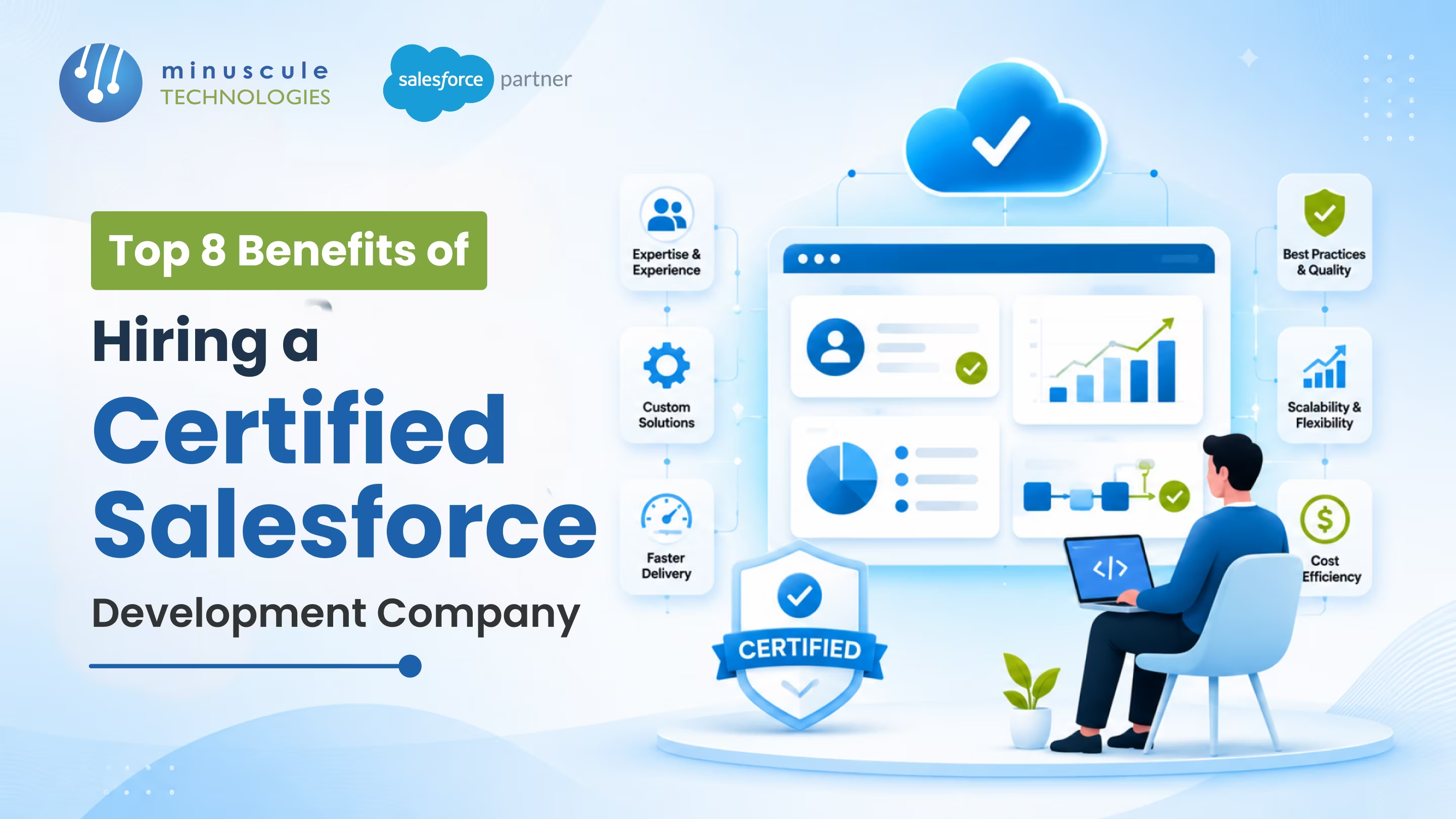
A certified Salesforce development company is a team of pros who hold official Salesforce credentials. They have proven they can build, customize, and maintain Salesforce solutions. These certifications come straight from Salesforce. Each one confirms real skill in specific clouds, tools, and specialties. Over 150,000 companies now run on Salesforce, and the platform grows more complex with every release. So working with a certified partner is no longer a nice-to-have. It's how you protect your investment.
In this post, you'll learn eight clear benefits of hiring a certified Salesforce development company. You'll also see what a full-service team delivers, and how to verify credentials before you sign.
A certified Salesforce development company is a services firm whose developers, architects, and consultants hold current Salesforce certifications. The credentials come from Salesforce's own program. Proctored exams test real-world knowledge: Apex development, Lightning Web Components, platform admin work, and cloud-specific solutions.
Think of Salesforce certifications as a ladder. At the base sit Administrator, Salesforce Certified Platform App Builder, and Platform Developer I. These are solid starter credentials. They prove someone can design and ship custom apps. Move up and you hit Platform Developer II, Application Architect, and System Architect. These test whether someone can solve hard problems under pressure. The top rung? Technical Architect and B2C Solution Architect. Those require a live review board. Salesforce doesn't hand them out. Community sites like Apex Hours keep a full map of every path if you want the details.
Why does this matter for your hiring choice? A solo developer with one cert can handle basic page layouts and simple automations. But some projects need 10+ certified pros covering Sales Cloud, Service Cloud, Experience Cloud, and integration work. That's a team that can design a full enterprise rollout. And when things break - they always do - someone on that team has seen your exact problem before.
One thing people miss: certifications expire. Salesforce pushes three big releases a year. After each one, cert holders must complete upkeep modules or lose their credentials. So when a company keeps 20, 30, or 50+ certs current, that tells you something. They invest real time in staying sharp. They're not coasting on a badge from 2019.
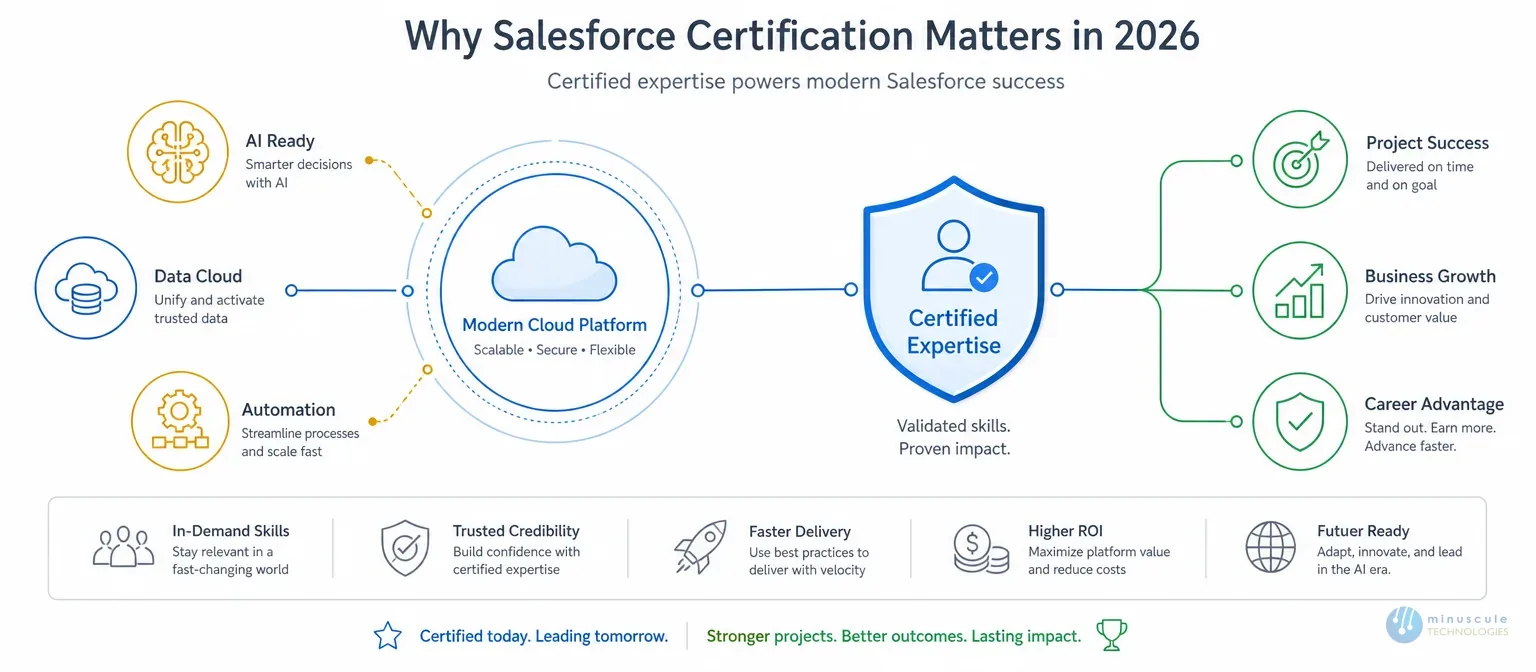
If you last vetted Salesforce partners in 2022 or 2023, the game has changed. Agentforce dropped in late 2024. Data Cloud went from nice add-on to the central nervous system of most enterprise orgs. AI is no longer bolted on. It's woven into Sales Cloud, Service Cloud, and Marketing Cloud at the feature level. The platform got harder to build on the right way.
Here's the uncomfortable stat: industry studies show 60–70% of failed CRM projects fail because of the team, not the tech. Bad design. Misread requirements. Custom code that ignores governor limits. And now AI agents raise the stakes. A flaw in your data model no longer just slows a report. It feeds garbage to an Agentforce agent, which then makes bad calls at scale.
Certified teams have passed exams on Data Cloud design, Agentforce-to-Flow behavior, and the newer limits of org-wide builds. They proved it before your project starts. Uncertified teams? They'll figure it out on your dime. Maybe. In time.
Salesforce's partner program also weighs certifications when it assigns partner tiers. Higher-tier partners get early access to releases, priority support, and a direct line to Salesforce engineers. When your partner has that access, you benefit. Most of all at 2 AM before a go-live, when you hit a platform bug.
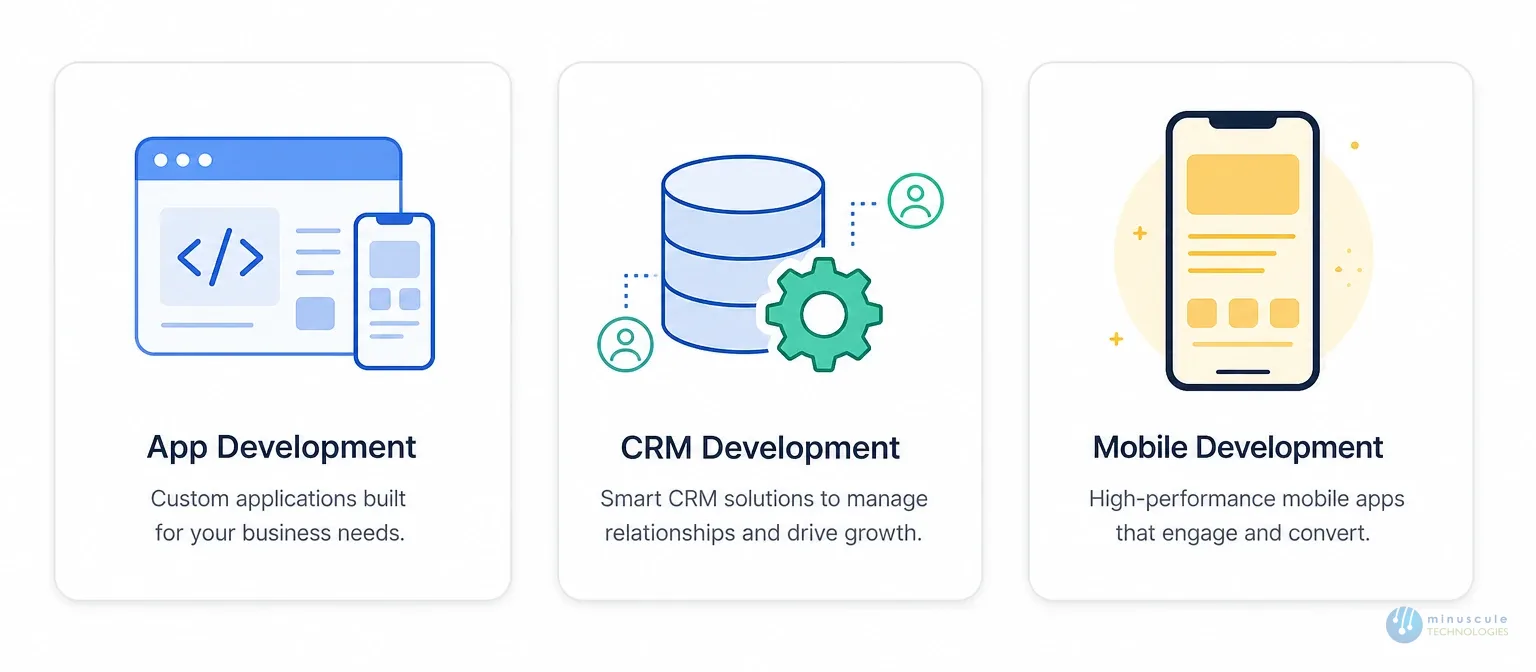
Before the benefits, a quick scope check. A full-service Salesforce app development company covers three linked disciplines. A gap in any of them shows up later as rework:
Salesforce application development is the engineering core. It means custom apps built with Apex, Lightning Web Components, and platform APIs. Think approval engines, partner portals, and AppExchange products. A complete salesforce application development service takes you from design through build, test, and release.
Salesforce CRM development services shape the core CRM around how your teams sell and serve. That covers custom objects, territory routing, quote-to-cash flows, and reports. Good Salesforce CRM development removes clicks and tech debt. Bad development adds both.
Salesforce mobile application development takes the platform into the field. It covers offline field service tools and custom Salesforce Mobile App screens. It also covers mobile-first Lightning apps for reps who don't sit at desks.
Certified Salesforce developers pass exams that test real build scenarios — not just theory. Platform Developer II, for example, demands command of async Apex, complex trigger frameworks, and integration patterns. So when your project hits a snag (and complex projects always do), a certified team finds the cause faster.
Across 75+ Salesforce projects, we've seen where the certified gap shows most: edge cases. Bulk data jobs that hit governor limits. Multi-object automations that clash with existing flows. Security settings that break when mixed with custom Apex.
What does that look like in practice? Your QA cycle shrinks. Production bugs drop. And eighteen months after go-live, your org still works. No six-figure rework because someone hardcoded IDs or skipped sharing rules.
Certified teams build faster because they've made the common design calls before. They know when to use Flows vs. Apex. They know when to build custom vs. install from AppExchange. And they know when to push back on requests that will cause trouble later.
We've seen certified teams ship a Sales Cloud build in 8–14 weeks. The same project with a green team? Six to nine months — and the result still needed rework. For a 50-person sales org, that delay can cost hundreds of thousands in missed pipeline alone.
Salesforce's flexibility can be a trap. Without industry knowledge, teams build generic tools. They work on paper but not in your business.
A certified Salesforce CRM development company with a track record in manufacturing, finance, health care, and real estate brings tested patterns. A team that has built loan origination flows in Financial Services Cloud won't reinvent what works. They adapt proven patterns to your needs.
This is where Salesforce consulting partners with deep domain skill stand out. They've seen what works in auto dealer management, real estate lease tracking, and BFSI compliance. They skip months of trial and error.
Certified Salesforce developers know the platform's security model at a level most uncertified teams don't. That means field-level security, sharing rules, permission sets, and the Salesforce Trust Layer. It also means how each one interacts with custom code.
A real example: a SOQL query written without proper sharing rules can expose Account records across business units. We've cleaned up this exact issue for clients. The cause is almost always a builder who didn't grasp Salesforce's sharing model. A certified developer knows the difference between with sharing and without sharing in Apex. More important, they know when to use each. They also stay current on GDPR, HIPAA, and SOC 2 — and how Salesforce's native tools map to each one.
In banking or health care, this is not academic. It's the line between passing an audit and paying a fine that dwarfs your Salesforce budget.
2025 and 2026 are the AI years in Salesforce. Agentforce, Einstein, prompt templates, and Data Cloud-powered AI. But AI features only work when your data foundation is solid.
What makes an org AI-ready? Clean object relationships. De-duped records (we've seen orgs with 40% duplicate Contacts — Einstein fed them garbage predictions as a result). Consistent field naming, so AI tools parse your data with no manual mapping. And Data Cloud links to outside systems, so Agentforce agents see the full picture — not just the 30% of customer data that lives in Salesforce.
Salesforce integration specialists join your ERP, marketing tools, and data warehouses into one layer. Skip this step and even Agentforce produces output your team won't trust. Then they stop using it. That's an expensive shelf.
A certified team costs more up front than a freelancer or an uncertified agency. But total cost tells a different story.
Certified teams write code that others can maintain. They follow trigger frameworks, service layers, and clean separation of concerns. They also right-size your licenses, so you stop paying for features nobody uses.
Here's the pattern we keep seeing. A company saves $30K–$50K up front with the cheapest option. Within 12 months, they've spent $80K+ on bug fixes and rework. By year three, total overspend hits 40–60% more than a certified team would have cost from day one.
Salesforce releases three major updates a year. Each one adds features, retires others, and can change how things work. A certified Salesforce managed services team tracks these releases and adjusts your org before problems land.
This is not "call us when it breaks." A good Salesforce development partner reviews org health scores and spots unused features. They flag fixes based on patterns across dozens of clients. Maybe a Visualforce page should become a Lightning Web Component (cutting load time by 60%). Maybe a new Flow feature makes a 200-line Apex trigger pointless.
Without this care, orgs decay. Slowly at first. Then all at once - right before a board meeting.
Salesforce is an ecosystem of 12+ clouds, thousands of AppExchange apps, and a growing set of AI tools. Certified companies help you navigate it instead of building from scratch.
Need to connect Salesforce to SAP? A certified team already knows the MuleSoft patterns. Within a day, they can tell you if a pre-built connector fits or if you need custom API work. Weighing Marketing Cloud? They've mapped journeys across clouds before. They know where the data gaps hide.
That knowledge is worth real money. One workshop replaces six weeks of tool research.
For small, well-defined projects (one integration or one custom Lightning component), a certified freelancer can be smart. For enterprise builds, multi-cloud rollouts, or ongoing platform care, a certified development company is the safer bet.
The baseline is Administrator, Salesforce Certified Platform App Builder, and Platform Developer I — spread across the team, not stacked on one person. For complex custom code, look for Platform Developer II and at least one Application or System Architect. Cloud-specific certs matter too. Sales Cloud Consultant fits a Sales Cloud rollout. It matters less for a Marketing Cloud build.
In the US, certified firms tend to charge $150–$300 per hour. Offshore certified partners run $40–$100. A mid-size Sales Cloud build might cost $50,000–$200,000. The range depends on custom work, integrations, and data migration scope.
A clean Sales Cloud or Service Cloud build with a certified team takes 8–16 weeks. Multi-cloud rollouts with complex integrations run 4–9 months.
A consultant handles strategy, process design, and click-based setup. A development company writes code — Apex, Lightning Web Components, custom integrations — and owns the technical design. Most certified Salesforce partners now do both under one roof. That means you don't need two vendors.
Search the AppExchange Partner Directory. Or ask for Trailhead verification links, which show each person's certs and upkeep status. Partner tiers (Crest, Ridge, Summit) are public.
Your Salesforce investment is only as good as the team behind it. All eight benefits above - less risk, faster delivery, AI-ready design, lower long-term cost — trace back to one thing: verified, current skill.
Minuscule Technologies has done this work since 2014. We bring 160+ Salesforce experts, 75+ projects shipped worldwide, and certified teams across manufacturing, real estate, BFSI, and health care. Our focus areas - Salesforce re-engineering, DevOps automation, enterprise integrations, and cost control — exist to solve the exact problems this post describes.
Schedule a Free Strategic Call - no pitch deck. Just a candid look at what your org needs, and whether we're the right fit.
You've seen what's possible. Now, let's make it happen for your business. Whether you need an end-to-end Salesforce solution, a complex integration, or ongoing managed services, our team is ready to deliver.

Schedule a Free Strategic Call


