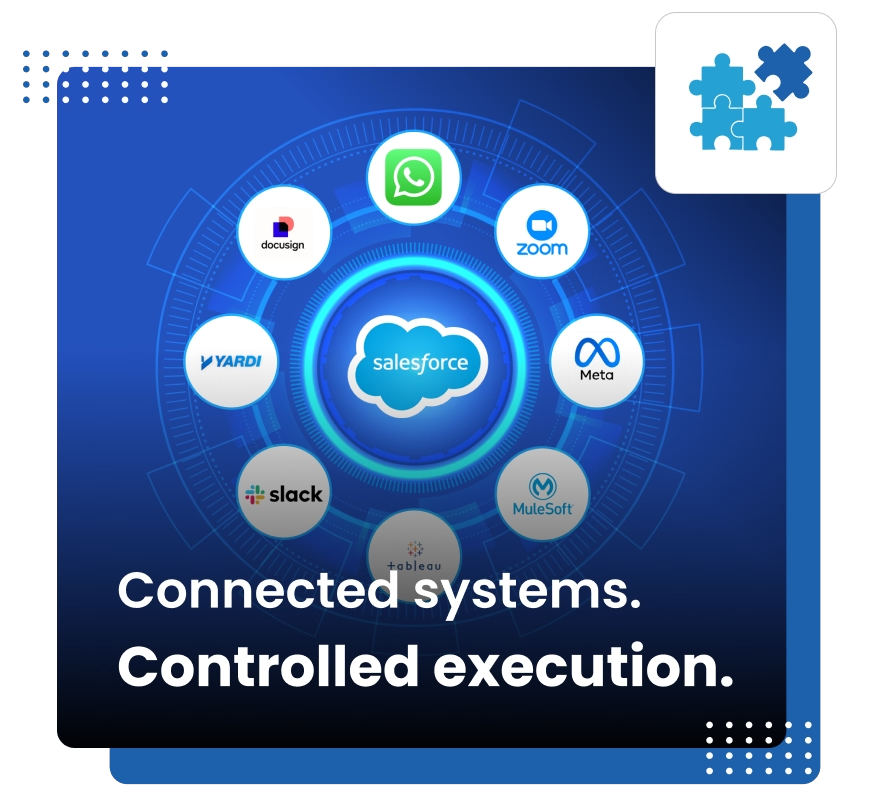
We don't just connect systems at the surface level. Every integration we build is designed for reliability, security, and long-term maintainability — using the right architecture for your specific use case.
We use Salesforce REST, SOAP, Bulk, and Streaming APIs to connect your CRM to external systems at the right level for each use case. A real-time customer update needs a different API pattern than a nightly bulk sync of 100,000 records — and we pick the right one every time. Every API integration we build includes proper authentication, rate limit management, error handling, and retry logic. So when something unexpected happens at 3am, the system recovers on its own instead of silently losing data.
When you have more than two or three systems to connect, point-to-point integrations quickly become unmaintainable. We design middleware-based integration architectures using MuleSoft, Azure Integration Services, and other iPaaS platforms — giving you a governed integration layer where every connection is documented, monitored, and manageable from a single place. This is how enterprise-scale businesses handle integration without creating a web of spaghetti connections that nobody understands in six months.
Some business processes can't wait for a nightly sync. When a loan applicant submits documents, your team needs to see them immediately. When a field technician closes a work order, the payment system needs to trigger right away. We build event-driven integrations using Salesforce Platform Events, Change Data Capture, and webhook architectures that push data between systems the moment something happens — not hours later. This is what gives your teams real-time visibility across systems they used to check manually.
As AI agents become part of your business operations, they need to communicate with each other — not just with humans. A2A integration connects multiple AI agents across your Salesforce ecosystem so they can pass tasks, share context, and coordinate actions without human hand-holding. For example, a service agent who identifies a billing issue can hand the case to a finance agent, who can automatically initiate the refund process in Salesforce. We design and implement A2A integration architectures that make multi-agent AI workflows reliable, auditable, and connected to your real business data.
If your current Salesforce integrations are unreliable, slow, poorly documented, or held together by workarounds, you need an audit before you build anything new. We review your entire integration landscape: every connection, every data flow, every point of failure. We identify what's working, what's fragile, and what's actively causing problems. Then we give you a clear remediation plan with prioritized recommendations — so you fix the right things first, in the right order, without disrupting the integrations your business depends on today.
Model Context Protocol is the emerging standard for connecting AI agents to live business data and external tools. We integrate Salesforce with MCP-compatible AI systems so your AI agents can access CRM records, update opportunities, trigger workflows, and retrieve context from Salesforce in real time. This enables your AI agents to automate business processes, make data-driven decisions, and work efficiently without requiring you to build custom APIs for every scenario. Deploying AI agents with MCP integration transforms their impact—turning routine tasks and decision-making into streamlined, real-time processes that add measurable value to your business. We are among the few Salesforce partners delivering this capability today.
We work across every major Salesforce Cloud — not just one or two. Here's where our certified engineers have real, hands-on experience.
How We Work
Every integration we build follows the same structured process — so nothing gets missed, nothing breaks on go-live, and you always know what's happening and why.
We start by mapping the full picture — which systems you use, what data needs to move between them, how often, in which direction, and what happens when something goes wrong. We talk to the people who work with these systems every day, not just the IT team. The result is a detailed integration requirements document that covers every edge case your business actually encounters — not just the happy path. This is the step most integration projects skip, which is exactly why they fail.
With your requirements mapped, we design the integration architecture — including which approach to use (direct API, middleware, event-driven, or hybrid), the data models on each side, authentication and security, error handling, and the monitoring strategy. You review and approve this plan before a single line of code gets written. No surprises, no assumptions. If your requirements change mid-project, we revisit the plan first — not after the integration is half-built.
We test every integration in a dedicated sandbox environment that mirrors your production setup. Our QA team runs functional tests, load tests, failure-scenario tests, and data validation checks — covering both normal flows and edge cases. We check what happens when the external system is unavailable. We check what happens when a record arrives with missing fields. We check what happens when the same record comes through twice. You don't go live until every scenario passes. Our 30+ dedicated automation testing engineers make this thorough, not theoretical.
We deploy integrations using a structured release process — with staging validation, change management documentation, and a rollback plan ready before we touch production. We run the initial data sync with full monitoring in place, so we catch any issues the moment they surface rather than after your team has been working on bad data for three days. Go-live happens in a planned window, with our engineers on standby throughout. Not "we deployed it, good luck."
Integrations aren't a "set it and forget it" deliverable. APIs change. Systems get updated. Business processes evolve. We provide SLA-backed integration monitoring and support, so when something changes on either side of your integration, we catch it and fix it before it causes a data problem. We also handle Salesforce's three annual releases — reviewing any changes that could affect your integrations and applying updates proactively. Your integrations keep working as your business keeps changing.

Many partners can connect two systems. Here's what makes Minuscule different — and why our integrations keep running long after other partners' connections have failed.
We Build Integrations That Recover on Their Own: Every integration we build includes error handling, retry logic, and alerting — so when an external system goes down temporarily, your data doesn't disappear. It queues, retries, and catches up automatically. Most integration projects don't include this. We do it as standard.
We Offer MCP and A2A — Capabilities Most Partners Don't Have Yet:
Model Context Protocol and Agent-to-Agent integration are the next frontier for AI-connected business systems. We're already building these for clients. If you're planning AI adoption inside Salesforce, working with a partner who understands these architectures now gives you a significant head start.
One Team From Design to Support: The engineers who design your integration are the same ones who build it, test it, and support it after go-live. There's no handoff to a separate support team that doesn't know your setup. When something needs attention, the people who know your integration best are the ones who fix it.
Full Documentation as a Standard Deliverable: Every integration we deliver comes with complete technical documentation — data flow diagrams, API mappings, error-handling specs, and runbooks for your internal team. You're never locked into us because your integration is undocumented. You own the knowledge, not just the connection.
Proven Track Record With Enterprise Systems: Our 160+ certified Salesforce engineers have handled complex, multi-system integration environments at enterprise scale — with MuleSoft, Azure DevOps, SAP, PeopleSoft, and more. We've run integrations across 9 industries and 3 global offices. We know where integrations break, and we design against those failure points from day one.
One promise: Salesforce that fits your business.
08
Industries
200+
Implementations
It depends on the number of systems, the complexity of the data model, and whether you need real-time or batch integration. A focused single-system integration — like connecting Salesforce to Outlook or Slack — can take 2 to 4 weeks. A mid-complexity integration involving custom data mapping, error handling, and testing typically runs 4 to 8 weeks. Multi-system enterprise integration programs with middleware architecture can take 2 to 4 months. During your first call with us, we'll scope it properly and provide a realistic timeline based on your actual setup.
This is one of the most important questions to ask — and one that most integration vendors don't address clearly. Every integration we build includes structured error handling with retry logic, dead-letter queuing, and alerting. If an external system becomes temporarily unavailable, data queues and retries are automatically resumed once the system recovers — instead of silently disappearing. Our monitoring setup catches failures in real time and notifies our support team. For clients on our managed support plan, we respond to integration failures within the SLA and fix them before they cause downstream data problems.
No, and using MuleSoft for everything is actually a common mistake. MuleSoft is the right choice for enterprise-scale middleware architectures where you're managing many systems, complex data transformations, and strict governance requirements. For simpler integrations, direct Salesforce API connections or native connectors are faster, cheaper, and easier to maintain. We recommend the right tool for your specific situation — not the most expensive one. In your discovery call, we'll assess your integration landscape and recommend the approach that fits your needs and budget.
Model Context Protocol (MCP) is an emerging open standard — developed by Anthropic — that defines how AI agents connect to live data sources and tools. In a Salesforce context, MCP integration means your AI agents can read CRM records, trigger Salesforce workflows, update opportunity stages, and pull contextual data from your org in real time — without custom API code for every interaction. As AI agents become part of how businesses operate in Salesforce, MCP serves as the architectural standard to ensure they are reliable and maintainable. We're already building MCP-connected Salesforce environments for forward-thinking clients. If AI adoption is in your roadmap, this is the right time to get the architecture right.
Yes. Legacy on-premises systems are often the most complex integration challenge — they may lack modern REST APIs, require VPN or secure gateway connections, and have underdocumented data models. We've handled this before. We assess which connectivity your legacy system supports (SOAP, file-based, database-level, or custom protocols), design the integration pattern that works within those constraints, and build it with appropriate error handling to keep it reliable. We've done this for manufacturing ERP systems, banking core platforms, and HR systems that haven't changed in 15 years.
Real-time integration moves data the moment something happens — a new lead arrives, a payment gets made, a case gets updated. It's essential when your teams need to act immediately on changes. Batch integration processes data in scheduled groups — hourly, nightly, or weekly — and works well for large-volume data transfers where immediate sync isn't required. The right choice depends on your business process. We recommend real-time for customer-facing workflows and high-volume transactional data; batch for reporting feeds, bulk data updates, and legacy system connections that can't handle continuous requests. We'll guide you to the right approach for each use case.
It can — if the integration wasn't built with release resilience in mind, or if no one is monitoring it. Salesforce releases major updates three times a year (Spring, Summer, Winter), and some updates deprecate API versions, change object behavior, or alter the way specific features work. Our managed support clients get proactive release review — before each Salesforce release, we check your integrations against the release notes, identify anything that could be affected, and apply updates in a test environment before the release goes live. You're never caught off-guard by a Salesforce release breaking something your business depends on.
Common signs include: your team complains about data that "doesn't match" between systems, records that appear in one tool but not another, manual reconciliation to fix sync issues, or your Salesforce logs showing frequent API errors that nobody is investigating. If any of these sound familiar, you likely have integration problems that are costing your team time and eroding trust in your CRM data. Our Integration Audit & Strategy Advisory service is designed exactly for this situation — we review your full integration landscape, identify every point of failure, and give you a clear picture of what's working, what's fragile, and what to fix first.
Stories of Growth, Innovation & Trust
Dealer Performance Tracking with Automated KPI Monitoring
A global automotive manufacturer with an extensive network of dealerships responsible for sales, service, and product support....

Streamlining Lead Management for an Online Medication Management and Pharmacy Solution
Discover how Minuscule Technologies enhanced lead management for an online pharmacy, boosting efficiency and customer engagement.

Seamless Migration from MS Dynamics to Salesforce CRM
Seamless migration from MS Dynamics to Salesforce CRM by Minuscule Technologies, ensuring data integrity, smooth transition, and enhanced efficiency.
200+
Successful Projects
40%
Increase in Sales Efficiency
98%
Client Satisfaction
30%
Faster Service
The Salesforce Pulse: Insights and Innovation
Powering Growth with
Award-Winning Salesforce Solutions
Trusted by enterprises for innovation, performance, and proven results.




You've seen what's possible. Now, let's make it happen for your business. Whether you need an end-to-end Salesforce solution, a complex integration, or ongoing managed services, our team is ready to deliver.
Schedule a Free Strategic Call