
January 29, 2026
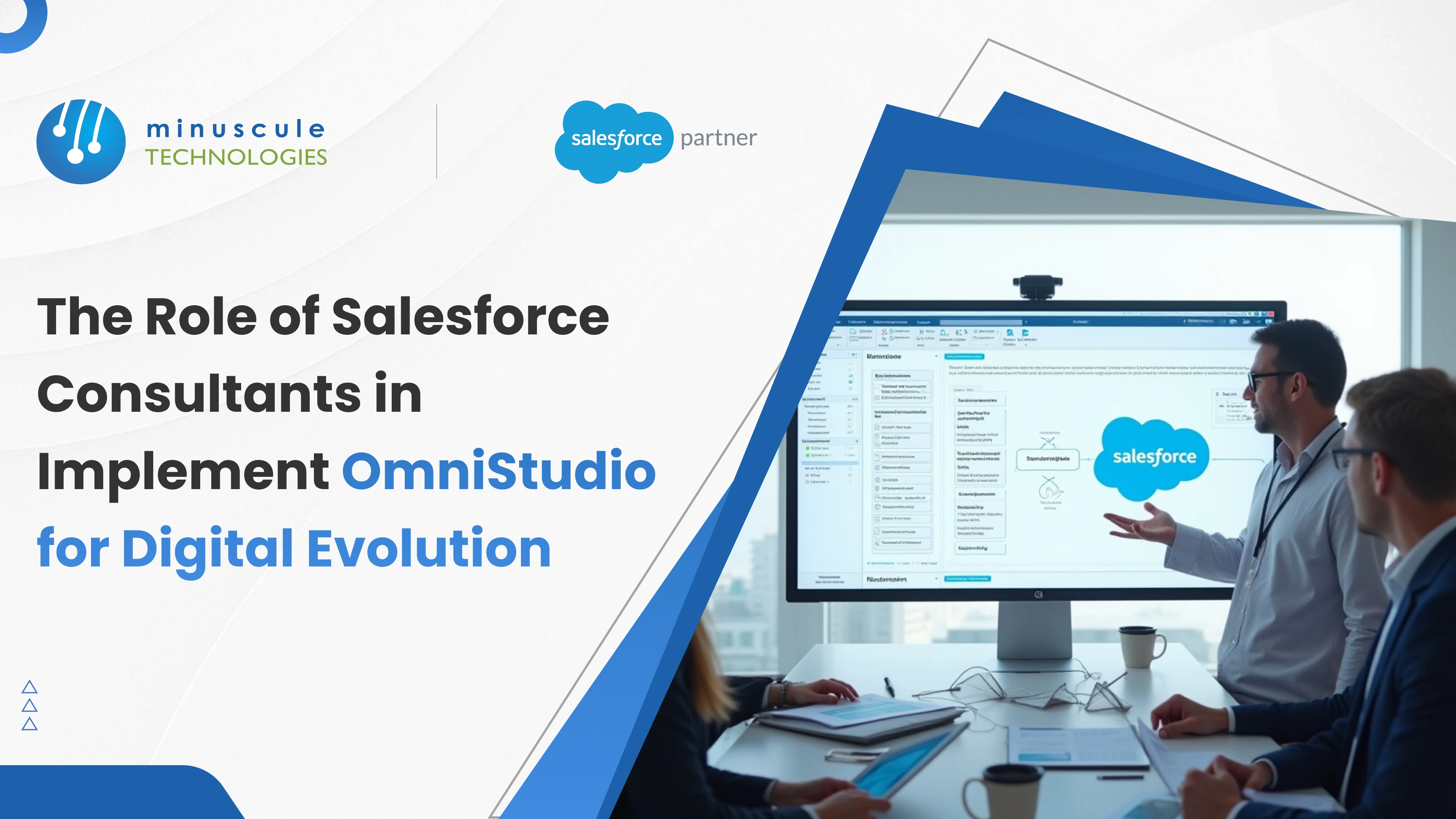
A Salesforce OmniStudio consultant does four things: translates business processes into FlexCards, OmniScripts, Data Mappers, and Integration Procedures, designs for reuse and performance instead of building one-off screens, runs the migration from the Vlocity managed package to the OmniStudio standard runtime, and puts release management around components that do not deploy like ordinary metadata.
That third item is why most OmniStudio conversations start in 2026. Salesforce is moving OmniStudio off the managed package onto a standard runtime, and it has shipped a Migration Assistant to help. If you run OmniStudio today, that migration is the work in front of you, and it is the clearest test of whether a consultant knows the platform or just the drag-and-drop canvas.
OmniStudio is not one tool. It is a set of parts that build guided digital experiences without writing the application in code, and it underpins the Salesforce industry clouds for sectors like energy, insurance, health, and communications.
Knowing what each part is for is the difference between a fast app and a slow one.
Data Mappers were called DataRaptors under the Vlocity naming, and you will still see both terms in older documentation and in your own org. A plain-English primer on the surrounding platform concepts is available on Salesforce Tutorial if your team is new to this.
OmniStudio arrived at Salesforce through the Vlocity acquisition, which means it ran as a managed package. Salesforce is moving it onto a standard runtime built into the platform, and that changes the near-term agenda for every org running it.
Salesforce documents the migration as a way to reduce package dependencies while moving your FlexCards, OmniScripts, Data Mappers, and Integration Procedures onto the standard runtime. It has released an Omnistudio Migration Assistant, delivered as a Salesforce CLI plug-in, to automate much of the mechanical work, and it published guidance for it in late 2025.
The forward-looking reason matters more than the mechanics. New capability is being built on the standard runtime, so an org left on the managed package gradually stops receiving improvements. Practitioners in the community make the same point: the standard runtime is where the roadmap now lives.
I should be precise about one thing. In the material reviewed for this article, Salesforce had not announced a forced end date for the managed package runtime. Treat this as a planned migration with a widening capability gap, not a cliff, and confirm current timelines against Salesforce's own release notes before you build a plan around them.
The tool is genuinely useful and it is not the whole project. Salesforce also provides an assessment step so you can understand the impact on your components before committing, which tells you something about how much variance there is between orgs.
The rows the tool cannot cover are where migrations go wrong. Community reports of teams struggling with a few hundred OmniScripts, FlexCards, and Data Mappers are not reports of a broken tool. They are reports of a project that needed inventory discipline, dependency sequencing, and a test plan before anyone ran a command.
Salesforce's own Salesforce Developers material is the authoritative reference for the Migration Assistant and its current capabilities. Treating this as a structured Salesforce migration engagement rather than a CLI task is what keeps it boring, which is the goal.
Low-code lowers the cost of the first version and raises the cost of the tenth. Most OmniStudio debt comes from decisions that felt harmless at the time.
The middle column is not incompetence. It is what happens when nobody is accountable for the shape of the whole thing, which is precisely the gap a Salesforce consulting engagement is supposed to close.
The performance point deserves emphasis. OmniStudio makes it easy to trigger many small server round trips from a single screen, and users experience that as a sluggish app rather than as an architecture problem. Consolidating those calls into Integration Procedures is one of the highest-value moves available. Developer-oriented breakdowns on SFDCPanther are useful when you get into the specifics.
Most rescue engagements look the same. These are the recurring five.
Notice that four of the five are governance failures rather than technical ones. That is why ongoing ownership matters more than a clever initial build, and why these problems tend to reappear without managed services or an equivalent internal owner. Community write-ups on SFDC Fanboy often surface the same patterns from a practitioner angle.
OmniStudio skills are harder to assess than general Salesforce skills, because the canvas makes everyone look capable in a demo.
Salesforce does offer a Certified Omnistudio Consultant credential, and it is a reasonable filter. Treat it as evidence of vocabulary rather than of judgment. The last question in that table tells you more than any certificate, because a consultant who has never declined a request has never protected a client from one.
People searching this topic usually want an hourly rate. Publishing one would be dishonest, because it swings by region, seniority, and scope, and any number here would be stale within a quarter.
What is useful is knowing the shape of the work and what drives the number.
Assessment. A short, fixed-scope engagement that inventories your components, runs the migration assessment, and produces a plan. Days to a couple of weeks. If you run OmniStudio today, this is the right first purchase, and it makes every later quote more accurate.
Project delivery. A defined build or migration with a scope and an end date. The main cost drivers are component count, how much custom code sits inside those components, how many integrations they touch, and how much test coverage you already have.
Ongoing ownership. Someone accountable for the component inventory, the pipeline, and release hygiene once the project ends. Cheaper than the rescue engagement that follows when nobody owns it.
Ask any partner to price the assessment separately from the build. A partner willing to be paid for an honest look before quoting the project is telling you something useful.
The AI story around OmniStudio has moved on, and older articles still describe it with retired product names. Salesforce's agent platform is now Agentforce, and the practical intersection with OmniStudio is worth being concrete about.
Guided flows and agents solve overlapping problems from opposite directions. An OmniScript walks a person through a process you have designed. An agent handles a request conversationally and decides which steps to take. Neither replaces the other, and the interesting builds combine them: an agent gathers context and hands off into a guided flow for the regulated part.
That combination only works when both are grounded in the same data. If you are planning Agentforce work alongside OmniStudio, treat the data foundation as one project rather than two.
OmniStudio builds guided digital experiences without coding the application from scratch. FlexCards display data at a glance, OmniScripts walk users through multi-step processes, Data Mappers move and reshape data, and Integration Procedures run server-side logic. It underpins the Salesforce industry clouds.
Yes, and the standard runtime migration has increased demand rather than reduced it. Every org running the older managed package has a migration to plan and execute, and that work needs people who understand both the components and the deployment mechanics.
Salesforce is moving OmniStudio from the Vlocity managed package onto a runtime built into the platform, which reduces package dependencies. A Migration Assistant, delivered as a Salesforce CLI plug-in, automates much of the component movement, with an assessment step to gauge impact first.
An admin can build and maintain components once the architecture is set. The parts that need experience are the initial design decisions, moving logic off the browser, deployment pipelines, and migrations. A common pattern is a consultant setting the patterns and an internal team owning them afterward.
Rates vary too much by region, seniority, and scope for a published figure to be useful. Cost is driven by component count, custom code inside components, integration surface, and existing test coverage. Buy a fixed-scope assessment first so the project quote is based on your actual org.
Run the assessment now regardless. It is inexpensive and it tells you the size of the eventual project. Whether you execute immediately depends on your release calendar and how much custom code sits inside your components, since that is the part automation cannot move for you.
OmniStudio gives you the building blocks. What a consultant contributes is the decision about where logic lives, which components get reused, how changes reach production safely, and who owns the result after go-live.
Right now that role has a clear focal point. The move to the standard runtime is the work in front of most OmniStudio orgs, and it rewards inventory discipline and a real test plan far more than speed with the canvas.
At Minuscule Technologies we treat OmniStudio as engineering: component inventories with owners, logic pushed server side, deployment through a pipeline, and migrations planned from an assessment rather than a command. Talk to our architecture team about an OmniStudio assessment, and you will know the size of your migration before you commit a budget to it.
You've seen what's possible. Now, let's make it happen for your business. Whether you need an end-to-end Salesforce solution, a complex integration, or ongoing managed services, our team is ready to deliver.

Schedule a Free Strategic Call


Plot No. 4, Sridevi Amman Street, Perumal Nagar Extension, Old Pallavaram, Chennai, Tamil Nadu 600117, India.
