
March 6, 2026
Imagine you are a sales director preparing for a high-stakes meeting. You check your CRM, and it says the client is happy. But what you don't see is that three hours ago, that same client filed a critical support ticket. Or that your marketing team just sent them a "new customer" discount email for a product they’ve owned for years. You walk into that meeting with a "360-degree view" that is actually a cracked mirror.
This isn't a failure of your team; it’s the reality of the digital age. We are drowning in data from CRM systems, social media, and IoT devices, yet most of it remains trapped in isolated silos. For many businesses, the "Single Source of Truth" has become a myth - a manual, expensive hurdle that slows down every decision.
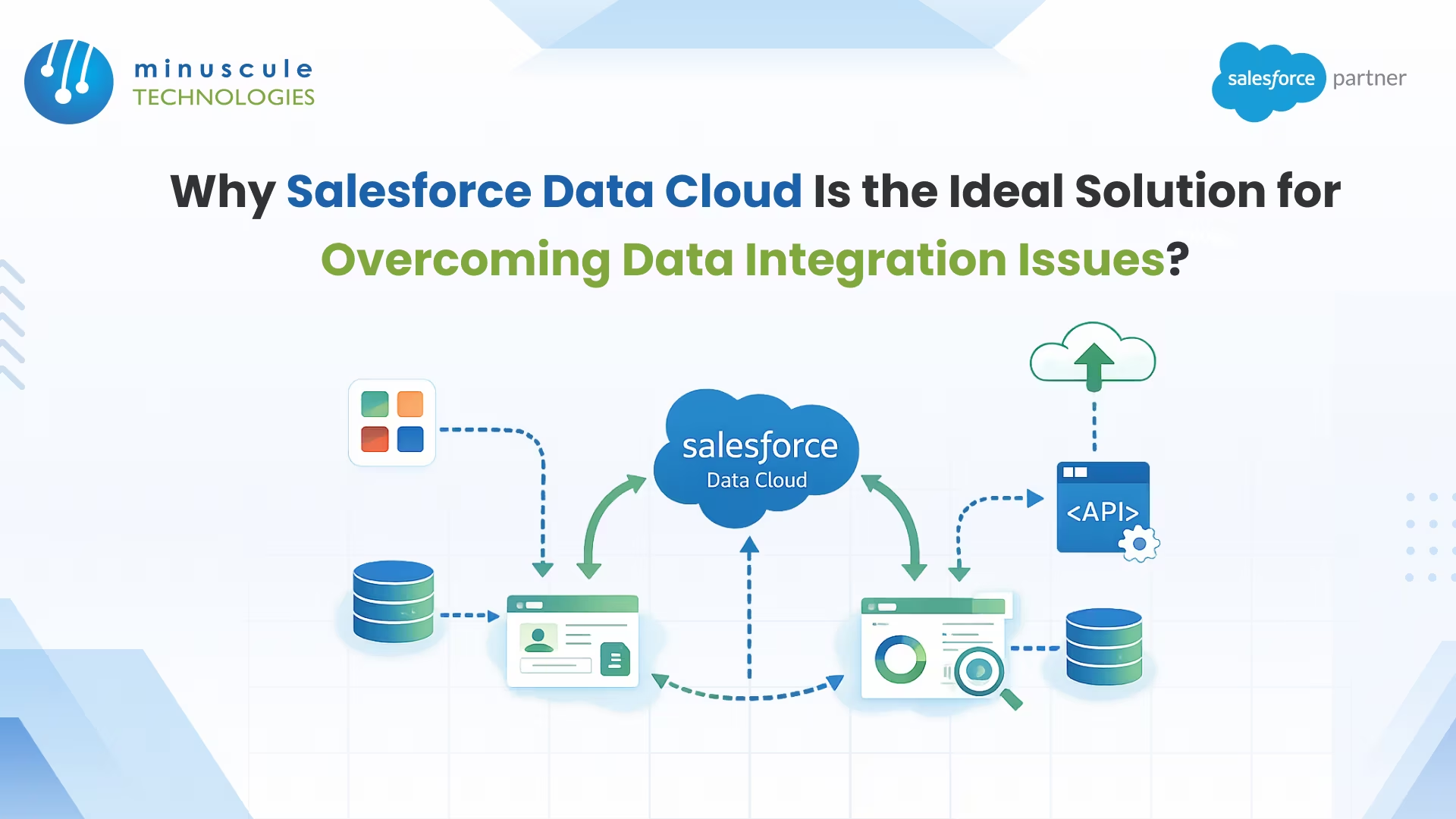
The Salesforce Data Cloud emerged to change that story. It isn’t just another database; it’s a hyperscale engine designed to weave these disconnected threads into a single, living profile. By connecting disparate sources in real-time, it finally solves the integration puzzle that has haunted IT departments for decades. Here is a deep dive into how Data Cloud turns fragmented data into your most valuable strategic asset.
Before understanding the solution, it is vital to identify the specific roadblocks that hinder digital transformation:
Salesforce Data Cloud resolves these systemic issues through advanced data harmonization, seamless connectivity, and robust processing capabilities.
Data Cloud eliminates the need to manually move, copy, or reformat data from external systems. Utilizing zero-copy integration and pre-built connectors, businesses can directly pull data from modern data warehouses like AWS, Snowflake, and Google BigQuery. Data Cloud simply creates data-lake objects (DLOs) that point to the external data, vastly reducing technical complexities and minimizing storage costs.
One of the most significant differentiators of Data Cloud is its ability to embed unstructured data into a native vector database. By leveraging Retrieval Augmented Generation (RAG), Data Cloud can efficiently search and retrieve context-rich insights from previously inaccessible formats. This allows businesses to analyze customer sentiment and history without complex coding.
Built natively on the Salesforce platform, Data Cloud simplifies the data mapping process. It harmonizes disconnected data from various sources into Salesforce's standard metadata model. This ensures that once the data is integrated, it becomes instantly accessible within core Salesforce applications, granting every team a true 360-degree view of the customer.
Waiting for batch processing is no longer viable in a fast-moving business environment. Salesforce Data Cloud features a sub-second end-to-end real-time layer that allows enterprises to ingest and activate data instantly. This enables automated, data-triggered workflows, transforming passive insights into immediate calls to action.
Autonomous AI models and agents require clean, integrated, and contextual data to function effectively. Data Cloud serves as the foundation for Agentforce, empowering AI agents to reason, make decisions, and act.
Through deep integration with the Atlas Reasoning Engine, AI agents can decipher insights using complex unstructured data, helping support representatives resolve customer issues faster and empower sales teams to identify upselling opportunities.
Salesforce Data Cloud (formerly Customer 360) is a hyperscale data platform that integrates structured and unstructured data from disparate sources into a unified, real-time environment. It provides businesses with a single source of truth to enhance personalization, analytics, and AI-driven automation.
It utilizes pre-built connectors and zero-copy integration to connect data from third-party systems and external data lakes (like Snowflake or AWS) directly into the Salesforce platform without duplicating it, making a comprehensive customer profile universally accessible to all departments.
Yes. It handles unstructured data such as PDFs, voicemails, and text documents by converting them into a native vector database. This allows tools like AI agents to perform semantic searches and extract actionable insights using Retrieval Augmented Generation (RAG).
AI models and agents (like Salesforce's Agentforce) require contextually accurate, real-time data to make reliable decisions. Without a unified data foundation, AI tools produce incomplete or untrustworthy results. Data Cloud provides the clean, integrated context that AI needs to thrive.
Overcoming data integration challenges is no longer just an IT goal - it is a strategic business necessity. For years, enterprises have paid a heavy "integration tax," spending more time moving and cleaning data than using it to drive growth. Salesforce Data Cloud breaks this cycle by transforming isolated, fragmented data into your most asset.
After years of refactoring complex Salesforce environments, we know that a unified data view isn't bought; it’s engineered. We help you move beyond the "cracked mirror" of siloed data by building a high-performance Data Cloud engine designed for scale.
Consult with Minuscule Technologies Today. Stop fighting legacy silos. Let us help you engineer a seamless Data Cloud transition that eliminates friction and unlocks the real-time value your bottom line deserves.
You've seen what's possible. Now, let's make it happen for your business. Whether you need an end-to-end Salesforce solution, a complex integration, or ongoing managed services, our team is ready to deliver.

Schedule a Free Strategic Call


Plot No. 4, Sridevi Amman Street, Perumal Nagar Extension, Old Pallavaram, Chennai, Tamil Nadu 600117, India.
