Connect your Salesforce CRM with SAP ERP for real-time data, automated quote-to-cash, and zero manual re-entry. One customer record. One workflow. One truth.
Certified Salesforce, MuleSoft, and SAP integration engineers. ISO 27001 and SOC 2 Type II compliant. Live in 6–16 weeks.


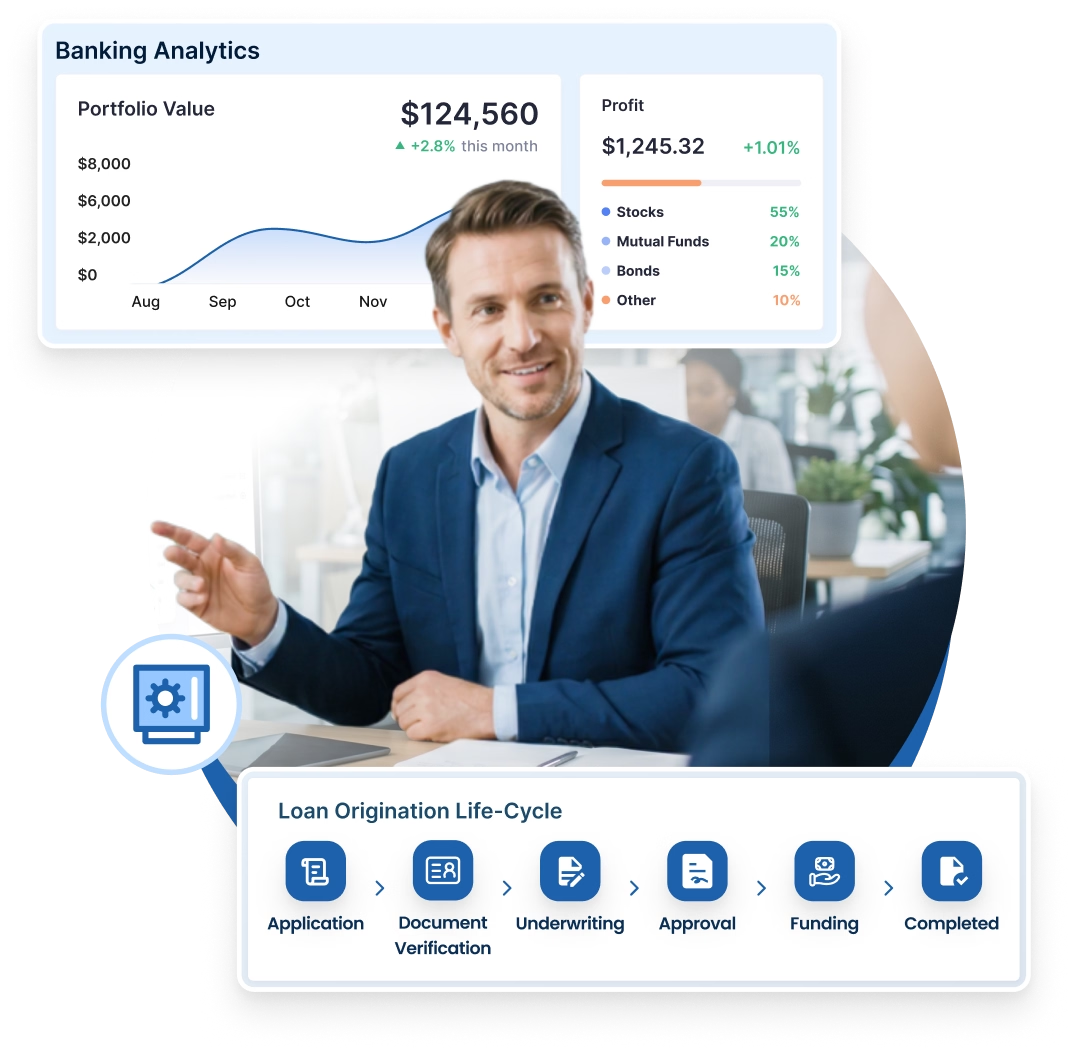
Salesforce SAP Integration is the connection between Salesforce CRM and SAP ERP that unifies customer, sales, order, invoice, and operational data across both systems. It creates a single source of truth — so your sales, service, finance, and supply chain teams see the same customer, the same order, and the same status in real time.
Common methods include middleware platforms (MuleSoft, SAP CPI/Integration Suite, Boomi), pre-built connectors (Enosix, Overcast, AppExchange packages), and custom API integrations using OData, BAPI, RFC, IDoc, REST, and SOAP.
SAP Systems We Integrate With SalesforceEvery SAP landscape is different. Some clients run modern SAP S/4HANA on the cloud. Many still run SAP ECC on-premise. Others use SAP Business One, ByDesign, or CPI as their middleware.

SAP S/4HANA: SAP's modern in-memory ERP, running on-cloud, on-premise, or hybrid. Native OData APIs make S/4HANA the easiest SAP flavor to integrate with Salesforce. Common use cases: real-time order sync, live inventory, unified customer master, quote-to-cash automation.
SAP ECC (SAP ERP Central Component): The classic on-premise SAP ERP running at thousands of enterprises. SAP has set 2027 as the end of mainstream maintenance — but ECC will keep running long past that. We integrate ECC using BAPI, RFC, IDoc, and SOAP web services through MuleSoft, SAP CPI, or custom middleware.
SAP Business One: SAP's ERP for small and mid-sized businesses. Native REST APIs and Service Layer make it a good fit for cloud-based Salesforce integration. Common use cases: order sync, customer master sync, invoice status updates.
SAP CPI / SAP Integration Suite: SAP's own middleware platform. If you already run CPI, we build the Salesforce side and configure CPI iFlows to handle the integration logic — the SAP-recommended path for enterprises deep in the SAP stack.
SAP Data Cloud Connectors (for Salesforce Data Cloud): Salesforce Data Cloud offers native SAP connectors — SAP HANA and SAP Concur are Generally Available, while SAP ASE, IQ, Hybris, and SuccessFactors are in beta (as of the latest Salesforce Data 360 docs). For AI-driven use cases with Einstein and Agentforce, Data Cloud + SAP is the future path.
Every integration turns into a real business outcome. Here is what changes once your CRM and ERP finally talk to each other.

360° Customer View
Sales sees the full order history. Service sees payment status. Finance sees deal pipeline. Everyone works from the same customer record — no more chasing five spreadsheets to answer one question.

Improved Data Quality (No Duplication)
One master record per customer. One product catalog. One price book — synced across both systems.
Data quality scores improve by 40–60% within 90 days of go-live.

Reduced Operational Costs
No more parallel data teams. No more manual reconciliations. No more failed integrations you patch every Monday. Clients typically save 20–40% on operational costs tied to CRM-ERP handoffs.
Faster Sales Cycles
Reps see real-time inventory, pricing, and credit limits inside Salesforce. Quotes go out faster. Orders flow to SAP without human touch. Most clients see 25–40% shorter quote-to-order cycles after integration.
End-to-End Process Automation
Quote → Order → Fulfillment → Invoice → Payment → Service — all flow across Salesforce and SAP without CSVs, without emails, without human copy-paste.
Increased Revenue
Faster quoting, cleaner pipeline data, higher forecast accuracy, and better customer experience — all drive top-line revenue. Clients report 15–30% revenue growth from tighter Salesforce-SAP integration within the first year.
Not every business needs the same approach. Here is an honest comparison of the three real integration methods.
Custom API — pick this if you have unique workflows (industry-specific compliance, complex pricing logic, custom SAP add-ons) that no connector or middleware handles cleanly.
Middleware / iPaaS — pick this if you integrate SAP with multiple systems beyond Salesforce (marketing, e-commerce, logistics, IoT). Best long-term investment.
Pre-Built Connectors — pick this if your use case is standard (order sync, customer master, invoice status) and you want live in weeks, not months.
Not every data field needs sub-second sync. Not every field can wait 24 hours.
Real-Time Sync — needed for pricing, inventory, credit limits, order status, and customer service data. Sub-second latency using event-driven architecture (Anypoint MQ, Kafka, SAP Event Mesh).
Batch Sync — fine for master data (customer records, product catalogs, historical orders) and reporting data. Hourly, daily, or weekly schedules using scheduled iFlows or middleware batch jobs.
How We Work
An integration without a process is a recipe for broken syncs, angry users, and endless support tickets. Our 5-phase process gets you live on time — with zero data loss.

We work across every major Salesforce Cloud — not just one or two. Here's where our certified engineers have real, hands-on experience.
Triple-Certified Team — Salesforce, MuleSoft, and SAP: Our team holds Salesforce Application Architect, MuleSoft Certified Architect (MCPA), and SAP integration certifications. You get one team that speaks all three platforms — no vendor ping-pong.
Every Approach Under One Roof: Custom API, middleware, or pre-built connector — we deliver all three. We recommend the right approach based on your data, budget, and use case. Not the one that pays us the most.
Deep SAP Version Coverage: S/4HANA, ECC, Business One, ByDesign, and CPI. We know the OData API for S/4HANA, the BAPI/RFC quirks of ECC, and the Service Layer of Business One.
Real-Time + Batch Hybrid Expertise: Not every field needs sub-second sync. We design hybrid architectures that use real-time where it matters and batch where it does not — cutting middleware costs by 20–40%.
AI-Ready Integration Approach: Every integration is built for Salesforce Data Cloud and Agentforce readiness. Your Salesforce-SAP data becomes the foundation for AI-driven forecasting, agent workflows, and customer analytics.
Security and Compliance Discipline: OAuth 2.0, mutual TLS, Named Credentials, tokenization, encrypted payloads, and full audit logging on every integration. Compliance-mapped for GDPR, HIPAA, SOC 2, PCI, and industry-specific rules.
Industry-Ready Playbooks: We have integrated Salesforce with SAP for Manufacturing (dealer + supply chain), BFSI (customer + loan data), Healthcare (patient + billing), Automotive (dealer + parts), and Real Estate (lease + finance).
ISO 27001 + SOC 2 Type II Compliant: Your integration credentials, sensitive payloads, and API logs stay protected by audited security controls.
Post-Launch Managed Services: Every integration comes with 30 days of hypercare. Optional Managed Services with SLA-backed L2/L3 support — 24/7 monitoring, incident response, and quarterly optimization.
One promise: Salesforce that fits your business.
09
Industries
75+
Implementations

Business analysis, roadmap creation, architecture design.


Greenfield setups, best-practice configurations, clean deployments.

Zero-loss transfers, deduplication, AI-ready harmonization.

Custom Apex, Lightning components, platform solutions.

ERP connectivity, API development, system unification.

User management, security, compliance, governance.

Workflow automation, custom objects, process optimization.

24/7 monitoring, proactive maintenance, continuous optimization.
Tell us about your SAP version, your Salesforce setup, and your integration goals. We will send you a Salesforce SAP Integration plan with architecture path, milestones, and timeline — in 48 hours.
Talk to a Salesforce–SAP Integration Expert Today


Plot No. 4, Sridevi Amman Street, Perumal Nagar Extension, Old Pallavaram, Chennai, Tamil Nadu 600117, India.