Connect Salesforce with your ERP, legacy systems, and cloud apps for real-time data flow — no silos, enterprise-grade security, built to grow with your business.
Certified MuleSoft architects and developers. ISO 27001 and SOC 2 Type II compliant. API-led connectivity — the way Salesforce and MuleSoft recommend it.





Salesforce MuleSoft Integration uses MuleSoft's Anypoint Platform to connect Salesforce with any system — ERP (SAP, Oracle, NetSuite), databases (Snowflake, Postgres), legacy applications, cloud apps, IoT devices, and custom software — through API-led connectivity.
The integration replaces brittle point-to-point connections with reusable APIs built in three layers — System, Process, and Experience — designed for real-time data flow, enterprise security, and long-term reuse. MuleSoft's 450+ pre-built Salesforce connectors and adapters speed up common integrations by 60–80%.
At Minuscule Technologies, our certified MuleSoft architects and developers design, build, and manage integrations for Manufacturing, BFSI, Healthcare, Real Estate, and Automotive clients.
Every enterprise wrestles with disconnected systems. Sales runs in Salesforce. Finance runs in SAP. Support runs in Zendesk. Data in HubSpot. Customer records in a legacy Oracle DB.
The result — data silos, manual data sync, slow projects, and now, blocked AI adoption. Here is the enterprise pain MuleSoft solves.

Fragmented Systems and Data Silos
Your customer's real story lives across 5–10 systems. Sales sees one slice. Support sees another. Finance sees a third. Nobody sees the whole picture.
MuleSoft unifies these systems through APIs — one source of truth per customer, product, and account.

Point-to-Point Integrations That Do Not Scale
Every new integration means custom code, new dependencies, and more places to break. A single system change causes a chain reaction across 12 fragile connections.
MuleSoft's API-led model builds reusable APIs — one integration, unlimited consumers.
AI Adoption Blocked by Disconnected Data
According to MuleSoft's own research, 95% of businesses say data integration blocks their AI initiatives. Einstein, Agentforce, and Data Cloud need clean, connected, real-time data to work.
Without integration, your AI strategy is stuck at slide one. MuleSoft is the fastest path to AI-ready data foundations.

Manual Data Sync and Human Errors
Nightly CSV exports. Weekly copy-paste updates. Broken batch jobs. Reps updating the same record in three tools.
MuleSoft handles real-time bi-directional sync — no CSVs, no manual jobs, no drift between systems.

Security and Compliance Risk
Custom scripts move sensitive customer data — often without encryption, audit trails, or access control.
MuleSoft applies enterprise security by default — OAuth 2.0, mutual TLS, token-based auth, audit logging, and Anypoint Security Fabric.
From strategy to managed support — the full lifecycle of MuleSoft delivery, all under one team.
Anypoint Platform is MuleSoft's flagship product — the runtime, tooling, and governance layer that runs every integration we build.
Real-Time Bi-Directional Sync
Sub-second data sync between Salesforce and any connected system. Event-driven architecture using Anypoint MQ, Kafka, and Salesforce Platform Events.
Anypoint Platform (iPaaS + API Management)
Design Center — visual API design
Runtime Manager — deployment and monitoring
API Manager — policies, security, throttling
Exchange — private catalog of reusable APIs
Anypoint Monitoring — observability across every API
Anypoint MQ — enterprise messaging
OAuth 2.0 and Enterprise Security
Built-in support for OAuth 2.0, mutual TLS, JWT, SAML, basic auth, and API key policies. Anypoint Security Fabric adds threat protection, DDoS defense, and Web Application Firewall.
Monitoring and Governance
Real-time dashboards on API traffic, response times, error rates, and consumer usage. Alerts on SLA breaches. Automated compliance reports.
Salesforce Data Cloud + Agentforce Integration
Native connectors for Salesforce Data Cloud and Agentforce. Feed unified data from every system into Data Cloud, then power AI agents with clean, real-time context.
450+ Pre-Built Connectors
Native connectors for Salesforce, SAP, Oracle, NetSuite, Workday, ServiceNow, DocuSign, Marketo, HubSpot, Snowflake, and 400+ more systems.
Custom connectors also supported via the Anypoint Connector DevKit.
DataWeave Transformations
DataWeave is MuleSoft's native data transformation language — designed for JSON, XML, CSV, EDI, flat file, and binary payloads.
Handles complex mapping, filtering, joins, and pivots with fewer lines than Java or JavaScript.
Reusable APIs
Every API you build lives in Anypoint Exchange — a private catalog searchable by every developer in your org. Ship an API once, reuse it forever.
Growth-Ready Runtime
Deploy on CloudHub (MuleSoft's iPaaS), Runtime Fabric (Kubernetes-based), or hybrid on-prem. Auto-scaling, load balancing, and zero-downtime deployments come standard.
How We Work
Every project runs through the same 7-phase methodology — refined across 100+ MuleSoft engagements. Joint architect-developer teams from both Salesforce and MuleSoft sides work together from day one.

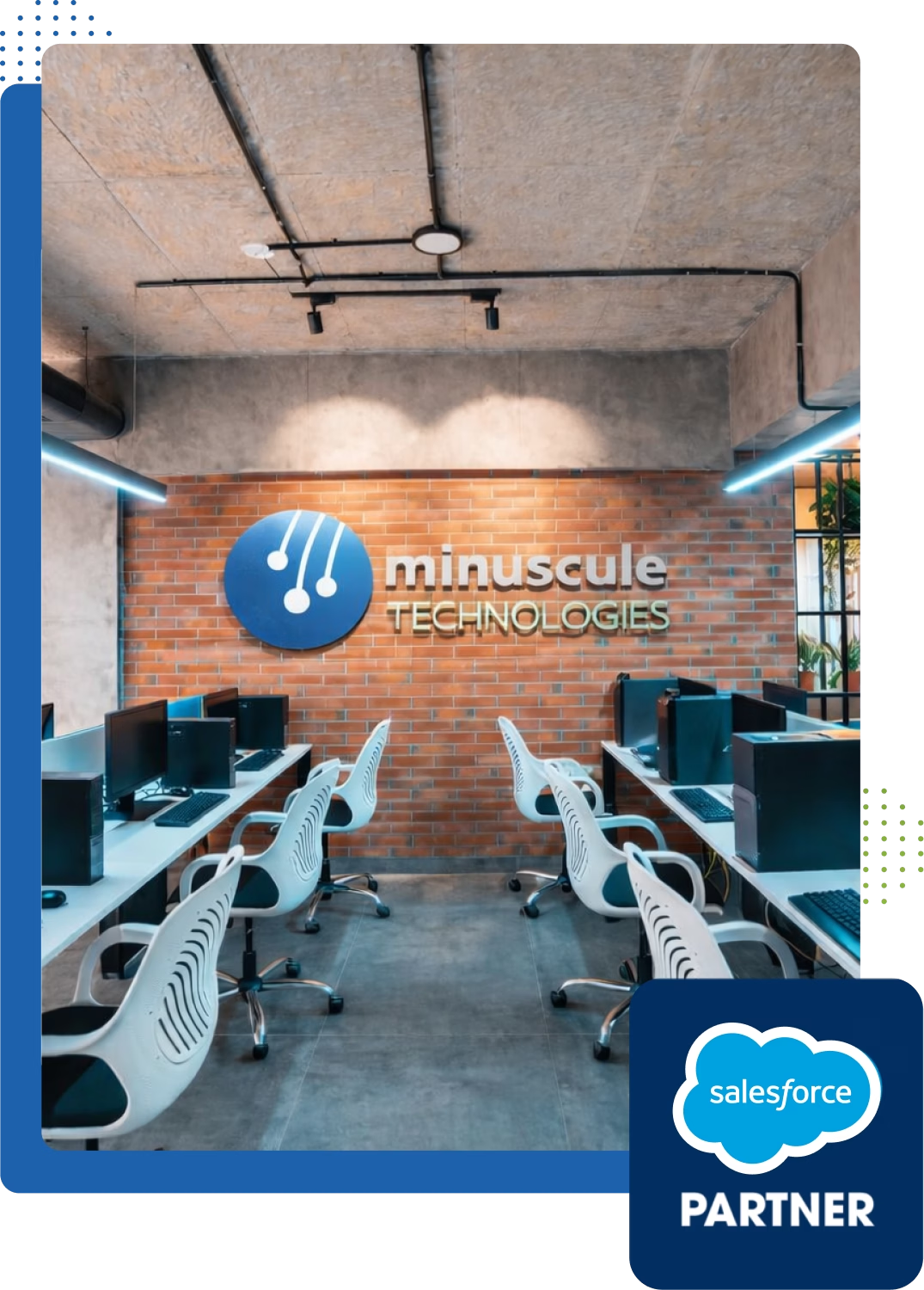
Plenty of vendors call themselves "MuleSoft partners." Few of them have real API-led experience, dual Salesforce + MuleSoft certifications, or a delivery process that survives enterprise audits.
Certified MuleSoft Architects and Developers: Our team holds MuleSoft Certified Developer (MCD Level 1 and Level 2), MuleSoft Certified Architect (MCPA), and MuleSoft Certified Platform Architect certifications.
Every API we build is reviewed by a certified MuleSoft architect.
Dual Salesforce + MuleSoft Expertise: Most vendors specialize in one. We specialize in both. Salesforce Application Architects and B2B Solution Architects work side-by-side with MuleSoft Certified Architects.
You get one team that speaks both platforms — no vendor ping-pong.
API-Led Best Practices — Every Time: Every integration follows Anypoint's API-led connectivity model. System, Process, and Experience APIs — with reuse, governance, and versioning built in.
We do not build point-to-point integrations. Ever.
Security and Governance Discipline: OAuth 2.0, mutual TLS, JWT, SAML, and Anypoint Security Fabric on every project.
Full compliance mapping for GDPR, HIPAA, SOC 2, PCI, and industry-specific rules.
Proven Delivery Track Record: 100+ MuleSoft integrations shipped across Manufacturing, Automotive, BFSI, Healthcare, Real Estate, Aviation, Energy, and Education.
Ask for a case study from your industry.
AI-First Integration Approach: Every integration is built with Einstein, Agentforce, and Salesforce Data Cloud readiness in mind. Your API-led foundation becomes your AI-ready foundation.
Ongoing Managed Services: Every project comes with 30 days of hypercare. Optional Managed Services after — 24/7 monitoring, incident response, and quarterly optimization reviews with SLA guarantees.
ISO 27001 + SOC 2 Type II Compliant: Your integration credentials, sensitive payloads, and API logs stay protected by audited security controls. Critical for regulated industries.
One promise: Salesforce that fits your business.
09
Industries
75+
Implementations
One partner, all clouds. Our expertise ensures each Salesforce product delivers maximum ROI.

Business analysis, roadmap creation, architecture design.


Greenfield setups, best-practice configurations, clean deployments.

Zero-loss transfers, deduplication, AI-ready harmonization.

Custom Apex, Lightning components, platform solutions.

ERP connectivity, API development, system unification.

User management, security, compliance, governance.

Workflow automation, custom objects, process optimization.

24/7 monitoring, proactive maintenance, continuous optimization.
Tell us your current systems, integration goals, and AI ambitions. We will send you a MuleSoft API-led roadmap — architecture, phases, hours, and a fixed price — in 48 hours.
Talk to a Salesforce DocuSign Architect